Quick answer: Lots = (account size × risk %) ÷ (stop-loss distance × value per unit of price move per lot). Round down to a whole lot. For NSE USD/INR futures, one lot is $1,000, so every ₹1 move is worth ₹1,000 per lot. With a ₹2 lakh account, 1% risk (₹2,000) and a 10-paise stop (₹0.10), the stop costs ₹100 per lot, so you trade 20 lots.
The formula as a single line:
\text{Lots} = \left\lfloor \frac{\text{Capital} \times \text{Risk \%}}{\text{Stop distance} \times \text{Contract multiplier} \times \text{FX conversion}} \right\rfloor
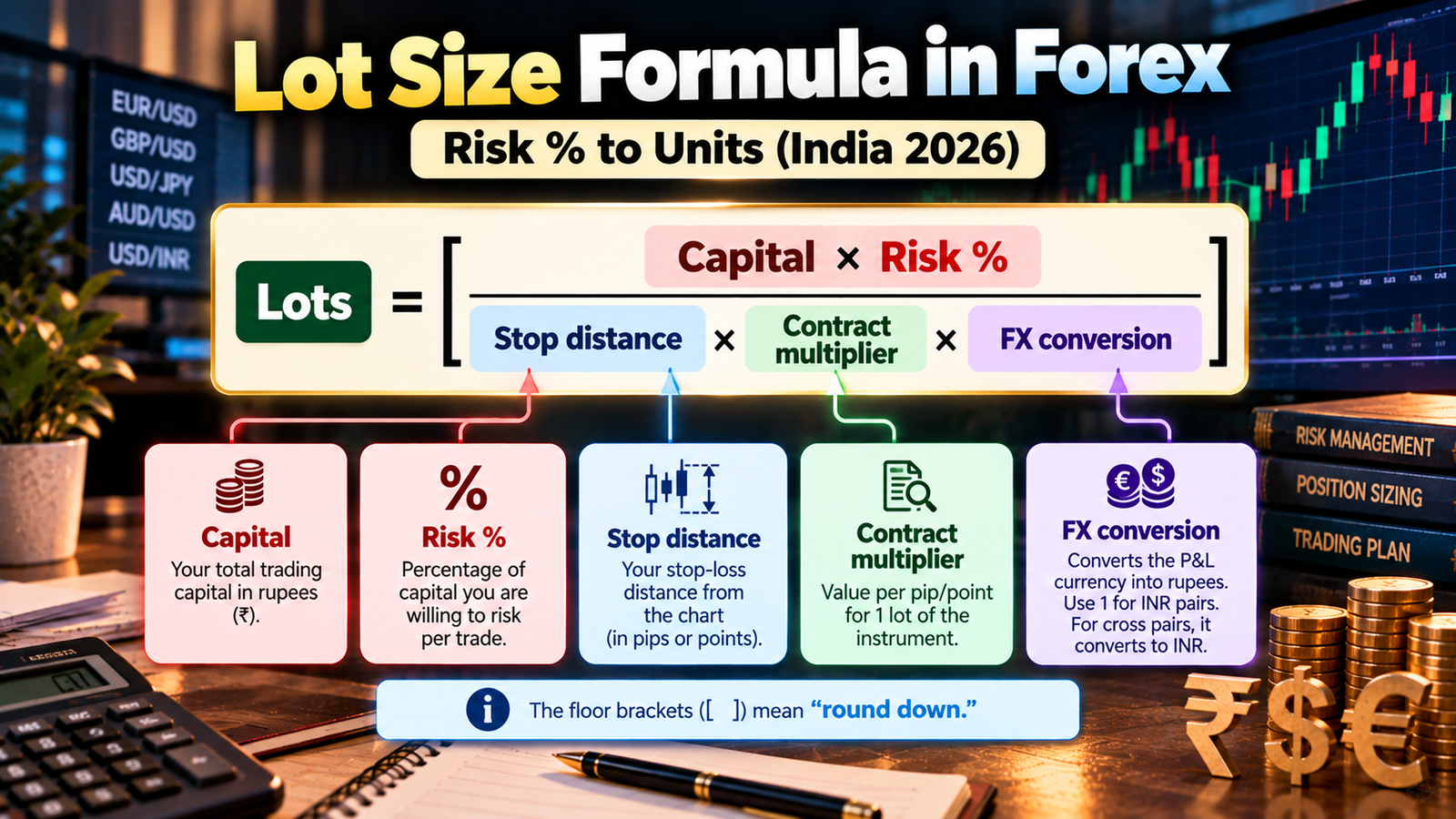
The floor brackets mean “round down.” The FX conversion is 1 for INR pairs. For cross pairs, it converts the P&L currency into rupees.
Position sizing is the single most important risk tool a trader has. It decides whether a losing streak costs 10% of your account or 50%. This guide explains lot sizes in India, walks through the calculation for every NSE currency pair, and gives a calculator you can build in a spreadsheet.
What is a lot?
Definition: A lot is the standard contract size you trade. Your profit or loss equals the price move multiplied by the lot size and the number of lots.
Lot sizes on Indian exchanges (NSE)
| Pair | One lot | Quoted as | Tick | Value of 1 tick per lot | Value of a ₹1 (or $1/¥1) move per lot |
|---|---|---|---|---|---|
| USD/INR | $1,000 | ₹ per $1 | ₹0.0025 | ₹2.50 | ₹1,000 |
| EUR/INR | €1,000 | ₹ per €1 | ₹0.0025 | ₹2.50 | ₹1,000 |
| GBP/INR | £1,000 | ₹ per £1 | ₹0.0025 | ₹2.50 | ₹1,000 |
| JPY/INR | ¥1,00,000 | ₹ per ¥100 | ₹0.0025 | ₹2.50 | ₹1,000 |
| EUR/USD | €1,000 | $ per €1 | $0.0001 | $0.10 | $1,000 |
| GBP/USD | £1,000 | $ per £1 | $0.0001 | $0.10 | $1,000 |
| USD/JPY | $1,000 | ¥ per $1 | ¥0.01 | ¥10 | ¥1,000 |
All NSE currency contracts are settled in rupees. Cross-pair P&L is converted using the RBI reference rate: USD/INR for EUR/USD and GBP/USD, and JPY/INR (per ¥100) for USD/JPY.
Global lot sizes (for context)
Most international forex content uses offshore lot sizes:
| Lot type | Units of base currency | Value of 1 pip on EUR/USD |
|---|---|---|
| Standard | 100,000 | $10 |
| Mini | 10,000 | $1 |
| Micro | 1,000 | $0.10 |
An NSE EUR/USD lot (€1,000) is the same size as an offshore micro lot. But trading on overseas online forex platforms is illegal for Indian residents under FEMA, and the RBI keeps an Alert List of unauthorised platforms. This guide covers only exchange-traded contracts.
Who can trade these contracts?
Under RBI directions effective 3 May 2024, rupee-linked currency derivatives on Indian exchanges are for hedging a genuine currency exposure. Positions up to $100 million need no documents, but the exposure must exist. Check the latest RBI rules before trading.
How to calculate lot size: step by step
The five steps
- Choose your risk per trade (e.g., 1% of capital).
- Convert it to rupees: capital × risk %.
- Set your stop-loss distance from the chart, not from how much you want to trade.
- Work out the risk per lot: stop distance × contract multiplier × FX conversion.
- Divide and round down: lots = rupee risk ÷ risk per lot.

Worked examples (₹2 lakh account, 1% risk = ₹2,000)
Prices and stops are illustrative. Conversion rates used: USD/INR ₹95.585 (NSE September contract on 23 September 2026) and JPY/INR ₹63.80 per ¥100 (illustrative).
| Pair | Stop distance | Risk per lot | Lots (exact) | Lots (rounded down) | Actual risk |
|---|---|---|---|---|---|
| USD/INR | ₹0.10 (40 ticks) | 0.10 × 1,000 = ₹100 | 20.00 | 20 | ₹2,000 |
| EUR/INR | ₹0.15 (60 ticks) | 0.15 × 1,000 = ₹150 | 13.33 | 13 | ₹1,950 |
| GBP/INR | ₹0.20 (80 ticks) | 0.20 × 1,000 = ₹200 | 10.00 | 10 | ₹2,000 |
| JPY/INR | ₹0.20 per ¥100 | 0.20 × 1,000 = ₹200 | 10.00 | 10 | ₹2,000 |
| EUR/USD | $0.0025 (25 pips) | 0.0025 × 1,000 × 95.585 = ₹238.96 | 8.37 | 8 | ₹1,911.70 |
| USD/JPY | ¥0.50 (50 pips) | 0.50 × 1,000 ÷ 100 × 63.80 = ₹319.00 | 6.27 | 6 | ₹1,914.00 |
Worked example in words: EUR/USD
- Risk budget: ₹2,00,000 × 1% = ₹2,000.
- Stop: 25 pips = 0.0025.
- Risk per lot in dollars: 0.0025 × €1,000 = $2.50.
- In rupees: $2.50 × 95.585 = ₹238.96.
- Lots: ₹2,000 ÷ ₹238.96 = 8.37, so 8 lots, risking about ₹1,912.
Why round down?
Rounding up would push risk above your limit. Rounding 8.37 up to 9 lots would risk ₹2,150.64, or 1.08% of capital. Small overshoots add up across a losing streak.
Four checks before you place the order
1. Set the stop from the chart, not the size
A common beginner mistake is to pick a size first and then squeeze the stop to fit. Instead, place the stop where the trade idea is proved wrong, beyond a swing high or low plus a volatility buffer. Then let the formula decide the size.
ATR-based stop example (illustrative): USD/INR 1-hour ATR(14) = ₹0.16. A stop of 1.5 × ATR = ₹0.24 (96 ticks).
- Risk per lot = 0.24 × 1,000 = ₹240
- Lots = ₹2,000 ÷ ₹240 = 8.33, so 8 lots
A wider stop means fewer lots, and the rupee risk stays the same.
2. Check the margin
Your position must also fit your margin.
| Position | Margin per lot (about, 23 Sep 2026) | Total margin |
|---|---|---|
| 20 lots USD/INR | ₹2,281 | about ₹45,620 |
| 8 lots USD/INR | ₹2,281 | about ₹18,250 |
Margin is not your risk. It is the deposit the exchange holds. Your risk is set by the stop and the lot count. Keep extra cash above the margin for daily mark-to-market swings.
3. Include charges
For a 20-lot USD/INR round trip at about ₹95.6, charges come to about ₹69: brokerage ₹40 at ₹20 per order, exchange charge about ₹13, SEBI fee about ₹4, stamp duty about ₹2 and GST about ₹10. That is about 1.4 ticks per lot, so it barely affects a 40-tick stop. On 1–2 lots, flat brokerage matters far more, so consider adding charges to the risk per lot.
4. Handle small accounts honestly
| Capital | 1% risk | Stop | Risk per lot | Lots |
|---|---|---|---|---|
| ₹25,000 | ₹250 | ₹0.20 | ₹200 | 1 |
| ₹25,000 | ₹250 | ₹0.30 | ₹300 | 0 (skip the trade) |
If even one lot risks more than your limit, the right answer is to skip the trade or wait for a setup with a tighter logical stop. Don’t make the stop artificially tight, and don’t raise the risk percentage.
How risk percentage changes the picture
On a ₹2 lakh account, with a ₹0.10 USD/INR stop (₹100 per lot):
| Risk % | Rupee risk | Lots | Loss after 10 straight losses (fixed % of current capital) |
|---|---|---|---|
| 0.5% | ₹1,000 | 10 | about 4.9% |
| 1% | ₹2,000 | 20 | about 9.6% |
| 2% | ₹4,000 | 40 | about 18.3% |
Most beginners should stay at 0.5–1% per trade.
The calculator: inputs, formulas and a spreadsheet version
Inputs
| Input | Example | Notes |
|---|---|---|
| Capital (₹) | 2,00,000 | Trading capital only |
| Risk % | 1% | 0.5–1% suits most beginners |
| Pair | USD/INR | Sets the conversion rule |
| Entry price | 95.5850 | |
| Stop-loss price | 95.4850 | |
| Conversion rate | 1 for INR pairs; USD/INR for EUR/USD and GBP/USD; JPY/INR ÷ 100 for USD/JPY | |
| Margin per lot (₹) | 2,281 | From your broker’s calculator |
Outputs
| Output | Formula |
|---|---|
| Rupee risk | Capital × risk % |
| Stop distance | abs(entry − stop) |
| Risk per lot (₹) | Stop distance × 1,000 × conversion rate |
| Lots | Round down (rupee risk ÷ risk per lot) |
| Actual risk (₹) | Lots × risk per lot |
| Margin needed (₹) | Lots × margin per lot |
| Stop in ticks | Stop distance ÷ tick size |
Spreadsheet version
Put inputs in B1 capital, B2 risk % (as 0.01), B3 entry, B4 stop, B5 conversion rate (1 for INR pairs), B6 margin per lot, B7 tick size (0.0025 for INR pairs).
| Cell | Label | Formula |
|---|---|---|
| B9 | Rupee risk | =B1*B2 |
| B10 | Stop distance | =ABS(B3-B4) |
| B11 | Risk per lot | =B10*1000*B5 |
| B12 | Lots | =IF(B11=0,0,ROUNDDOWN(B9/B11,0)) |
| B13 | Actual risk | =B12*B11 |
| B14 | Actual risk % | =B13/B1 |
| B15 | Margin needed | =B12*B6 |
| B16 | Stop in ticks | =B10/B7 |
Check: ₹2,00,000, 1%, entry 95.5850, stop 95.4850, conversion 1, margin ₹2,281 and tick 0.0025 give 20 lots, ₹2,000 risk (1.00%), ₹45,620 margin and a 40-tick stop.
For USD/JPY, enter the conversion rate as JPY/INR ÷ 100 (e.g., 63.80 ÷ 100 = 0.638) and a tick size of 0.01. For EUR/USD and GBP/USD, use the USD/INR rate and a tick size of 0.0001.
Expert analysis
Fact: on NSE, every INR currency pair has a multiplier of 1,000 and a ₹0.0025 tick, so one tick is ₹2.50 per lot. Cross pairs settle in rupees after conversion at the RBI reference rate.
Fact: at 1% risk per trade, a run of 10 straight losses costs about 9.6% of capital; at 2%, about 18.3%.
Analysis: lot size is the lever that turns a trade idea into a rupee risk. Two traders with the same entry and stop can have completely different outcomes because one trades 5 lots and the other 50. The chart decides the stop; the formula decides the size.
Analysis: leverage in currency futures (roughly 40 times at about 2.4% margin) makes it easy to open far more lots than the risk budget allows. Margin tells you what you can trade; the lot-size formula tells you what you should trade.
Opinion: beginners should fix their risk at 0.5–1% per trade, always round down, and treat “zero lots” as a valid answer when the stop is too wide for the account.
Common mistakes
- Choosing lots first and tightening the stop to fit.
- Sizing by available margin instead of risk.
- Forgetting that JPY/INR is quoted per ¥100.
- Forgetting to convert EUR/USD or USD/JPY risk into rupees.
- Rounding up instead of down.
- Using offshore lot sizes ($10 per pip) for NSE contracts.
- Raising the risk percentage after a losing streak to “catch up.”
Myths vs facts
| Myth | Fact |
|---|---|
| More margin means you can safely trade more lots | Margin sets what’s allowed; risk % sets what’s sensible |
| A tight stop is safer | A stop that’s too tight gets hit by normal noise; size down instead |
| One lot is always small | One lot’s risk depends on the stop; a wide stop can exceed a small account’s budget |
| Lot size should stay the same every trade | Lots should change with stop distance so rupee risk stays fixed |
| International lot calculators work for NSE | NSE lots are ₹1,000 per ₹1 move for INR pairs, not $10 per pip |
Key takeaways
- Lots = (capital × risk %) ÷ (stop distance × multiplier × conversion), rounded down.
- For all NSE INR pairs, the multiplier is 1,000 and one tick (₹0.0025) is ₹2.50 per lot.
- On a ₹2 lakh account at 1% risk, a 10-paise USD/INR stop means 20 lots.
- Cross pairs need conversion to rupees: USD/INR for EUR/USD and GBP/USD, and JPY/INR ÷ 100 for USD/JPY.
- Always check margin and charges, and keep extra cash for daily mark-to-market.
- Set stops from the chart (ATR helps), then size. If one lot is too much, skip the trade.
FAQs
1. How do I calculate lot size in forex?
Divide the rupee amount you’re willing to risk by the risk per lot (stop distance × contract multiplier × conversion rate), then round down.
2. What is the lot size of USD/INR futures?
One lot is $1,000. A ₹1 move is worth ₹1,000 per lot, and one tick (₹0.0025) is ₹2.50.
3. How many lots can I trade with ₹1 lakh?
It depends on your stop. At 1% risk (₹1,000) and a 10-paise USD/INR stop (₹100 per lot), you can trade 10 lots.
4. How do I calculate lot size for 1% risk?
Multiply your capital by 1% to get the rupee risk, work out the risk per lot from your stop, and divide the first by the second.
5. What is a standard lot in forex?
Internationally, a standard lot is 100,000 units of the base currency, a mini lot 10,000 and a micro lot 1,000. NSE currency lots are 1,000 units (¥1,00,000 for JPY/INR).
6. How do I calculate lot size for JPY/INR?
JPY/INR is quoted per ¥100 and one lot is ¥1,00,000, so the multiplier is 1,000, the same as other INR pairs.
7. How do I calculate lot size for EUR/USD on NSE?
Risk per lot = stop distance × €1,000 × USD/INR rate. With a 25-pip stop and USD/INR at 95.585, that’s ₹238.96 per lot.
8. How do I calculate lot size for USD/JPY on NSE?
Risk per lot = stop distance × $1,000 ÷ 100 × JPY/INR rate (per ¥100). With a 50-pip stop and JPY/INR at 63.80, that’s ₹319 per lot.
9. Should I round lot size up or down?
Always down, so your actual risk stays at or below your limit.
10. What if my calculation gives less than one lot?
Skip the trade or wait for a setup with a tighter logical stop. Don’t tighten the stop artificially or raise your risk percentage.
11. Is margin the same as risk?
No. Margin is the deposit the exchange holds. Risk is what you lose if your stop is hit, which depends on the stop distance and the number of lots.
12. How much margin do I need for 20 lots of USD/INR?
At about ₹2,281 per lot on 23 September 2026, about ₹45,620. Margins change daily.
13. How do I set my stop-loss distance?
Place it where your trade idea is proved wrong, such as beyond a swing high or low, plus a buffer like 1–1.5 × ATR. Then calculate lots.
14. What risk percentage should a beginner use?
Most beginners should use 0.5–1% per trade, so that normal losing streaks stay survivable.
15. Can I use an international lot size calculator for NSE contracts?
No. International calculators assume offshore lot sizes and dollar pip values. NSE INR pairs use ₹1,000 per ₹1 move per lot.
16. Is forex trading legal in India?
Indian residents may trade permitted currency derivatives on recognised Indian exchanges, subject to RBI rules on genuine underlying exposure. Trading on overseas online forex platforms is illegal under FEMA.