Introduction
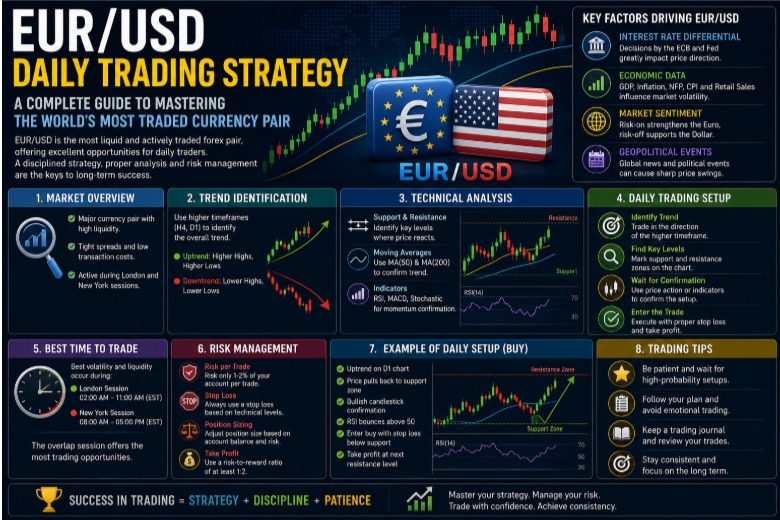
The EUR/USD currency pair is the most actively traded pair in the global foreign exchange market. It represents the exchange rate between the Euro and the US Dollar, two of the world’s strongest and most influential economies. Due to its exceptional liquidity, tight spreads, and consistent trading volume, EUR/USD attracts millions of traders ranging from beginners to professional institutions. Every trading day, billions of dollars flow through this currency pair, making it one of the most reliable markets for identifying high-probability opportunities.
Developing a profitable EURUSD trading strategy requires much more than simply buying when prices rise or selling when they fall. Successful traders understand market psychology, economic fundamentals, technical confirmation, and disciplined risk management. Rather than chasing every market movement, experienced traders focus on following structured plans supported by objective analysis and patience.
Whether you are a beginner learning forex trading or an experienced trader refining your skills, understanding how EUR/USD behaves under different market conditions can significantly improve your long-term performance.
Understanding the EUR/USD Currency Pair
EUR/USD belongs to the category of major currency pairs, meaning it combines two of the world’s most liquid and widely traded currencies. The Euro represents the economies of the Eurozone, while the US Dollar remains the world’s primary reserve currency.
Because both economies release regular economic reports, interest rate decisions, inflation figures, employment statistics, and GDP updates, EUR/USD frequently experiences healthy price movement throughout the trading week.
Unlike many exotic currency pairs, EUR/USD generally offers lower spreads and better execution because of its enormous trading volume. This makes it attractive for day traders, swing traders, and long-term investors alike.
Why EUR/USD Is the Most Popular Forex Pair
There are several reasons why professional traders prefer EUR/USD over many other currency pairs.
First, liquidity remains exceptionally high throughout the European and US trading sessions. High liquidity allows traders to enter and exit positions efficiently without significant price slippage.
Second, the pair responds well to technical structures, making chart analysis more reliable than lower-volume markets.
Finally, abundant market information allows traders to stay informed about upcoming economic events and central bank decisions that influence price movement.
These characteristics make EUR/USD one of the best markets for traders seeking consistency.
Building a Strong Trading Foundation
Every profitable trader begins with a clear trading plan. Instead of entering trades based on emotions, professionals develop structured routines that include market preparation, economic research, chart analysis, entry criteria, and risk management.
A successful EURUSD trading strategy starts before the market opens. Traders review the economic calendar, identify important support and resistance levels, analyze higher timeframes, and determine the prevailing market direction.
Preparation reduces emotional decisions and increases confidence when opportunities appear during active trading sessions.
Understanding Market Structure
Price never moves randomly. Financial markets create recognizable structures consisting of higher highs, higher lows, lower highs, and lower lows.
An uptrend develops when buyers consistently push prices higher, creating new highs while maintaining higher support levels. Conversely, downtrends form when sellers dominate and prices establish progressively lower lows.
Recognizing market structure helps traders avoid entering positions against strong momentum while increasing the probability of successful trades.
The Importance of Technical Analysis
Professional traders rely heavily on technical analysis to understand market behavior. Charts reveal areas where buyers and sellers have historically become active, helping traders identify potential trading opportunities.
Support and resistance remain two of the most valuable concepts in forex trading. Support represents areas where buyers frequently enter the market, while resistance highlights zones where selling pressure often increases.
Moving averages help identify overall trend direction, while indicators such as RSI and MACD provide additional confirmation regarding momentum and potential reversals.
Instead of relying on a single indicator, experienced traders combine multiple analytical tools to improve decision-making.
Identifying High-Probability Trade Entries
Finding quality entries requires patience. Many beginners enter trades simply because prices move quickly, but professional traders wait for confirmation before risking capital.
One common method involves waiting for price to pull back toward support during an uptrend before looking for bullish confirmation.
In downtrends, traders often wait for temporary rallies into resistance before searching for bearish opportunities.
Following this disciplined approach improves entry quality while reducing unnecessary losses.
Using Trend Trading for Better Consistency
One of the most reliable approaches for EUR/USD is trend trading. Rather than attempting to predict reversals, traders align themselves with existing market momentum.
Strong trends often continue longer than many traders expect because institutional investors gradually build or reduce positions over time.
Waiting for pullbacks within established trends frequently produces better entry opportunities than chasing rapid price movement after breakouts.
Patience remains one of the defining characteristics of successful trend traders.
Understanding Economic News

Although charts provide valuable information, economic developments frequently determine long-term market direction.
Interest rate decisions by the European Central Bank and the Federal Reserve influence investor expectations regarding future currency strength.
Employment reports, inflation data, GDP growth, retail sales, manufacturing indexes, and consumer confidence surveys all contribute to changing market sentiment.
Successful traders combine economic awareness with technical confirmation before entering positions.
Trading During Active Sessions
EUR/USD experiences its highest activity during the London and New York trading sessions.
The overlap between these sessions creates the greatest liquidity and volatility, providing numerous opportunities for disciplined traders.
Higher market participation generally leads to stronger trends, cleaner breakouts, and more reliable price movement.
Many professional traders concentrate their activity during these periods instead of trading throughout the entire day.
Creating Reliable Forex Setups
Every successful trade begins with well-defined forex setups supported by multiple forms of confirmation.
High-quality setups often include trend alignment, nearby support or resistance, favorable risk-to-reward ratios, and confirmation from candlestick patterns or momentum indicators.
Rather than forcing trades during uncertain conditions, experienced traders patiently wait until all required conditions align.
Quality consistently outperforms quantity in long-term trading performance.
Risk Management Principles
Risk management separates consistently profitable traders from those who struggle.
Professional traders determine stop-loss levels before entering positions and calculate position size according to account balance rather than emotions.
Many experienced traders risk only a small percentage of their capital on individual trades.
This disciplined approach allows them to survive temporary losing streaks while remaining prepared for future opportunities.
Common Trading Mistakes
Many beginners overtrade because they believe constant market participation increases profits.
In reality, excessive trading often leads to emotional decisions and poor execution.
Another common mistake involves ignoring the broader market trend.
Entering trades against strong institutional momentum significantly reduces the probability of success.
Failing to follow a structured trading plan also contributes to inconsistent results.
Successful traders prioritize discipline over excitement.
Improving Through Continuous Learning
Every completed trade provides valuable experience.
Maintaining a trading journal allows traders to record entry reasons, exit decisions, emotional responses, and final outcomes.
Reviewing past trades helps identify recurring strengths while exposing mistakes that require improvement.
Continuous education remains one of the strongest competitive advantages in financial markets.
Developing Long-Term Confidence
Confidence develops through preparation rather than prediction.
Traders who consistently follow structured processes become less influenced by temporary market fluctuations.
Instead of focusing exclusively on profits, successful traders evaluate whether they correctly followed their trading plan.
This mindset encourages gradual improvement while reducing emotional stress.
Conclusion
Trading EUR/USD successfully requires discipline, preparation, and continuous improvement. A structured EURUSD trading strategy combines knowledge of major currency pairs, effective technical analysis, disciplined trend trading, and carefully planned forex setups to identify high-probability opportunities while protecting trading capital.
Although no strategy guarantees profits, traders who consistently follow proven methods, manage risk responsibly, and continue learning are far more likely to achieve sustainable long-term success in the world’s most actively traded currency pair.