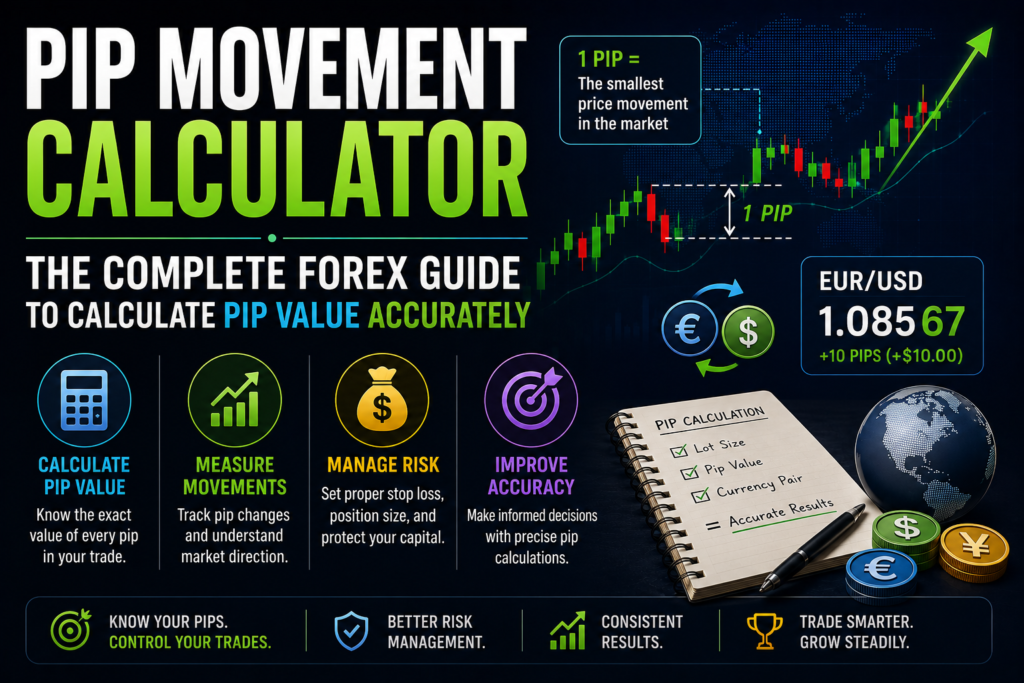
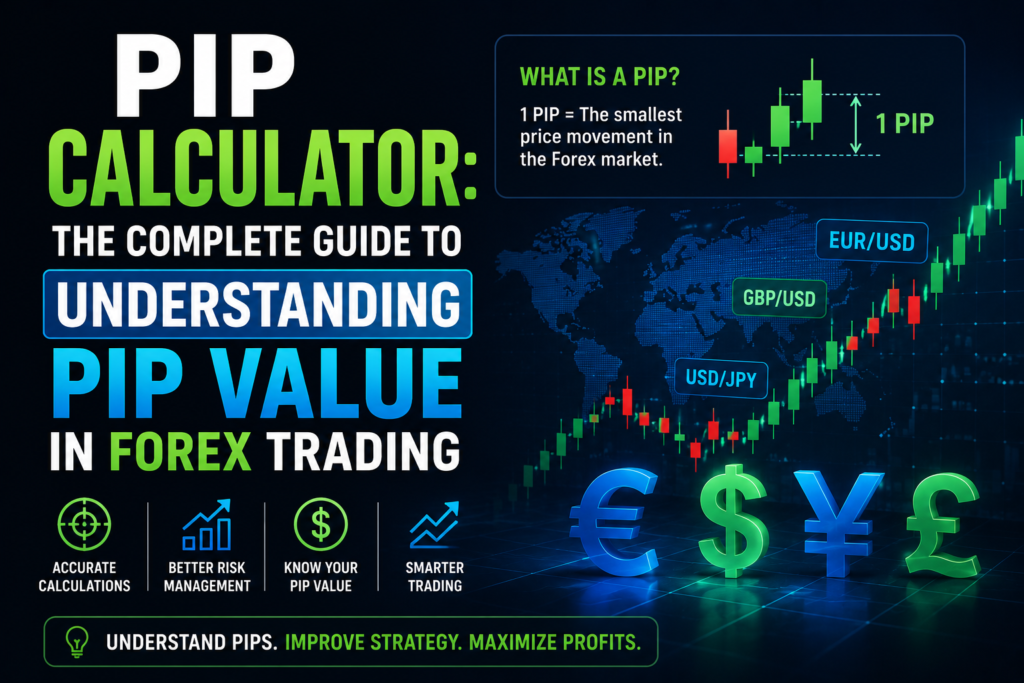

A single pip movement can be the difference between a winning trade and a costly mistake. If you’ve ever closed a position and been surprised by how much (or how little) you actually made, the missing piece was probably pip value — and the fastest way to master it is with a reliable pip calculator.
This guide breaks down what a pip actually is, how pip value is calculated across different currency pairs and instruments, and how to put a pip calculator to work in your own risk management strategy.
Quick Summary
- A pip is the standard unit used to measure price movement in forex.
- For most currency pairs, 1 pip = 0.0001 (the fourth decimal place).
- For pairs involving the Japanese yen, 1 pip = 0.01 (the second decimal place).
- On a standard lot (100,000 units) of EUR/USD, 1 pip is worth roughly $10.
- A pip calculator does this math instantly, adjusting for pair, lot size, and account currency.
What Exactly Is a Pip?
“Pip” stands for percentage in point — the smallest standardized increment by which a currency pair’s exchange rate can move. It exists so traders across different brokers and platforms have a common language for describing price movement, regardless of account size.
For the majority of currency pairs, one pip sits at the fourth decimal place. If EUR/USD moves from 1.1000 to 1.1050, that’s a 50-pip move. The Japanese yen is the exception: because JPY pairs trade at very different price scales, a pip there is the second decimal place instead of the fourth.
Without a shared unit like this, comparing volatility or setting consistent stop-loss levels across different pairs would be far messier than it needs to be.
Pip Value on Metals and Exotic Pairs
Pips aren’t exclusive to currency pairs. Gold (XAU/USD) and Silver (XAG/USD) also use a pip system, though it doesn’t follow the standard forex convention — for both metals, one pip typically equals 0.01.
Exotic pairs such as USD/TRY or USD/ZAR add another layer of complexity: their pip value shifts with the underlying exchange rate and can vary meaningfully between brokers. Always confirm pip sizing with your specific broker before trading anything outside the major pairs.
Why Pip Value Matters More Than Most Traders Realize
Pip value isn’t just trivia — it’s the foundation of position sizing, stop-loss placement, and profit projection. Every serious trading plan starts with knowing exactly how much a single pip is worth in real money, because that number determines how big a position you can safely take.
A 50-pip swing on EUR/USD might mean nothing on a micro lot but represent a significant gain or loss on a standard lot. Traders who skip this step often end up either overexposed (risking far more than intended) or underexposed (leaving profit on the table by trading too small). A pip calculator closes that gap instantly.
What Does a Pip Calculator Actually Do?
A pip calculator converts a pip movement into a real monetary value, using three core inputs:
- Currency pair — determines the pip size (0.0001 or 0.01 for JPY pairs)
- Trade size (lot size) — standard, mini, or micro
- Account currency — the currency your trading account is denominated in
The underlying formula looks like this:
Pip Value = (One Pip ÷ Exchange Rate) × Trade Size
Most online pip calculators pull live exchange rates automatically, so the figure you see reflects current market conditions rather than a stale rate. Enter EUR/USD, select a standard lot, set your account currency to USD, and the calculator will show that one pip equals roughly $10 — instantly, and adjusted correctly if you’re trading a JPY pair or a cross pair with different decimal conventions.
What Traders Actually Use a Pip Calculator For

- Estimating potential profit or loss on a trade before entering it
- Sizing a position appropriately for a given risk tolerance
- Setting realistic stop-loss and take-profit levels in monetary terms, not just price levels
In short, it turns abstract price movement into numbers a trader can actually plan around.
Manual Calculation vs. a Live Pip Calculator
You can calculate pip value by hand, and for a quick sanity check on a major pair, that’s fine. But manual math breaks down fast with cross pairs (like EUR/GBP) or exotic pairs (like USD/ZAR), where the exchange rate is constantly shifting. A live calculator recalculates automatically, which matters most when you’re managing several open positions and don’t have time for arithmetic between trades.
How to Use a Pip Calculator: Step by Step
Step 1 — Choose your currency pair. This sets the pip size. Standard pairs use the fourth decimal; JPY pairs use the second.
Step 2 — Enter your trade size. Standard lot = 100,000 units, mini lot = 10,000 units, micro lot = 1,000 units. This scales how much each pip is worth.
Step 3 — Select your account currency. The calculator converts the result into whatever currency your account is funded in — USD, EUR, GBP, or otherwise.
Step 4 — Confirm the exchange rate. Most tools fetch this automatically. If you’re doing it manually, make sure you’re using a current rate.
Step 5 — Calculate. The tool runs the formula and returns your pip value instantly, denominated in your account currency.
Step 6 — Read the result in context. On EUR/USD, a standard lot typically returns about $10 per pip, a mini lot about $1, and a micro lot about $0.10. That number tells you exactly how a given price move translates into gains or losses for your specific position size.
Pip Value Reference Table
| Currency Pair | Pip Size | Standard Lot (1.0) | Mini Lot (0.1) | Micro Lot (0.01) |
|---|---|---|---|---|
| EUR/USD | 0.0001 | $10 | $1 | $0.10 |
| GBP/USD | 0.0001 | $10 | $1 | $0.10 |
| USD/JPY | 0.01 | ~$9.09* | ~$0.91 | ~$0.09 |
| XAU/USD (Gold) | 0.01 | $10 | $1 | $0.10 |
| USD/TRY (Exotic) | 0.0001 | Varies | Varies | Varies |
*Approximate — fluctuates with the live exchange rate.
Connecting Pip Value to Risk Management
Knowing your pip value only pays off once you connect it to how you size trades. A widely used guideline is the 1% rule: never risk more than 1% of your account balance on a single trade.
Here’s how that plays out in practice. Say your account holds $5,000, and you’re comfortable risking 1% ($50) on a trade. If your stop-loss is 20 pips away on EUR/USD, where one pip on a standard lot equals $10, your maximum position size works out to 0.25 lots.
Where you place that stop matters too — ideally it’s informed by market structure (support/resistance) or volatility measures like ATR, not a round number picked arbitrarily. A wider stop calls for a smaller position; a tighter stop allows a larger one — all while keeping a healthy risk-to-reward ratio, ideally 1:2 or better.
Used together, a pip calculator and a position-size calculator remove the guesswork from this process entirely, turning “how much should I trade” into a quick, repeatable calculation instead of a gut call.
Frequently Asked Questions
What is a pip in forex trading? A pip (percentage in point) is the smallest standardized price movement for a currency pair — typically the fourth decimal place (0.0001), or the second decimal place (0.01) for yen pairs.
How do I use a pip calculator? Enter your currency pair, lot size, and account currency. The calculator instantly returns the monetary value of one pip, which you can then use for position sizing and stop-loss planning.
How do I calculate pip value manually? Use the formula: Pip Value = (One Pip ÷ Exchange Rate) × Lot Size. For a standard lot of EUR/USD at 1.10, that’s (0.0001 ÷ 1.10) × 100,000 ≈ $9.09 per pip. For anything beyond major pairs, a live calculator is far more reliable than manual math.
What is a pipette? A pipette, or fractional pip, is one-tenth of a standard pip — the fifth decimal place for most pairs, or the third for JPY pairs. Most modern platforms quote prices to this precision by default.
Why does pip value change between currency pairs? Because it depends on the exchange rate and which currency is quoted. USD-quoted pairs tend to stay relatively stable in pip value, while cross and exotic pairs shift as their exchange rates move — another reason a live calculator beats a fixed manual estimate.
What’s the pip value for Gold (XAU/USD)? One pip equals 0.01, and on a standard lot that’s typically $10 — the same dollar value as EUR/USD. But because gold moves in larger increments day to day, its pip ranges tend to be wider, so position sizing deserves extra attention.
Final Thoughts
Whether you’re sizing a EUR/USD trade, setting a stop-loss on GBP/JPY in pips, or applying the 1% risk rule to your account, pip value sits at the center of every decision. A dependable pip calculator strips out manual error and gives you a number you can actually trust — pair it with a position-size calculator and a clear risk management framework, and you’ve got a repeatable process for trading with discipline, no matter which pair you’re watching.
This article is for educational purposes only and does not constitute financial advice. Trading forex involves substantial risk — always do your own research before entering a position.