Summary
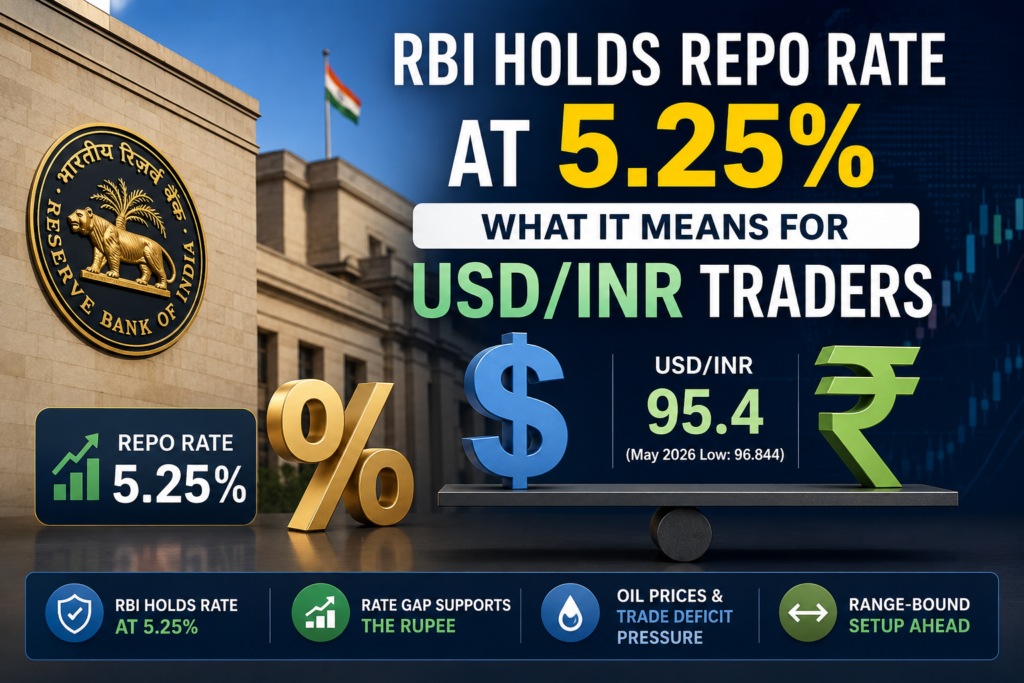
On 5 August 2026, the Reserve Bank of India kept its repo rate unchanged at 5.25% for the fourth meeting in a row, holding a neutral stance in a unanimous 6-0 vote and nudging its FY27 growth forecast up to 6.7%. For USD/INR traders, a “hold” is rarely a non-event: it fixes the India-US rate gap for another cycle, shapes carry, and interacts with a rupee already near record lows around 95.4. This analysis breaks down the decision, the immediate rupee reaction, the tug-of-war of forces driving the pair, and a balanced set of forecast scenarios — from banks calling USD/INR toward 94 to those seeing it capped near 96, and a minority warning of RBI rate hikes before year-end.
Introduction
The Reserve Bank of India did the expected thing on 5 August 2026 — and expected doesn’t mean irrelevant. By keeping the repo rate at 5.25% for a fourth straight meeting, the RBI locked in the gap between Indian and US interest rates for another cycle, at a moment when the rupee is trading near its weakest levels on record. For anyone with a position in USD/INR, that’s the setup that matters: two big central banks both on pause, both eyeing inflation, and a currency pinned between a firm dollar and the RBI’s determination to keep the rupee from sliding too far.
This piece explains what the decision was, how a “hold” actually transmits into the exchange rate, where the rupee stands today, and — crucially — the range of scenarios analysts see from here, presented as competing possibilities rather than a single confident call.
The Decision in Brief
Quick answer: On 5 August 2026, the RBI’s Monetary Policy Committee (MPC), chaired by Governor Sanjay Malhotra, kept the repo rate at 5.25% in a unanimous 6-0 vote and retained a neutral stance. It was the fourth consecutive hold, following the cut from 5.5% to 5.25% in December 2025. The MPC nudged its FY27 real GDP growth forecast up to 6.7% and flagged upside inflation risks from food, fuel and the West Asia conflict.
The supporting rates were left in place: the Standing Deposit Facility (SDF) at 5.00%, and the Marginal Standing Facility (MSF) and Bank Rate at 5.50%. Across 2025 the RBI had cut a cumulative 125 basis points (from 6.50%), so the current pause represents a central bank that has finished easing for now and is watching how inflation and global risks evolve before its next move.
Why a “Hold” Matters for USD/INR
A currency pair like USD/INR is, at its core, a bet on the relative value of two economies — and interest rates are one of the biggest inputs. Here’s the transmission chain traders care about.
The rate differential. The RBI’s repo rate sits at 5.25%. The US Federal Reserve, at its 29 July 2026 meeting, held the federal funds rate at 3.50%–3.75% for a fifth straight time. That leaves a nominal gap of roughly 1.5–1.75 percentage points in India’s favour. All else equal, a higher domestic rate makes rupee assets more attractive to yield-seeking capital — the classic carry argument that supports a currency.
Why the rupee is soft anyway. Rate differentials don’t operate in a vacuum. The rupee has been dragged lower by India’s large oil import bill, a persistent trade deficit, and a broadly firm US dollar as the Fed keeps rates elevated. When those structural pressures outweigh the carry appeal, the currency weakens despite a favourable rate gap — which is exactly what 2026 has shown.
The stance signal. A “neutral” stance tells markets the RBI is not committed to cutting further, which is mildly rupee-supportive versus an easing bias. Governor Malhotra has repeatedly stressed that the RBI does not target any particular rupee level, intervening only to smooth volatility — so traders read the stance as much as the number.

Rupee Dollar Rate Today: Where USD/INR Stands
As of mid-August 2026, USD/INR is trading around 95.4 (the RBI reference rate was 95.43 on 11 August). To put that in context:
| Metric | Level | Note |
| Current USD/INR | ~95.4 | Mid-August 2026 |
| 2026 opening level | ~89.98 | Rupee ~6% weaker year-to-date |
| Record low (rupee) | 96.844 | Reached 20 May 2026 |
| Recent high (USD/INR) | above 96.90 | Late-July 2026 spike, since eased |
The rupee actually firmed into the August policy as crude oil prices fell, recording its strongest close in a month — though the RBI’s decision to hold (rather than signal support-boosting tightening) trimmed some of those gains. Encouragingly for the currency, the RBI’s measures to attract foreign capital are working: inflows under the FCNR(B) deposit scheme have run stronger than expected, and foreign portfolio investment (FPI) has turned positive, led by the debt segment.
The Tug-of-War: Forces Pulling USD/INR
USD/INR is being pushed in both directions at once. Understanding which force is winning at any moment is the trader’s real job.
| Force | Direction | What it does |
| India-US rate differential (carry) | ↓ USD/INR (rupee-supportive) | Higher Indian yields attract capital |
| RBI intervention | ↓ USD/INR | Central bank smooths sharp rupee falls |
| Capital inflows (FCNR(B), FPI) | ↓ USD/INR | Dollar supply into India supports rupee |
| Oil import bill | ↑ USD/INR (rupee-negative) | Higher crude = more dollar demand |
| Trade deficit | ↑ USD/INR | Structural dollar outflow |
| Firm US dollar / Fed on hold | ↑ USD/INR | Elevated US rates keep dollar bid |
| West Asia geopolitical risk | ↑ USD/INR | Risk-off and oil-spike channel |
The net result through 2026 has been a rupee that is weak but managed — grinding rather than collapsing, because RBI intervention and improving inflows keep pushing back against the oil-and-dollar pressure.

USD/INR Forecast: Scenarios, Not Certainties
No one knows where the rupee will end the year, and honest analysis means presenting the spread of views with their assumptions. Bank forecasts for H2 2026 cluster in a 93–98 range, but they disagree on direction. Here are three scenarios plus a wildcard.
Scenario 1 — Range-bound, capped near 96 (base case for several banks). Crédit Agricole characterises the RBI as “practising patience” and expects USD/INR to stay capped around 96 through H2 2026, with intervention, bond-market inflows and deposit measures offsetting oil and inflation pressure. Assumption: oil stays contained, inflows continue, RBI defends the record-low zone.
Scenario 2 — Gradual rupee recovery toward 94. MUFG forecasts USD/INR grinding lower toward 94.00 over the next 3–6 months (before rebounding toward 96 in 2027), citing a large expected wave of inflows from the RBI’s FX measures. Some desks pencil in figures as strong as 93 by Q4 2026. Assumption: oil falls, the dollar softens, inflows exceed expectations.
Scenario 3 — Renewed weakness toward record lows. A sustained oil spike from the West Asia conflict, a fresh dollar surge, or lighter RBI intervention could push USD/INR back above the 96.8 record-low zone toward 97–98. Assumption: external shocks overwhelm domestic support.
Wildcard — an RBI rate hike. This is the contrarian view worth watching. Natixis and MUFG both argue the RBI may eventually need to raise rates — MUFG sees a possible 50 bps hike to 5.75% by December 2026 — to defend the rupee and anchor inflation expectations. A hike would be rupee-supportive but would also mark a policy U-turn from the current pause. Notably, the Fed faces a mirror-image debate: three FOMC members dissented in July in favour of hiking, and markets are pricing potential US hikes too. A world where both central banks turn hawkish would be volatile for the pair.
Key point: These are competing scenarios with different assumptions, not predictions. The single most important swing factor across all of them is crude oil, followed by the US dollar’s own trajectory.
What It Means for USD/INR Traders
Turning analysis into practice, here’s how the current setup shapes the trading environment.
- A low-volatility, range-trading backdrop is the default. With both the RBI and Fed on hold, USD/INR lacks a strong directional driver, favouring mean-reversion around the mid-95s until a catalyst appears.
- Respect the RBI’s defensive zone. The central bank has repeatedly leaned against sharp rupee falls near record lows, making the 96.8–97 area a natural resistance/intervention zone. That creates two-sided risk near the highs.
- Watch the catalysts, not the calendar. The next Fed decision (15–16 September 2026), the RBI’s October meeting, crude oil, US-India trade and tariff developments, and any escalation in West Asia are the events most likely to break the range.
- Carry cuts both ways. The rupee’s yield advantage rewards patience but is repeatedly offset by depreciation risk — a reminder that carry strategies in emerging-market currencies carry tail risk.
- Trade it legally. Resident Indians should access USD/INR through exchange-traded currency derivatives on NSE/BSE via a SEBI-registered broker. Trading the pair through offshore platforms or remitting margin abroad is restricted under FEMA, and the RBI maintains an Alert List of unauthorised platforms.
- Manage event risk. Policy days can gap prices; size positions and stops with that in mind.
Common Misconceptions
- “A hold means nothing changes.” A hold fixes the rate differential and signals stance — both move the currency.
- “Higher Indian rates mean a stronger rupee, always.” Only when carry outweighs oil, the deficit and dollar strength — often it doesn’t.
- “The RBI is trying to hit a rupee target.” The RBI says it targets volatility, not a level.
- “Forecasts are predictions.” They are scenario estimates built on assumptions that frequently change.
Expert Analysis
The most useful way to read this decision is as a pause with a hawkish tail. The RBI has stopped cutting, raised its growth forecast, and flagged inflation risks — a posture that quietly removes downside protection for the rupee’s yield appeal while stopping short of the tightening some analysts think is coming. For USD/INR, that argues for a currency held in a managed range rather than one trending decisively either way, at least until an external shock — almost certainly oil or the dollar — forces the issue.
The genuinely interesting tension is the symmetry with the Fed. Both central banks are on hold, both have vocal internal camps arguing for hikes, and both are wrestling with energy-driven inflation from the same geopolitical source. In that environment, the rate differential is less likely to be the decisive driver than the flow picture — India’s success (or not) in sustaining the FCNR(B) and FPI inflows that have been propping up the rupee. Traders who track those flows, and crude, will read USD/INR better than those fixated on the policy rate alone.
A note on uncertainty, appropriate for a Your-Money-Your-Life topic: every figure here is a mid-August 2026 snapshot, and forecasts span a wide 93–98 range precisely because the drivers are unstable. Rupee levels, oil prices and central-bank guidance can shift quickly. Treat this as context for your own research, not a recommendation, and verify the latest policy statements on the RBI and Federal Reserve websites before acting.
Key Takeaways
- The RBI held the repo rate at 5.25% on 5 August 2026 — a unanimous, fourth consecutive hold with a neutral stance; FY27 GDP forecast raised to 6.7%.
- The Fed held at 3.50%–3.75% in late July, leaving a rate gap of ~1.5–1.75 points in India’s favour — supportive of the rupee via carry, but offset by oil, the trade deficit and a firm dollar.
- USD/INR trades near 95.4, close to the record low of 96.844 (May 2026); the rupee is ~6% weaker year-to-date.
- Forecasts diverge (93–98 range): some see the pair capped near 96, others drifting toward 94, with a minority expecting RBI hikes to defend the rupee.
- Crude oil and the US dollar are the biggest swing factors.
- The setup favours a managed, range-bound environment until a catalyst breaks it — with RBI intervention capping the highs.
- Resident Indians should trade USD/INR only via NSE/BSE currency derivatives through SEBI-registered brokers.

FAQs
- What is the RBI repo rate in August 2026? The RBI kept the repo rate at 5.25% at its 5 August 2026 meeting, unchanged for the fourth consecutive time, with a neutral stance.
- When was the last time the RBI changed the repo rate? The last change was a cut from 5.5% to 5.25% in December 2025. The RBI has held at 5.25% since then.
- Why did the RBI hold the repo rate? Growth remained resilient (FY27 GDP forecast raised to 6.7%) while inflation risks from food, fuel and geopolitical tensions argued for caution, so the MPC kept rates and stance unchanged.
- What is the rupee dollar rate today? As of mid-August 2026, USD/INR is trading around 95.4, near its record low of 96.844 set on 20 May 2026.
- How does the RBI repo rate affect USD/INR? The repo rate sets India’s benchmark yield. A higher rate versus the US supports the rupee through carry, but oil, the trade deficit and dollar strength can override that effect.
- What is the current US Federal Reserve rate? The Fed held the federal funds rate at 3.50%–3.75% at its 29 July 2026 meeting, its fifth consecutive hold.
- What is the India-US interest rate differential now? Roughly 1.5–1.75 percentage points in India’s favour, with the RBI at 5.25% and the Fed at 3.50%–3.75%.
- Will USD/INR reach 96 or higher? Some banks expect the pair capped near 96 in H2 2026; a sustained oil spike or dollar surge could push it toward record lows near 96.8–98. These are scenarios, not certainties.
- Could the rupee strengthen from here? Yes — some forecasts see USD/INR drifting toward 94, or even 93 by Q4 2026, if oil falls, the dollar softens and capital inflows stay strong.
- Is the RBI likely to raise rates in 2026? A minority of analysts (including Natixis and MUFG) think the RBI may hike, possibly by 50 bps to 5.75% by December 2026, to defend the rupee and anchor inflation. It is not the consensus view.
- What is a “neutral” monetary policy stance? It means the RBI is not biased toward either cutting or raising rates and will respond to incoming data — a signal of watchful waiting.
- What are the biggest drivers of USD/INR right now? Crude oil prices, the US dollar’s trajectory, RBI intervention, and foreign capital inflows via the FCNR(B) scheme and FPI.
- How does RBI intervention affect the rupee? The RBI sells dollars to slow sharp rupee falls, effectively capping USD/INR near record lows, though it says it targets volatility rather than a specific level.
- Can Indian residents trade USD/INR? Yes, through exchange-traded currency derivatives on NSE and BSE via SEBI-registered brokers. Trading via offshore platforms or sending margin abroad is restricted under FEMA.
- When is the next RBI monetary policy meeting? The RBI MPC meets roughly every two months; the next review follows the August meeting in the bi-monthly cycle. Check the RBI website for the exact date.
- Does a rate hold increase or decrease currency volatility? Typically it lowers near-term volatility by removing a directional catalyst, favouring range-bound trading until an external shock emerges.