
Quick Summary
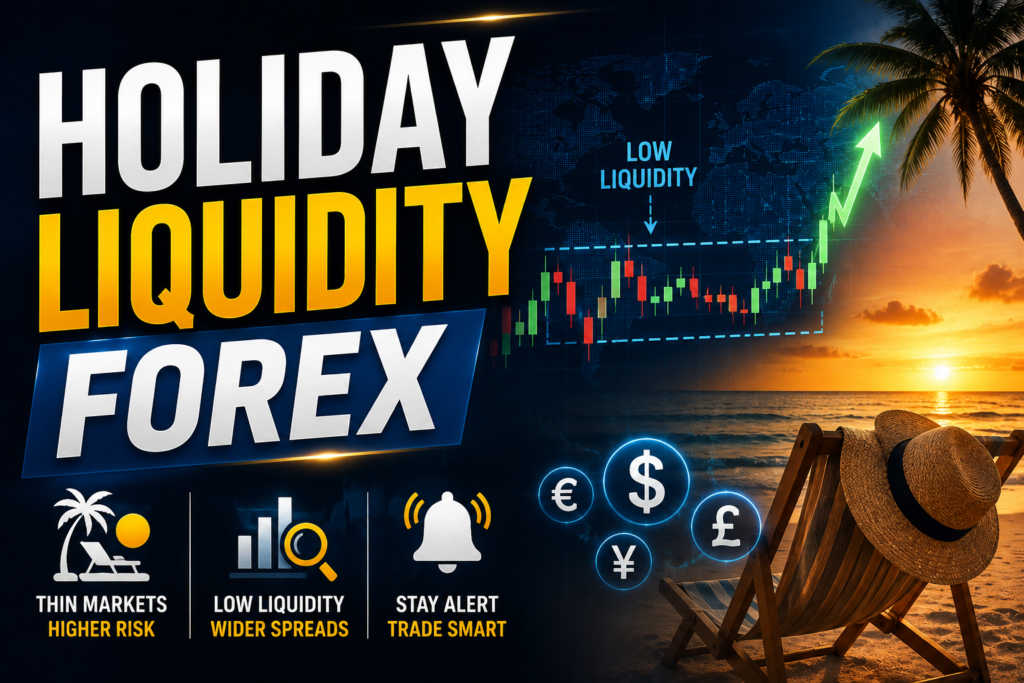
Knowing how market liquidity drops during public holidays, wider spreads cause unusual behavior, and unreliable technical patterns are known as Holiday Liquidity Forex. If you ignore holiday trading conditions, for sure you’re going to lose money. During this, traders face a phase that is commonly known as low liquidity holiday trading. This is exactly what we are going to explore today in this guide that
- How price moves
- How spreads behave
- How risk must be managed
What Is Holiday Liquidity Forex?
During global public holidays, a sharp drop in market participation is known as holiday liquidity forex. The forex market technically stays open 24/5, but many banks, liquidity providers, and institutional traders either close or open with minimal staff.
Being traders, it is essential for you to understand holiday liquidity forex. It is about adjusting position size and preferring range-bound or scalping strategies to protect your capital in low-liquidity conditions.
Why Does Liquidity Drop During Holidays?
Are you also confused and thinking, “Why does liquidity suddenly disappear during holidays even though the forex market is open for 24/5?” It is very simple, because forex is not moved by retail traders alone.
The players who create deep order flow, smooth price action, and tight spreads are banks, institutions, hedge funds, and interbank liquidity providers. In case they step away, the market becomes thin. That’s why you can see:
- Long candle wicks
- Random price spikes
- Breakouts that instantly fail
- Slow or delayed order execution
- Wide and unstable spreads
Which Forex Pairs Are Most Affected by Holiday Liquidity?
| Asset | Holiday Behavior |
| EURUSD | False breakouts |
| GBPUSD | Sudden whipsaws |
| USDJPY | Flat, then spike |
| US30 | Random stop hunts |
| NAS100 | Artificial volatility |
How Does Holiday Liquidity Impact US30?
| Normal Day | Holiday Session |
| Clean structure | Choppy movement |
| Predictable pullbacks | Erratic spikes |
| Trend continuation | Stop hunts |
How to Identify Holiday Liquidity Forex?
Signs of Holiday Liquidity:
- Price feels “Too quiet” for the time of day
- Long wicks start appearing everywhere
- Breakouts fail instantly
- Now-follow through after news
- Sudden random spikes
- ATR drops sharply
- Spreads suddenly look wider than usual
When Should You Avoid Trading During Holidays?
During low liquidity holiday trading conditions, you’ve learned when not to trade; it is the best and smartest skill of trading. Trading often results in false breakouts and stop-loss hunting during major holidays like Christmas, Good Friday, New Year, US Independence Day, Thanksgiving, and regular weekends.
These days are not profit-seeking days, and also you should treat these as your capital-protection days. Because protecting your account is the smartest trade you can make.
Can you trade during holiday liquidity forex? (Only If…)
Yes, you can definitely trade during holiday liquidity forex, but keep in mind that you don’t treat it like a normal day. If you’re choosing to trade during low-liquidity periods, you should follow some strict rules, and they are:
- Reduce your lot size aggressively
- Only trade ranges, not breakouts
- Use wider stop-losses
- Lower your profit expectations
- Trade only the best time window
- Avoid news completely
Holiday Liquidity forex Lot Size Table
You can see the practical lot size guide:
| Account Size | Normal Lot Size | Holiday Lot Size | Why This Works |
| $500 | 0.05 | 0.01 | If suddenly price spikes, it keeps risk under control |
| $1,000 | 0.10 | 0.03 | It protects your account from spread jumps & slippage |
| $2,000 | 0.20 | 0.06 | During choppy markets, it reduces emotional pressure |
| $5,000 | 0.50 | 0.15 | Limit drawdown during fake breakouts |
| $10,000 | 1.00 | 0.30 | Keeps real risk aligned with your plan |
Formula for Risk Adjustment
If you’re a beginner or an experienced trader, you do have knowledge that if you are using your normal lot size when liquidity is thin, the price can jump faster, and slippage means you are no longer protected properly.
Here’s a simple yet powerful rule for you, which is used by professional traders to adjust their position sizing:
Holiday Lot Size = Normal Lot Size * 0.3
It indicates that during holiday sessions, you trade with only 30% of your usual size.
Why does it work in low-liquidity markets?
- Slippage increases your real risk
- Stop-loss levels are hit more easily
- Price reacts sharply to small orders
- Spread widening reduces your true
Pip Value Table
| Pair | 1 Lot Pip Value |
| EURUSD | $10 |
| GBPUSD | $10 |
| USDJPY | $9.3 |
| XAUUSD | $10 |
Common Trader Mistakes During Holidays
Do you know why it is dangerous? Because it feels quiet, easy, and slow. Mistakes will happen if you don’t change your behavior when the market environment changes. Let’s discuss the mistakes that secretly damage our accounts during the holidays.
- If you’re trading in a normal market
- Using tight stop-losses
- Ignoring the spread widening
- Overtrading when the market looks “calm.”
- Revenge trading after random losses
- Chasing breakouts
Learn from these mistakes and avoid them because holiday liquidity forex is a place where you need to protect your capital.
Pro Trader Tips
Holiday sessions look harmless and quiet, but this is exactly why they catch you off guard. You treat it like a capital-protection zone instead of a profit-chasing zone. Here’s how to stay safe:
- Ignore breakout trading completely
- Reduce your lot size more than you think you need
- Stick to major pairs only
- Always use limit orders
- Accept small targets
- Walk away if the chart looks too quiet
- Trade only the first 60-90 minutes of the London session

Advantages vs Disadvantages of Holiday Liquidity Forex
Let’s be honest, holiday trading looks tempting, but it also comes with both opportunities and risks. You also want to know the reasons why many traders like it and why most traders ignore it. Here are the reasons:
Pros
- The market moves slowly
- Clear price ranges
- Good for light scalping
- Calm environment
- Fewer news events
Cons
- Fake moves
- Hard to trend
- Spread widening
- Slippage
| Feature | Normal Day | Holiday Session |
| Liquidity | High | Very low |
| Spreads | Tight | Wide |
| Trends | Clean and reliable | Rare and weak |
| Stop-hunt risk | Low | Very high |
| Best style | Trend & breakout | Range & scalping |
FAQs
Q1: Is forex open on holidays?
Yes, during most public holidays, it remains open, and the reason behind it is that it operates globally across different financial centers.
Q2: Can I scalp during holidays?
Definitely yes, you can scalp during holidays with extreme caution. You should use wider stop-losses, reduce lot sizes, and avoid breakouts to scalp safely.
Q3: Why do spreads increase on holidays?
The reason is that mostly banks, institutional traders, or liquidity providers reduce or stop their market activity, which is why spreads increase on holidays.
Q4: Is holiday trading risky?
Yes, the market operates with thin liquidity and reduced institutional participation, so holiday trading is considered risky.
Q5: Which is the safest asset to trade?
Currency pairs like EURUSD and USDJPY are considered the safest assets to trade during holiday liquidity conditions.
Final Thoughts
Now you have to know very well that holiday liquidity forex is a silent killer. Making it simple, holiday liquidity Forex is not about finding more trades; it is about knowing when not to trade. When you’re trading, it doesn’t mean that you need to be active 24/7. If you want to become a professional trader, you have to make smart decisions when the odds are in your favor.
Always keep in mind that discipline and risk management at the time of low-liquidity sessions are more important than chasing profits. Sometimes, no trade can also be a good trade.
Visit InsightfulTrade today to master holiday liquidity forex safely and protect your account during low-liquidity holidays.
Author: Arihant Jain
Trading Experience: 5+ Years
Arihant Jain is a financial markets analyst and trading educator with expertise in Forex, indices, crypto, and risk-managed trading systems. His insights are based on real trading experience, data-driven analysis, and transparent market understanding. All content is reviewed for accuracy and aligns with Google’s EEAT guidelines.
Risk Disclaimer:
Trading involves substantial risk. All information is for educational purposes only and should not be taken as financial advice. Always do your own research.
Last Updated: 09 January 2026