
Introduction
Most traders check their profit after the trade closes. Professionals calculate it before they enter. That’s the whole point of a pip profit calculator — it takes your entry, exit, lot size and instrument, and tells you what the trade is worth in real money, so you can decide whether the reward justifies the risk.
But there’s a trap. A calculator that shows you “+₹5,000” is showing gross profit. What actually lands in your account is smaller, because spreads, overnight swaps, brokerage and transaction taxes take their cut. This guide covers the full picture — the exact formula, worked examples across the instruments Indians can legally trade, and how to read the net number that really matters.
What Is a Pip Profit Calculator?
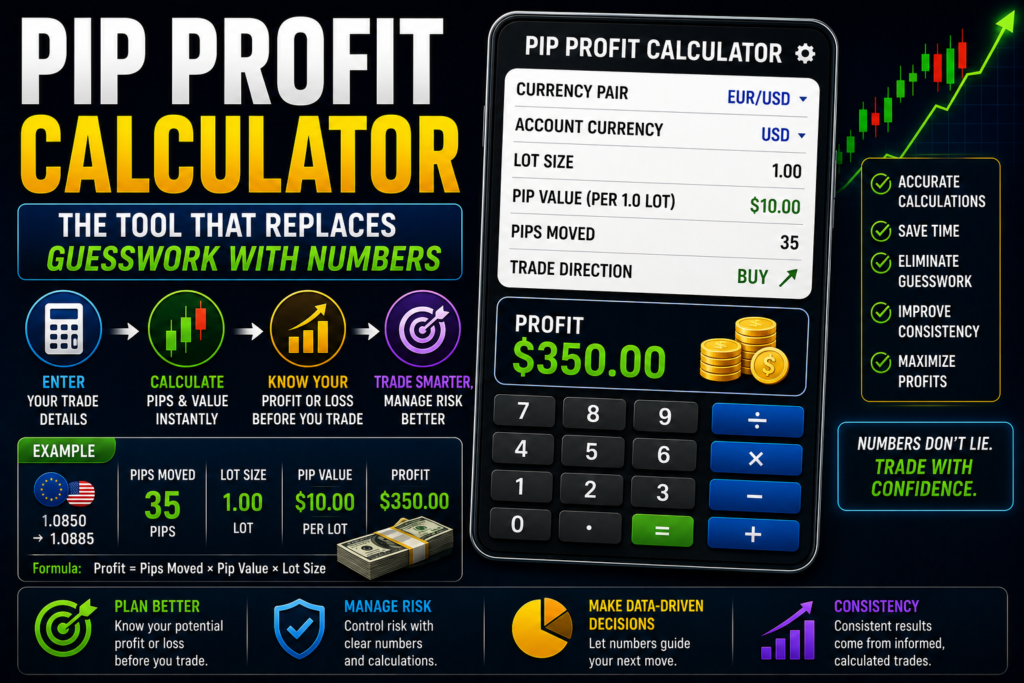
Quick answer: A pip profit calculator computes the profit or loss on a trade using three inputs — the number of pips gained or lost, the pip value for your instrument and lot size, and the number of lots. The core formula is: Profit/Loss = Pips × Pip value per lot × Number of lots.
It’s the natural extension of a pip value calculator. A pip value calculator tells you what one pip is worth; a pip profit calculator multiplies that by how many pips the price moved and how many lots you hold, giving you the full trade result. The best ones also subtract costs to show net profit and let you model a stop-loss and target together for risk-reward.

The Profit & Loss Formula (Step by Step)
Here is the master formula, kept clean:
Gross P/L = Number of pips × Pip value per lot × Number of lots
Each input has a small rule attached:
1. Number of pips (with direction).
- For a long (buy) trade: pips = (Exit − Entry) ÷ pip size
- For a short (sell) trade: pips = (Entry − Exit) ÷ pip size
A positive result is profit; a negative result is loss. Getting the direction sign right is where beginners slip.
2. Pip value per lot (established for each instrument):
| Instrument | Standard pip size | Standard-lot pip value |
|---|---|---|
| EUR/USD (USD account) | 0.0001 | $10 per standard lot (100,000) |
| USD/INR on NSE | 0.0001 (tick 0.0025) | ₹0.10 per pip; ₹2.50 per tick per lot ($1,000) |
| XAUUSD (gold) | 0.01 | $1 per standard lot (100 oz) |
| MCX Gold | ₹1 per 10 g (tick) | ₹100 per tick per lot (1 kg) |
3. Number of lots — how many contracts you’re trading.
Worked Examples Across Instruments
Example 1 — EUR/USD (global forex)
You buy 1 standard lot of EUR/USD at 1.1370 and close at 1.1420.
- Pips = (1.1420 − 1.1370) ÷ 0.0001 = 50 pips
- Gross P/L = 50 × $10 × 1 = +$500
Example 2 — USD/INR (NSE, legal in India)
You buy 10 lots of USD/INR futures at 95.8000 and close at 96.0500.
- Move = 0.2500 = 100 ticks (0.2500 ÷ 0.0025)
- Gross P/L = 100 × ₹2.50 × 10 = +₹2,500
Example 3 — Gold (XAUUSD short)
You sell 0.10 lot (10 oz) of XAUUSD at 4,080.00 and buy back at 4,065.00.
- Pips = (4,080.00 − 4,065.00) ÷ 0.01 = 1,500 pips
- Gross P/L = 1,500 × $0.10 × 1 = +$150 (or simply 10 oz × $15)
Example 4 — MCX Gold (legal Indian route)
You buy 1 lot of MCX Gold and the price rises ₹400 per 10 grams.
- Ticks = ₹400 ÷ ₹1 = 400 ticks
- Gross P/L = 400 × ₹100 × 1 = +₹40,000
In every case, the calculator’s job is the same: convert a price move into money via pip value and lot count.
Gross vs Net Profit: The Part Most Calculators Ignore
This is the single most valuable section for real traders. Your gross profit is the raw price-move result. Your net profit is what remains after four deductions:
1. Spread. The gap between bid and ask. If EUR/USD has a 1-pip spread, you start each standard-lot trade effectively $10 in the hole. On gold, spreads are wider — often several dollars — because gold is more volatile.
2. Swap / overnight financing. Positions held past the daily rollover are charged (or occasionally paid) a swap based on interest-rate differentials. Multi-day trades accumulate this.
3. Brokerage. Your broker’s per-trade fee or commission.
4. Transaction taxes and statutory charges (India). On Indian exchanges these include:
- Exchange transaction charges (NSE/MCX)
- GST (18%) on brokerage plus transaction charges
- Stamp duty on the buy side
- SEBI turnover fee
- Commodities Transaction Tax (CTT) on the sell side of commodity futures such as gold (currently around 0.01% — verify the live rate)
- Note: currency derivatives on NSE do not attract STT/CTT, but the other charges still apply
Net profit example. Take the USD/INR trade above (+₹2,500 gross). If total round-trip costs — spread built into your fills, brokerage, exchange charges, GST and stamp duty — come to, say, ₹300, your net profit is ₹2,200. The exact figure depends entirely on your broker and volume, which is why a good pip profit calculator lets you enter a cost estimate.
Rule of thumb: Gross profit tells you if your analysis was right. Net profit tells you if your trading is profitable. Only the second one pays your bills.
Using a Pip Profit Calculator for Risk-Reward (Not Just Winnings)
The smartest use of the tool isn’t counting profit after a win — it’s planning both outcomes before you enter. Run the calculator twice:
- Reward leg: entry to target
- Risk leg: entry to stop-loss
Example (EUR/USD, 1 standard lot):
- Stop-loss 20 pips away → risk = 20 × $10 = $200
- Target 60 pips away → reward = 60 × $10 = $600
- Risk-reward ratio = 1:3
A 1:3 ratio means you can be right just 1 out of 3 times and still break even. This reframes trading from “will this trade win?” to “is the payout worth the risk?” — a far more durable question.
Expectancy: the number behind long-term profit
Over many trades, profitability comes down to expectancy:
Expectancy = (Win rate × Average win) − (Loss rate × Average loss)
If you win 40% of trades with an average win of ₹600 and lose 60% with an average loss of ₹200:
- Expectancy = (0.40 × ₹600) − (0.60 × ₹200) = ₹240 − ₹120 = +₹120 per trade
A positive expectancy, applied consistently with disciplined position sizing, is what separates traders who last from those who don’t.
Trading Legally in India: Which Instruments Feed the Calculator
The maths is universal, but for resident Indians the instruments matter. Trading spot forex or CFDs (including EUR/USD spot or XAUUSD) through offshore brokers is restricted under the Foreign Exchange Management Act (FEMA), administered by the RBI, which also publishes an Alert List of unauthorised platforms. Sending margin abroad is treated as an illegal capital outflow.
What Indian residents can legally trade (and calculate profits on):
- Currency derivatives on NSE/BSE: USD/INR, EUR/INR, GBP/INR, JPY/INR, plus exchange-listed cross pairs (EUR/USD, GBP/USD, USD/JPY)
- Commodity derivatives on MCX: Gold, Gold Mini, Silver, Crude Oil and more, all SEBI-regulated
Apply the same pip profit formula to these; only the pip/tick value changes. The EUR/USD and XAUUSD examples above are included for conceptual fluency — execute through regulated Indian channels.
Pros and Cons of a Pip Profit Calculator
| Advantages | Limitations |
|---|---|
| Shows trade profit/loss before you enter | Gross figure misleads unless you add costs |
| Enables precise risk-reward planning | Depends on accurate entry/exit/lot inputs |
| Works across forex, currency and commodity contracts | Doesn’t predict whether the trade will win |
| Turns abstract pips into real money | Rates and costs change; a saved input goes stale |
Common Mistakes When Calculating Trade Profit
- Wrong direction sign. Subtracting entry from exit on a short trade flips profit into loss on paper.
- Confusing gross with net. Ignoring spread, swap and taxes overstates real profit.
- Using the wrong pip value. A EUR/USD $10-per-pip habit gives the wrong answer on gold or USD/INR.
- Forgetting lot count. Multiplying pip value by pips but not by the number of lots.
- Sizing off reward, not risk. Always calculate the stop-loss leg first; it defines your lot size.
Myths vs Facts
| Myth | Fact |
|---|---|
| “The profit the calculator shows is what I keep.” | That’s gross; net is lower after spread, swap, brokerage and taxes. |
| “A high win rate means I’m profitable.” | Expectancy depends on win and loss size, not win rate alone. |
| “Pip value is the same for every instrument.” | It differs — $10 for EUR/USD standard lot, $1 for gold, ₹2.50 per tick for NSE USD/INR. |
| “I can trade any instrument in India.” | Only exchange-traded NSE currency and MCX commodity derivatives are permitted for residents. |
Expert Analysis
The reason a pip profit calculator matters more than it looks is psychological, not just arithmetical. Traders who calculate profit only after the fact make decisions emotionally — chasing trades, moving stops, hoping. Traders who calculate both outcomes before entry make decisions structurally: the trade either offers acceptable reward for its risk, or it doesn’t, and the answer is a number, not a feeling.
The gross-versus-net distinction is where most retail edges quietly disappear. A strategy that looks profitable on gross pips can be a net loser once realistic spreads and Indian statutory charges are applied — especially for high-frequency styles where costs compound across many trades. The professional move is to build cost assumptions into every calculation, so your expectancy reflects the money you actually keep.
A note on uncertainty: the rates used here (EUR/USD ~1.137, USD/INR ~95.8, XAUUSD ~$4,050) are late-July-2026 snapshots and will move; brokerage and tax rates vary by broker and are periodically revised. Treat every calculated figure as a planning estimate, recompute with live prices and your own cost schedule before trading, and verify current charges with your broker and on the NSE, MCX, RBI and SEBI websites.
Key Takeaways
- Gross P/L = Pips × Pip value per lot × Number of lots — with the direction sign set by long vs short.
- Pip value differs by instrument: ~$10 (EUR/USD standard lot), ₹2.50 per tick (NSE USD/INR), $1 (gold standard lot), ₹100 per tick (MCX Gold).
- Net profit = gross − spread − swap − brokerage − taxes. Only net profit is real.
- Use the calculator to plan risk-reward before entry — size positions off the stop-loss leg.
- Positive expectancy, not win rate, drives long-term profitability.
- In India, feed the calculator with legal instruments: NSE currency and MCX commodity derivatives.
- All figures are snapshots — recompute with live data and your own costs.
FAQs
1. How does a pip profit calculator work? It multiplies the number of pips gained or lost by the pip value for your instrument and lot size, then by the number of lots, to give your profit or loss.
2. What is the formula for forex profit? Gross profit or loss = number of pips × pip value per lot × number of lots. For a long trade, pips = (exit − entry) ÷ pip size; for a short trade, reverse the subtraction.
3. How do I calculate profit on a EUR/USD trade? Find the pip move, multiply by the pip value (about $10 per standard lot) and by your lot count. A 50-pip gain on one standard lot is about $500 gross.
4. What is the difference between gross and net profit in trading? Gross is the raw price-move result. Net is what remains after spread, overnight swap, brokerage and transaction taxes are subtracted.
5. How do I calculate profit on USD/INR at NSE? Count the ticks moved (each tick is 0.0025), multiply by ₹2.50 per lot, then by your number of lots. A 100-tick move on 10 lots is ₹2,500 gross.
6. How do I calculate gold trade profit? Multiply the dollar move by ounces (XAUUSD), or use pips × $1 per standard lot. On MCX, multiply ticks by ₹100 per lot.
7. Does the pip profit calculator include spreads and taxes? Only if you add them. Most show gross profit; you should subtract spread, swap, brokerage and statutory charges for the net figure.
8. What costs reduce my forex profit in India? Spread, overnight swap, brokerage, exchange transaction charges, GST on brokerage, stamp duty, SEBI fee, and CTT on the sell side of commodity futures.
9. How do I use the calculator for risk-reward? Calculate the loss if your stop-loss hits and the profit if your target hits, then compare them. A 20-pip stop and 60-pip target is a 1:3 ratio.
10. What is expectancy in trading? Expectancy = (win rate × average win) − (loss rate × average loss). A positive number means the strategy makes money on average over many trades.
11. Why is my real profit lower than the calculator shows? Because the calculator likely showed gross profit. Spread, swap, brokerage and taxes reduce it to your net result.
12. Is forex trading profit taxable in India? Yes. Income from currency and commodity derivatives is taxable; treatment and rates depend on your situation, so consult a tax professional.
13. How many pips do I need to break even? Enough for your gross profit to cover the spread and all round-trip costs. On a tight-spread pair that may be a pip or two; on gold it’s more.
14. Can I calculate profit for MCX gold the same way? Yes — the logic is identical. Multiply ticks moved by the tick value (₹100 per lot for the 1 kg contract) by your number of lots.
15. Does pip value change with price? For USD-quoted instruments like gold it’s constant. For pairs where the quote currency differs from your account currency, it moves with the exchange rate.
16. Should I plan profit before or after entering a trade? Before. Calculating both the target and stop outcomes in advance lets you judge whether the reward justifies the risk.
This article is for educational purposes only and does not constitute financial advice. Trading forex involves substantial risk — always do your own research or consult a professional advisor before making trading decisions.