
Quick Summary
Let’s be honest. You all know that forex trading itself is not a scam, or traders like you wouldn’t lose because their strategy is weak. Sometimes they lose because of their mindsets. Your fear can push you to make random trades because you see that everyone else is making money very easily, as compared to you.
In this trading psychology guide, we’ll explore how professional traders think and react and also learn risk formulas, the journaling method, and real trade examples. Let’s learn together.
What Is Trading Psychology and Why Is It the Real Profit Engine?
Basically, when we talk about psychology, it refers to the mental and emotional state of any person, and trading psychology is related to a trader’s mental and emotional state while trading. Due to uncertainty, fast price movements, and financial risk, triggers greed, fear, impatience, and frustration in traders.
If you don’t have emotional discipline, you often close winning trades too early, hold the losing trades too long, overtrade after a winning streak, or revenge trade after a loss. Let’s discuss more about the trading psychology guide for emotional control in trading.
Why Do 90% of Traders Lose Money Emotionally?
According to the trading psychology guide, many traders lose money because their emotions take over, not because of the strategy. Now we’ll see why it happens.
- Don’t have clear plan
- Chasing fast-moving candles
- Overtrading
- Revenge Trading
- Risking too much or overconfidence
How Does Fear Destroy Profitable Trades?
Talking about fear? It is one of your biggest enemies while trading. This trading psychology guide explains to you how fear can quietly sabotage even the best setups and strategies. Let’s look for an example for the EURUSD scenario.
Suppose you buy EURUSD at 1.0750, and your target is 1.0800. You place a stop loss for 1.0720. In case the price moves to 1.0775. Due to fear, you close your trade to avoid a big loss. And later the price hits 1.0800 without you.
How to Build Discipline Step-by-Step?
| Steps | Action |
| Step 1 | Fixed trading plan |
| Step 2 | Fixed risk per trade |
| Step 3 | Journal every trade |
| Step 4 | Follow timing rules |
| Step 5 | Review performance weekly |
How Does Greed Blow Trading Accounts?
Are you a smart trader? Greed can convert you into a reckless gambler. This phase starts when you want just a little more profit and hold your trades longer, hoping for “one more candle.” Your hope for profit can turn into losses if the market reverses. Let’s check what it does:
- Greed can push you to overleverage, which can wipe out your gains.
- It also encourages overtrading that ends with emotional mistakes and rapid drawdowns.
- It kills risk management when you ignore the rules and stop-loss orders are moved.
In short, greed never increases your profits; also, it can destroy consistency, which is essential for long-term survival in trading.
What Is the Golden Trading Psychology Formula?
The Golden Trading Psychology Formula is a core concept that is explained in every professional trading psychology guide. Here’s the formula given:
Consistency = Discipline * Risk Control * Emotional Neutrality
If you’re losing, it’s not because of the market. It is because your psychology breaks your system.
How Much Risk Should You Take Emotionally?
| Account size | Risk 1% | Risk 2% |
| $1,000 | $10 | $20 |
| $5,000 | $50 | $100 |
| $10,000 | $100 | $200 |
What Are the Best Emotional Habits of Profitable Traders?
As per the trading psychology guide, they don’t depend only on luck; they depend on emotional structure. Let’s see more:
- Calmly accepts losses
- Risk is a fixed percentage per trade
- Follow strict trading hours
- Journal every trade
- Think in probabilities, not money
- Trade fewer but higher-quality setups
- Stop after daily loss limits
- Stay emotionally neutral after wins
What Are the Most Common Psychological Mistakes?
| Mistake | Result |
| Trading without SL | Account blow |
| Overtrading | Mental fatigue |
| Trading news emotionally | Panic & Slippage |
| Switching strategies daily | No growth |

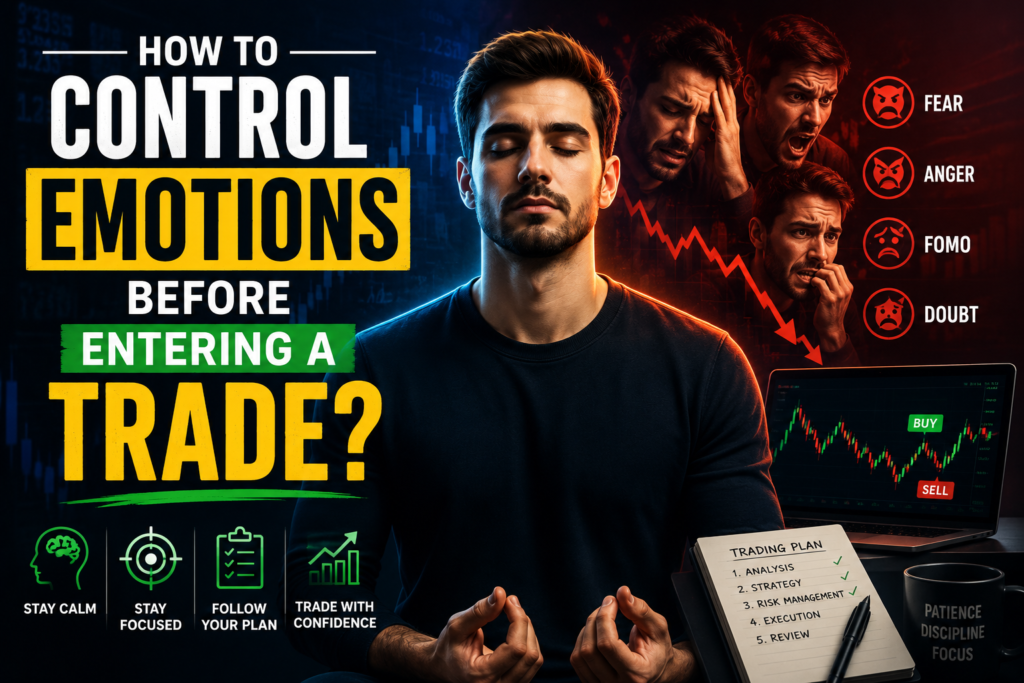
How to Control Emotions Before Entering a Trade?
Check these points before entering into any trade.
- Am I calm?
- Never risk more than 1-2% per trade
- Is my SL fixed?
- Is my setup valid?
- Rate your emotional state
What Are Pro Tips from Funded Traders?
- Avoid revenge trading and control your emotions
- Always learn continuously
- Record for you every trade to identify patterns and improve discipline
- Treat losses as business expenses to maintain emotional stability
- Choose quality over quantity to avoid chasing every market movement
- Don’t obsess over money, execution over profits,
- Stick to the rules of the risk
Why Journaling Is a Trader’s Superpower
- Refine your strategies
If you review your journal regularly, you can consistently keep an eye on your trade setups, which helps you improve your overall strategy over time.
- Learn from losses
Learn something from your losses that can be helpful for you for your future improvement.
- Track every trade
To spot your mistakes and patterns, you should record entries, exits, and position sizes.
- Emotional awareness
Self-awareness allows you to manage reactions, stay disciplined, and be more rational.
- Build discipline
If you maintain a journal for every trade, it reinforces adherence to your trading rules by holding you accountable for every decision.
- Long-term growth
You can develop self-awareness by highlighting behavioral patterns and emotional triggers by journaling regularly.
Pros and Cons of Strong Trading Psychology
| Pros | Cons |
| Consistent Profits | Need patience |
| Reduce stress | Slower growth |
| High win-rate | Emotional discipline |
| Capital protection | No instant money |
FAQs
1. What is trading psychology?
It refers to the mental, emotional, and behavioral state of traders that influences their trading decisions.
2. Why do traders fail emotionally?
Many traders fail emotionally because it causes the real damage, such as greed, FOMO, fear of losing money, overtrading, and real trading.
3. How can I control trading emotions?
By building a structured routine to remove impulsive decision-making, you can control trading emotions. Take regular breaks and limit the number of trades per day.
4. What is the best risk per trade?
The best risk per trade is a maximum of 1-2% of your total trading capital because small losses are easier to recover from than big losses.
5. Can psychology make me profitable?
Yes, psychology plays a bigger role than strategy. If your strategy is average but you have strong emotional discipline, you can perform better in your trade.
Final Thought
Giving the trading psychology guide a closure, when you learn to control your emotions and accept that losses are just a part of any trade, then your trading will become calmer and more consistent. Master your mindset, and your profits start taking care of themselves because indicators don’t make you rich.
In trading, your biggest competitor is your mind, not the market. So, emotional control in trading is very necessary. Trade better and make strict rules, accept losses, and respect your risk per trade. Professional traders stay profitable year after year by controlling their emotions with this trading psychology guide.
Start building real consistency and explore our complete Trading Psychology Guide on InsightfulTrade because mindset is your biggest trading edge.
Author: Arihant Jain
Trading Experience: 5+ Years
Arihant Jain is a financial markets analyst and trading educator with expertise in Forex, indices, crypto, and risk-managed trading systems. His insights are based on real trading experience, data-driven analysis, and transparent market understanding. All content is reviewed for accuracy and aligns with Google’s EEAT guidelines.
Risk Disclaimer:
Trading involves substantial risk. All information is for educational purposes only and should not be taken as financial advice. Always do your own research.
Last Updated: 30 December 2025