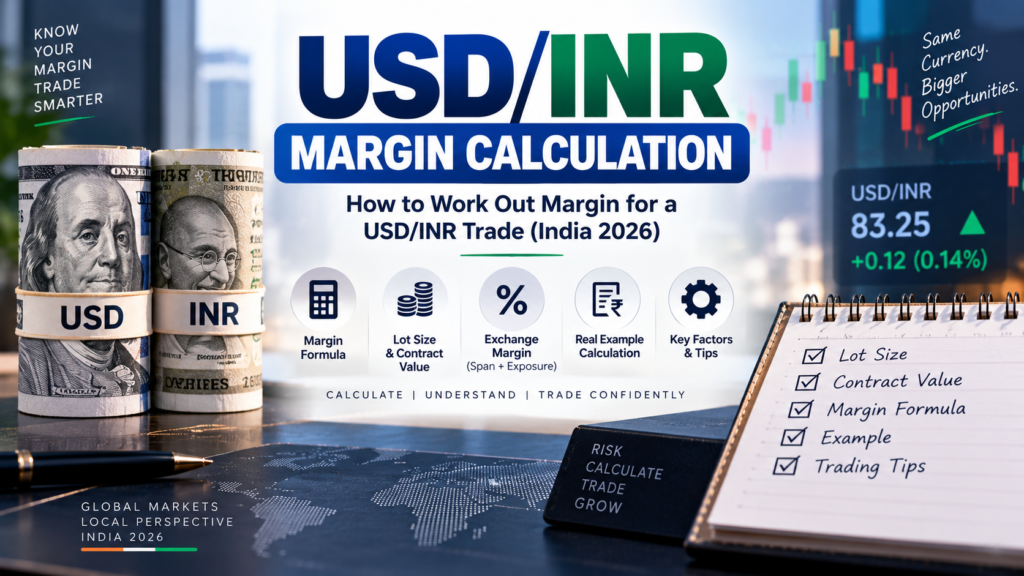
Quick answer: Margin for a USD/INR futures trade = contract value × margin %. One lot is $1,000, so contract value = futures price × 1,000. At a price of ₹95.585, one lot is worth ₹95,585. On 23 September 2026, a large broker’s calculator showed a margin of about ₹2,281 per lot, roughly 2.4% of contract value. That total is the SPAN margin plus the extreme loss margin, and you must pay it upfront. Your profit or loss is then settled daily through mark-to-market (MTM).
Margin is not a fee or a cost. It is a deposit the exchange’s clearing house holds so you can cover a bad day’s loss. Because it is only a small slice of the contract value, currency futures are leveraged: a small move in the rupee creates a large change in your margin money.
This guide explains the contract basics, each part of the margin, how to calculate it step by step in rupees, and the RBI rule that decides who is allowed to trade USD/INR derivatives in the first place.
USD/INR futures: the contract basics
Definition: A USD/INR futures contract is an exchange-traded agreement to buy or sell US dollars against rupees at a fixed rate on a future date. On Indian exchanges it is cash-settled in rupees; no dollars change hands.
| Specification (NSE) | Detail |
|---|---|
| Lot size | $1,000 |
| Quotation | Rupees per US dollar (e.g., 95.5850) |
| Tick size | ₹0.0025 (0.25 paise) = ₹2.50 per lot |
| Trading hours | 9:00 am to 5:00 pm, Monday to Friday |
| Contract months | Monthly contracts, up to 12 months ahead |
| Final settlement price | RBI reference rate on the last trading day |
| Settlement | Cash, in rupees |
Contract value (notional value) = futures price × lot size × number of lots.
Example: 95.585 × 1,000 × 1 lot = ₹95,585.
Who is allowed to trade USD/INR derivatives?
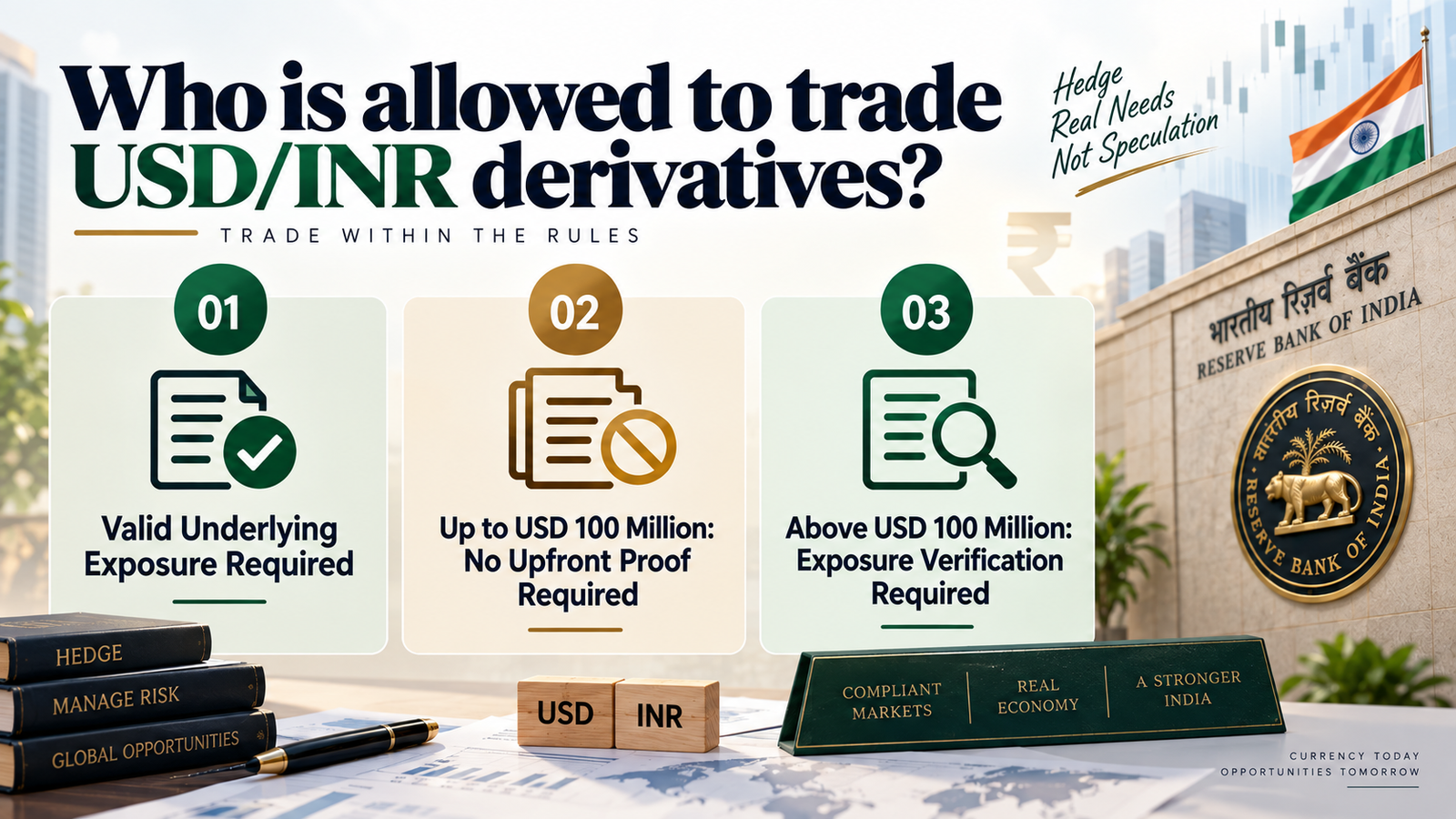
This matters before any margin maths. Under RBI directions effective 3 May 2024, rupee-linked exchange-traded currency derivatives are permitted only to hedge a genuine currency exposure: for example, an import bill, export receivable, foreign fees or a planned remittance.
- Positions up to $100 million across all exchanges and pairs need no documents, but the exposure must actually exist.
- Positions above $100 million require documentary proof through a bank.
- Purely speculative trading, with no underlying exposure, is not permitted.
The rule cut NSE’s average daily currency derivatives turnover by 87% in April 2024. Check RBI’s current directions before trading, as the framework has been under review.
How margin works for USD/INR
The total margin on a currency futures position has two upfront parts, plus a daily settlement once you hold it.
| Component | What it is | USD/INR rule (NSE Clearing) |
|---|---|---|
| SPAN (initial) margin | Covers the largest likely one-day loss, based on 99% value at risk | Set daily by the clearing house using the SPAN risk model |
| Extreme loss margin (ELM) | Extra buffer for moves beyond the SPAN estimate | 0.50% of the value of the futures position; 0.75% for short options |
| Mark-to-market (MTM) | Daily settlement of profit or loss against that day’s settlement price | Credited or debited to your account each day |
Total upfront margin = SPAN margin + ELM. Brokers must collect both upfront before the trade goes through.
Why the SPAN margin changes
SPAN is not a fixed percentage. The clearing house recalculates it from recent volatility several times a day. When the rupee is calm, margin is lower; when it swings sharply, margin rises, sometimes after you have already opened a position.

Margin shortfall penalty
If your account falls below the required margin, the exchange charges a penalty on the shortfall:
| Shortfall | Penalty per day |
|---|---|
| Less than ₹1 lakh and less than 10% of required margin | 0.50% of the shortfall |
| ₹1 lakh or more, or 10% or more of required margin | 1.00% of the shortfall |
Clearing members must also take at least nine intraday snapshots to check peak margin, so a position that is under-margined for part of the day can still attract a penalty.
How to calculate USD/INR margin: step by step
The prices below are from a broker margin calculator on 23 September 2026 (September contract at ₹95.585). Margins change daily, so treat them as a worked example rather than today’s quote.
Step 1: Find the contract value
Contract value = futures price × $1,000 × lots
95.585 × 1,000 × 1 = ₹95,585 per lot
Step 2: Work out the extreme loss margin
ELM = 0.50% × contract value = 0.005 × ₹95,585 = ₹478
Step 3: Get the SPAN margin
SPAN comes from the exchange’s daily risk file, which your broker’s margin calculator reads. The broker showed a total of ₹2,281 per lot, so:
SPAN ≈ ₹2,281 − ₹478 = ₹1,803 (about 1.9% of contract value)
Step 4: Add them up
| Item | Per lot | 10 lots |
|---|---|---|
| Contract value | ₹95,585 | ₹9,55,850 |
| SPAN margin (approx.) | ₹1,803 | ₹18,030 |
| Extreme loss margin (0.50%) | ₹478 | ₹4,780 |
| Total margin | ₹2,281 | ₹22,810 |
| Margin as % of contract value | about 2.4% | about 2.4% |
Keep extra cash above this minimum. If the rupee moves against you, MTM losses come out of your account the same day, and SPAN can rise overnight.
Step 5: Understand the leverage
Leverage = contract value ÷ margin = ₹95,585 ÷ ₹2,281 ≈ 42 times
A 1% move in USD/INR (about 96 paise) changes the value of one lot by about ₹956. That is roughly 42% of your margin in a single move.
Step 6: Track mark-to-market
MTM per lot = (today’s settlement price − previous price) × 1,000, with the sign depending on whether you are long or short.
| Scenario (long 1 lot from ₹95.585) | Price move | Ticks | MTM per lot |
|---|---|---|---|
| Rupee weakens to ₹95.80 | +₹0.215 | +86 | +₹215 |
| Rupee strengthens to ₹95.30 | −₹0.285 | −114 | −₹285 |
A move of about ₹2.28 against you (to near ₹93.30 for a long) would wipe out the entire ₹2,281 margin per lot. Brokers may square off your position well before that point.
Quick formula summary
- Contract value = price × 1,000 × lots
- ELM = 0.50% × contract value
- Total margin = SPAN + ELM
- P&L = (exit − entry) × 1,000 × lots (long); reverse the sign for a short
- Leverage = contract value ÷ total margin
Options, spreads and hedging
USD/INR options margin
| Position | What you pay | Why |
|---|---|---|
| Buy a call or put | Premium only | Your maximum loss is the premium |
| Sell (write) a call or put | SPAN margin + ELM of 0.75% of position value | Your potential loss is open-ended |
Buyer example (illustrative): a premium of ₹0.40 per dollar costs 0.40 × 1,000 = ₹400 per lot. There is no further margin call.
Seller example (illustrative): at ₹95.585, ELM alone is 0.0075 × ₹95,585 = ₹717 per lot, plus SPAN. Use your broker’s calculator for the exact SPAN amount.
Calendar spreads get a margin benefit
A calendar spread means buying one month and selling another, e.g., long September and short October. Because the two legs largely offset, ELM is charged on only one-third of the far-month value.
| Position | ELM on the October leg (price ₹95.89) |
|---|---|
| Short October on its own | 0.5% × ₹95,890 = ₹479 |
| Short October as part of a calendar spread | ₹479 ÷ 3 = about ₹160 |
The SPAN margin on a spread is also usually much lower than on two separate positions.
Hedging example: an importer
An importer must pay $50,000 for goods in November. They worry the rupee will weaken. They buy 50 lots of November USD/INR futures at ₹96.1225.
- Contract value: 96.1225 × 1,000 × 50 = ₹48,06,125
- Margin at about ₹2,293 per lot: about ₹1,14,650
| Rupee at expiry | Futures P&L | Extra cost of buying $50,000 vs ₹96.1225 | Net effect |
|---|---|---|---|
| Weakens to ₹97.50 | +₹68,875 | −₹68,875 | Rate locked near ₹96.12 |
| Strengthens to ₹95.00 | −₹56,125 | +₹56,125 | Rate locked near ₹96.12 |
The hedge removes the uncertainty in both directions. The importer gives up the gain from a stronger rupee in exchange for protection against a weaker one. They still need enough cash to meet daily MTM losses along the way, because the offsetting gain on the actual import only arrives when the dollars are bought. Illustrative only; it ignores brokerage, taxes and the gap between the futures settlement price and the bank’s actual rate.
Expert analysis
Fact: on 23 September 2026 a broker calculator showed about ₹2,281 margin for one USD/INR September futures lot at ₹95.585, roughly 2.4% of contract value. NSE Clearing’s ELM for USD/INR futures is 0.50%.
Analysis: the low margin percentage reflects how slowly USD/INR usually moves compared with equities. But low margin means high leverage, about 42 times. A move that looks small on the rupee chart can use up a big share of your deposit.
Analysis: the RBI’s underlying-exposure rule changes who these calculations matter for. For a hedger, margin is a working-capital cost of locking in a rate. For someone with no real currency exposure, the question is not how much margin to post but whether the trade is permitted at all.
Analysis: because SPAN is recalculated with volatility, margin tends to rise exactly when the rupee is under pressure, around RBI policy, US Fed decisions, oil shocks or heavy foreign outflows. Hedgers should budget for higher margins in those periods.
Opinion: for a small business hedging a one-off payment, keep at least two to three times the minimum margin in the account. That buffer covers MTM swings and avoids forced square-offs at the worst moment.
Common mistakes
- Confusing the lot size ($1,000) with the contract value in rupees.
- Keeping only the exact minimum margin in the account.
- Forgetting that MTM losses are debited daily, even when the hedge will work out at expiry.
- Using an old margin percentage from a blog instead of the broker’s live calculator.
- Assuming option sellers pay only the premium, like buyers.
- Trading USD/INR futures without a genuine underlying exposure.
Myths vs facts
| Myth | Fact |
|---|---|
| Margin is the cost of the trade | It is a refundable deposit; costs are brokerage, taxes and charges |
| Margin stays fixed once you enter | SPAN is recalculated daily and can rise |
| Low margin means low risk | Low margin means high leverage, about 42 times here |
| Anyone can trade USD/INR futures | RBI rules require a genuine underlying currency exposure |
| Hedging guarantees a profit | Hedging locks in a rate; it removes both upside and downside |
Key takeaways
- One USD/INR lot is $1,000; contract value = price × 1,000.
- Total margin = SPAN + ELM; ELM is 0.50% for futures and 0.75% for short options.
- On 23 September 2026, margin was about ₹2,281 per lot, around 2.4% of contract value.
- Leverage is about 42 times, so a 1% rupee move equals about 42% of margin.
- MTM gains and losses are settled daily; keep a cash buffer above the minimum.
- Calendar spreads pay ELM on only one-third of the far-month value.
- Rupee-linked currency derivatives require a genuine underlying exposure under RBI rules.
FAQs
1. How do you calculate margin for USD/INR futures?
Multiply the futures price by 1,000 to get the contract value per lot, then add the SPAN margin and the extreme loss margin of 0.50%. Your broker’s calculator gives the exact SPAN figure.
2. How much margin is needed for 1 lot of USD/INR?
On 23 September 2026, about ₹2,281 for the September contract at ₹95.585, roughly 2.4% of contract value. The figure changes daily.
3. What is the lot size of USD/INR futures?
One lot is $1,000. At ₹95.585, that is a contract value of ₹95,585.
4. What is SPAN margin?
SPAN margin covers the largest likely one-day loss on your position, estimated at a 99% confidence level. The clearing house recalculates it daily based on volatility.
5. What is extreme loss margin in currency futures?
It is an extra buffer beyond SPAN. For USD/INR it is 0.50% of the value of futures positions and 0.75% for short options.
6. What is the leverage in USD/INR futures?
At about 2.4% margin, leverage is roughly 42 times. A 1% move in the rupee changes your position by about 42% of your margin.
7. How is profit or loss calculated on USD/INR futures?
Profit or loss = (exit price − entry price) × 1,000 × number of lots for a long position. Reverse the sign for a short.
8. What is MTM in currency futures?
Mark-to-market is the daily settlement of gains and losses. Your account is credited or debited each day based on that day’s settlement price.
9. What happens if my margin falls short?
The exchange charges a penalty of 0.50% or 1.00% of the shortfall per day, depending on its size. Your broker may also square off your position.
10. How much margin does a USD/INR option buyer need?
Only the premium. For example, a premium of ₹0.40 per dollar costs ₹400 per lot.
11. How much margin does a USD/INR option seller need?
SPAN margin plus ELM of 0.75% of the position value, which is about ₹717 per lot at ₹95.585 before SPAN.
12. Do calendar spreads need less margin?
Yes. ELM is charged on only one-third of the far-month contract’s value, and SPAN is usually lower because the two legs offset.
13. Can anyone trade USD/INR futures in India?
No. Under RBI directions effective 3 May 2024, rupee-linked exchange-traded currency derivatives are for hedging a genuine currency exposure. Positions up to $100 million need no documents, but the exposure must exist.
14. Where can I check the latest USD/INR margin?
Use your broker’s currency margin calculator or NSE Clearing’s daily SPAN files. Margins change every trading day.
15. Is margin a charge or a fee?
No. Margin is a refundable deposit held while your position is open. Brokerage, taxes and exchange charges are separate costs.
16. What price is used to settle USD/INR futures at expiry?
The RBI reference rate on the last trading day. Settlement is in cash, in rupees.