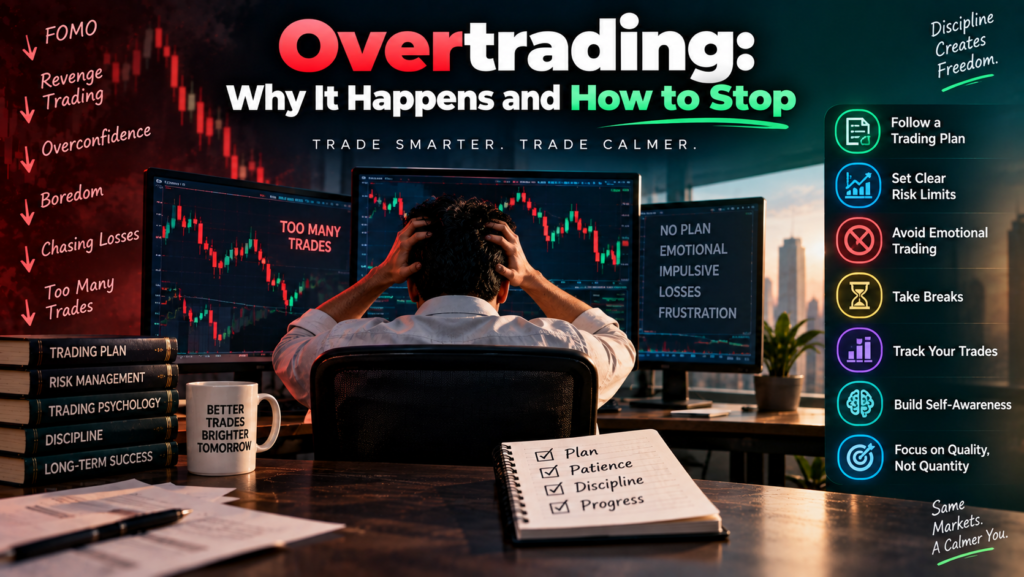
Quick answer: To stop overtrading, cap the number of trades you take per day, take only setups written in your trading plan, and stop for the day once you hit a fixed loss limit. Track every trade in a journal so you can see how much the extra trades really cost you. Overtrading means trading more often or in bigger size than your plan justifies, usually driven by boredom, FOMO or the urge to win back losses.
In India, cheap brokerage, instant mobile apps and daily options expiries make it easy to place trade after trade. Each click feels small, but costs and emotional mistakes add up fast. This guide shows how to recognise overtrading, why it happens, what it costs in rupees, and a step-by-step system to stop it.
What is overtrading?
Definition: Overtrading is placing more trades, or taking bigger positions, than your trading plan and capital justify. The problem is not a high trade count itself; it is trading without a valid reason.
A scalper with a tested plan may take 20 trades a day and not be overtrading. A beginner whose plan calls for two setups a day but who takes 12 is overtrading.
Two types
| Type | What it looks like | Typical trigger |
|---|---|---|
| Overtrading by frequency | Too many trades, many outside your plan | Boredom, FOMO, revenge |
| Overtrading by size | Positions too large for your capital; too much leverage | Greed, overconfidence after wins |
Warning signs: are you overtrading?
- You take trades that don’t match any setup in your plan.
- You feel restless or anxious when you are not in a trade.
- You trade more after a loss to “get it back.”
- Your charges and taxes are a large share of your gross profit.
- You increase size after a few winning trades.
- You can’t explain why you entered many of your recent trades.
- You trade through lunch, expiry afternoons and news events without a plan for them.
- Your win rate falls as your trade count rises.
If three or more apply, you are very likely overtrading.
Why does overtrading happen?
Psychological causes
| Cause | How it leads to overtrading |
|---|---|
| Revenge trading | After a loss, you take extra or bigger trades to win it back the same day |
| FOMO (fear of missing out) | You jump into moves you didn’t plan for because others seem to be profiting |
| Overconfidence | A winning streak makes you believe every setup will work, so you trade more and larger |
| Boredom and action bias | Sitting in cash feels like doing nothing, so you invent reasons to trade |
| Loss aversion | You can’t accept a small loss, so you keep adding or re-entering to avoid booking it |
| Near-miss excitement | Small wins give a quick thrill that feels like progress, even when the account is shrinking |
Structural causes in India
- Flat low brokerage. A ₹20 order feels free, so each extra trade seems harmless. But brokerage is only one of several charges, as the cost section shows.
- Mobile apps built for speed. One-tap orders, live P&L, push alerts and option chains on your phone make impulse trades easy.
- Weekly expiries. Nifty weekly options expire every Tuesday on NSE and Sensex weekly options every Thursday on BSE. Cheap near-expiry premiums tempt traders into many small, fast bets.
- Small capital, big leverage. Options let a small account control large exposure, so traders use high frequency to chase meaningful profits.
- Social media and tips. Telegram and YouTube calls create a steady flow of trade ideas that aren’t part of your own plan.
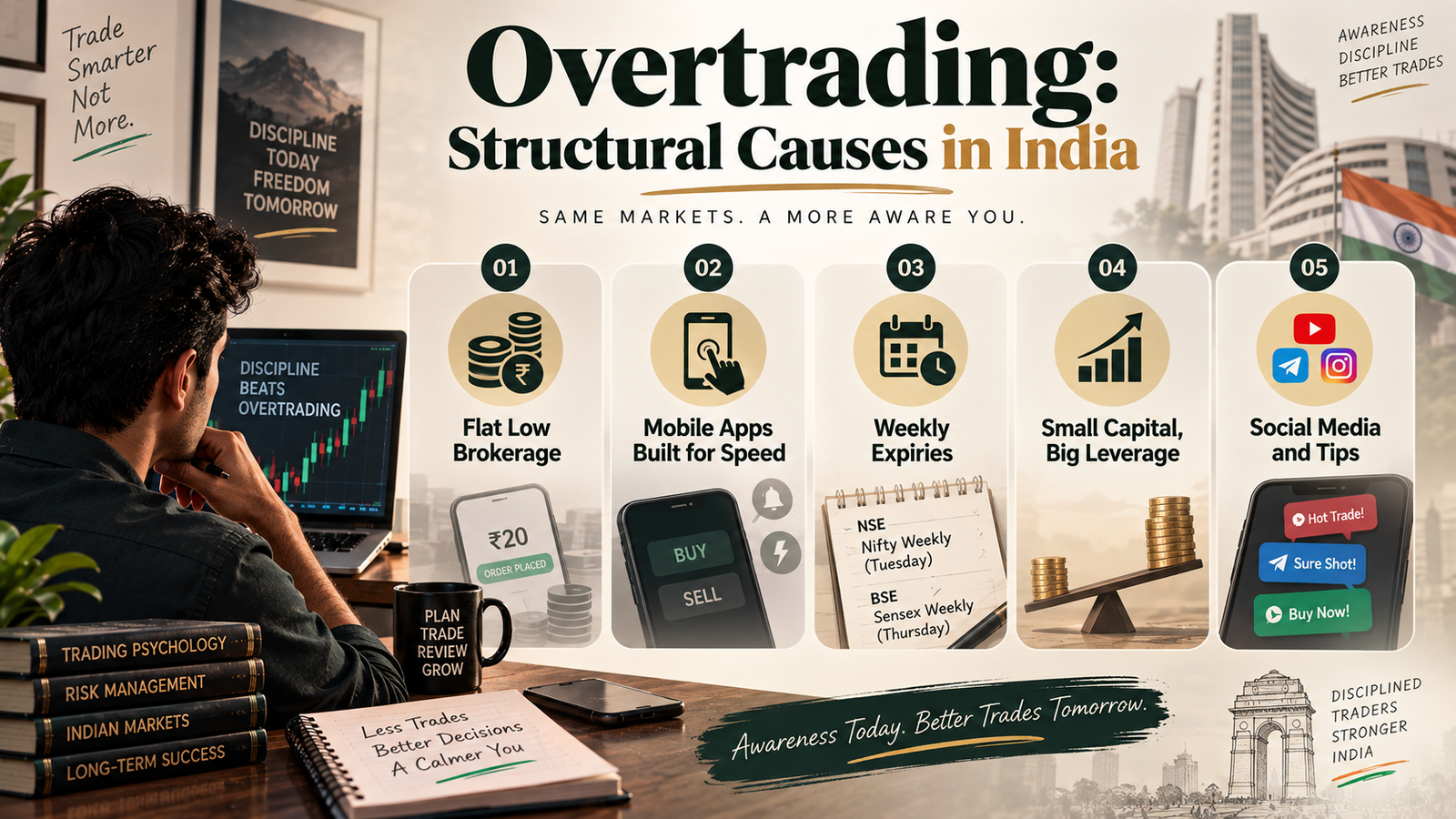
These structural factors don’t cause overtrading on their own. They lower the friction, so any psychological urge turns into a trade within seconds.
What does overtrading really cost?
Every trade pays charges whether it wins or loses. Frequent trading also produces more emotional, lower-quality trades. Both costs grow with every extra click.
Charges on F&O trades in India (as of September 2026)
| Charge | Futures | Options |
|---|---|---|
| STT (from 1 April 2026) | 0.05% on sell side | 0.15% of premium on sell side |
| NSE transaction charge (from 1 March 2026) | 0.00183% of turnover | 0.03553% of premium |
| Stamp duty | 0.002% on buy side | 0.003% on buy side |
| SEBI fee | ₹10 per crore | ₹10 per crore |
| GST | 18% on brokerage + exchange + SEBI charges | Same |
| Brokerage | Varies by broker; ₹20 per order is common at discount brokers | Same |
Budget 2026 raised STT on futures from 0.02% to 0.05% and on options premium from 0.10% to 0.15%, effective 1 April 2026. STT is charged on every sale, whether you make a profit or a loss.
Worked example 1: one Nifty option round trip (illustrative)
Buy 1 lot (65 units) of a Nifty option at ₹100, sell at ₹105. Assumes ₹20 brokerage per order.
| Item | Amount |
|---|---|
| Gross profit (₹5 × 65) | ₹325.00 |
| Brokerage (2 orders) | ₹40.00 |
| STT (0.15% of ₹6,825 sell value) | ₹10.24 |
| NSE transaction charge | ₹4.73 |
| Stamp duty | ₹0.20 |
| SEBI fee | ₹0.01 |
| GST | ₹8.05 |
| Total charges | ₹63.23 |
| Net profit | ₹261.77 |
Charges took about 19% of the gross profit. A trader doing 10 such round trips a day pays about ₹632 a day, or roughly ₹12,650 a month over 20 trading days, even if half the trades are losers.
Worked example 2: one Nifty futures round trip (illustrative)
Buy and sell 1 lot of Nifty futures at about 25,000 (contract value about ₹16.25 lakh). Total charges come to about ₹966, mostly STT (₹812.50). That equals about 15 Nifty points. The market must move 15 points in your favour just to break even on each round trip.
What SEBI’s data shows
| SEBI finding | What it suggests about overtrading |
|---|---|
| FY23 intraday study: loss-makers made more trades on average than profit-makers | More trades did not mean more profit |
| FY23 intraday study: 80% of “very frequent” traders (500+ trades a year) lost money, vs about 70% overall | The most active traders fared worst |
| FY24 F&O study: individual traders spent about ₹26,000 each on transaction costs on average | Costs are a large, steady drain |
| FY22–FY24: individual F&O traders paid about ₹50,000 crore in transaction costs | The combined cost of frequent trading is huge |
Charges are only the visible cost. The hidden cost is lower decision quality: the 12th trade of the day is rarely as well planned as the first.
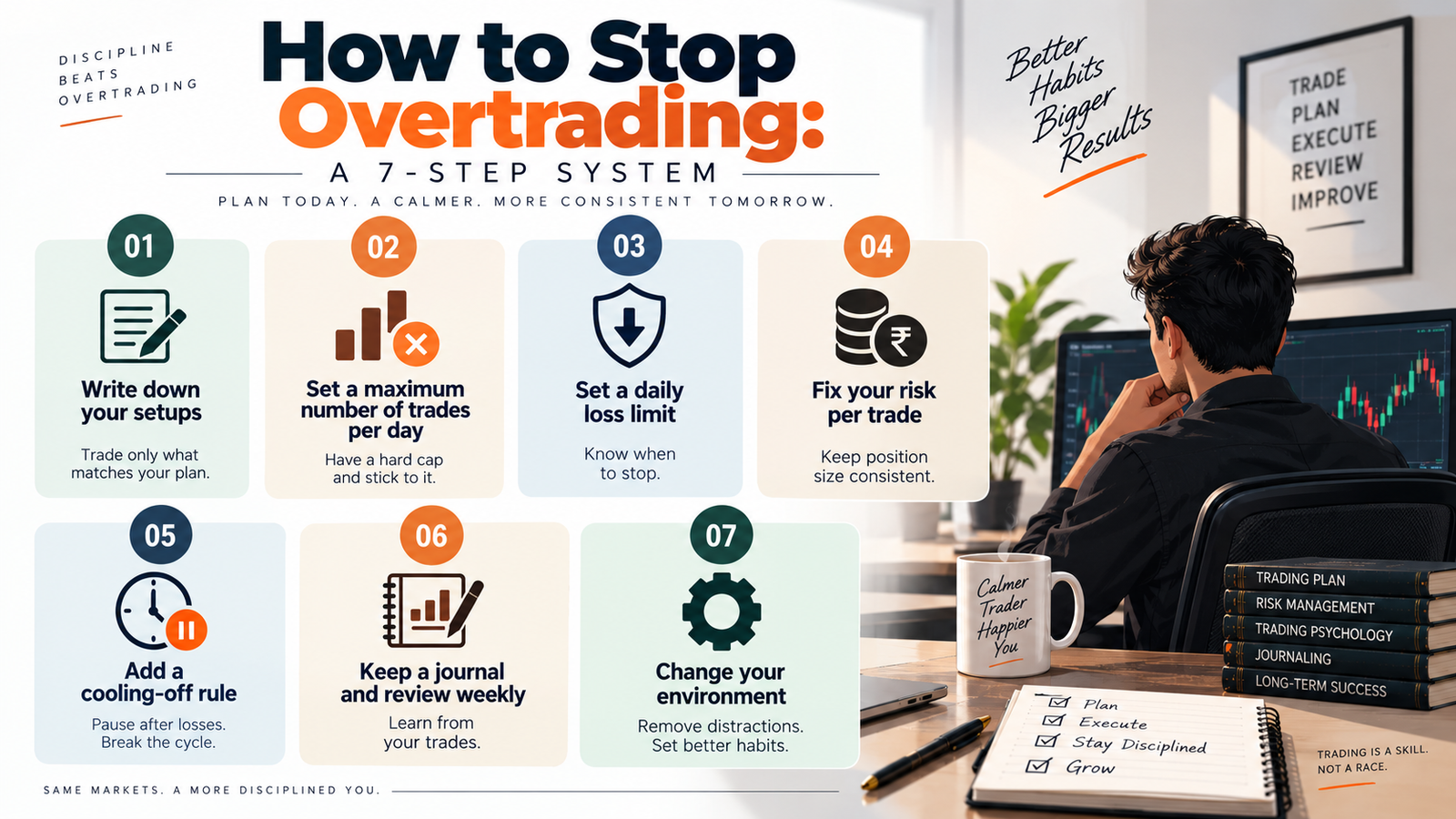
How to stop overtrading: a 7-step system
The fix is to make trading decisions once, when you are calm, and then follow them mechanically during market hours.
Step 1: Write down your setups
List the exact conditions for each trade you take: instrument, time window, entry trigger, stop-loss and target. If a trade doesn’t match a written setup, you don’t take it. For most beginners, one or two setups is enough.
Step 2: Set a maximum number of trades per day
Pick a hard cap, for example 3 trades a day, based on how many valid setups your plan usually produces. Once you hit it, you are done for the day, even if you are in profit.
| Trades per day | Round trips a month (20 days) | Charges a month at ₹63 each (option example) |
|---|---|---|
| 3 | 60 | about ₹3,800 |
| 10 | 200 | about ₹12,650 |
| 20 | 400 | about ₹25,300 |
Cutting from 10 trades a day to 3 saves about ₹8,850 a month in charges alone, before counting fewer impulse losses.
Step 3: Set a daily loss limit
Decide in advance how much you can lose in a day, commonly 2% of capital (₹2,000 on ₹1 lakh). When you hit it, close the app. This is the single most effective defence against revenge trading.
Step 4: Fix your risk per trade
Risk the same small share of capital on every trade, typically 1% for beginners.
Position size = (capital × risk %) ÷ risk per unit
On ₹1 lakh with 1% risk (₹1,000) and a ₹5 stop on an option premium: ₹1,000 ÷ (₹5 × 65) = 3.07, so you trade 3 lots at most. Fixed risk stops size creeping up after wins.
Step 5: Add a cooling-off rule
After two consecutive losses, stop for at least 30 minutes, or for the rest of the session. After any trade, wait a fixed time, such as 15 minutes, before the next entry. The pause breaks the loss-then-rush cycle.
Step 6: Keep a journal and review weekly
For each trade note the setup, entry, exit, P&L, charges and why you took it. Tag each one “planned” or “unplanned.” At the weekend, total the P&L and charges of unplanned trades separately. Most overtraders find their unplanned trades lose money as a group.
| Weekly review question | What to look for |
|---|---|
| How many trades were unplanned? | Anything above zero is a leak |
| What did unplanned trades earn after charges? | Usually negative |
| When did unplanned trades happen? | After losses, near expiry, or late in the session |
| What share of gross profit went to charges? | Rising share = trading too often |
Step 7: Change your environment
- Trade from a laptop at set times instead of from your phone all day.
- Turn off price alerts and push notifications you don’t need.
- Leave Telegram and tip groups that push constant trade ideas.
- Place stop-loss and target orders with your entry, so there is nothing to watch.
- Plan specific rules for expiry days, or avoid trading them until your process is stable.
Pre-trade checklist
- This trade matches a written setup.
- I am under my trade cap for today.
- I am under my daily loss limit.
- My size fits my fixed risk per trade.
- My stop-loss and target are set before entry.
- I am not trying to win back a previous loss.
Learn more about fear and greed in trading
Expert analysis
Fact: SEBI’s FY23 intraday study found that loss-makers made more trades on average than profit-makers, and 80% of very frequent traders lost money.
Fact: from 1 April 2026, STT on futures sales rose to 0.05% and on options premium to 0.15%. Every extra round trip now costs more than it did a year ago.
Analysis: overtrading hurts twice. The first cost is mechanical: charges that are paid on every trade, win or lose. The second is behavioural: trades taken out of boredom, FOMO or revenge are usually lower quality than planned ones. A cap on trades attacks both at once.
Analysis: the regulatory direction is clear. SEBI cut weekly index expiries to one per exchange in November 2024, minimum index contract sizes were raised, and STT was increased in 2024 and again in 2026. Each step raises the cost or friction of high-frequency retail trading. A strategy that only works with many small trades is getting harder to run profitably.
Opinion: for most beginners, the best trade of the day is often no trade at all. Waiting for a setup you have written down is a skill, not a missed opportunity.
Common mistakes
- Setting a trade cap but raising it “just for today.”
- Counting only brokerage and ignoring STT, exchange charges and GST.
- Trading near-expiry options all day because premiums look cheap.
- Treating a green day as a reason to keep trading instead of stopping.
- Switching from one strategy to another after every losing day.
- Keeping the trading app on your phone’s home screen during work or study hours.
Myths vs facts
| Myth | Fact |
|---|---|
| More trades mean more chances to make money | SEBI found loss-makers traded more than profit-makers |
| With ₹20 brokerage, trading is almost free | STT, exchange charges, stamp duty and GST add up; one Nifty futures round trip costs about 15 points |
| Professionals trade all day | Many professionals trade rarely and only on their own setups |
| If I stop after a loss, I’ll miss the recovery | Revenge trades after a loss are usually the weakest trades of the day |
| Overtrading only means too many trades | Taking positions too large for your capital is also overtrading |
Key takeaways
- Overtrading means trading more often or in bigger size than your plan justifies.
- The main causes are revenge trading, FOMO, overconfidence and boredom, made easier by apps and weekly expiries.
- From April 2026, STT is 0.05% on futures sales and 0.15% on options premium.
- One illustrative Nifty option round trip costs about ₹63; ten a day is about ₹12,650 a month.
- A Nifty futures round trip costs about ₹966, or roughly 15 points, before any profit.
- A daily trade cap, a daily loss limit and fixed risk per trade are the core fixes.
- A journal that tags trades as planned or unplanned shows exactly what overtrading costs you.
FAQs
1. What is overtrading?
Overtrading is taking more trades, or bigger positions, than your trading plan and capital justify. It is usually driven by emotion rather than a valid setup.
2. How do I stop overtrading?
Set a maximum number of trades per day, a daily loss limit and a fixed risk per trade. Only take setups written in your plan, and journal every trade.
3. How many trades per day is too many?
There is no universal number. It is too many when you take trades outside your plan. For most beginners, a cap of two to three trades a day works well.
4. What are the signs of overtrading?
Trading outside your plan, feeling restless without a position, trading more after losses, charges eating a large share of profit, and a falling win rate as trade count rises.
5. Why do I overtrade after a loss?
Loss aversion and the urge to get even quickly lead to revenge trading. A daily loss limit and a cooling-off rule after two losses break this cycle.
6. Is overtrading the same as revenge trading?
Revenge trading is one cause of overtrading. Overtrading also comes from FOMO, boredom and overconfidence after wins.
7. How much does overtrading cost in India?
In an illustrative example, one Nifty option round trip costs about ₹63 in charges. Ten a day adds up to about ₹12,650 a month, win or lose.
8. How much does a Nifty futures round trip cost?
At a Nifty level near 25,000, one lot costs about ₹966 in total charges, mostly STT. That is roughly 15 Nifty points.
9. What is the STT on F&O in 2026?
From 1 April 2026, STT is 0.05% on the sell side of futures and 0.15% on the sell side of options premium.
10. Does zero or low brokerage cause overtrading?
It lowers the felt cost of each trade, which makes overtrading easier. STT, exchange charges and GST still apply to every trade.
11. Is overtrading worse in options?
It is often more tempting because premiums near expiry look cheap and move fast. Options also carry the highest exchange transaction charges as a share of premium.
12. Does a trading journal help stop overtrading?
Yes. Tagging trades as planned or unplanned and reviewing them weekly shows how much the unplanned trades cost after charges.
13. What is a daily loss limit?
It is a maximum amount you allow yourself to lose in a day, such as 2% of capital. When you hit it, you stop trading until the next session.
14. Can overtrading happen in long-term investing?
Yes. Frequently switching stocks or mutual funds based on news or short-term moves is a form of overtrading, and it adds costs and taxes.
15. Is it bad to take no trades on some days?
No. If no setup in your plan appears, not trading is the correct decision.
16. How long does it take to stop overtrading?
It varies. Most traders see a difference within a few weeks of using a hard trade cap, a loss limit and a weekly journal review.