
Quick answer
Margin in forex is the deposit you put up to open and hold a leveraged position – a good-faith security amount, not a fee. It’s set aside while the trade is open and returned when you close. Understanding what margin is in forex, and terms like free margin and margin call, protects you from forced liquidation.
Introduction
If leverage is the engine of forex trading, margin is the fuel gauge – and misreading it is how traders get their positions closed out from under them. Yet many beginners aren’t sure what margin actually is: a fee? a loss? borrowed money? Getting a clear answer to what is margin in forex is one of the most practical things you can do before risking a rupee, because margin is what stands between you and a forced liquidation.
This guide explains margin from the ground up – what it is, the terms around it, how a margin call happens, and how margins work specifically in India. Figures here were computed and verified. It’s educational information, not investment advice.
What Is Margin in Forex?
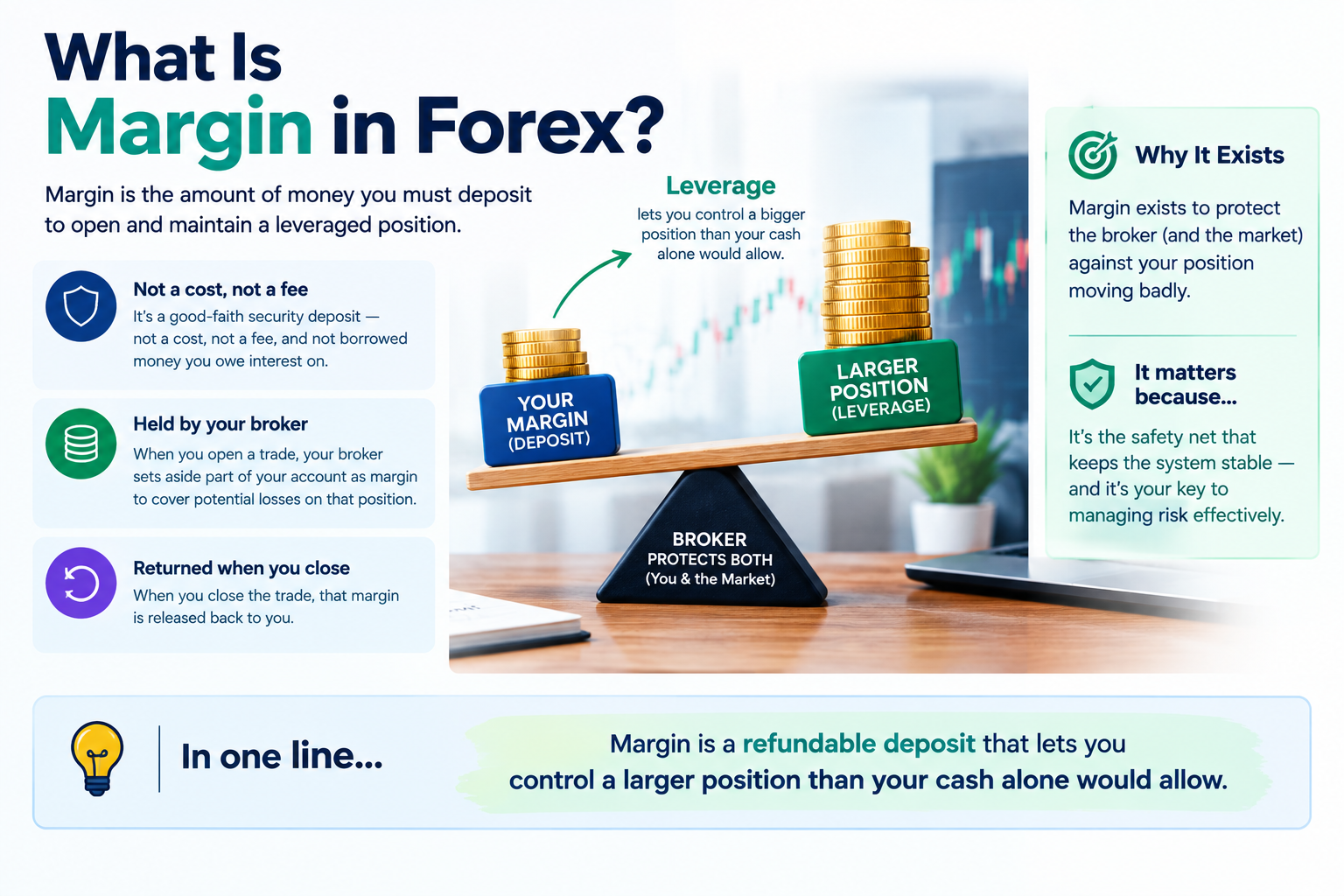
Margin is the amount of money you must deposit to open and maintain a leveraged position. It is a good-faith security deposit – not a cost, not a fee, and not borrowed money you owe interest on. When you open a trade, your broker sets aside part of your account as margin to cover potential losses on that position; when you close the trade, that margin is released back to you.
So the honest one-line answer to what is margin in forex is: it’s a refundable deposit that lets you control a larger position than your cash alone would allow. It exists to protect the broker (and the market) against your position moving badly – which is exactly why it matters so much to you.
Margin Is Not a Fee (a Common Confusion)
This point trips up almost every beginner, so it’s worth stating clearly: margin is not money you spend. Your brokerage, spread and taxes are costs you lose; margin is your own money, temporarily locked. If you deposit Rs 1,00,000 and a trade uses Rs 20,000 of margin, you still have Rs 1,00,000 in equity (assuming no profit or loss yet) – Rs 20,000 is just reserved. Confusing margin with a cost leads traders to badly misjudge how much risk they’re actually carrying.
Margin and Leverage: Two Sides of a Coin
Margin and leverage are inversely linked – one defines the other:
Margin % = 1 / Leverage
1:50 leverage -> 2% margin required
1:100 leverage -> 1% margin required
1:500 leverage -> 0.2% margin required
Higher leverage means a smaller margin controls a bigger position – which is powerful and dangerous in equal measure. (Our separate guide on leverage covers this in depth.)
The Key Margin Terms You Must Know
A handful of terms describe the state of your account. Learn these and margin stops being mysterious:
| Term | What it means |
|---|---|
| Used (required) margin | The portion of your funds locked to hold open positions |
| Equity | Your balance plus or minus unrealised profit/loss on open trades |
| Free (available) margin | Equity minus used margin – what’s left for new trades or losses |
| Margin level | Equity divided by used margin, as a percentage – your safety gauge |
| Margin call | A warning that your margin level has fallen too low |
| Stop-out | The point at which the broker auto-closes positions to protect itself |
Margin Level, Margin Call and Stop-Out
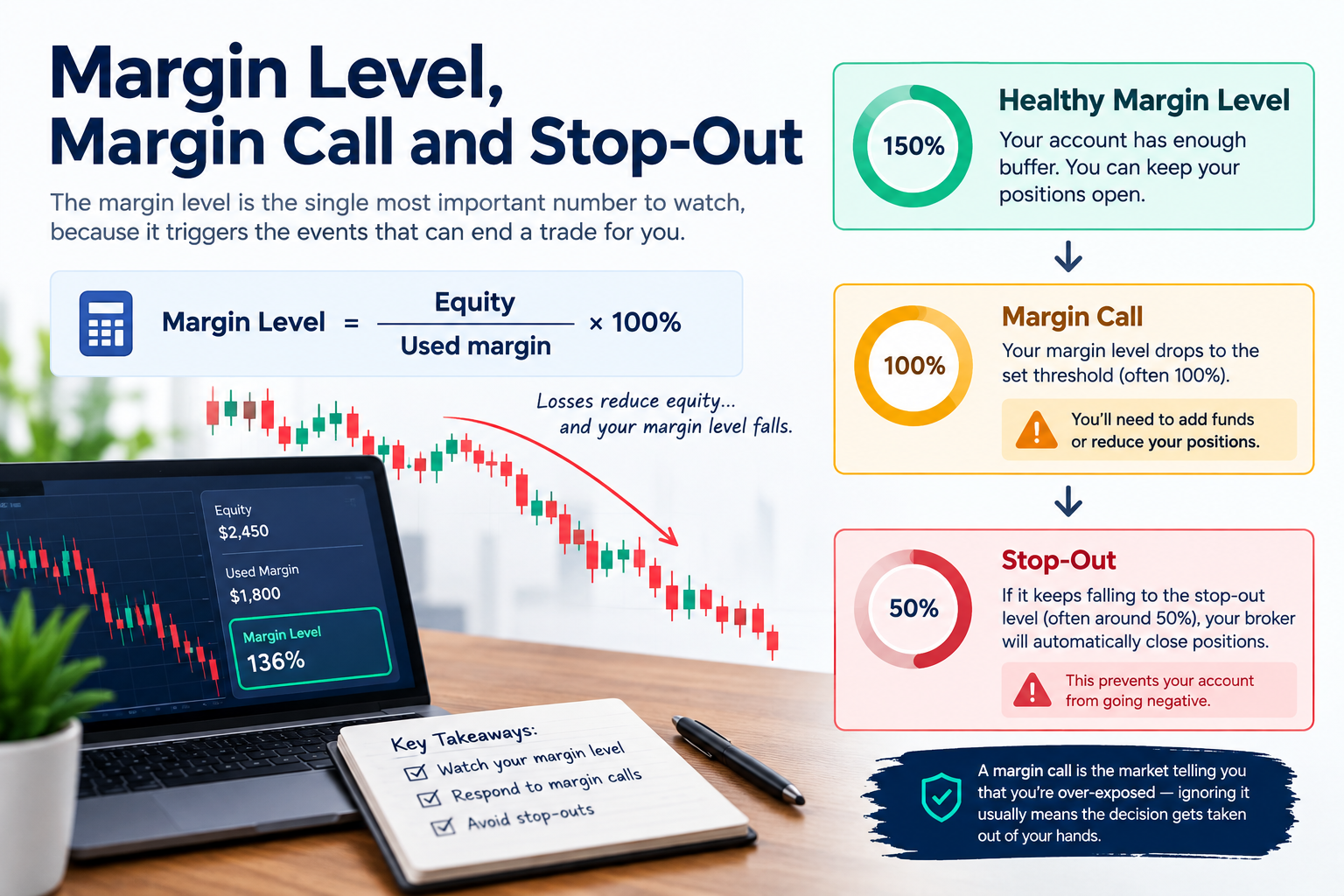
The margin level is the single most important number to watch, because it triggers the events that can end a trade for you:
Margin level = (Equity / Used margin) x 100%
As your open trades lose money, your equity falls, and so does your margin level. When it drops to a set threshold (often 100%), you get a margin call – a warning to add funds or reduce positions. If it keeps falling to the stop-out level (often around 50%), the broker automatically closes positions to stop your account going negative. A margin call is the market telling you that you’re over-exposed – ignoring it usually means the decision gets taken out of your hands.
A Worked Example
Numbers make this concrete. Say you have a balance of Rs 1,00,000 and open a position that uses Rs 20,000 of margin:
Balance: Rs 1,00,000
Used margin: Rs 20,000
If the trade is down Rs 10,000:
Equity = 1,00,000 – 10,000 = Rs 90,000
Free margin = 90,000 – 20,000 = Rs 70,000
Margin level = 90,000 / 20,000 = 450% (healthy)
If losses grow to Rs 80,000:
Equity = Rs 20,000
Margin level = 20,000 / 20,000 = 100% (margin call)
At 450% the position is comfortable; at 100% you’re at a margin call, with a stop-out not far below. Watching free margin and margin level – not just profit and loss – is what keeps you in control. (Illustrative figures.)
How Margin Works in India
On Indian exchanges, margin isn’t a number a broker invents – it’s set by the exchange’s risk model and collected in full, upfront. For currency (and equity) derivatives, the initial margin has two parts:
- SPAN margin – the core initial margin, calculated to cover the worst-case one-day move in the position (a value-at-risk approach).
- Exposure margin – an additional buffer on top of SPAN, for extra safety.
Together these form the total initial margin. Under SEBI’s Peak Margin framework, brokers must collect this full margin before you trade and hold it at all times, verified by random intraday snapshots – so the old practice of tiny intraday margins is gone. You’ll also face mark-to-market (MTM) adjustments as prices move, topping up margin when positions lose. The upshot: Indian margins are conservative and strictly enforced, which is protective even when it feels restrictive.
How to Avoid a Margin Call
- Keep plenty of free margin – don’t deploy most of your capital into used margin; leave a cushion.
- Size positions small – risk a fixed small percentage per trade, not the maximum the margin allows.
- Always use a stop-loss – it caps a losing trade before it can drain your margin level.
- Watch your margin level – treat it, not just P&L, as your key risk gauge.
- Avoid over-leveraging – the more leverage, the thinner your margin buffer against normal swings.
Common Mistakes
- Thinking margin is a fee you’ve spent, and misjudging real risk.
- Using nearly all your capital as margin, leaving no cushion.
- Ignoring the margin level until a margin call arrives.
- Adding funds to hold a losing trade instead of cutting it.
- Trading without a stop-loss, so one trade can trigger a stop-out.
Learn more about How to Read a Forex Quote
Myths vs Facts
| Myth | Fact |
|---|---|
| Margin is a fee you pay to trade. | It’s a refundable deposit that’s released when you close the trade. |
| A margin call means you owe extra money as a charge. | It’s a warning to add funds or reduce positions, not a fee. |
| More margin used means more profit. | It means more exposure and less cushion – and more risk. |
| Indian brokers can set any margin they like. | Margins are set by exchange risk models and collected fully upfront. |
Risk disclaimer
This article is for educational purposes only and is not investment advice. Trading on margin greatly increases risk, and you can lose more than you expect. Margin and margin-call thresholds vary by broker and instrument, and Indian margin rules are set by SEBI and the exchanges and change over time. Verify current margins and stop-out policies with your broker, and consult a qualified professional before trading.
Expert Analysis
The reason margin deserves as much attention as strategy is that it governs survival, not profit. A trader can be right about direction and still be closed out at a loss if their margin level collapses during a temporary swing against them – the position is liquidated before the market comes back. This is why experienced traders watch free margin and margin level the way a pilot watches fuel: not because they expect to run out, but because running out ends the flight regardless of where you were heading. Understanding what margin is in forex, and building a habit of leaving a generous margin cushion, is therefore less about mechanics and more about staying in the game long enough for a plan to work.
India’s margin framework, strict as it is, quietly protects retail traders from their own worst instincts. By forcing full, upfront margin and eliminating flimsy intraday leverage, the Peak Margin rules make it far harder to build the kind of over-extended position that a single volatile session can wipe out. For the individual, the smartest posture is to treat those rules as a floor and add your own ceiling on top: use only a fraction of your available margin, size to a stop-loss rather than to the margin limit, and regard a healthy margin level as a core discipline rather than an afterthought. Margin is not the boring cousin of leverage – it is the number that decides whether you get to keep trading tomorrow.
Key Takeaways
- Margin is a refundable deposit to open a leveraged position – not a fee or borrowed money.
- It’s inversely linked to leverage: margin % = 1 / leverage.
- Watch used margin, free margin, equity and especially margin level.
- A margin call warns you; a stop-out auto-closes positions – avoid both by keeping a cushion.
- In India, margins (SPAN + exposure) are exchange-set and collected fully upfront.
Frequently Asked Questions (FAQ)
Q: What is margin in forex trading?
A: It’s the deposit you put up to open and hold a leveraged position – a refundable good-faith amount set aside while the trade is open, not a fee.
Q: Is margin a fee or a cost?
A: No. Margin is your own money, temporarily locked to hold a position, and released when you close it. Brokerage and taxes are the real costs.
Q: What is the difference between used and free margin?
A: Used margin is locked to hold open positions; free margin is your equity minus used margin – what’s available for new trades or to absorb losses.
Q: What is equity in a trading account?
A: Your account balance plus or minus the unrealised profit or loss on your open positions.
Q: What is margin level?
A: Equity divided by used margin, shown as a percentage. It’s your key safety gauge; a falling level signals rising risk.
Q: What is a margin call?
A: A warning that your margin level has dropped too low, asking you to add funds or reduce positions before a stop-out occurs.
Q: What is a stop-out?
A: The level at which the broker automatically closes positions to prevent your account going negative, often around a 50% margin level.
Q: How is margin related to leverage?
A: Inversely: margin percentage equals one divided by leverage. 1:100 leverage requires 1% margin; 1:50 requires 2%.
Q: How is margin calculated in India?
A: For exchange derivatives it’s SPAN plus exposure margin, set by the exchange’s risk model and collected fully upfront under SEBI’s Peak Margin rules.
Q: What is SPAN margin?
A: The core initial margin, calculated to cover the worst-case one-day move in your position using a value-at-risk approach.
Q: What is mark-to-market (MTM) margin?
A: Daily adjustments that require you to top up margin as open positions lose value, based on the latest market price.
Q: Can I lose more than my margin?
A: In some setups losses can exceed the initial margin, which is why MTM top-ups and stop-outs exist; never treat margin as your maximum loss.
Q: How do I avoid a margin call?
A: Keep plenty of free margin, size positions small, use a stop-loss, and watch your margin level rather than just profit and loss.
Q: Does using more margin increase profit?
A: No. It increases exposure and reduces your cushion, which raises risk – it doesn’t improve your edge.
Q: Is trading on margin risky?
A: Yes. Margin enables leverage, which magnifies losses; disciplined position sizing and risk control are essential.