Introduction
Most traders track their profits and losses closely, but many forget about the costs that sit behind every trade: brokerage, data subscriptions, internet bills, a laptop, a second monitor. If your trading counts as a business, many of these costs can reduce your taxable income.
Understanding trading expenses tax deduction rules can make a meaningful difference to how much tax you pay. It can also increase the loss you are able to carry forward in a bad year. But the rules depend on how your trading income is classified, and claiming the wrong items can invite questions from the tax department.
This guide explains:
- When trading expenses are deductible and when they are not
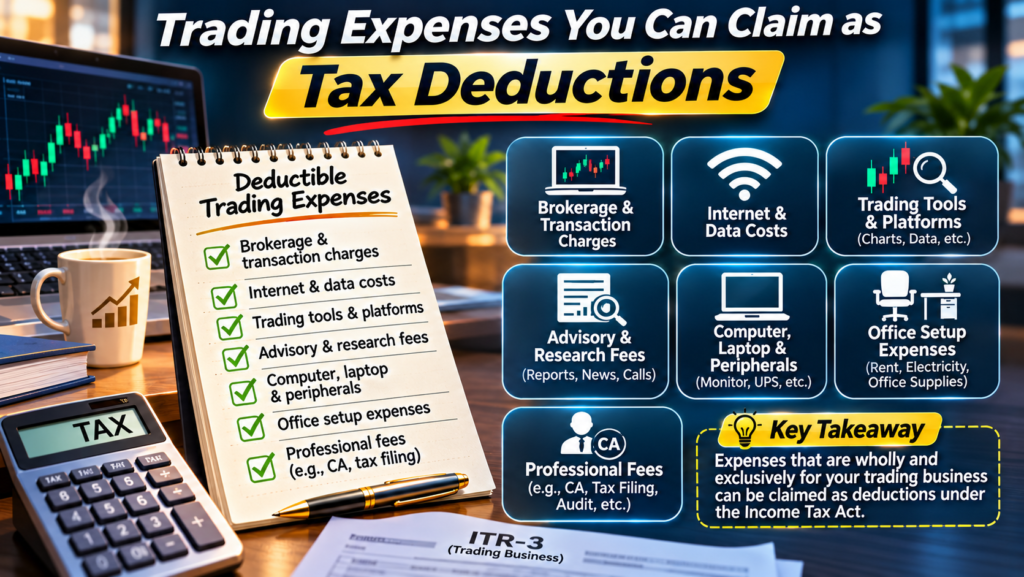
- Which expenses Indian traders can usually claim
- What cannot be claimed
- How depreciation, STT and GST are treated
- A worked example, record-keeping tips and common mistakes
Why Income Classification Matters for a Trading Expenses Tax Deduction
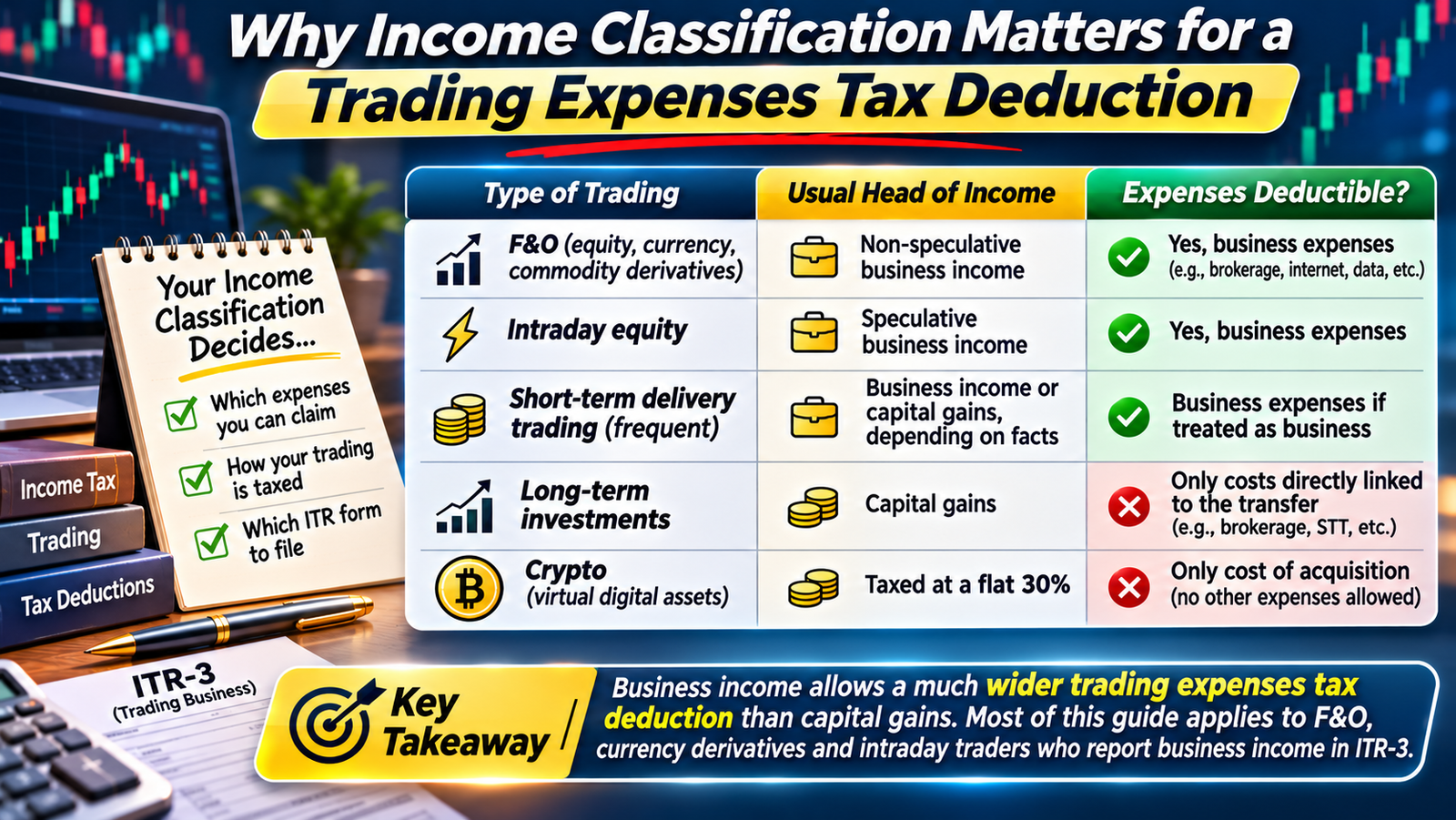
Whether you can claim a trading expenses tax deduction depends first on the head of income your trading falls under:
| Type of trading | Usual head of income | Expenses deductible? |
|---|---|---|
| F&O (equity, currency, commodity derivatives) | Non-speculative business income | Yes, business expenses |
| Intraday equity | Speculative business income | Yes, business expenses |
| Short-term delivery trading (frequent) | Business income or capital gains, depending on facts | Business expenses if treated as business |
| Long-term investments | Capital gains | Only costs directly linked to the transfer |
| Crypto (virtual digital assets) | Taxed at a flat 30% | Only cost of acquisition |
The key point is that business income allows a much wider trading expenses tax deduction than capital gains. Most of this guide therefore applies to F&O, currency derivatives and intraday traders who report business income in ITR-3.
The Basic Rule for Business Expenses
For business income, an expense is generally deductible if it is:
- Incurred wholly and exclusively for the trading business
- Not capital in nature (capital assets are handled through depreciation instead)
- Not a personal expense
- Supported by evidence, such as invoices, contract notes or bank statements
Every trading expenses tax deduction you claim should pass this test. If an expense is partly personal, such as a home internet connection used by the whole family, claim only a reasonable business share.
Trading Expenses Tax Deduction: What You Can Usually Claim
1. Brokerage and transaction charges
Brokerage, exchange transaction charges, SEBI turnover fees, clearing charges and stamp duty shown on your contract notes are direct costs of trading and are usually deductible.
2. Securities Transaction Tax (STT)
When trading income is taxed as business income, STT paid on those transactions can generally be claimed as a deduction (under section 36(1)(xv) of the 1961 Act). This is one of the largest items for active F&O traders. Currency derivatives do not attract STT.
3. GST on charges
GST charged on brokerage and exchange fees is part of your trading cost. Individual traders who are not registered for GST can usually include it in their expenses.
4. Internet and phone
A reasonable share of internet and mobile bills used for trading can be claimed. Keep bills and be ready to explain the proportion.
5. Data, charting and software subscriptions
Paid charting platforms, real-time data feeds, trading software, algo platforms and research subscriptions used for trading are commonly claimed.
6. Depreciation on computers and equipment
Laptops, desktops, monitors and other equipment used for trading are capital assets. You cannot claim the full cost in one year, but you can claim depreciation. Under the 1961 Act rules, computers and related hardware attract depreciation at 40% a year on the written-down value, with half the rate if the asset is used for less than 180 days in the year of purchase.
7. Office rent and electricity
If you rent a separate office for trading, the rent and electricity are deductible. If you trade from home, a modest, reasonable share may be claimable, but this is often scrutinised, so take advice.
8. Professional fees
Fees paid to a chartered accountant for accounting, tax audit or return filing related to the trading business are usually deductible.
9. Demat and trading account charges
Annual maintenance charges and other account-related fees can be claimed as part of the trading expenses tax deduction.
10. Interest on borrowed funds
Interest on a loan taken specifically for trading capital can generally be claimed, provided you can show the link between the borrowing and the trading business.
11. Salaries and payments to staff
If you employ someone to help with trading operations or research, their salary is deductible. Remember any TDS obligations that may apply.
12. Books, courses and seminars
Trading books, courses and seminars are sometimes claimed. Courses taken before you start trading, or general education, are more likely to be questioned. Claim only costs that clearly relate to your existing trading business.
Trading Expenses Tax Deduction: What You Cannot Claim
- Personal expenses: Household bills, personal travel or family phone plans unrelated to trading.
- Income tax itself: Income tax paid is never deductible.
- Penalties and fines: Penalties for breaking laws or regulations are not allowed.
- Full cost of capital assets in one year: Laptops and furniture must be depreciated.
- Expenses without proof: Cash payments with no bills, or estimated costs, are risky.
- Crypto expenses: For crypto taxed at the flat 30% rate, only the cost of acquisition is allowed. Fees, internet and similar costs cannot be deducted.
- STT on capital gains: When income is taxed as capital gains, STT is not deductible.
Trading Expenses Tax Deduction Under Capital Gains
If your trades are taxed as capital gains, for example long-term delivery investments, the trading expenses tax deduction is much narrower. You can generally include only costs directly connected with buying or selling, such as brokerage and certain transaction charges, in the cost of acquisition or the cost of transfer. Subscriptions, internet, depreciation and other overheads are not allowed against capital gains.
This difference is one reason active traders often prefer to report frequent trading as business income, though classification must reflect the facts and should be consistent from year to year.
Presumptive Taxation and Expenses
Some traders consider the presumptive scheme (section 44AD under the 1961 Act), which deems a fixed percentage of turnover as profit. If you opt for it, the deemed profit is treated as covering all expenses, so you cannot claim any separate trading expenses tax deduction.
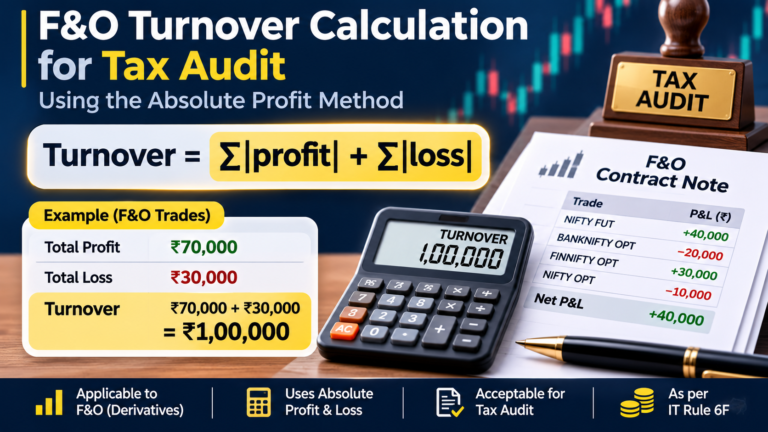
The scheme also has lock-in conditions, and opting out within the lock-in period can trigger a tax audit. Because F&O turnover is usually small (it is calculated as the absolute sum of profits and losses), presumptive taxation often does not suit traders, especially those with losses. Discuss it with your chartered accountant before choosing.
Worked Example of a Trading Expenses Tax Deduction
Suppose an F&O trader has the following figures for a financial year:
| Item | Amount |
|---|---|
| Gross trading profit (before charges) | ₹6,00,000 |
| Brokerage, exchange charges, stamp duty and GST | ₹45,000 |
| STT | ₹35,000 |
| Charting and data subscriptions | ₹18,000 |
| Internet (business share) | ₹9,000 |
| Depreciation on a ₹90,000 laptop bought in April (40%) | ₹36,000 |
| CA fees | ₹12,000 |
| Total expenses | ₹1,55,000 |
| Taxable business income | ₹4,45,000 |
By claiming ₹1.55 lakh of legitimate expenses, the trader reduces taxable trading income from ₹6 lakh to ₹4.45 lakh. If the trader is in a 20% slab, that saves around ₹31,000 plus cess. If the year had ended in a loss instead, the expenses would have increased the loss available to carry forward.
This example is illustrative and simplified. Actual tax depends on total income, the tax regime chosen and individual circumstances.

Speculative vs Non-Speculative Expenses
If you trade both intraday equity (speculative) and F&O (non-speculative), allocate expenses between the two businesses:
- Direct costs, such as brokerage and STT, belong to the segment where they were incurred.
- Common costs, such as internet, software and depreciation, can be split on a reasonable basis, for example in proportion to turnover or time spent.
Correct allocation matters because speculative losses can be set off only against speculative income and carried forward for up to 4 years, while non-speculative losses can be set off against other non-salary income and carried forward for up to 8 years. Keep a short note of the method you used to split shared costs, so your trading expenses tax deduction is consistent from one year to the next and easy to explain if questioned.
Record-Keeping for Your Trading Expenses Tax Deduction
Good records make every trading expenses tax deduction easier to defend:
- Download contract notes and the annual tax P&L report from your broker.
- Keep invoices for subscriptions, equipment, internet and professional fees.
- Pay business expenses digitally, ideally from one bank account used for trading.
- Maintain a simple expense register or spreadsheet, with date, vendor, amount and purpose.
- Keep a fixed asset register for computers and equipment, showing depreciation each year.
- Retain records for the period required by law, in case of scrutiny.
Depending on your income and turnover, you may also be required to maintain formal books of account. Ask your CA whether this applies to you.
Common Trading Expenses Tax Deduction Mistakes
- Claiming personal costs: Family holidays, personal phones or household bills invite disallowance.
- Claiming 100% of shared costs: Home internet or electricity should be apportioned.
- Expensing a laptop in full: Capital items must be depreciated.
- Deducting STT against capital gains: STT is deductible only for business income.
- Opting for presumptive taxation and still claiming expenses: The two cannot be combined.
- No documentation: Claims without bills are hard to defend.
- Changing classification every year: Switching between business and capital gains without a basis can attract scrutiny.
- Missing the filing deadline: Business losses, including those increased by expenses, can be carried forward only if the return is filed on time.
Trading Expenses Tax Deduction Checklist
- Is my trading income reported as business income?
- Have I collected contract notes and the broker’s tax P&L?
- Have I listed brokerage, charges, STT and GST?
- Have I kept invoices for subscriptions, internet and professional fees?
- Have I calculated depreciation on equipment correctly?
- Have I apportioned shared and personal costs reasonably?
- Have I split expenses between speculative and non-speculative income?
- Have I confirmed with my CA whether presumptive taxation, books of account or tax audit rules apply?
FAQs
Can I claim a trading expenses tax deduction for F&O trading?
Yes. F&O income is usually treated as non-speculative business income, so legitimate business expenses such as brokerage, STT, data subscriptions, internet and depreciation can generally be claimed.
Is STT deductible?
Yes, when the related income is taxed as business income. It is not deductible against capital gains.
Can I claim my laptop as an expense?
Not in full in one year. You can claim depreciation, typically 40% a year for computers under the older rules, on the portion used for trading.
Can I claim expenses if I made a loss?
Yes. Expenses increase your business loss, which can be carried forward if you file your return on time.
How much can a trading expenses tax deduction save me?
It depends on your expenses and tax slab. Every ₹1,000 of genuine expenses reduces taxable business income by ₹1,000, so the saving equals your expenses multiplied by your marginal tax rate, plus cess.
Can I claim expenses against crypto profits?
No. Crypto gains are taxed at a flat 30%, and only the cost of acquisition is deductible.
Conclusion
A well-documented trading expenses tax deduction can significantly reduce the tax on your trading profits, or increase the losses you can carry forward. The essentials are simple: report active trading correctly as business income, claim only costs incurred for trading, depreciate capital assets, apportion shared expenses fairly and keep every invoice and contract note.
Because classification, presumptive taxation and audit rules interact in complex ways, review your position each year with a chartered accountant who understands trading income.