
Introduction
Forex and crypto are two of the most talked-about markets for new traders. Both trade around the clock or close to it, both move on global news and both promise big opportunities. But they are very different in size, behaviour, regulation and, for Indian traders especially, legal and tax treatment.
The forex vs crypto question is not about which market is “best” in general. It is about which one suits your capital, goals, schedule and tolerance for risk. This guide compares them side by side.
We cover:
- What forex and crypto trading involve
- Key differences in size, liquidity, volatility and hours
- Leverage, costs and risk
- Regulation and tax in India
- Which market suits which kind of trader
What Is Forex Trading?
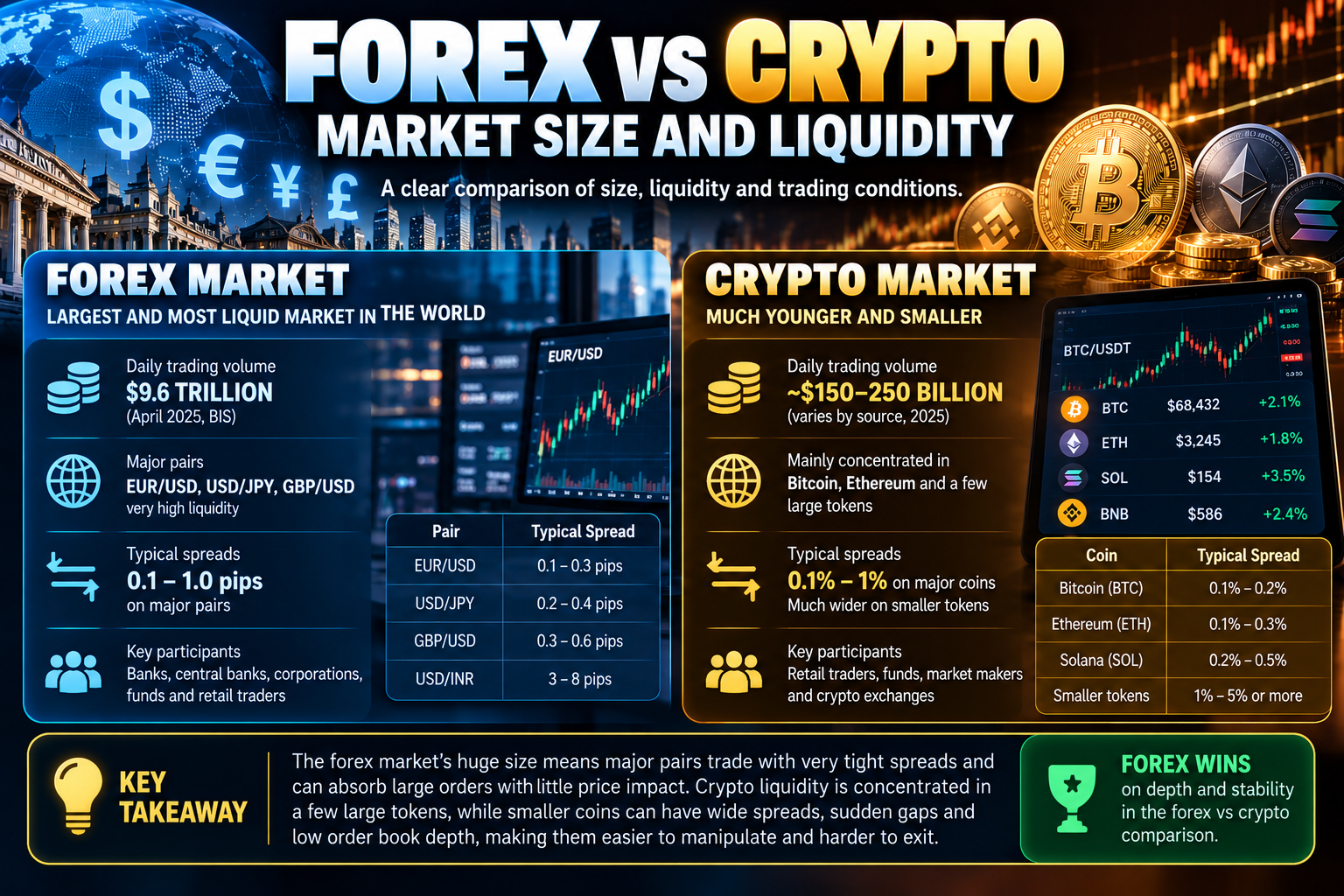
Forex (foreign exchange) trading is buying one currency while selling another, such as EUR/USD or USD/INR. It is the largest financial market in the world. According to the Bank for International Settlements (BIS) Triennial Survey, global FX turnover averaged about $9.6 trillion per day in April 2025.
Currency prices are driven by interest rates, inflation, economic growth, trade flows and central bank policy. Major participants include banks, corporations, central banks and funds.

What Is Crypto Trading?
Crypto trading involves buying and selling digital assets such as Bitcoin, Ethereum and many smaller tokens, either on exchanges or through derivatives. Crypto markets are much younger and smaller than forex, and prices are driven by adoption, sentiment, liquidity flows, regulation, technology developments and speculative interest.
Unlike currencies, most cryptocurrencies have no central bank or government behind them, which contributes to their high volatility.
Forex vs Crypto: Key Differences at a Glance
| Feature | Forex | Crypto |
|---|---|---|
| Market size | About $9.6 trillion daily turnover (BIS, April 2025) | Much smaller, with volume concentrated in a few coins |
| Trading hours | 24 hours, five days a week (globally) | 24 hours, seven days a week |
| Volatility | Major pairs often move under 1% a day | Daily moves of 5% or more are common |
| Liquidity | Very deep in major pairs | Deep in Bitcoin and Ethereum, thin in smaller tokens |
| Price drivers | Interest rates, economic data, central banks | Sentiment, adoption, regulation, flows |
| Regulation | Heavily regulated in most countries | Still developing, varies widely |
| Legal route in India | INR and cross pairs on NSE/BSE via SEBI-registered brokers | Spot trading on exchanges registered with FIU-IND |
| Tax in India | Usually business income at slab rates | Flat 30% plus cess, 1% TDS, no loss set-off |
Forex vs Crypto: Market Size and Liquidity
Liquidity matters because it affects how easily you can enter and exit trades and how much you pay in spreads. The forex market’s huge size means major pairs such as EUR/USD trade with very tight spreads and can absorb large orders with little price impact.
Crypto liquidity is concentrated in Bitcoin, Ethereum and a handful of large tokens. Smaller coins can have wide spreads, sudden gaps and low order book depth, which makes them easier to manipulate and harder to exit in a panic. In the forex vs crypto comparison, forex clearly wins on depth and stability.
Forex vs Crypto Volatility: Opportunity and Risk
Volatility is the biggest attraction of crypto. A 10% move in Bitcoin in a day is not unusual, while a 1% move in EUR/USD is considered large. That can mean bigger profits, but also bigger and faster losses.
Forex volatility is lower and more predictable, often clustered around scheduled events such as central bank decisions and economic releases. Crypto can move sharply on a social media post, an exchange failure or a regulatory headline, sometimes in the middle of the night or on a weekend.
For most traders, the forex vs crypto volatility trade-off comes down to temperament: steadier markets reward patience and leverage discipline, while volatile markets reward fast risk control.
Forex vs Crypto Trading Hours
Global forex trades 24 hours a day from Monday to Friday, moving through the Sydney, Tokyo, London and New York sessions. For Indian traders, NSE currency derivatives on INR pairs trade from 9:00am to 5:00pm IST on weekdays.
Crypto never closes. It trades 24/7, including weekends and holidays. That flexibility suits people with day jobs, but it also means positions can move sharply while you sleep, and there is no weekend break to reset.
Forex vs Crypto Leverage and Margin
Leverage magnifies both profits and losses. In regulated Indian currency futures, margins are set by the exchange and are relatively modest because INR pairs move slowly. Offshore forex brokers advertise very high leverage, but these platforms are not legal for Indian residents.
Crypto derivatives on global platforms can offer very high leverage too. Combined with crypto’s volatility, that can wipe out an account in minutes. In any forex vs crypto decision, leverage is where most beginners lose money, so use it sparingly whichever market you choose.
Forex vs Crypto Trading Costs
| Cost | Forex (NSE currency futures) | Crypto (Indian exchanges) |
|---|---|---|
| Spread | Very tight on USD/INR | Varies; wider on smaller coins |
| Brokerage / fees | Low flat fees at discount brokers | Trading fees per transaction |
| Transaction taxes | No STT on currency derivatives; exchange charges and GST apply | 1% TDS on sale consideration above thresholds |
| Tax on profits | Slab rate, expenses deductible | Flat 30% plus cess, only cost deductible |
The 1% TDS on crypto is a credit against your final tax, but for active traders it ties up capital on every sale.
Forex vs Crypto in India: Regulation
Forex
- Indian residents can trade currency derivatives only on recognised exchanges such as NSE and BSE, through SEBI-registered brokers.
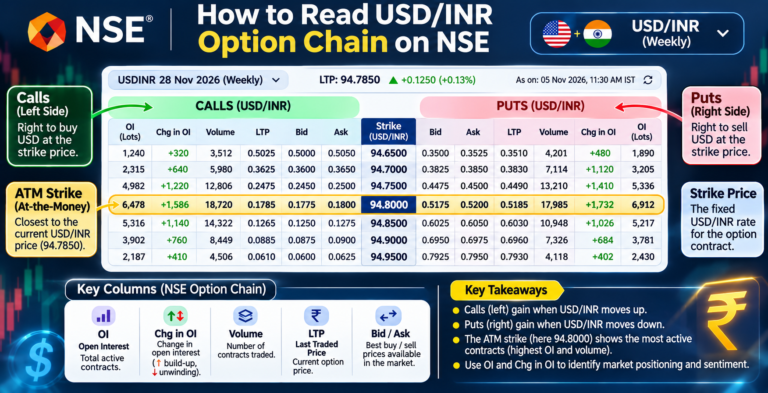
- Permitted pairs include USD/INR, EUR/INR, GBP/INR and JPY/INR, plus cross-currency pairs such as EUR/USD, GBP/USD and USD/JPY.
- Leveraged forex or CFD trading through offshore platforms is not permitted under FEMA. The RBI maintains an Alert List of unauthorised forex trading platforms.
Crypto
- Crypto is not banned in India, but it is not legal tender either, and there is no dedicated regulator for crypto trading as there is for securities.
- Indian crypto exchanges must register with the Financial Intelligence Unit (FIU-IND) for anti-money-laundering compliance.
- Investor protection is weaker than in SEBI-regulated markets, so exchange risk and fraud risk are higher.
From a regulatory point of view, the forex vs crypto comparison favours exchange-traded currency derivatives, which come with exchange guarantees and SEBI oversight.
Forex vs Crypto Tax in India
| Aspect | Currency derivatives (NSE/BSE) | Crypto (VDA) |
|---|---|---|
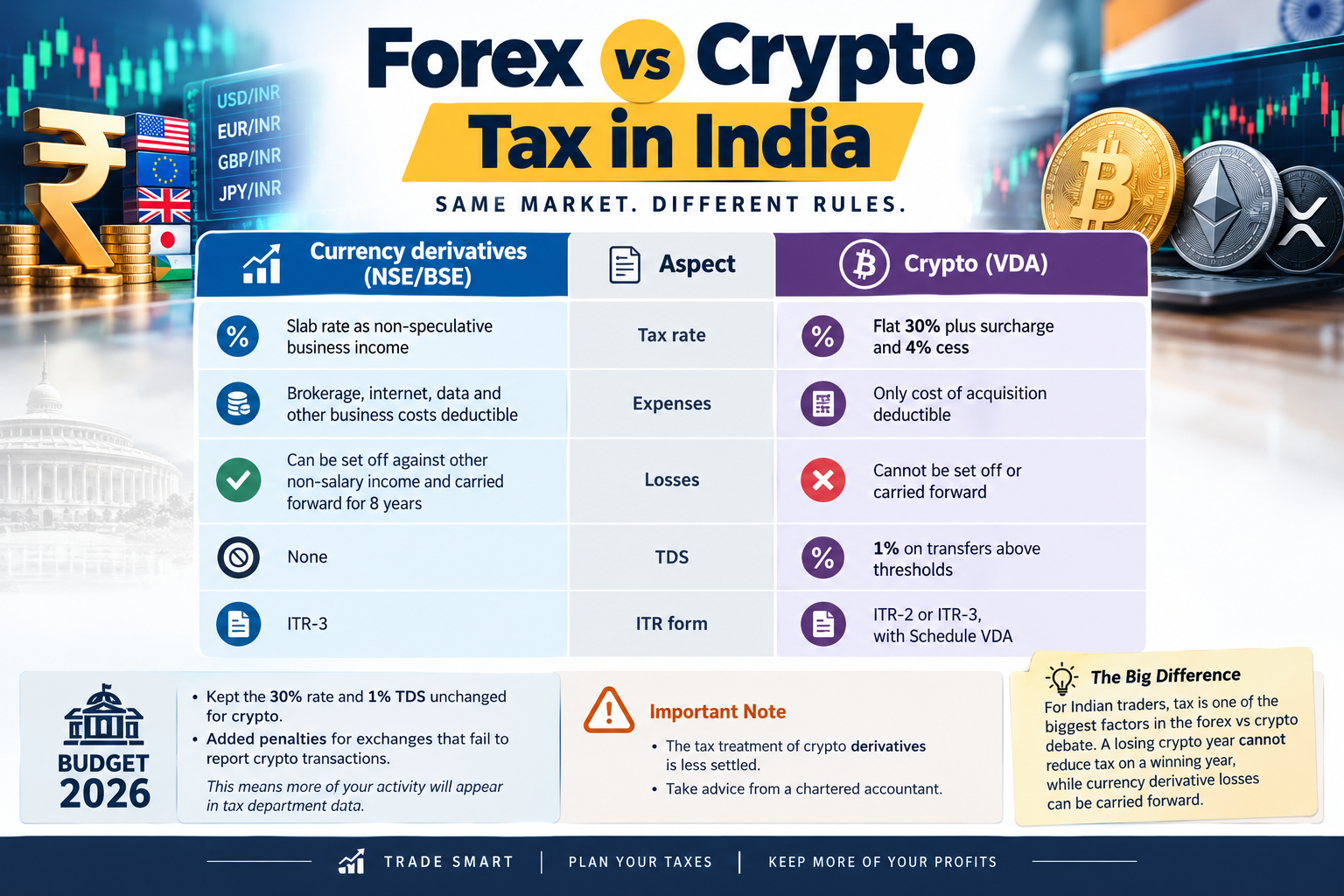
| Tax rate | Slab rate as non-speculative business income | Flat 30% plus surcharge and 4% cess |
| Expenses | Brokerage, internet, data and other business costs deductible | Only cost of acquisition deductible |
| Losses | Can be set off against other non-salary income and carried forward for 8 years | Cannot be set off or carried forward |
| TDS | None | 1% on transfers above thresholds |
| ITR form | ITR-3 | ITR-2 or ITR-3, with Schedule VDA |
Budget 2026 kept the 30% rate and 1% TDS unchanged and added penalties for exchanges that fail to report crypto transactions, which means more of your activity will appear in tax department data. The tax treatment of crypto derivatives is less settled, so take advice from a chartered accountant.
For Indian traders, tax is one of the biggest factors in the forex vs crypto debate. A losing crypto year cannot reduce tax on a winning year, while currency derivative losses can be carried forward.
Worked Example: How Tax Changes the Result
Imagine two traders, each with ₹2,00,000 of gross profit in a year and ₹30,000 of trading-related expenses.
- Currency futures trader: Taxable business income is ₹1,70,000 after expenses, taxed at their slab rate. If they also had a past loss carried forward, it could reduce this further.
- Crypto trader: Expenses other than cost are not deductible, so tax is 30% of ₹2,00,000 = ₹60,000, plus cess. If they also lost ₹50,000 on another coin, that loss cannot be set off.
The exact outcome depends on total income and slab, but the structural difference is clear: crypto is taxed more heavily and less flexibly.
This example is illustrative and simplified. Consult a tax professional for your situation.
Forex vs Crypto Pros and Cons
Forex
- Pros: Deep liquidity, lower volatility, regulated exchange route in India, favourable tax treatment, strong link to economic fundamentals.
- Cons: Limited pairs available legally in India, lower volatility means smaller moves, offshore platforms are off-limits.
Crypto
- Pros: 24/7 trading, high volatility and big potential moves, easy access through apps, wide choice of assets.
- Cons: Heavy tax burden, no loss set-off, exchange and fraud risk, weaker regulation, extreme drawdowns.
Forex vs Crypto: Which Is Better for You?
| If you… | Consider |
|---|---|
| Prefer steady, fundamentals-driven markets | Forex |
| Want regulated exchanges and SEBI oversight | Forex (NSE/BSE currency derivatives) |
| Need tax-efficient trading with loss carry-forward | Forex |
| Can only trade evenings and weekends | Crypto, with small position sizes |
| Have high risk tolerance and want big moves | Crypto, with strict stops |
| Are a complete beginner | Start with a demo account in either, then small size in a regulated market |
There is no universal winner in forex vs crypto. Many traders use both: forex for structured, lower-volatility trading and crypto for a smaller, higher-risk allocation.
Strategies That Suit Each Market
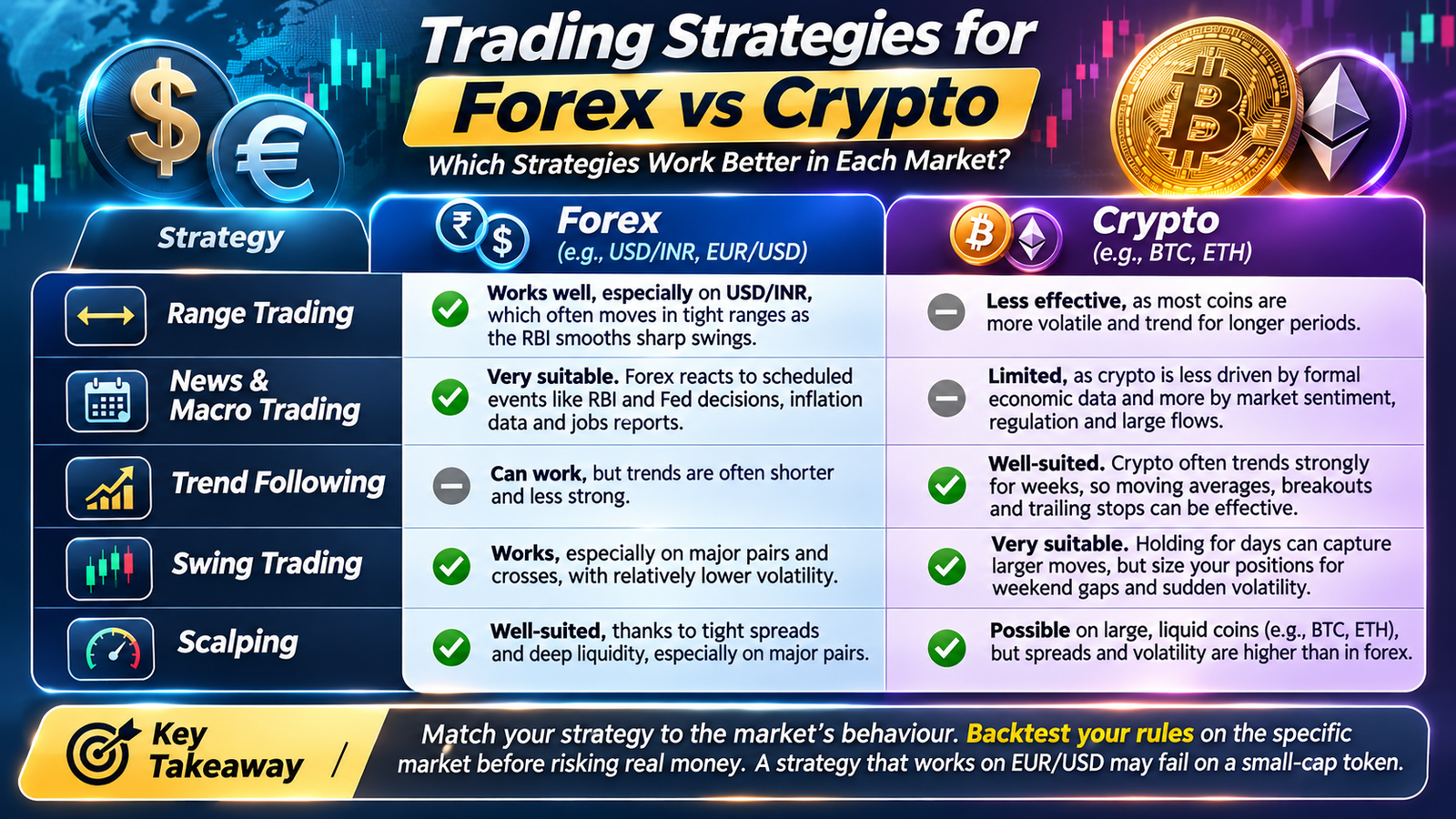
The strategies that work best also differ in the forex vs crypto comparison, because each market behaves differently.
- Range trading: USD/INR often moves in tight ranges because the RBI smooths sharp swings, so buying support and selling resistance can work well in currency futures.
- News and macro trading: Forex reacts to scheduled events such as RBI and US Federal Reserve decisions, inflation data and jobs reports, so traders can plan around a known calendar.
- Trend following: Crypto often trends strongly for weeks, so moving averages, breakouts and trailing stops tend to suit it.
- Swing trading: Holding for days captures larger crypto moves, but position size must account for weekend gaps and sudden volatility.
- Scalping: This needs tight spreads and deep liquidity, which favours major forex pairs and the largest coins only.
Whatever you choose, backtest your rules on the specific market before risking real money. A strategy that works on EUR/USD may fail on a small-cap token.
Risk Management in Both Markets
- Risk no more than 1% to 2% of your capital on a single trade.
- Always use stop-losses, especially in crypto, where gaps can be sudden.
- Avoid high leverage until you have a proven track record.
- Keep crypto on reputable exchanges and consider withdrawing long-term holdings to secure wallets.
- Keep a trading journal and review results weekly.
- Never trade with money you cannot afford to lose.
FAQs
Forex vs crypto: which is more profitable?
Neither is reliably more profitable. Crypto offers bigger moves but bigger losses. Profitability depends on your strategy, risk management and costs, including tax.
Is forex trading legal in India?
Yes, through NSE and BSE currency derivatives via SEBI-registered brokers. Leveraged trading on offshore forex platforms is not permitted under FEMA.
Is crypto trading legal in India?
Crypto is not banned, but it is not legal tender. Profits are taxed at 30% plus cess, and 1% TDS applies on transfers above thresholds.
Which is better for beginners?
Regulated currency futures are generally more forgiving thanks to lower volatility and exchange safeguards. Whichever you choose, start with a demo account and small size.
Can I offset crypto losses against forex profits?
No. Crypto losses cannot be set off against any other income or carried forward.
Conclusion
The forex vs crypto choice depends on what you value. Forex offers deep liquidity, lower volatility, a regulated route through NSE and BSE, and more flexible tax treatment for Indian traders. Crypto offers round-the-clock trading and large price swings, but comes with higher risk, weaker investor protection and a heavy, inflexible tax regime.
For most Indian traders, starting with regulated currency derivatives and treating crypto as a smaller, higher-risk allocation is a sensible approach. Whichever market you choose, learn the rules, manage risk carefully and practise before committing real money.