Quick answer
GST on forex trading and forex transactions is charged at 18% on the service – the brokerage on a trade, or the conversion margin on money-changing – not on the amount you convert or the profit you make. For currency conversion, the taxable value is a tiny slab-based figure under Rule 32(2), capped so the maximum GST is Rs 10,800.
Introduction
Few taxes cause as much needless panic as GST on forex. Traders and travellers alike hear ‘18% GST’ and imagine losing 18% of the money they trade or convert – which would be enormous. The reality is far gentler, and understanding GST on forex trading and transactions correctly saves you both worry and, occasionally, money. The key is knowing what the 18% is actually charged on.
This guide explains exactly that: what GST applies to, how it’s calculated for trading and for conversion, what it doesn’t touch, and how it differs from income tax and TCS. Details were verified against current 2026 sources, but GST rules and rates change, so confirm the latest and consult a chartered accountant. This is educational information, not tax advice.
The Key Principle: GST Is on the Service, Not Your Money
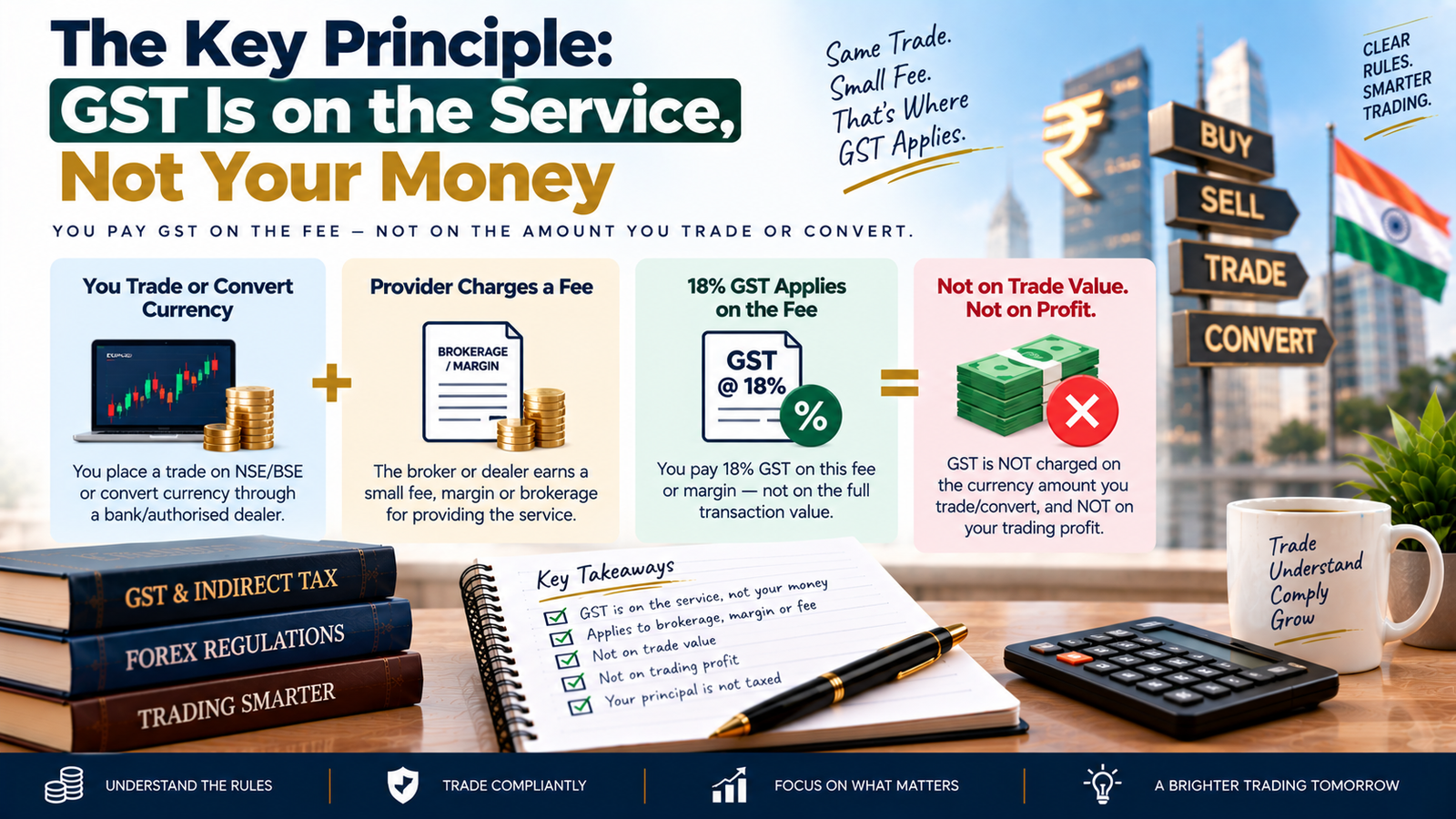
Here’s the one idea that dissolves most of the confusion: GST is levied on the forex service – the fee, margin or brokerage – not on the currency amount or your trading profit. When you trade, GST applies to the brokerage; when you convert currency, it applies to the small margin the provider earns. So ‘18% GST’ never means 18% of the money you move. Your principal and your profit are not the tax base at all.
GST on Forex Trading (Currency Derivatives)
For someone trading currency derivatives on the NSE or BSE, GST on forex trading is simple: 18% is charged on your brokerage and exchange transaction charges – not on the trade value and not on your profit. Because brokerage on currency derivatives is small (often a flat per-order fee at discount brokers), the GST on it is correspondingly tiny. And there’s a bonus for income tax: this GST, like the brokerage it sits on, is a legitimate business expense you can deduct when computing your trading income. So GST is a minor cost of trading, and a deductible one at that.
GST on Currency Conversion (Remittance, Travel, Forex Cards)
The other place GST shows up is when you actually convert currency – buying or selling foreign exchange, sending a remittance, or loading a forex travel card. Here, GST at 18% applies to a ‘value of supply’ computed under Rule 32(2) of the CGST Rules, using one of two methods:
Method 1: The spread (calculation) method
The taxable value is the difference between the rate you’re given and the RBI reference rate, times the units exchanged. For example, if a bank sells USD at ₹84.50 when the RBI reference rate is ₹84.10, the margin is ₹0.40 per dollar; on USD 2,000 that’s a taxable value of ₹800, and 18% GST is ₹144.
Method 2: The slab method
When no reference rate is available (or by the provider’s choice), the taxable value is a fixed slab-based figure of the gross amount exchanged, on which 18% GST applies.
The Rule 32(2) Slabs (Value of Supply)
Under the slab method, the ‘value of supply’ is computed as follows, and 18% GST is charged on that value (not on the gross amount):
| Amount exchanged | Value of supply (the GST base) | GST at 18% of the value |
|---|---|---|
| Up to ₹1 lakh | 1% of the amount (minimum ₹250) | e.g. ₹1 lakh -> ₹1,000 value -> ₹180 GST |
| ₹1 lakh to ₹10 lakh | ₹1,000 + 0.5% of amount above ₹1 lakh | e.g. ₹2 lakh -> ₹1,500 value -> ₹270 GST |
| Above ₹10 lakh | ₹5,500 + 0.1% of amount above ₹10 lakh (value capped at ₹60,000) | capped at ₹10,800 GST |
The ceiling matters: because the value of supply is capped at ₹60,000, the maximum GST on any single forex conversion is 18% of ₹60,000 = ₹10,800 – no matter how large the transaction. On everyday amounts it’s a few hundred rupees.
Worked Examples
Two quick illustrations under the slab method (indicative; confirm with your provider):
Example 1: Convert ~Rs 1,95,000 (e.g. USD 3,000 at Rs 65)
Value of supply = Rs 1,000 + (1,95,000 – 1,00,000) x 0.5%
= Rs 1,000 + Rs 475 = Rs 1,475
GST at 18% = Rs 265.50
Example 2: Convert ~Rs 13,00,000 (e.g. USD 20,000 at Rs 65)
Value of supply = Rs 5,500 + (13,00,000 – 10,00,000) x 0.1%
= Rs 5,500 + Rs 300 = Rs 5,800
GST at 18% = Rs 1,044
On a ₹13 lakh conversion, the GST is about ₹1,044 – roughly 0.08% of the amount. That’s the reality behind the scary-sounding ‘18%’.
What GST Does NOT Apply To
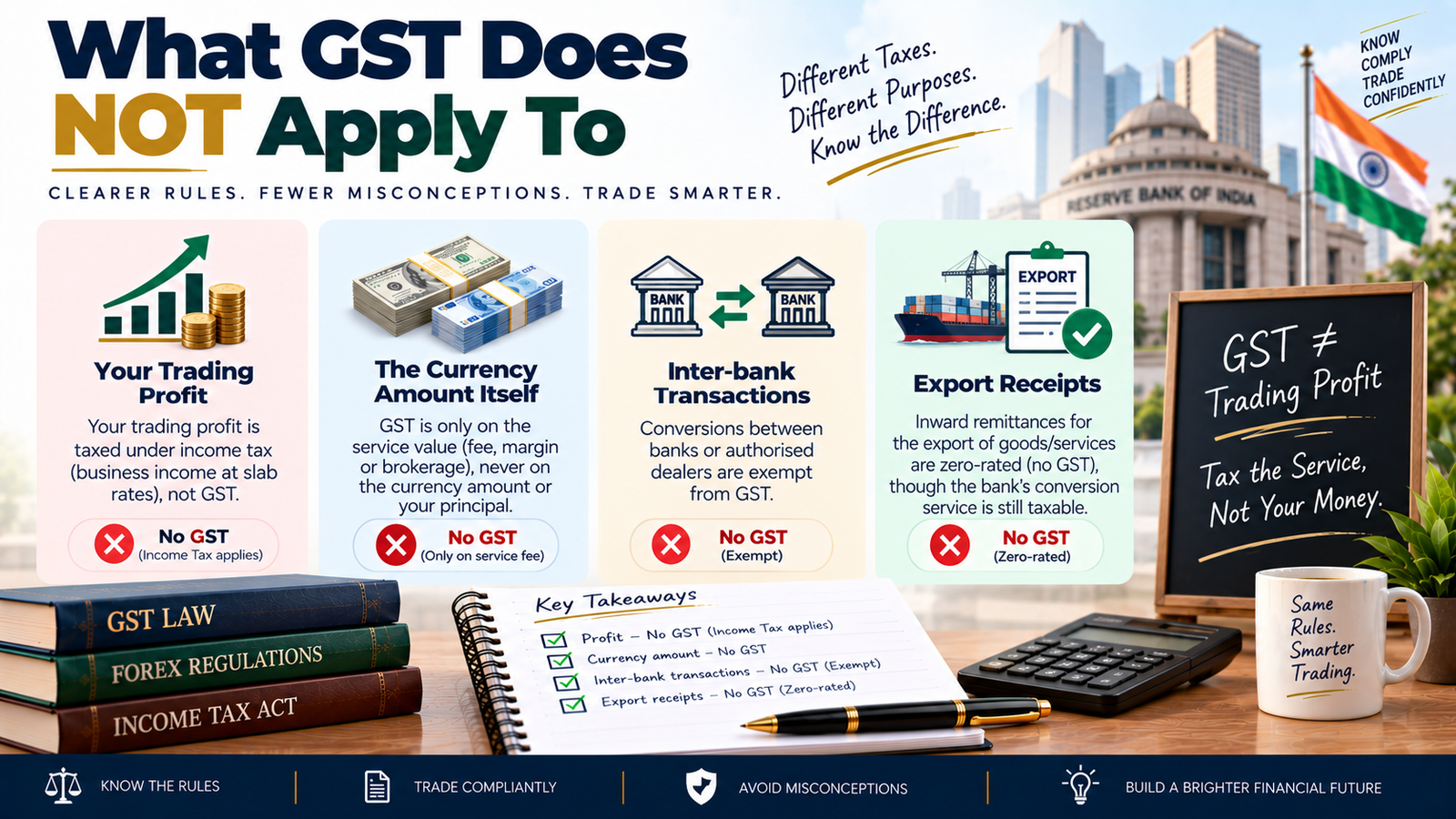
- Your trading profit – that’s income tax (business income at slab rates), not GST.
- The currency amount itself – GST is only on the service value, never the principal.
- Inter-bank transactions – conversions between banks or authorised dealers are exempt.
- Export receipts – inward remittances for the export of goods/services are zero-rated (though the bank’s conversion service is still taxable).
Input Tax Credit (for Businesses)
If you’re a GST-registered business converting currency for business purposes, the GST charged can often be claimed as input tax credit (ITC) – effectively recovering it – provided the bank or dealer issues a proper tax invoice bearing your GSTIN. The rules have conditions, so a registered business should confirm eligibility with its accountant before relying on the credit. For an individual retail trader, ITC generally isn’t available, but the amounts involved are small in any case.
GST vs Income Tax vs TCS: Don’t Confuse Them
Three different taxes touch forex, and conflating them causes most of the confusion. Here’s how they line up:
| Tax | What it’s charged on | Rate | Collected by |
|---|---|---|---|
| GST | The forex service (brokerage or conversion margin) | 18% of the service value | Bank / broker |
| Income tax | Your trading profit | Your slab rate | You, via your ITR |
| TCS | LRS remittances above ₹10 lakh | 20% (2% for some), refundable | Bank |
So GST is a small service tax, income tax is on your profit, and TCS is a refundable advance tax on large remittances. They coexist without overlapping – each has its own base.
The Bottom Line: It’s Smaller Than It Sounds
Add it up and GST on forex is a minor cost. On trading, it’s 18% of a small brokerage – a few rupees per trade – and it’s deductible. On conversion, it’s 18% of a tiny value-of-supply figure, capped so no single transaction attracts more than ₹10,800 in GST. The ‘18%’ headline frightens people into imagining a huge levy on their capital; in truth it lands on a sliver of a service fee, and the effective rate on your money is a fraction of a percent.
Common Mistakes
- Thinking 18% GST applies to the money you convert or your profit – it’s only on the service.
- Confusing GST (on the service) with income tax (on profit) or TCS (on remittances).
- Overlooking that trading-related GST is a deductible business expense.
- A registered business forgetting to claim eligible input tax credit.
- Assuming inter-bank or export receipts are taxed the same as retail conversion.
Myths vs Facts
| Myth | Fact |
|---|---|
| GST is 18% of the money I convert. | It’s 18% of the service value, which is a tiny slab-based figure. |
| GST applies to my trading profit. | No – profit is income tax; GST is only on the brokerage/service. |
| Big transactions mean huge GST. | The value of supply is capped, so max GST is ₹10,800 per conversion. |
| GST, income tax and TCS are the same thing. | They’re three different taxes with different bases and purposes. |
Tax disclaimer
This article is for educational purposes only and is not tax, legal or investment advice. GST rates, valuation rules (Rule 32(2)), thresholds and input-tax-credit conditions change, and individual situations vary. Details here were checked against 2026 sources but may since have changed. Always verify current rules with the GST/CBIC framework and your provider, and consult a qualified chartered accountant.
Expert Analysis
The panic around GST on forex is almost entirely a failure of framing. Because the headline number – 18% – is the same rate applied to a restaurant bill or a phone plan, people instinctively apply it to the whole sum in front of them, which for a ₹10 lakh remittance would be a terrifying ₹1.8 lakh. The law does the opposite: it deliberately narrows the tax base to a notional ‘value of supply’ that represents the provider’s small margin, then applies 18% only to that. The result is that GST on a large conversion is measured in hundreds or low thousands of rupees, and is capped outright at ₹10,800 however big the transaction. Once a trader or remitter internalises that GST rides on the service, not the sum, the fear evaporates and the number becomes what it is – a minor line item.
For the currency-derivative trader specifically, GST is almost a non-event that’s worth understanding only so you don’t double-count your taxes. It attaches to brokerage, which on Indian exchanges is already small, and it’s fully deductible against business income, so its net cost is smaller still. The more valuable habit is keeping the three forex taxes mentally separate: GST is a consumption tax on the service, income tax is a direct tax on your profit at your slab, and TCS is a refundable advance tax on large outward remittances. Treating them as one blurry ‘tax on forex’ leads to both overestimating your costs and mis-filing your returns. Kept distinct, each is manageable – and GST, the one that sounds the most alarming, turns out to be the smallest of the three for almost everyone.
Key Takeaways
- GST at 18% applies to the forex service – brokerage or conversion margin – not the money or profit.
- On currency-derivative trading, GST is 18% of small brokerage/charges, and it’s deductible.
- On conversion, GST uses Rule 32(2): a tiny value of supply, with the value capped at ₹60,000.
- Maximum GST on a single forex conversion is ₹10,800, however large the transaction.
- GST (on the service), income tax (on profit) and TCS (on remittances) are three separate taxes.
Frequently Asked Questions (FAQ)
Q: Is there GST on forex trading?
A: Yes, but only on the brokerage and exchange charges (18%), not on the trade value or your profit. It’s a small, deductible cost.
Q: What is the GST rate on forex?
A: 18%, applied to the value of the service (the brokerage or conversion margin) – not to the amount of money involved.
Q: Does GST apply to my trading profit?
A: No. Your trading profit is taxed under income tax as business income; GST applies only to the service fee.
Q: How is GST on currency conversion calculated?
A: 18% is charged on a ‘value of supply’ computed under Rule 32(2) – either the spread over the RBI reference rate, or a slab-based figure of the amount.
Q: What are the Rule 32(2) slabs?
A: Value of supply is 1% up to ₹1 lakh (min ₹250), ₹1,000 + 0.5% up to ₹10 lakh, and ₹5,500 + 0.1% above ₹10 lakh, capped at ₹60,000.
Q: What is the maximum GST on a forex transaction?
A: Because the value of supply is capped at ₹60,000, the maximum GST on a single conversion is 18% of that, i.e. ₹10,800.
Q: Is GST charged on the whole amount I convert?
A: No. GST applies only to the small service value, not the principal you convert. The effective rate on your money is a fraction of a percent.
Q: Can I claim input tax credit on forex GST?
A: A GST-registered business converting for business purposes often can, with a proper tax invoice bearing its GSTIN. Individuals generally can’t.
Q: Do inter-bank forex transactions attract GST?
A: No. Conversions between banks or authorised dealers are exempt; GST applies to retail transactions.
Q: Is GST charged on export receipts from abroad?
A: Export of services is zero-rated, but the bank’s conversion service on the inward remittance is still taxable at 18% on its value.
Q: Is GST the same as TCS on remittances?
A: No. GST is a service tax on the conversion; TCS is a refundable advance tax on LRS remittances above ₹10 lakh – different taxes.
Q: Is forex GST a big cost for traders?
A: No. It’s 18% of a small brokerage, deductible against business income, so its net cost is tiny.
Q: Does GST apply to loading a forex card?
A: Yes. Each load is a conversion service, so 18% GST applies to the value of supply for that load amount.
Q: How does GST differ from income tax on forex?
A: GST is a consumption tax on the service; income tax is a direct tax on your trading profit at your slab rate.
Q: Where can I confirm the current GST rules?
A: With the GST/CBIC framework, your bank or broker’s tax invoice, and a chartered accountant, as rules can change.