
Introduction
Every year, thousands of futures and options (F&O) and intraday traders ask the same question: do I need a tax audit? The answer depends on your trading turnover, your profit, and whether you have used presumptive taxation in the past. Get it wrong and you could face a penalty or lose the right to carry forward trading losses. With the audit season for AY 2026-27 just wrapping up and a new Income-tax Act taking effect, the tax audit for traders 44AB question matters more than ever.
This guide explains tax audit for traders 44AB rules in plain language. It covers:
- How trading income is taxed and why turnover matters
- How to calculate F&O and intraday turnover
- When a tax audit is mandatory, with simple scenarios
- Due dates for AY 2026-27, penalties, and what changes under the new Income-tax Act, 2025
How Trading Income Is Taxed
Before looking at the tax audit for traders 44AB rules, it helps to know how different types of trading income are classified:
| Type of trading | Tax treatment | Loss carry-forward |
|---|---|---|
| F&O (futures and options) | Non-speculative business income | Up to 8 years, against business income |
| Intraday equity | Speculative business income | Up to 4 years, against speculative income only |
| Delivery-based shares | Capital gains (short or long term) | Under capital gains rules |
Because F&O and intraday trading are treated as business, traders must report them in ITR-3 under “Profits and Gains of Business or Profession”. That is why business audit rules under Section 44AB can apply to them. Delivery-based investing, taxed as capital gains, does not count towards business turnover.
What Is a Tax Audit for Traders 44AB Purposes?
A tax audit is an examination of your books of account by a Chartered Accountant (CA). The CA checks your income, expenses and compliance, then files an audit report. For FY 2025-26, the report is filed in Form 3CB with the detailed statement in Form 3CD (Form 3CA applies where accounts are already audited under another law).
Section 44AB of the Income-tax Act, 1961 sets out who needs this audit. For traders, two clauses matter most:
- Section 44AB(a): Audit is required if business turnover exceeds ₹1 crore. This limit rises to ₹10 crore if cash receipts and cash payments are each no more than 5% of the total. Since almost all trading happens through bank accounts, most traders qualify for the ₹10 crore limit.
- Section 44AB(e): Audit is required if you opted for presumptive taxation under Section 44AD in an earlier year, then opt out and declare lower profits within the five-year lock-in period, and your total income exceeds the basic exemption limit.
How to Calculate Trading Turnover
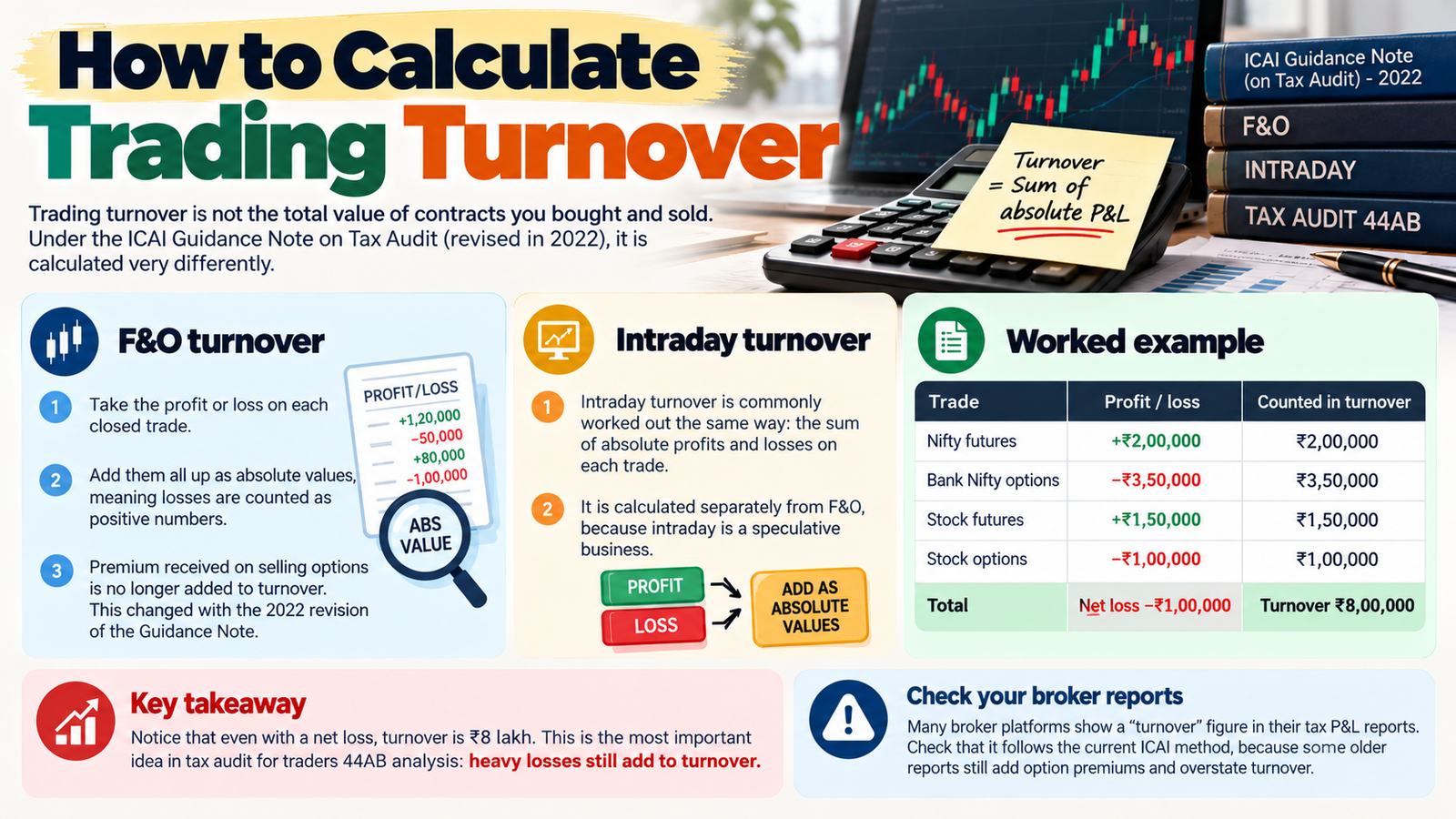
Trading turnover is not the total value of contracts you bought and sold. Under the ICAI Guidance Note on Tax Audit (revised in 2022), it is calculated very differently. Turnover is the starting point for every tax audit for traders 44AB decision, so it is worth getting right.
F&O turnover
- Take the profit or loss on each closed trade.
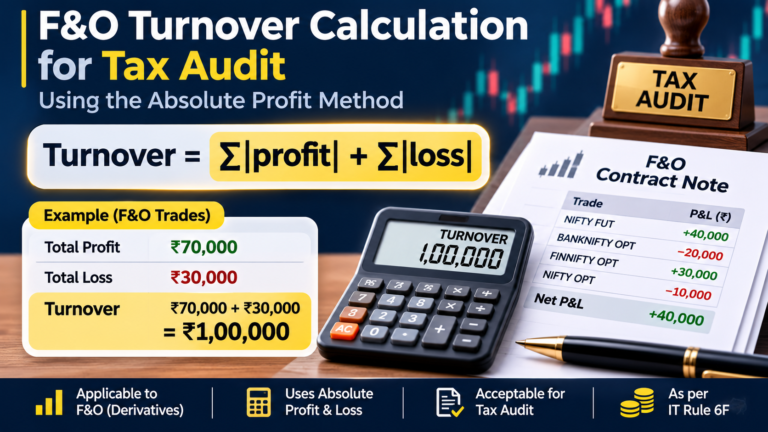
- Add them all up as absolute values, meaning losses are counted as positive numbers.
- Premium received on selling options is no longer added to turnover. This changed with the 2022 revision of the Guidance Note.
Intraday turnover
Intraday turnover is commonly worked out the same way: the sum of absolute profits and losses on each trade. It is calculated separately from F&O, because intraday is a speculative business.
Worked example
| Trade | Profit / loss | Counted in turnover |
|---|---|---|
| Nifty futures | +₹2,00,000 | ₹2,00,000 |
| Bank Nifty options | −₹3,50,000 | ₹3,50,000 |
| Stock futures | +₹1,50,000 | ₹1,50,000 |
| Stock options | −₹1,00,000 | ₹1,00,000 |
| Total | Net loss −₹1,00,000 | Turnover ₹8,00,000 |
Notice that even with a net loss, turnover is ₹8 lakh. This is the most important idea in tax audit for traders 44AB analysis: heavy losses still add to turnover.
Many broker platforms show a “turnover” figure in their tax P&L reports. Check that it follows the current ICAI method, because some older reports still add option premiums and overstate turnover.
Tax Audit for Traders 44AB: When Is It Mandatory?
For FY 2025-26, here is a simplified view of when the tax audit for traders 44AB rules apply, assuming cash transactions are within 5%:
| Turnover | Situation | Audit needed? |
|---|---|---|
| Up to ₹10 crore | Never used Section 44AD, declaring actual profit or loss | No |
| Up to ₹3 crore | Opting for 44AD and declaring at least 6% of digital turnover | No |
| Up to ₹10 crore | Used 44AD in an earlier year, now declaring lower profit within the 5-year lock-in, and total income above the basic exemption limit | Yes, under 44AB(e) |
| Up to ₹10 crore | Same as above, but total income below the basic exemption limit | No |
| Above ₹10 crore | Any case | Yes, under 44AB(a) |
If cash receipts or payments exceed 5%, the general audit limit falls back to ₹1 crore. For most retail traders, this is rare.
What about traders with losses?
A loss on its own does not trigger an audit under the current rules, as long as turnover is within ₹10 crore and the Section 44AD lock-in does not apply. Older rules required audits for many loss-making traders, which is why this question still causes confusion. However, the 44AB(e) trigger depends on your total income, including salary or other income, so a trader with a large salary and a small trading loss can still need an audit if they previously used 44AD.
Section 44AD and Traders
Section 44AD is closely linked to tax audit for traders 44AB rules, because opting in and out of it is the most common reason small traders end up needing an audit. It is a presumptive taxation scheme for small businesses. Instead of keeping full books, you declare a fixed percentage of turnover as profit: 6% for digital receipts or 8% for cash receipts. The limit is ₹2 crore of turnover, rising to ₹3 crore if cash receipts are within 5%.
Some F&O traders opt for 44AD to avoid detailed books and audits. But there is a catch. If you opt in and then opt out within the next five years, you cannot use 44AD again for five years, and you may need an audit under 44AB(e) if your income exceeds the basic exemption limit. There is also debate among tax experts about whether 44AD is the right fit for F&O income at all, so speak to a CA before choosing it.
For many traders, the simpler path is to declare actual profit or loss, maintain proper records and stay below the ₹10 crore limit, which avoids the tax audit for traders 44AB requirement altogether.
Tax Audit for Traders 44AB: Due Dates for AY 2026-27
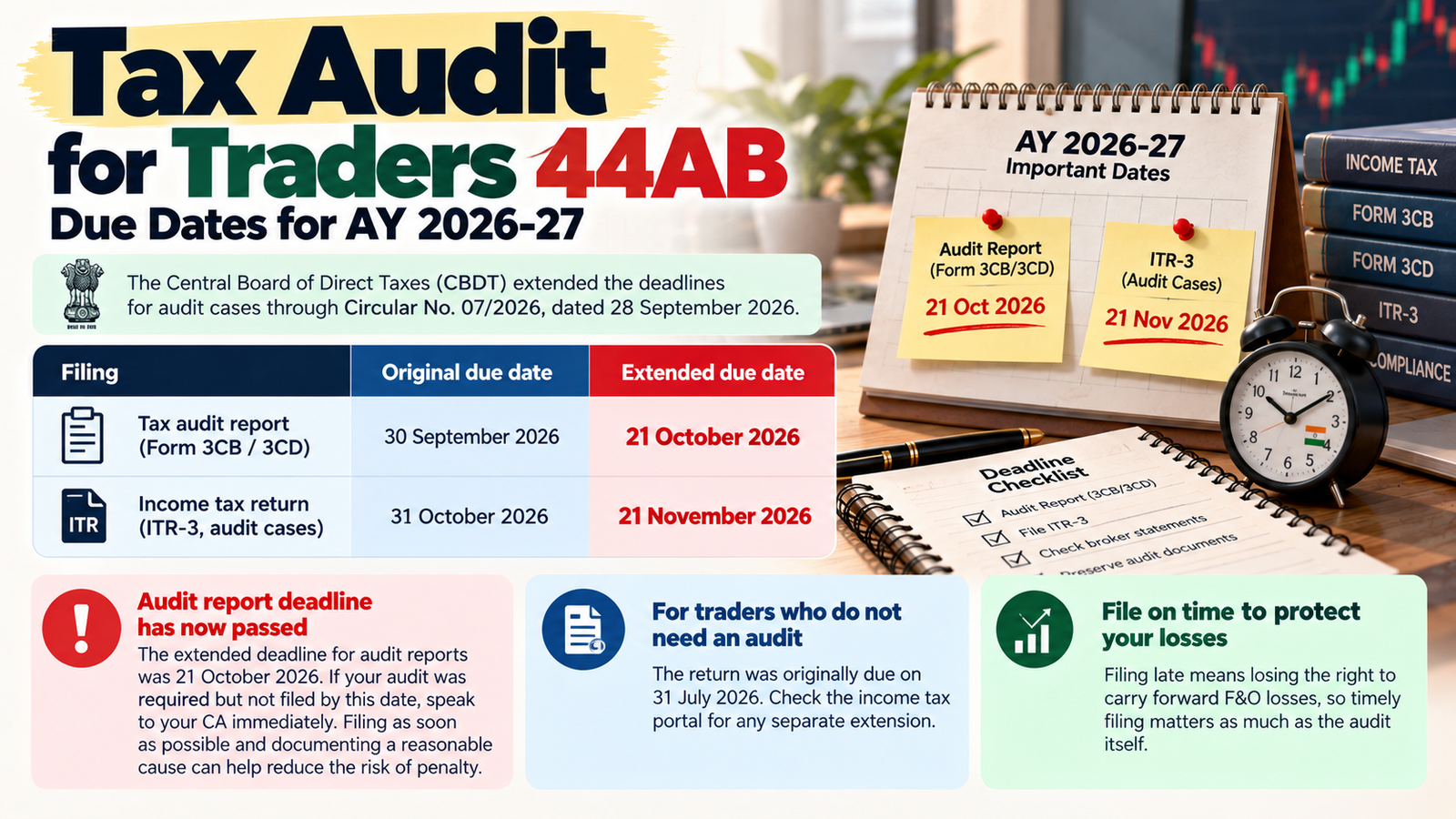
The Central Board of Direct Taxes (CBDT) extended the deadlines for audit cases through Circular No. 07/2026, dated 28 September 2026:
| Filing | Original due date | Extended due date |
|---|---|---|
| Tax audit report (Form 3CB / 3CD) | 30 September 2026 | 21 October 2026 |
| Income tax return (ITR-3, audit cases) | 31 October 2026 | 21 November 2026 |
The extended deadline for audit reports has now passed. If your audit was required but not filed by 21 October 2026, speak to your CA immediately. Filing as soon as possible and documenting a reasonable cause can help reduce the risk of penalty.
For traders who do not need an audit, the return was originally due on 31 July 2026; check the income tax portal for any separate extension. Filing late means losing the right to carry forward F&O losses, so timely filing matters as much as the audit itself.
Tax Audit for Traders 44AB: Penalties for Non-Compliance
Under Section 271B, failing to get accounts audited or to file the audit report on time can attract a penalty of 0.5% of turnover, up to a maximum of ₹1,50,000. Under Section 273B, no penalty applies if you can show a reasonable cause for the failure.
Beyond the penalty, missing deadlines has other costs. A return filed after the due date cannot carry forward business losses, which can be very expensive for traders who had a losing year. That is why understanding tax audit for traders 44AB rules early in the year is so important.
What Changes under the Income-tax Act, 2025
The Income-tax Act, 2025 replaces the 1961 Act from tax year 2026-27 (April 2026 to March 2027). For traders, the key changes are:
- New section numbers: Section 44AB becomes Section 63, and the presumptive schemes, including 44AD, move to Section 58.
- Same thresholds: The ₹1 crore and ₹10 crore business limits and the ₹2 crore and ₹3 crore presumptive limits continue, so the core tax audit for traders 44AB logic carries over to Section 63.
- “Tax year” concept: The old “previous year” and “assessment year” terms are replaced by a single “tax year”.
- New audit form: A single Form 26 replaces Forms 3CA, 3CB and 3CD.
- Fee instead of penalty: Reports indicate that the Section 271B penalty is replaced by a fixed fee for late audit reports, which may not allow the same reasonable-cause relief.
FY 2025-26 audits, being completed now, still follow Section 44AB. The new rules apply to audits for tax year 2026-27, which will be signed in 2027. Traders should keep an eye on CBDT notifications, because the forms and procedures under the new Act are still being rolled out.
Tax Audit for Traders 44AB Checklist: Documents Needed
- Tax P&L statement and contract notes from your broker
- Bank statements for all trading-linked accounts
- Ledger and trade-wise turnover working
- Records of expenses claimed, such as brokerage, internet, advisory fees and depreciation on equipment
- Annual Information Statement (AIS) and Form 26AS
- Details of losses carried forward from earlier years
- PAN, Aadhaar and previous year’s return
Having these ready makes the tax audit for traders 44AB process faster and reduces CA fees.

Practical Tips for Traders
These habits make tax audit for traders 44AB compliance much easier, whether or not you end up needing an audit:
- Track turnover monthly: Use your broker’s tax P&L to see if you are approaching ₹10 crore.
- Keep F&O and intraday separate: They are different businesses with different loss rules.
- Think twice before opting for 44AD: The five-year lock-in can create audit obligations later.
- Claim legitimate expenses: Brokerage, data subscriptions and advisory fees can reduce taxable income.
- File on time: Late filing can cost you the right to carry forward losses.
- Work with a CA: Trading taxation has grey areas, and professional advice can prevent costly mistakes.
FAQs
Is a tax audit compulsory for F&O traders with losses?
Not automatically. If turnover is within ₹10 crore and you have not opted out of 44AD within the five-year lock-in, a loss alone does not trigger an audit.
What is the tax audit limit for traders?
₹10 crore of turnover when cash transactions are within 5%, otherwise ₹1 crore.
Do option premiums count in turnover?
No. Since the ICAI Guidance Note was revised in 2022, premium received on selling options is not added.
Which ITR form do traders use?
ITR-3 for F&O and intraday income. ITR-4 may apply if you opt for presumptive taxation under 44AD.
Does tax audit for traders 44AB apply to delivery-based investors?
No. Profits from delivery-based share investing are usually taxed as capital gains, not business income, so they do not count towards the business turnover used for audit limits.
What is the tax audit for traders 44AB due date this year?
For AY 2026-27, the audit report was due by 21 October 2026, and the return for audit cases is due by 21 November 2026.
Conclusion
For most retail traders, a tax audit is not required as long as turnover stays below ₹10 crore and they avoid the Section 44AD lock-in trap. But because turnover counts both profits and losses, active F&O traders can cross thresholds faster than they expect.
Understand how turnover is calculated, track it through the year, file on time and get professional advice when in doubt. With the new Income-tax Act, 2025 bringing fresh section numbers and forms from tax year 2026-27, staying on top of the tax audit for traders 44AB rules, and their new Section 63 version, will help you avoid penalties and protect your right to carry forward losses.
Disclaimer: This article is for general information only and is not tax or legal advice. Tax rules change frequently. Consult a qualified Chartered Accountant for advice on your specific situation.