Quick answer
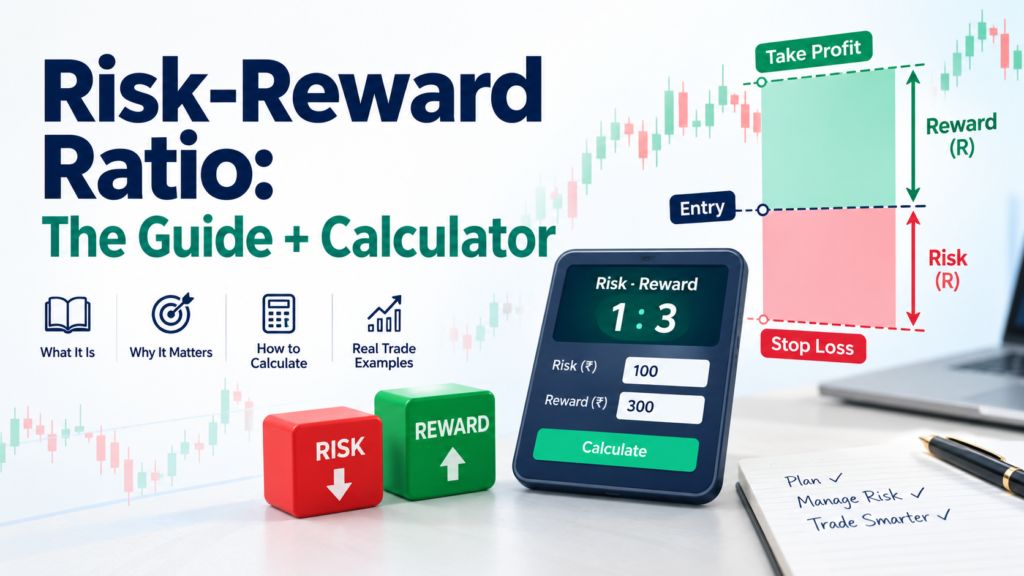
The risk-reward ratio compares what you risk on a trade to what you aim to gain. Risking 50 pips to make 100 is a 1:2 ratio. In forex, the risk reward ratio matters because a higher ratio lets you profit with a lower win rate – a 1:2 trade only needs to win about 33% of the time.
Introduction
Two traders can take the exact same trades and end the year with opposite results. Often the difference is not accuracy – it is the risk reward ratio forex traders use to structure each trade. The ratio decides how much a win pays relative to what a loss costs, and that single relationship can turn a mediocre win rate into a profitable system.
This guide explains the risk-reward ratio from scratch: what it is, how to calculate it, the win rate each ratio demands, and how to use it wisely. It includes a calculator method and reference table so you can apply it immediately. Everything here is educational, and every number has been verified.
What Is the Risk-Reward Ratio?
The risk-reward ratio (sometimes called reward-to-risk) compares the potential loss on a trade to its potential profit. It is written as risk:reward – so 1:2 means you risk one unit to potentially make two. If you risk $100 to make $200, that is a 1:2 risk-reward ratio.
In forex, the risk reward ratio is measured in the distance from your entry to your stop-loss (the risk) versus the distance from your entry to your target (the reward). It is one of the simplest yet most powerful concepts in trading, because it directly shapes long-term profitability.
How to Calculate the Risk-Reward Ratio
Calculating the ratio takes three numbers: your entry, your stop-loss and your target. The formula is:
Risk = | Entry price – Stop-loss price |
Reward = | Target price – Entry price |
Risk-Reward Ratio = Reward / Risk
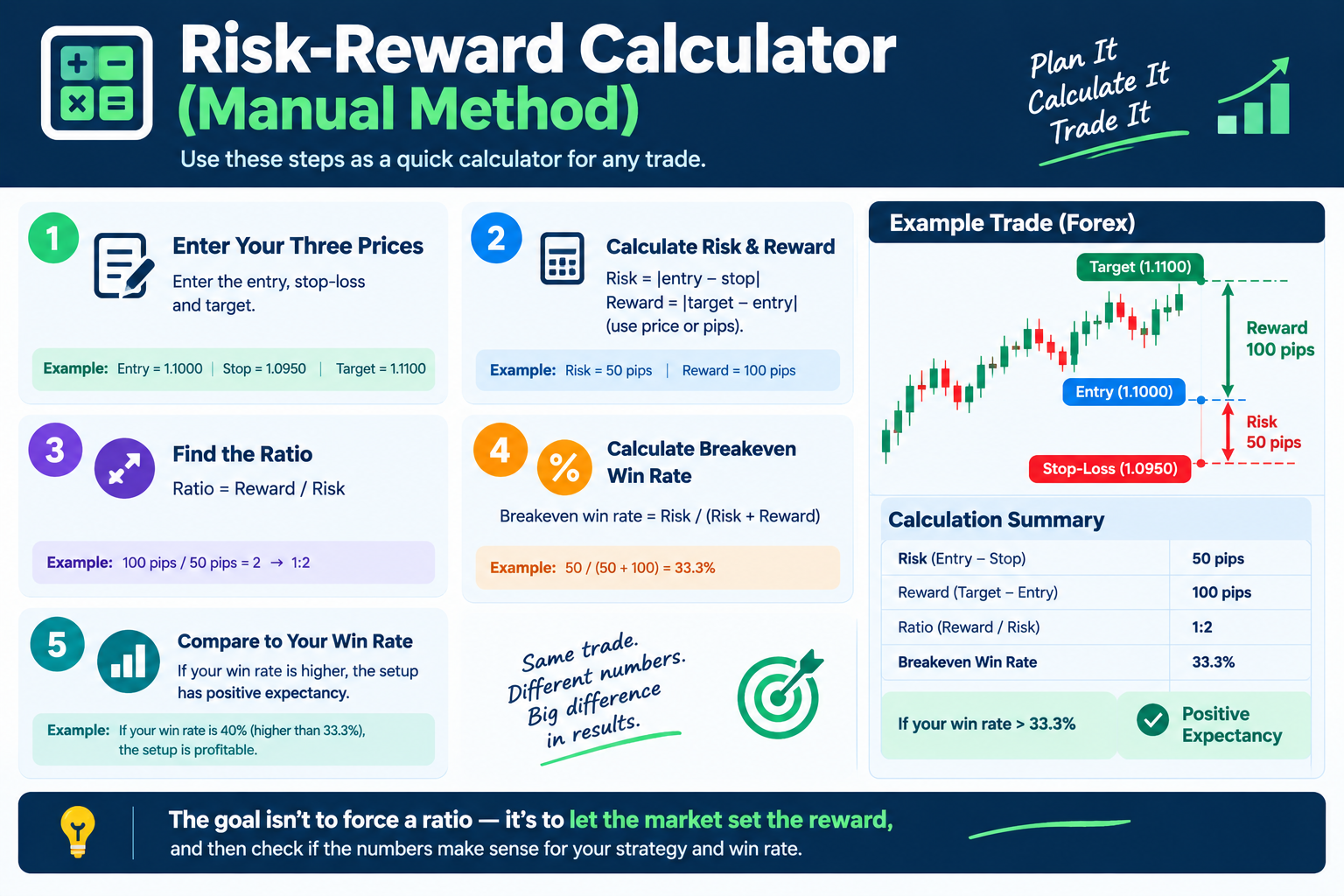
Worked example on EUR/USD: you buy at 1.1000, place a stop at 1.0950 and a target at 1.1100.
Risk = 1.1000 – 1.0950 = 0.0050 = 50 pips
Reward = 1.1100 – 1.1000 = 0.0100 = 100 pips
Ratio = 100 / 50 = 2 -> 1:2 risk-reward
So this trade risks 50 pips to make 100 – a 1:2 ratio. The same method works on any pair or instrument.
The Key Insight: Breakeven Win Rate
This is the concept that makes the risk reward ratio forex traders quote so powerful. Every ratio implies a minimum win rate you need just to break even. The formula is:
Breakeven Win Rate = Risk / (Risk + Reward)
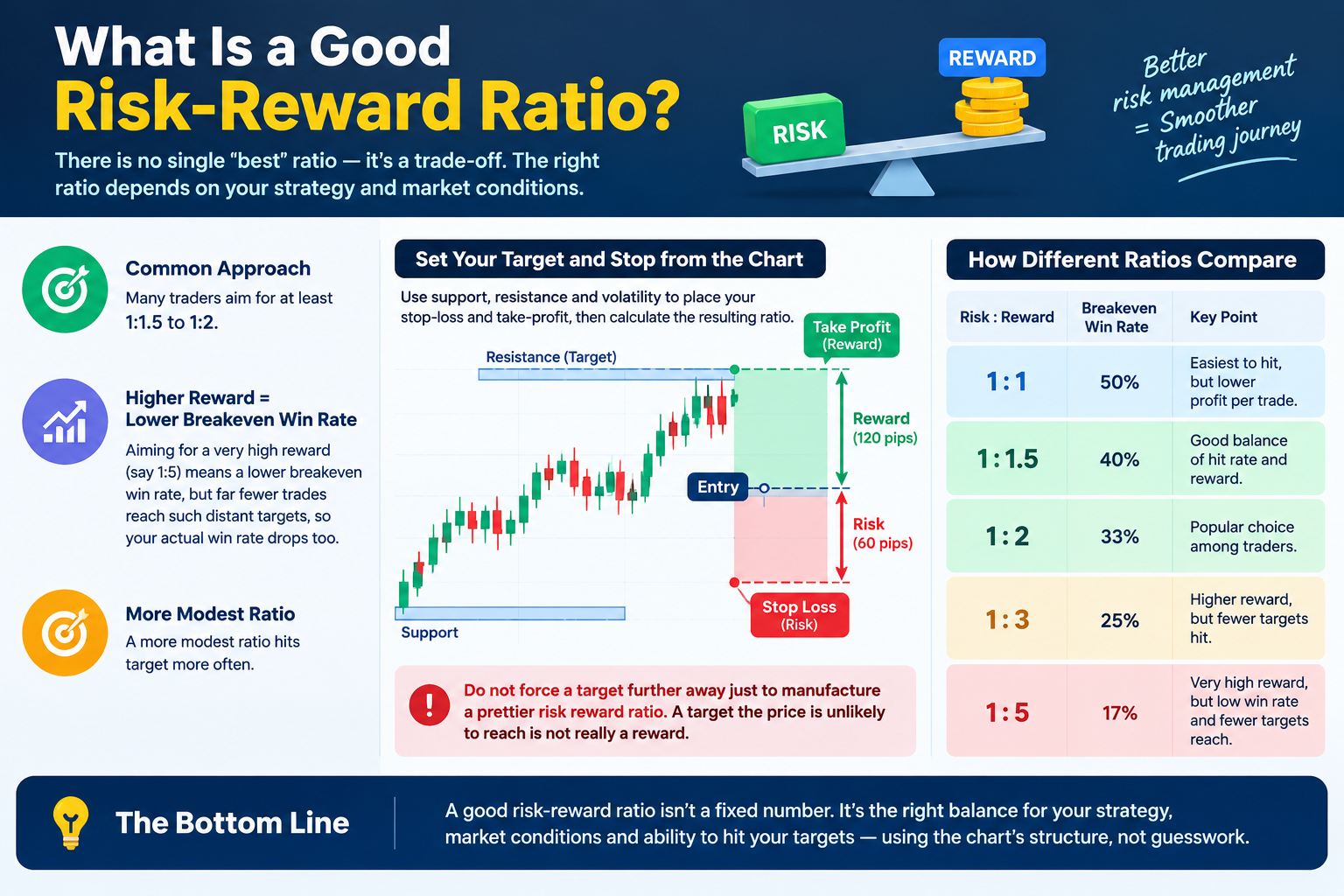
A better ratio lowers the win rate you need. The table below shows the breakeven win rate for common ratios (before costs):
| Risk-reward ratio | Breakeven win rate | Meaning |
|---|---|---|
| 1:0.5 (reward < risk) | 66.7% | You must win two of every three trades |
| 1:1 | 50.0% | You must win half your trades |
| 1:1.5 | 40.0% | Win 40% and you break even |
| 1:2 | 33.3% | Win one in three to break even |
| 1:3 | 25.0% | Win one in four to break even |
| 1:5 | 16.7% | Win one in six to break even |
Read that again: with a 1:3 ratio you can be wrong 75% of the time and still not lose money. That is why professionals obsess over risk-reward.
Risk-Reward + Win Rate = Expectancy
The ratio alone doesn’t tell the whole story – you need to beat the breakeven win rate. Combining the two gives expectancy, your average profit per trade:
Expectancy = (Win% x Avg Win) – (Loss% x Avg Loss)
Example: a 1:2 ratio (risking $100 to make $200) with a 40% win rate gives (0.40 x $200) – (0.60 x $100) = $20 profit per trade on average. The 40% win rate beats the 33.3% breakeven, so the edge is positive. A great risk reward ratio forex setup still loses money if your win rate falls below breakeven – both halves matter.
What Is a Good Risk-Reward Ratio?
Many traders aim for at least 1:1.5 to 1:2, but there is no single ‘best’ ratio – it involves a trade-off. Aiming for a very high reward (say 1:5) means a lower breakeven win rate, but far fewer trades reach such distant targets, so your actual win rate drops too. A more modest ratio hits target more often. The right choice depends on your strategy and market conditions.
The crucial rule: set your target and stop from the chart’s structure – support, resistance and volatility – then calculate the resulting ratio. Do not force a target further away just to manufacture a prettier risk reward ratio; a target the price is unlikely to reach is not really a reward.
How to Use Risk-Reward in Your Trading
- Mark structure first – identify logical stop and target levels from support, resistance and recent swings.
- Calculate the ratio – use reward divided by risk to get the trade’s risk-reward before you enter.
- Check it against your win rate – make sure your historical win rate beats the breakeven rate for that ratio.
- Skip poor setups – if the ratio is unfavourable (e.g. below 1:1) for your win rate, pass on the trade.
- Let it play out – resist moving your target closer or your stop further; that quietly wrecks your ratio.
Common Mistakes
- Forcing a target far away just to show a high ratio the price won’t reach.
- Moving the stop wider mid-trade, which secretly worsens the real risk-reward.
- Ignoring win rate – a great ratio still loses if you win below breakeven.
- Forgetting costs – spread and commission eat into the reward side.
- Cutting winners early, collecting less reward than the ratio assumed.
Myths vs Facts
| Myth | Fact |
|---|---|
| A higher ratio is always better. | Higher ratios lower breakeven win rate but are hit less often – it’s a trade-off. |
| You need a high win rate to profit. | With 1:2 you can profit winning ~33% of the time. |
| Risk-reward alone guarantees profit. | You must also beat the breakeven win rate; expectancy needs both. |
| 1:1 is a bad ratio | 1:1 is fine if your win rate is comfortably above 50%. |
Risk disclaimer
This article is for educational purposes only and is not investment advice. Forex trading carries a high risk of loss, and most retail traders lose money. Examples and figures are illustrative and exclude spread, commission and slippage, which reduce real results. Consult a licensed financial adviser before trading
Risk-Reward Calculator (Manual Method)
Use these steps as a quick calculator for any trade. (An interactive version can be embedded on the page.)
- Enter your three prices – entry, stop-loss and target.
- Risk = |entry – stop|; Reward = |target – entry| – in price or pips.
- Ratio = Reward / Risk – e.g. 100 pips / 50 pips = 2, i.e. 1:2.
- Breakeven win rate = Risk / (Risk + Reward) – e.g. 50 / 150 = 33.3%.
- Compare to your win rate – if your win rate is higher, the setup has positive expectancy.
Expert Analysis
The risk-reward ratio is deceptively simple, and that simplicity hides its most important lesson: profitability is a two-variable problem, not a one-variable one. Beginners chase win rate, believing that being right more often is the path to profit. But a trader who wins 70% of the time at a 1:0.5 ratio (risking two to make one) is barely above breakeven, while a trader who wins just 40% at 1:2 is comfortably profitable. Neither number means anything alone; only their interaction, expectancy, decides the outcome.
The practical discipline that follows is to let the market define the reward, not your hopes. The best risk reward ratio forex setups come from reading structure – placing the stop where the idea is invalidated and the target where price is realistically likely to travel – and then accepting whatever ratio that produces. Setups that don’t offer an acceptable ratio for your win rate are simply declined. Over hundreds of trades, that filter does more for a P&L than any indicator, because it ensures the math is on your side before you ever click buy.
Learn more about ECB Monetary Policy Statement
Key Takeaways
- The risk-reward ratio compares potential loss to potential gain (e.g. 1:2 = risk 1 to make 2).
- Calculate it as reward divided by risk, using entry, stop and target.
- Every ratio implies a breakeven win rate: 1:2 needs ~33%, 1:3 needs 25%.
- Profit needs both a good ratio and a win rate above breakeven – that is expectancy.
- Set stop and target from structure, then accept the ratio – don’t force it.
Frequently Asked Questions (FAQ)
Q: What is the risk-reward ratio in forex?
A: It compares what you risk on a trade (entry to stop) with what you aim to gain (entry to target), written as risk:reward, such as 1:2.
Q: How do I calculate the risk-reward ratio?
A: Divide the reward distance by the risk distance. If you risk 50 pips to make 100, the ratio is 100/50 = 2, or 1:2.
Q: What is a good risk-reward ratio in forex?
A: Many traders aim for at least 1:1.5 to 1:2, but the best ratio depends on your strategy and win rate; higher ratios are hit less often.
Q: What win rate do I need for a 1:2 ratio?
A: About 33.3% just to break even, so you need to win more than one in three trades to be profitable, before costs.
Q: Is a 1:1 risk-reward ratio good?
A: It can be, if your win rate is comfortably above 50%. On its own, 1:1 requires winning more than half your trades.
Q: What is breakeven win rate?
A: The minimum win rate needed to avoid losing money for a given ratio, calculated as risk / (risk + reward).
Q: How does risk-reward relate to expectancy?
A: Expectancy combines the ratio with your win rate: (Win% x Avg Win) – (Loss% x Avg Loss). Both are needed to know if you profit.
Q: Can I be profitable with a low win rate?
A: Yes. With a 1:3 ratio you can be wrong 75% of the time and still break even, so a high reward can offset a low win rate.
Q: Should I aim for the highest possible ratio?
A: Not necessarily. Very high ratios lower the breakeven win rate but are reached less often, so actual win rate falls – it’s a trade-off.
Q: How do costs affect risk-reward?
A: Spread, commission and slippage reduce the reward and can worsen your real ratio, so factor them into your calculation.
Q: Where should I set my stop and target?
A: At logical levels from chart structure – support, resistance and volatility – then calculate the resulting ratio, rather than forcing one.
Q: Does moving my stop change the ratio?
A: Yes. Widening a stop increases risk and worsens the ratio; that’s why moving stops mid-trade is discouraged.
Q: Is reward-to-risk the same as risk-reward?
A: They describe the same relationship from opposite sides; just be clear which order you’re quoting to avoid confusion.
Q: How many trades do I need to judge my ratio?
A: A meaningful sample – typically dozens to hundreds – because expectancy only shows over many trades, not a few.
Q: Is there a risk-reward calculator?
A: Yes – enter entry, stop and target, and it returns the ratio and breakeven win rate. The manual method in this guide does the same.