
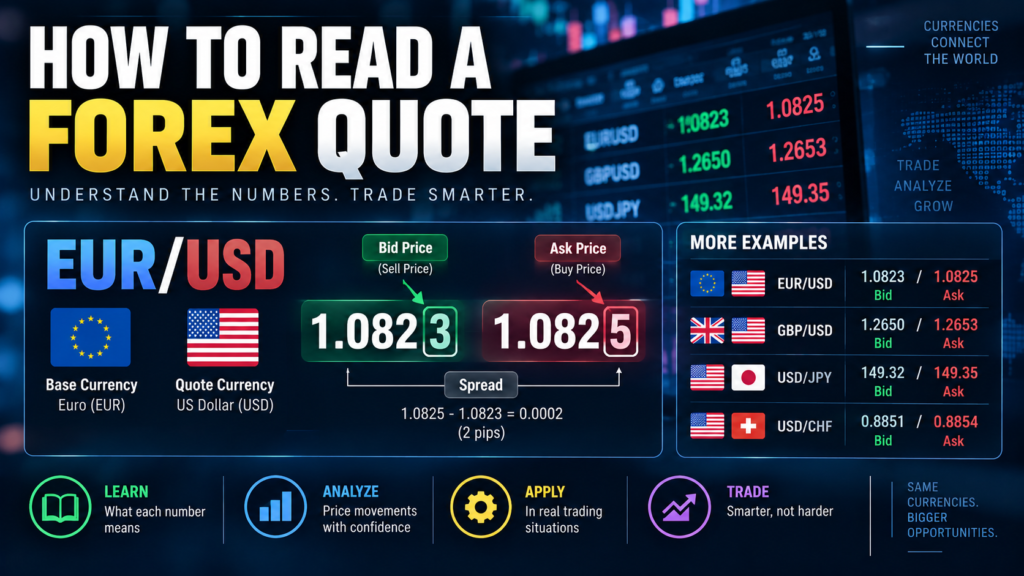
Open any trading platform and the first thing you’ll face is a wall of numbers: pairs, two prices side by side, tiny decimals ticking up and down. It looks intimidating, but a forex quote follows a strict, logical format — and once you know that format, you can read any quote on any platform in a second. Learning how to read a forex quote is the single most practical skill for a beginner, because every order you ever place starts by reading one correctly.
QUICK ANSWER
A forex quote shows a currency pair and two prices. The pair is a base currency and a quote currency (e.g. EUR/USD). The two prices are the bid (where you sell the base) and the ask (where you buy it); the gap between them is the spread. Prices move in tiny units called pips — usually the 4th decimal place. To read a quote: identify the pair, then read bid on the left, ask on the right.
The anatomy of a forex quote
Every quote has two layers. The first is the pair itself — two three-letter currency codes, like EUR/USD, telling you which currencies are being compared. The second is the price, which almost always appears as two numbers: a lower one and a higher one. Those are the bid and the ask. Knowing how to read a forex quote means reading both layers together — the pair tells you what, the two prices tell you at what cost.
Base and quote currency: the pair
The pair is the foundation of the quote. The first currency is the base; the second is the quote (or counter) currency. The price is always the value of one unit of the base in quote-currency terms. So EUR/USD 1.0849 means one euro is worth about 1.0849 US dollars. When you read a forex quote, always start here: get the base and quote currency straight, and the rest of the numbers make sense. If the base is on the left, a rising price means the base is strengthening.
Bid, ask, and the spread
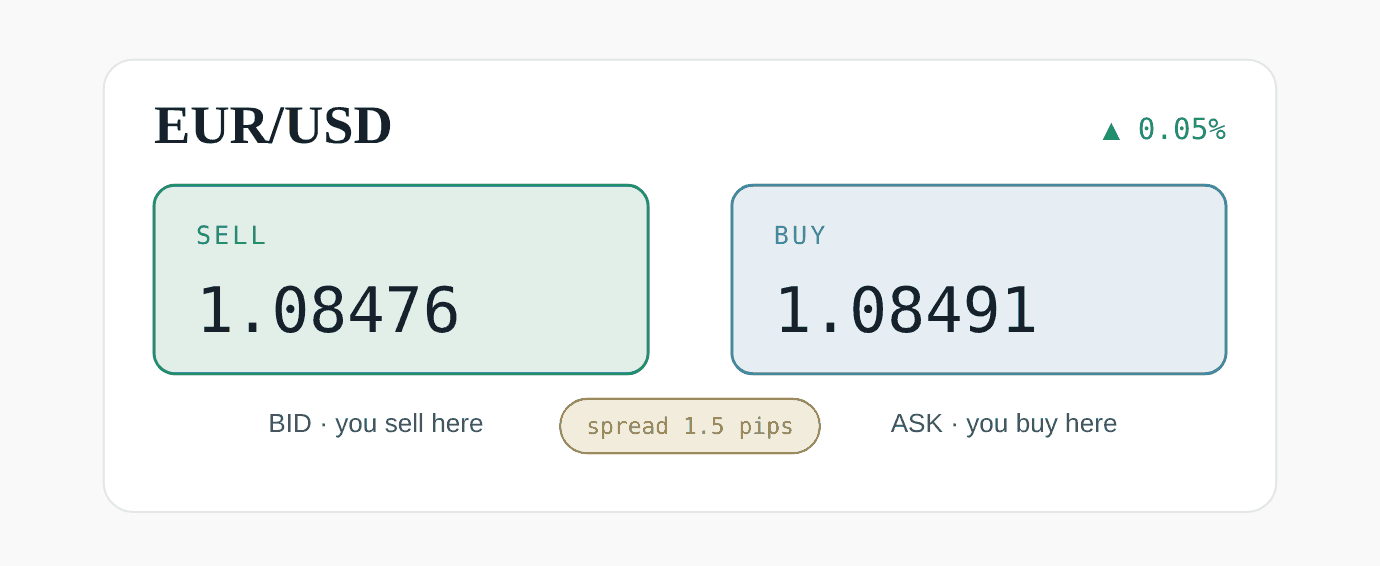
The two prices in a quote are the heart of how to read a forex quote. The bid is the lower price, and it’s where you can sell the base currency. The ask (also called the offer) is the higher price, where you can buy it. The little memory trick: you always trade at the price that’s worse for you — buy high, sell low — and the difference is the broker’s edge.
That difference is the spread. In the example above, the bid is 1.08476 and the ask is 1.08491, a spread of 0.00015 — that is, 1.5 pips. The spread is effectively your cost of entering a trade: the moment you buy at the ask, you could only sell back at the lower bid, so you start every trade fractionally “down” by the spread. Tighter spreads mean cheaper trading, which is why liquid major pairs are popular.
Pips and pipettes: how quotes move
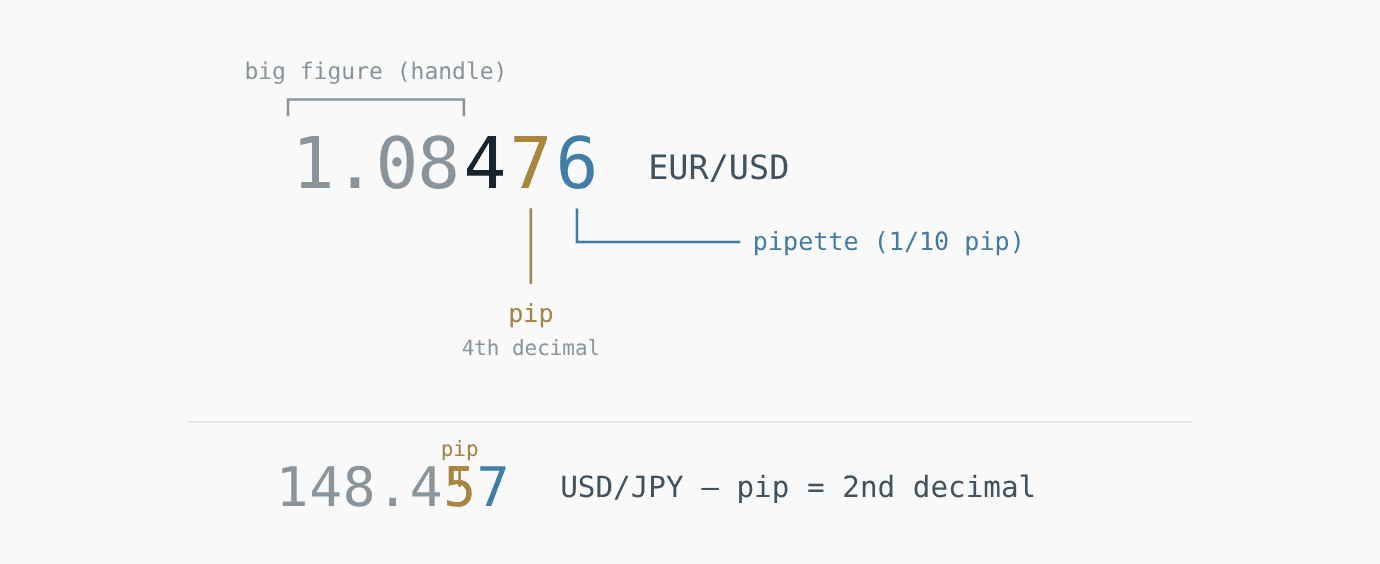
Forex prices move in tiny standardised steps. A pip (“percentage in point”) is normally the fourth decimal place — 0.0001 — for most pairs. Many platforms show a fifth decimal too: that’s a pipette, or fractional pip, one-tenth of a pip. For pairs involving the Japanese yen, the pip is the second decimal place (0.01) instead, because the numbers are much larger. Reading pips correctly is essential, because spreads, profits and losses are all counted in them.
Reading a quote on a live platform
On a real platform, a quote usually shows a little more: the pair, the bid and ask (often as clickable SELL and BUY buttons), the spread, and sometimes the daily change or high/low. The two prices update constantly. When you place a market order, you don’t choose the price — you take the bid if selling or the ask if buying, whatever it is at that instant. That’s why understanding how to read a forex quote before you click matters: the SELL button always shows the bid, and the BUY button always shows the ask.
| QUOTE | SELL AT (BID) | BUY AT (ASK) | SPREAD | 1 PIP = |
|---|---|---|---|---|
| EUR/USD | 1.08476 | 1.08491 | 1.5 pips | 0.0001 |
| GBP/USD | 1.27010 | 1.27032 | 2.2 pips | 0.0001 |
| USD/JPY | 148.452 | 148.480 | 2.8 pips | 0.01 |
Direct vs indirect quotes
One last wrinkle. A quote can be direct or indirect depending on whose home currency you’re standing in. A direct quote prices one unit of a foreign currency in your home currency; an indirect quote does the reverse. From an Indian trader’s point of view, USD/INR 95.50 (1 US dollar = 95.50 rupees) is a direct quote — the foreign currency, the dollar, priced in home rupees. The same relationship flipped, INR/USD 0.0105, would be an indirect quote.
You don’t need to overthink this: the reading rule never changes — base first, price in quote-currency terms. “Direct vs indirect” simply describes which currency happens to be your domestic one. Most retail platforms quote the market convention (like USD/INR), so you’ll usually be reading direct quotes without thinking about the label.
Common mistakes when reading a quote
- Mixing up bid and ask. You buy at the higher ask and sell at the lower bid — never the other way around.
- Forgetting which currency is the base. A rising price means the base is strengthening; misread the base and you’ll misread the whole move.
- Miscounting pips. On most pairs the pip is the 4th decimal; on yen pairs it’s the 2nd. The extra last digit is a pipette, not a full pip.
- Ignoring the spread. Every trade starts down by the spread — it’s a real cost, not just decoration.
- Reading a stale number. Quotes move constantly; a market order fills at the live bid or ask, not the price you first saw.
A beginner’s reminder: reading a quote fluently is a mechanical skill, and an essential one — but it doesn’t tell you which way the price will go. That’s the job of analysis and risk management. Practice reading quotes and placing small orders on a demo account until bid, ask, spread and pips are second nature, and always trade with a stop-loss.
For traders in India: you’ll mostly read rupee quotes like USD/INR, where the rupee is the quote currency. Residents can trade these legally as exchange-traded currency derivatives on NSE, BSE or MSE through a SEBI-registered broker; offshore spot forex is restricted under FEMA.
Key takeaways
- A forex quote = a currency pair plus two prices (bid and ask).
- The base is first, the quote currency second; the price is one unit of the base in quote terms.
- Bid (lower) is where you sell; ask (higher) is where you buy; the gap is the spread.
- A pip is normally the 4th decimal (2nd on yen pairs); the 5th decimal is a pipette.
- The spread is your cost of entry — every trade starts fractionally down by it.
- Direct vs indirect just describes whether the price is in your home currency; the reading rule never changes.
Frequently asked questions
How do you read a forex quote?
Read the pair first (base currency on the left, quote currency on the right), then read the two prices: the lower one is the bid, where you sell the base, and the higher one is the ask, where you buy it. The gap between them is the spread.
What is the bid and ask in a forex quote?
The bid is the price at which you can sell the base currency; the ask (or offer) is the higher price at which you can buy it. You always sell at the bid and buy at the ask.
What is a pip in a forex quote?
A pip is the standard smallest move in a quote — normally the fourth decimal place (0.0001) for most pairs, or the second decimal (0.01) for pairs involving the Japanese yen. Spreads and profits are measured in pips.
What is a pipette?
A pipette, or fractional pip, is one-tenth of a pip — the fifth decimal place on most pairs (or the third on yen pairs). Many brokers quote this extra digit for finer pricing.
What is the spread in a forex quote?
The spread is the difference between the bid and ask prices, measured in pips. It’s effectively your cost of trading, since you buy at the ask and can only sell back at the lower bid.
Why does a forex quote show two prices?
Because there’s a separate price for buying and for selling. The bid is what buyers in the market will pay you (so it’s your sell price), and the ask is what sellers want (your buy price). The two together let a broker make a market.
What is a direct vs indirect quote?
A direct quote prices a foreign currency in your home currency (e.g. USD/INR from India), while an indirect quote does the reverse. It only describes which currency is domestic; the base-then-quote reading rule stays the same.
How do I read a USD/INR quote?
In USD/INR, the US dollar is the base and the rupee is the quote currency, so a quote of 95.50 means one dollar costs 95.50 rupees. A rising number means the rupee is weakening against the dollar.