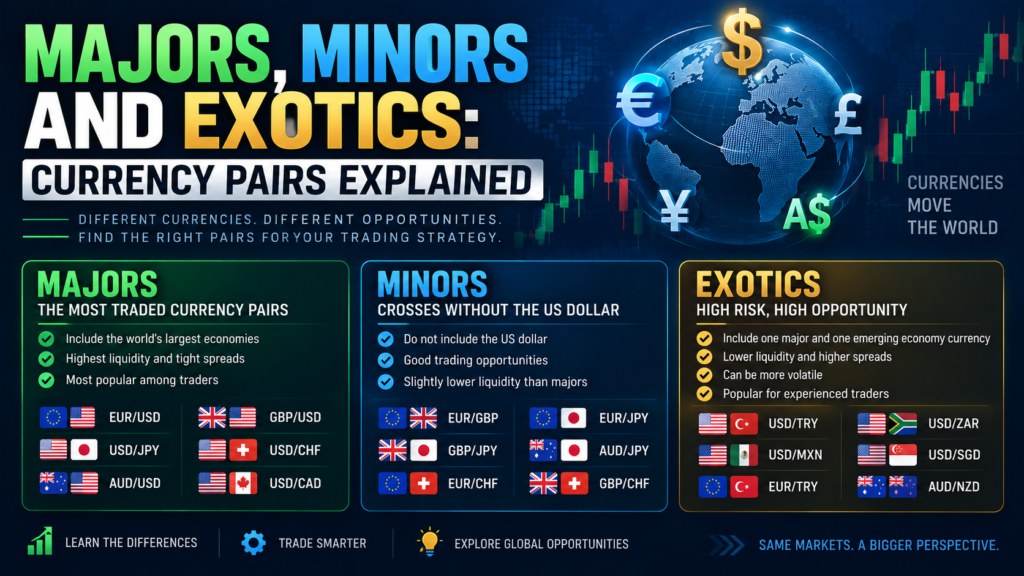
Once you know that every quote is built from a base and a quote currency, the next question is which pairs to actually watch. That’s where classification comes in. Traders sort the market into major, minor and exotic currency pairs — three tiers defined by how heavily each pair trades. The tier a pair belongs to is a fast proxy for its liquidity, its spread, and how wild its price swings tend to be, so understanding major, minor and exotic currency pairs is really about understanding risk and cost.
QUICK ANSWER
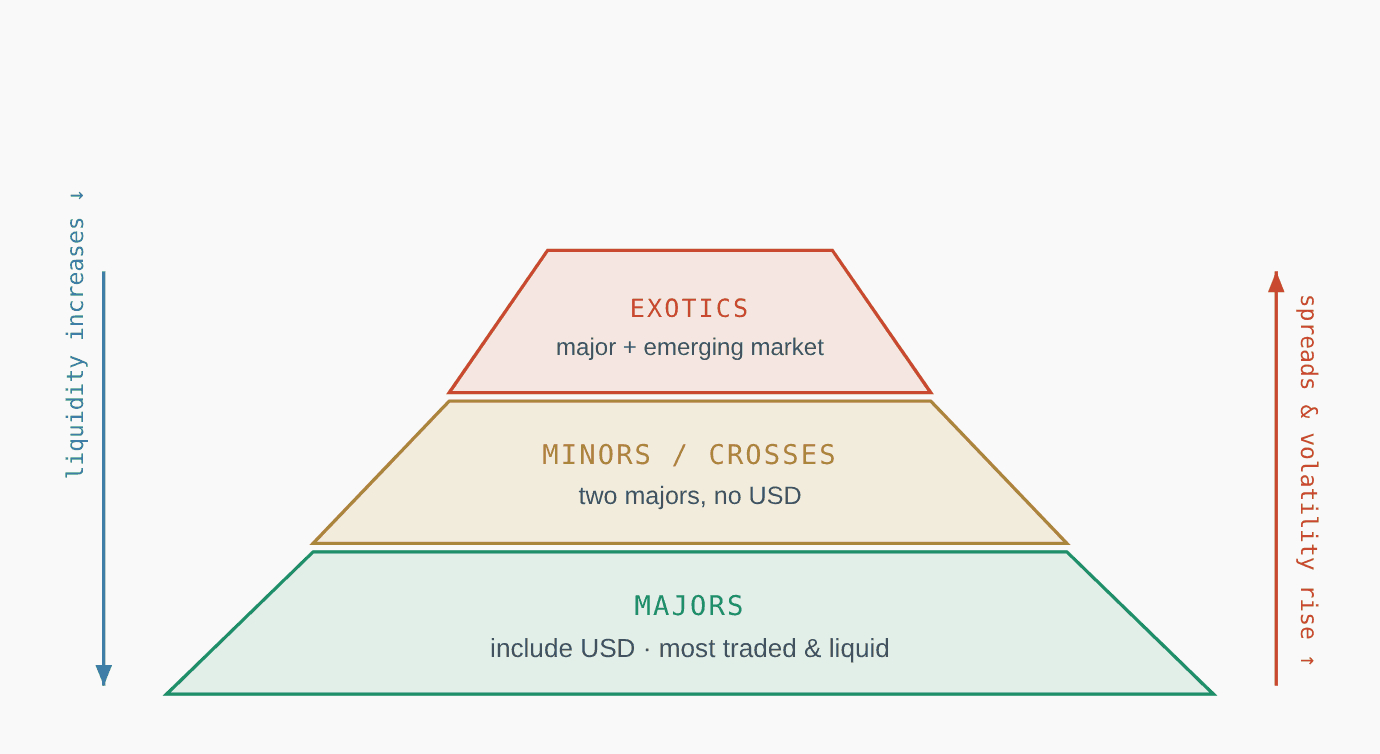
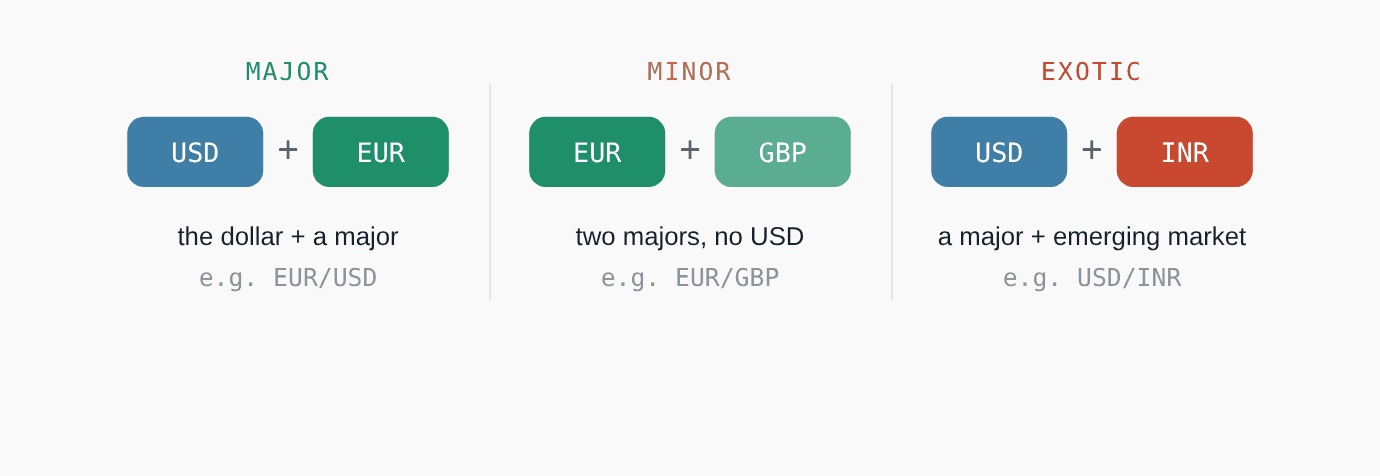
Major currency pairs are the most heavily traded and all include the US dollar (e.g. EUR/USD). Minor pairs, or crosses, are made of two major currencies without the dollar (e.g. EUR/GBP). Exotic pairs combine a major currency with an emerging-market one (e.g. USD/INR). As you move from majors to exotics, liquidity falls, spreads widen and volatility rises.
Why currency pairs are grouped this way
The forex market is enormous and lopsided. Around $9.6 trillion changes hands every day, and the US dollar sits on one side of roughly 89% of all trades. A handful of pairs soak up most of that volume, while thousands of others barely trade. Grouping pairs into majors, minors and exotics is simply a way of ranking them by that concentration — and because volume drives liquidity, the grouping also predicts how tight the spread will be and how smoothly a pair moves. That’s why the major, minor and exotic currency pairs framework is the first map any trader learns.
Major currency pairs
The major currency pairs are the blue-chip end of forex: the most traded, the most liquid, and the cheapest to deal in. What they all share is the US dollar on one side — paired with another heavily traded currency. EUR/USD alone is the single most-traded pair on the planet, and the majors together still account for the large majority of global turnover, though that share has eased in recent years as emerging-market trading has grown.
There are commonly seven majors:
- EUR/USD — euro / US dollar (the benchmark pair)
- USD/JPY — US dollar / Japanese yen
- GBP/USD — British pound / US dollar (“cable”)
- USD/CHF — US dollar / Swiss franc
- AUD/USD — Australian dollar / US dollar
- USD/CAD — US dollar / Canadian dollar
- NZD/USD — New Zealand dollar / US dollar
Because so much money flows through them, the majors have the tightest spreads and the least surprising price behaviour, which is exactly why almost every guide tells beginners to start here.
Minor currency pairs (crosses)
Minor currency pairs — usually called crosses — are combinations of two major currencies that leave out the US dollar. Before modern markets, converting, say, euros to yen meant going through the dollar twice; today these cross rates trade directly. Common crosses include:
- EUR/GBP — euro / British pound
- EUR/JPY — euro / Japanese yen
- GBP/JPY — British pound / Japanese yen
- EUR/CHF, AUD/JPY, GBP/AUD — and others
Crosses are still very liquid, but a notch below the majors — spreads are a little wider and moves can be a little sharper. Some, like GBP/JPY, are popular precisely because they move more, which suits shorter-term traders who want volatility. Among the three types of currency pairs, minors are the middle ground: more character than a major, far more stability than an exotic.
Learn more about How to Read the Economic Calendar for Forex Trading
Exotic currency pairs
Exotic currency pairs pair a major currency with the currency of an emerging or smaller economy. For Indian traders the obvious example is USD/INR; globally you’ll also see USD/ZAR (South African rand), USD/TRY (Turkish lira) and USD/MXN (Mexican peso). These are where the major, minor and exotic currency pairs spectrum turns genuinely risky.
Exotics trade far less, so their spreads are wide, their liquidity can dry up, and their prices can gap sharply on domestic news, political events or central-bank moves. That volatility can look like opportunity, but it cuts both ways: a wide spread is a cost you pay on entry, and thin liquidity means slippage when you most want out. Exotics reward traders who understand the specific economy behind the currency — and punish those chasing big moves without that context.
Majors vs minors vs exotics: side by side
The clearest way to see the trade-offs is to line the three types of currency pairs up against the things that actually affect your trading — liquidity, spread and volatility.
| FEATURE | MAJORS | MINORS | EXOTICS |
|---|---|---|---|
| Made of | USD + another major | Two majors, no USD | Major + emerging-market |
| Liquidity | Highest | High | Lower / variable |
| Typical spread | Tightest | Moderate | Widest |
| Volatility | Lower | Moderate | Higher, can gap |
| Best for | Beginners, all styles | Experienced, volatility seekers | Those who know the economy |
| Examples | EUR/USD, USD/JPY, GBP/USD | EUR/GBP, EUR/JPY, GBP/JPY | USD/INR, USD/ZAR, USD/TRY |
Which currency pairs should you trade?
There’s no single right answer, but the tiers point to sensible defaults. Beginners are almost always better off on the majors: tight spreads keep costs low, deep liquidity means your orders fill cleanly, and calmer price action is easier to read while you’re still learning. As you build experience, minors add variety and a little more movement for the same core skills.
Exotics are best treated with caution. They can be traded well — but only with a genuine understanding of the underlying economy and strict risk management, because the wide spreads and sudden gaps that define them will quietly erode careless trades. Across all three types of currency pairs, the rule is the same: match the pair to your experience, your strategy and your tolerance for cost and risk.
The honest caveat: an exotic’s big swings are not free money. The same volatility that produces large winners produces large losers, and wide spreads plus slippage mean the market takes a bigger cut of every trade. No tier is inherently “better” — majors aren’t boring and exotics aren’t a shortcut. Pick based on liquidity and cost, size your positions to the risk, and always use a stop-loss.
For traders in India: the relevant pairs are rupee ones — USD/INR, EUR/INR, GBP/INR, JPY/INR — plus permitted cross-currency pairs. Residents can trade these legally as exchange-traded currency derivatives on NSE, BSE or MSE through a SEBI-registered broker; offshore spot forex is restricted under FEMA.
Key takeaways
- Majors include the US dollar, are the most liquid, and have the tightest spreads — the beginner default.
- Minors (crosses) pair two majors without the dollar; still liquid, slightly wider spreads, a bit more movement.
- Exotics pair a major with an emerging-market currency; low liquidity, wide spreads, high, gap-prone volatility.
- Moving from majors to exotics, liquidity falls while spreads and volatility rise.
- The US dollar is on one side of about 89% of all trades, and EUR/USD is the most-traded pair.
- Match the pair to your experience and risk tolerance — an exotic’s volatility is a cost as much as a chance.
Frequently asked questions
What are major, minor and exotic currency pairs?
They are the three tiers used to classify forex pairs by trading volume. Majors include the US dollar and are the most traded; minors (crosses) combine two majors without the dollar; exotics pair a major with an emerging-market currency. Liquidity falls and spreads widen as you move from majors to exotics.
What makes a currency pair a “major”?
A major currency pair includes the US dollar on one side, paired with another heavily traded currency such as the euro, yen or pound. There are commonly seven: EUR/USD, USD/JPY, GBP/USD, USD/CHF, AUD/USD, USD/CAD and NZD/USD.
What is the difference between a minor pair and a cross?
They’re the same thing. “Minor pair” and “cross” (or “cross rate”) both describe a pair of two major currencies that does not include the US dollar, such as EUR/GBP or EUR/JPY.
Why are exotic pairs riskier?
Exotics trade in much lower volume, so spreads are wide, liquidity can vanish, and prices can gap sharply on local news or political events. That raises both the cost of trading and the chance of slippage.
Which currency pairs are best for beginners?
The majors — especially EUR/USD. Their tight spreads, deep liquidity and calmer price action make them cheaper and easier to trade while you’re learning.
Is USD/INR a major, minor or exotic pair?
USD/INR is an exotic pair, because it combines a major currency (the US dollar) with an emerging-market currency (the Indian rupee). For Indian traders it’s the most relevant pair, traded as an exchange-traded currency derivative.
Do exotic pairs cost more to trade?
Generally yes. Lower liquidity means wider bid-ask spreads, and the risk of slippage on entry and exit is higher, so the effective cost of trading an exotic is greater than a major.
How many currency pairs are there?
With around 180 currencies in circulation, there are roughly 2,500 possible pairs — but only a small group of majors and crosses account for the overwhelming majority of trading volume.