
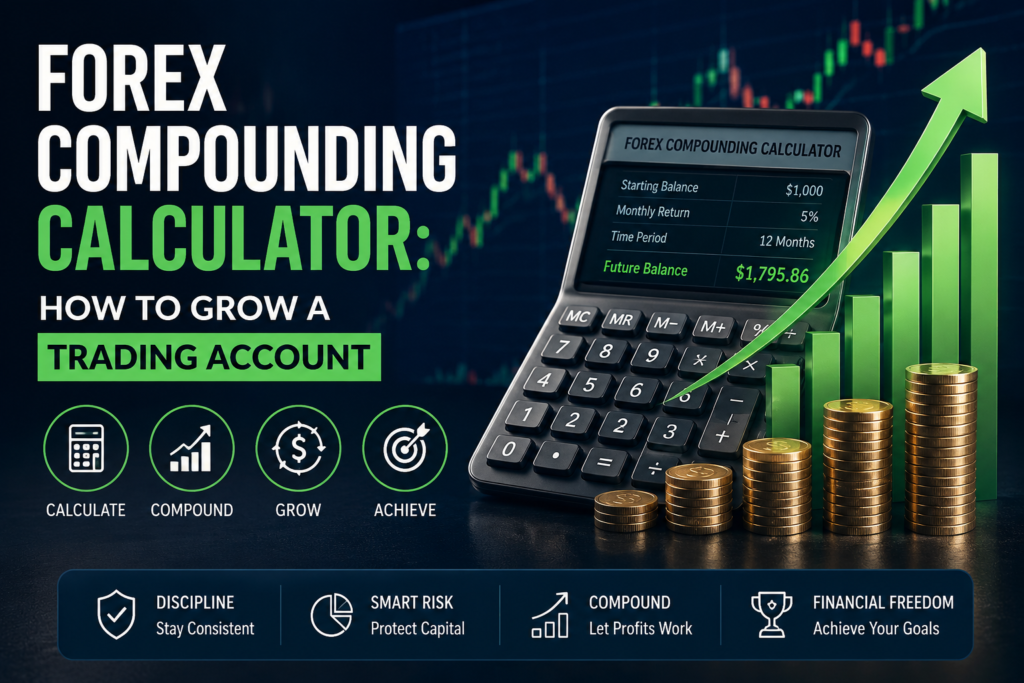
Quick answer
A forex compounding calculator projects how a trading account grows when profits are reinvested rather than withdrawn. You enter a starting balance, a gain per period and the number of periods, and it applies the formula Final = Start x (1 + rate)^periods. It shows the potential of compounding – and its risks.
Introduction
Every trader eventually asks the same question: if I make a steady return, how big could my account become? A forex compounding calculator answers exactly that. It takes a starting balance, a percentage gain per period and a number of periods, and projects forex account growth when each period’s profit is added back to the balance.
This guide explains how a forex compounding calculator works, the math behind it, and – just as importantly – why the smooth curves it produces rarely happen in real trading. Compounding is powerful, but it cuts both ways. Everything here is educational, not a promise of returns.
What Is a Forex Compounding Calculator?
A forex compounding calculator is a simple tool that models compound growth on a trading account. Instead of assuming you withdraw your profits, it assumes you reinvest them, so each period you earn a return on a slightly larger balance than before. Over many periods, that reinvestment is what turns a modest, steady gain into a much larger total gain.
The idea is the same as compound interest in a savings account – but with a critical difference. In forex, the ‘interest rate’ is your trading return, which is variable, uncertain and often negative. That is why a forex compounding calculator is best understood as a planning and illustration tool, not a forecast.
The Compounding Formula
Behind every forex compounding calculator is one formula:
Final Balance = Starting Balance x (1 + Rate)^Periods
Where:
Rate = gain per period (e.g. 0.05 for 5%)
Periods = number of periods (days, weeks or months)
For example, a $1,000 account growing 5% per month for 12 months becomes:
1,000 x (1 + 0.05)^12 = 1,000 x 1.7959 = $1,795.86
That is a 79.6% total gain from a 5% monthly return – noticeably more than the 60% you would get without compounding (5% x 12). The extra ~$196 is the compounding effect: profit earning profit.
Worked Example: 12 Months of Forex Account Growth
Here is the month-by-month path a forex compounding calculator would produce for a $1,000 account at a hypothetical 5% monthly return. Treat it as a mathematical illustration, not an expected result.
| Month | Balance | Month | Balance |
|---|---|---|---|
| 1 | $1,050.00 | 7 | $1,407.10 |
| 2 | $1,102.50 | 8 | $1,477.46 |
| 3 | $1,157.62 | 9 | $1,551.33 |
| 4 | $1,215.51 | 10 | $1,628.89 |
| 5 | $1,276.28 | 11 | $1,710.34 |
| 6 | $1,340.10 | 12 | $1,795.86 |
How Return Rate Changes the Outcome
Small differences in the periodic return compound into very different results. Below, a forex compounding calculator projects a $1,000 account over 12 months at several monthly rates:
| Monthly return | Balance after 12 months | Total gain |
|---|---|---|
| 1% | $1,126.83 | +12.7% |
| 2% | $1,268.24 | +26.8% |
| 5% | $1,795.86 | +79.6% |
| 10% | $3,138.43 | +213.8% |
A caution on the 10% row: a consistent 10% monthly return is extraordinarily rare and not a realistic planning assumption. The table shows the math, not a target.
How to Use a Forex Compounding Calculator
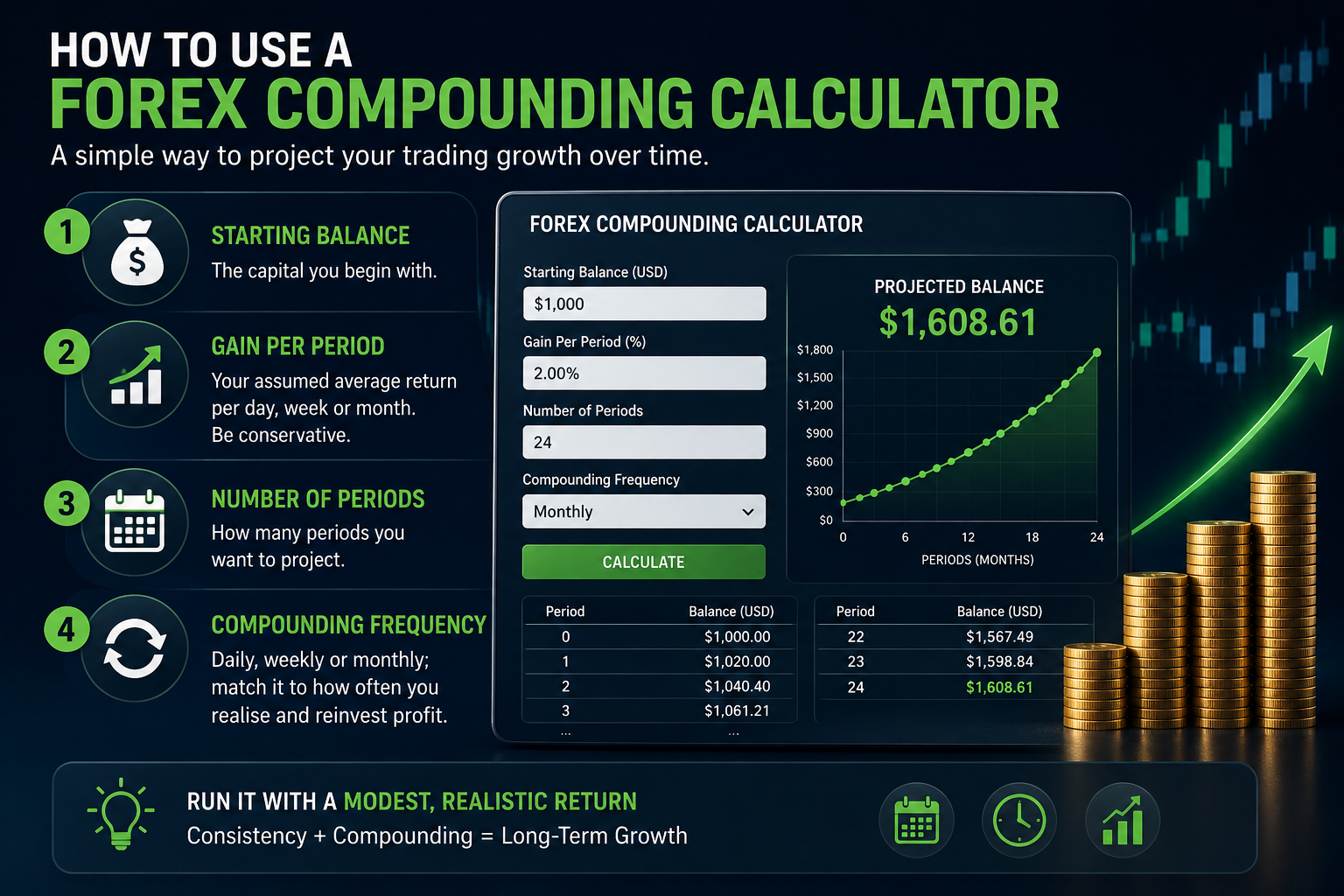
Using a forex compounding calculator takes four inputs:
- Starting balance – the capital you begin with.
- Gain per period – your assumed average return per day, week or month. Be conservative.
- Number of periods – how many periods you want to project.
- Compounding frequency – daily, weekly or monthly; match it to how often you realise and reinvest profit.
The calculator then applies the formula and shows the projected balance for each period. The most useful habit is to run it with a modest, realistic return rather than the best month you ever had.
The Other Side: How Drawdowns Compound
A forex compounding calculator usually shows only the upside. But losses compound too, and the math is unforgiving because you have to gain a larger percentage to recover a loss. A 50% loss needs a 100% gain just to get back to even.
| Drawdown | Gain needed to recover |
|---|---|
| -10% | +11.1% |
| -20% | +25.0% |
| -25% | +33.3% |
| -50% | +100.0% |
| -75% | +300.0% |
| -90% | +900.0% |
This is why protecting capital matters more than chasing big returns. Compounding rewards consistency and punishes large losses disproportionately.
Daily vs Monthly Compounding
A forex compounding calculator lets you choose the period. Daily compounding assumes you reinvest gains every trading day, which produces the fastest theoretical growth – but also assumes daily consistency that almost no trader sustains. Monthly compounding is a more realistic default for most retail traders, smoothing over the natural ups and downs of individual trades. Whichever you pick, the return assumption matters far more than the frequency.
Is Compounding Realistic in Forex?
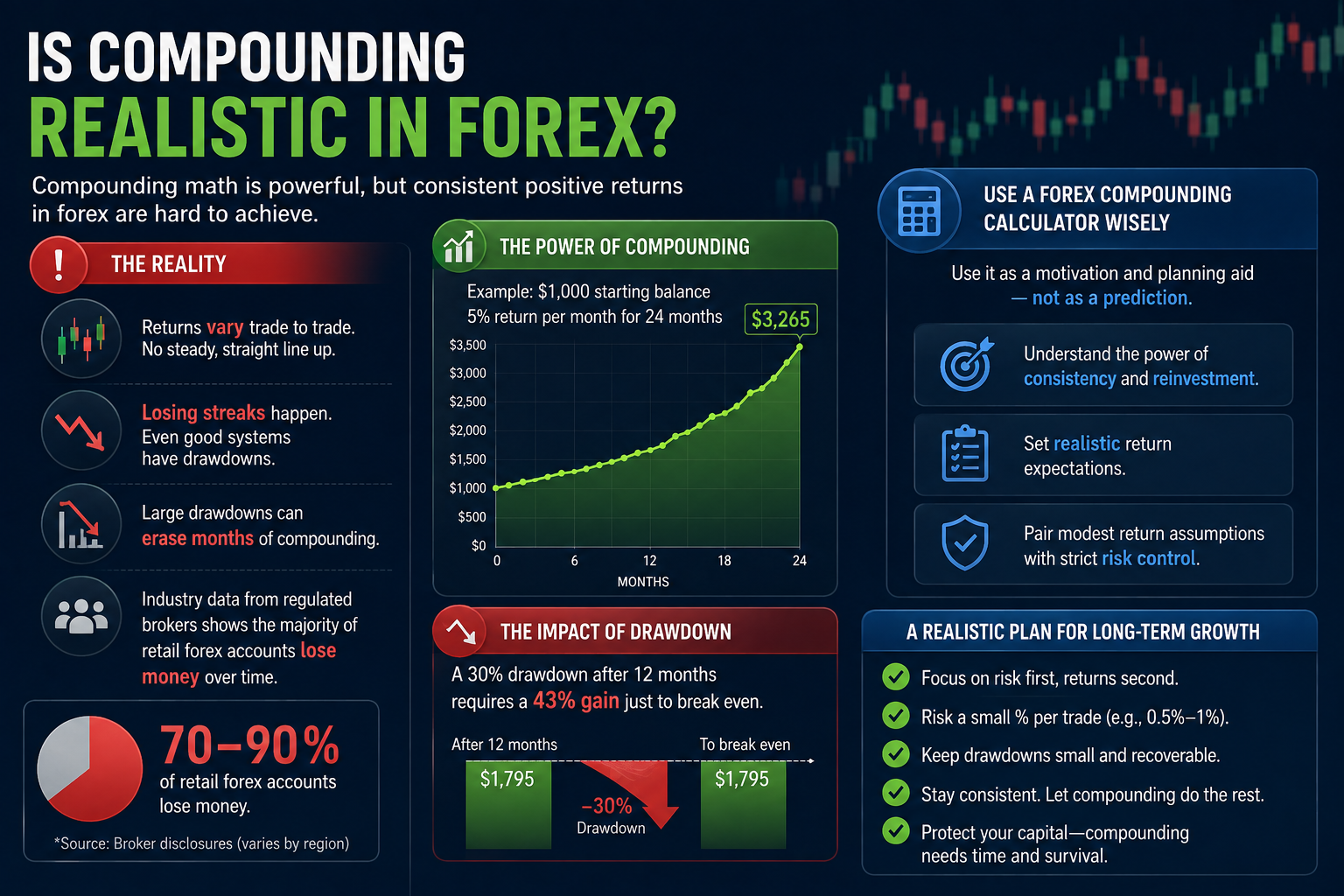
This is the honest heart of the topic. Compounding math is real, but it assumes a steady positive return that trading does not reliably provide. Returns vary trade to trade; losing streaks happen; and a large drawdown can erase months of compounding. Industry disclosures from regulated brokers consistently show that a majority of retail forex accounts lose money over time.
So use a forex compounding calculator as a motivation and planning aid – to understand the power of consistency and reinvestment – not as a prediction. A realistic plan pairs modest return assumptions with strict risk control.
Tips for Compounding Safely
- Assume conservative returns – model with a low monthly figure, not your best month.
- Cap risk per trade – many traders risk only 1-2% of the account per trade.
- Protect against drawdowns – the recovery math above is why capital preservation wins.
- Withdraw periodically – taking some profit out reduces risk, even if it slows compounding.
- Review assumptions – update the calculator with your real, realised results over time.
Learn more about SEBI Rules for Forex Trading in India, Explained
Common Mistakes
- Treating projections as guarantees – the smooth curve almost never happens live.
- Using an unrealistic return – a high monthly rate makes the math look magical and misleading.
- Ignoring drawdowns – upside-only planning hides the real risk.
- Over-leveraging to hit the numbers – chasing the projection is how accounts blow up.
- Forgetting costs – spreads, commissions and swaps reduce the real compounding rate.
Myths vs Facts
| Myth | Fact |
|---|---|
| A compounding calculator predicts profits. | It projects math from assumptions you supply; results are not guaranteed. |
| Compounding makes any trader rich. | It only works with consistent net-positive returns, which are hard to achieve. |
| Daily compounding is always better. | Faster frequency assumes daily consistency few traders sustain. |
| Losses don’t matter if wins are bigger. | Large drawdowns need disproportionately large gains to recover. |
Frequently Asked Questions (FAQ)
Q: What is a forex compounding calculator?
A: It is a tool that projects how a trading account grows when profits are reinvested, using a starting balance, a gain per period and a number of periods.
Q: How does compounding work in forex?
A: Each period’s profit is added to the balance, so the next period’s return is earned on a larger amount. Over time this reinvestment accelerates growth.
Q: What is the compounding formula?
A: Final Balance = Starting Balance x (1 + Rate)^Periods, where Rate is the gain per period and Periods is the number of periods.
Q: Is a forex compounding calculator accurate?
A: The math is exact, but it is only as realistic as your return assumption. Trading returns vary, so treat outputs as illustrations, not predictions.
Q: How much can I grow a $1,000 account?
A: At a hypothetical 5% monthly return, $1,000 becomes about $1,795 in a year – but such consistency is rare and not guaranteed.
Q: Is daily or monthly compounding better?
A: Daily compounding grows fastest in theory but assumes daily consistency few sustain. Monthly compounding is a more realistic default.
Q: Is compounding realistic in forex trading?
A: The math is real, but steady positive returns are hard to achieve. Most retail traders lose money, so plan conservatively.
Q: What return rate should I use?
A: Use a conservative figure – lower than your best month. Modeling with an unrealistic rate makes the projection misleading.
Q: Do losses compound too?
A: Yes. Drawdowns compound against you, and recovering requires a larger percentage gain than the loss – a 50% loss needs a 100% gain.
Q: Does compounding beat withdrawing profits?
A: Compounding grows the account faster, but withdrawing some profit reduces risk. Many traders balance the two.
Q: What is a realistic monthly return in forex?
A: There is no guaranteed figure; consistent double-digit monthly returns are unrealistic. Conservative planning is safer.
Q: Can I compound a small forex account?
A: Yes, mathematically, but small accounts leave little room for drawdowns, so risk control is even more important.
Q: How do costs affect compounding?
A: Spreads, commissions and swaps reduce your real return each period, lowering the effective compounding rate.
Q: Does leverage help compounding?
A: Leverage can amplify gains and losses; using it to force projected growth greatly increases the risk of ruin.
Q: Is a compounding calculator the same as compound interest?
A: The math is the same, but forex returns are variable and uncertain, unlike a fixed savings interest rate.