Quick answer
At its 10 September 2026 meeting, the ECB is expected to raise rates by 25 basis points, lifting the deposit rate from 2.25% to 2.50% – a move markets price at roughly 99%. Because the hike is priced in, the euro’s reaction to the ECB monetary policy statement depends mainly on Lagarde’s guidance.
Introduction
The September 2026 ECB monetary policy statement lands at an unusual moment. After cutting rates through 2024 and into 2025, the European Central Bank reversed course in mid-2026 and began hiking again in response to an energy-driven inflation shock. Now, with a further increase almost fully expected, the interesting question for markets is not whether the ECB acts, but what it signals next.
This preview lays out what the ECB is likely to decide on 10 September 2026, why, and how the euro might respond. All figures are drawn from current 2026 reporting and are dated; this is analysis and education, not a forecast or investment advice, and any market outcome remains uncertain until the decision and press conference are delivered.
What Is Happening: The 10 September 2026 Meeting
The ECB’s Governing Council meets on 10 September 2026, with its rate decision and monetary policy statement released in the early afternoon (Central European Time), followed roughly half an hour later by President Christine Lagarde’s press conference. The statement sets the three key ECB interest rates and explains the reasoning; the press conference is where Lagarde’s tone on inflation and future rates is scrutinised word by word.
For traders, the press conference often moves the euro more than the rate line itself – especially when, as now, the rate move is already expected.
Current ECB Rates (Going Into the Meeting)
Following the June 2026 hike, the three key ECB interest rates have stood at these levels since 17 June 2026:
| Key ECB rate | Level (from 17 June 2026) |
|---|---|
| Deposit facility rate | 2.25% |
| Main refinancing operations (MRO) | 2.40% |
| Marginal lending facility | 2.65% |
The deposit facility rate is the one markets watch most closely, since the ECB steers its policy stance through it.
What’s Expected: A 25bp Hike to 2.50%
Market pricing points to a near-certain quarter-point increase. Ahead of the meeting, futures markets implied roughly a 99% probability of a 25 basis point hike, which would lift the deposit rate from 2.25% to 2.50%. If delivered as expected, the full set of ECB interest rates would move as follows:
| Key ECB rate | Current | Expected after hike |
|---|---|---|
| Deposit facility rate | 2.25% | 2.50% |
| Main refinancing operations (MRO) | 2.40% | 2.65% |
| Marginal lending facility | 2.65% | 2.90% |
The key implication: because a hike is almost fully priced, the decision alone is unlikely to surprise markets. The euro’s move will likely come from the guidance around it – a classic ‘the news is in the price’ setup.
Why the ECB Is Hiking Again
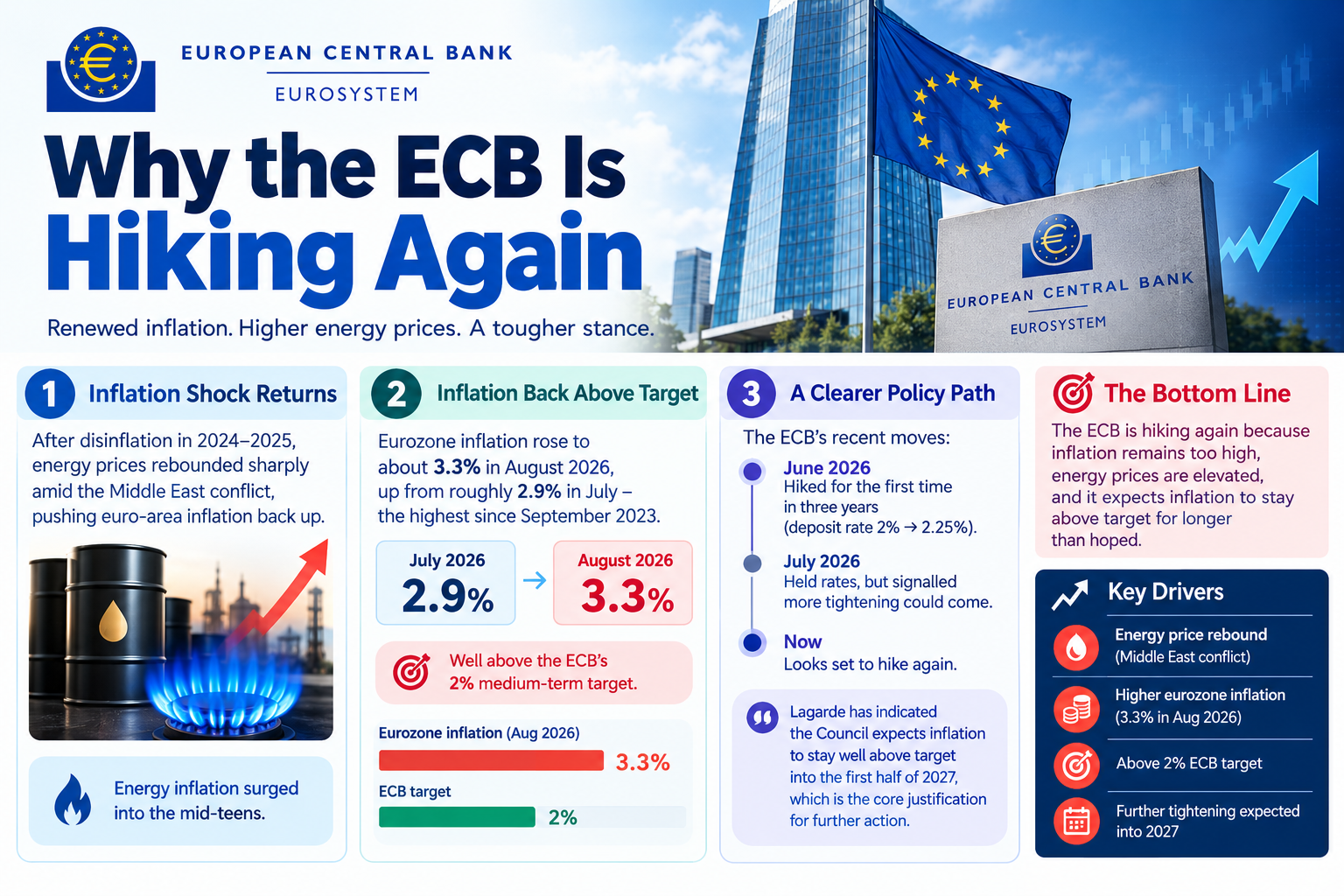
The turnaround in ECB monetary policy traces to a renewed inflation shock. After the disinflation of 2024-2025, energy prices rebounded sharply amid Middle East conflict, pushing euro-area inflation back up. On the latest readings, eurozone inflation rose to about 3.3% in August 2026, up from roughly 2.9% in July – the highest since September 2023 – with energy inflation surging into the mid-teens. That is well above the ECB’s 2% medium-term target.
The ECB responded by hiking for the first time in three years in June 2026 (deposit rate 2% to 2.25%), holding in July while signalling more tightening could come, and now looks set to move again. Lagarde has indicated the Council expects inflation to stay well above target into the first half of 2027, which is the core justification for further action.
The Real Question: Lagarde’s Guidance
With the hike itself priced in, the September ECB monetary policy statement will be judged on its forward guidance. Markets want to know whether this is a step in an ongoing tightening cycle or close to the peak. Lagarde’s characterisation of the inflation outlook, the balance of risks, and any hint about the October and December meetings will drive the euro far more than the rate number.
The ECB is also continuing quantitative tightening in the background – its asset portfolios (APP and PEPP) are shrinking as maturing bonds are no longer reinvested – which reinforces the restrictive stance regardless of the rate decision.
How the Euro Could React (Scenarios, Not Predictions)
Because the outcome hinges on tone, it helps to think in scenarios rather than a single call. Each rests on assumptions that may not hold:
Hawkish surprise
If Lagarde signals that more hikes are likely and stresses persistent inflation risks, the euro could strengthen even though the hike was expected, as markets price a higher rate peak. Assumption: guidance is more hawkish than already priced.
Dovish tilt
If she frames this hike as possibly the last and emphasises downside growth risks, the euro could weaken despite the increase – a ‘buy the rumour, sell the fact’ move. Assumption: the Council hints the peak is near.
As expected
If the statement broadly matches expectations, the euro reaction may be muted and short-lived, with attention shifting to the other central banks meeting the same week.
The Global Backdrop: A Big Central-Bank Week
The ECB decision does not happen in isolation – it opens a cluster of major central-bank meetings that together shape currency crosses:
| Central bank | Meeting | Market expectation |
|---|---|---|
| ECB | 10 September 2026 | ~25bp hike to 2.50% deposit rate |
| US Federal Reserve | 15-16 September 2026 | ~60% chance of a hike to 3.75-4.00% |
| Bank of Japan | 17-18 September 2026 | High odds of a move toward 1.25% |
| Bank of England | 17 September 2026 | Expected to hold at 3.75% |
For EUR/USD specifically, the interplay between the ECB and a potentially hiking Fed matters as much as the ECB decision alone – relative rate paths, not absolute levels, drive the pair.
What Traders Should Watch
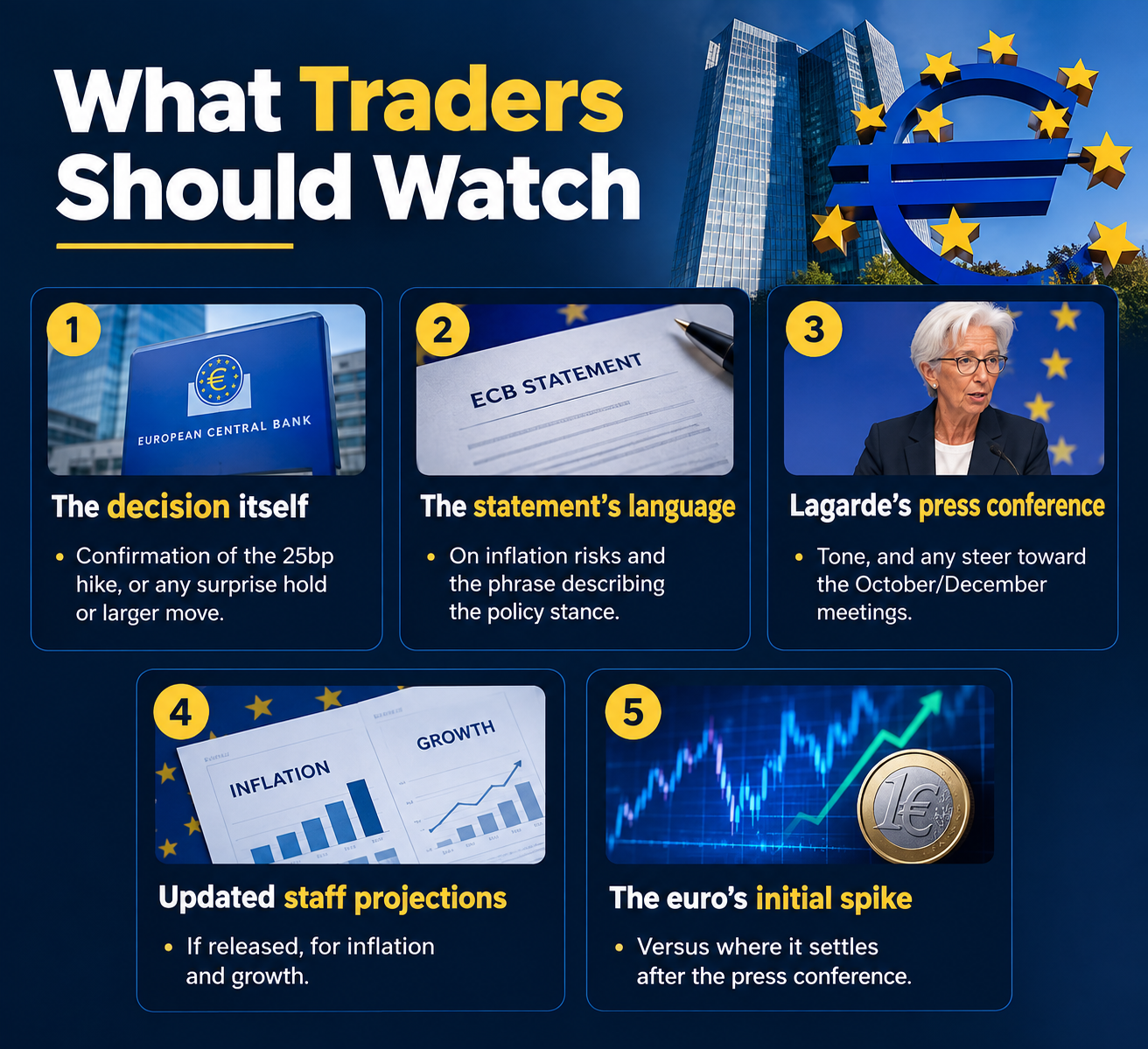
- The decision itself – confirmation of the 25bp hike, or any surprise hold or larger move.
- The statement’s language on inflation risks and the phrase describing the policy stance.
- Lagarde’s press conference – tone, and any steer toward the October/December meetings.
- Updated staff projections, if released, for inflation and growth.
- The euro’s initial spike versus where it settles after the press conference.
Risks and Uncertainty
Central-bank previews are inherently uncertain. Energy prices tied to geopolitics can shift the inflation picture quickly in either direction; the ECB could surprise on the decision or the guidance; and the euro’s reaction depends on positioning that is impossible to know precisely in advance. Treat the scenarios above as a framework for thinking, not a prediction – and remember that trading around high-impact events carries elevated risk from volatility and widening spreads.
Myths vs Facts
| Myth | Fact |
|---|---|
| A rate hike always lifts the currency. | If it’s priced in, the euro can fall on dovish guidance despite a hike. |
| The ECB has been cutting rates. | It resumed hiking in June 2026 after an energy-driven inflation shock. |
| The statement matters more than the presser. | Lagarde’s press conference often moves the euro more than the statement. |
| The ECB acts in isolation. | The Fed, BoJ and BoE all meet the same week, shaping euro crosses. |
| from public reporting; the actual decision, statement and market reaction may differ. Trading around central-bank events carries elevated risk. Verify the latest data with the ECB and consult a licensed adviser before trading. |
Disclaimer
This article is an educational preview and analysis, not investment advice or a forecast. Figures are dated to early September 2026 and drawn
Key Data at a Glance
| Metric | Latest reading (early Sept 2026) |
|---|---|
| Deposit facility rate (current) | 2.25% |
| Expected deposit rate after hike | 2.50% (~99% priced) |
| Euro-area inflation (August 2026) | ~3.3% (up from ~2.9% in July) |
| ECB inflation target | 2% over the medium term |
| First hike of the new cycle | 11 June 2026 (2% to 2.25%) |
| Balance sheet | APP/PEPP shrinking (quantitative tightening) |
Figures are dated to early September 2026 and should be re-checked against the ECB’s official release.
Expert Analysis
The September 2026 ECB monetary policy statement is a textbook example of why experienced traders separate the decision from the market reaction. When an outcome is priced at 99%, the hike carries almost no surprise value, so the euro’s path is set by the gap between the guidance delivered and the guidance expected. This is why a hawkish central bank can see its currency fall and a dovish one see its currency rise – what moves price is the change in expectations, not the level of rates.
The deeper story is the ECB’s uncomfortable position. It is tightening into an inflation shock driven largely by energy and geopolitics – forces monetary policy cannot directly control – while growth risks build underneath. That tension is precisely what makes Lagarde’s communication so delicate: she must sound committed enough to anchor inflation expectations without signalling a longer tightening path than the economy can bear. For euro traders, the lesson is to watch the framing as closely as the numbers, and to respect that event-driven volatility can whip price in both directions before a clear trend emerges.
Key Takeaways
- The ECB is expected to hike by 25bp on 10 September 2026, taking the deposit rate to 2.50%.
- With the hike ~99% priced, the euro’s reaction depends on Lagarde’s guidance, not the decision.
- The hikes are a response to an energy-driven inflation rebound (~3.3% in August 2026) versus a 2% target.
- Hawkish guidance could lift the euro; a ‘peak is near’ tilt could weaken it despite the hike.
- The Fed, BoJ and BoE all meet the same week, so euro crosses hinge on relative policy paths.
Frequently Asked Questions (FAQ)
Q: What is the ECB expected to decide in September 2026?
A: Markets expect a 25 basis point rate hike on 10 September 2026, lifting the deposit facility rate from 2.25% to 2.50%.
Q: What is the current ECB deposit rate?
A: Going into the September meeting, the deposit facility rate is 2.25%, in effect since 17 June 2026.
Q: Why is the ECB raising interest rates?
A: A rebound in energy prices amid geopolitical tension pushed euro-area inflation back above target, prompting the ECB to resume hiking.
Q: What is euro-area inflation now?
A: It rose to roughly 3.3% in August 2026, up from about 2.9% in July – the highest since September 2023, versus a 2% target.
Q: Is the ECB hike already priced in?
A: Yes. Market pricing implied around a 99% probability of a 25bp hike, so the decision itself should carry little surprise.
Q: Why might the euro fall even if the ECB hikes?
A: Because the hike is priced in; if Lagarde signals the peak is near, markets can sell the euro on a ‘buy the rumour, sell the fact’ basis.
Q: What are the three key ECB interest rates?
A: The deposit facility rate, the main refinancing operations (MRO) rate, and the marginal lending facility rate.
Q: When is the ECB press conference?
A: The statement is released in the early afternoon CET, with President Lagarde’s press conference following about half an hour later.
Q: What is the ECB’s inflation target?
A: Two percent over the medium term, which current inflation is running well above.
Q: How does the ECB decision affect EUR/USD?
A: Through relative rate expectations versus the Fed; the euro’s move depends on guidance and on the Fed meeting the following week.
Q: What is quantitative tightening at the ECB?
A: The ECB is letting its APP and PEPP bond portfolios shrink by not reinvesting maturing securities, reinforcing a restrictive stance.
Q: When did the ECB start hiking again?
A: On 11 June 2026, the ECB raised rates for the first time in three years, lifting the deposit rate from 2% to 2.25%.
Q: What other central banks meet the same week?
A: The US Federal Reserve (15-16 Sept), the Bank of Japan (17-18 Sept) and the Bank of England (17 Sept).
Q: Will the ECB keep hiking after September?
A: That’s the key uncertainty; the guidance in this statement will shape expectations for the October and December meetings.
Q: Is this article a prediction?
A: No. It presents expectations, scenarios and risks based on dated public data; the actual outcome and market reaction may differ.