
Quick answer
Yes – EUR/USD is legal to trade in India, but only one way: as an exchange-traded cross-currency derivative on a recognised exchange (NSE, BSE, MSE) through a SEBI-registered broker. It is one of the seven permitted pairs. Trading EUR/USD through offshore or CFD brokers is not permitted and breaches FEMA.
Introduction
EUR/USD is the most traded currency pair on earth, so it’s no surprise Indian traders want in – and immediately hit a confusing wall of contradictory advice. The good news is that the answer to ‘is EUR/USD trading legal in India?’ is clearer and more positive than for most forex products: yes, it’s legal. The catch is that there is exactly one legal way to do it, and the offshore apps most beginners find are not it.
This guide explains the legal route, the illegal one, and how to tell them apart, so you can trade the world’s biggest pair without breaking Indian law. Details were verified against current 2026 sources, but rules can change, so confirm the latest with the RBI, SEBI or your exchange. This is educational information, not legal advice.
What Is EUR/USD?
EUR/USD is the exchange rate between the euro and the US dollar – the price of one euro in dollars. It is the most liquid and heavily traded pair in the global forex market, driven by the two largest economic blocs and their central banks, the European Central Bank and the US Federal Reserve. Because it involves neither the rupee directly, EUR/USD is a ‘cross-currency’ pair from an Indian perspective – and that classification is exactly what makes its legal status interesting.
The Direct Answer: Is EUR/USD Trading Legal in India?
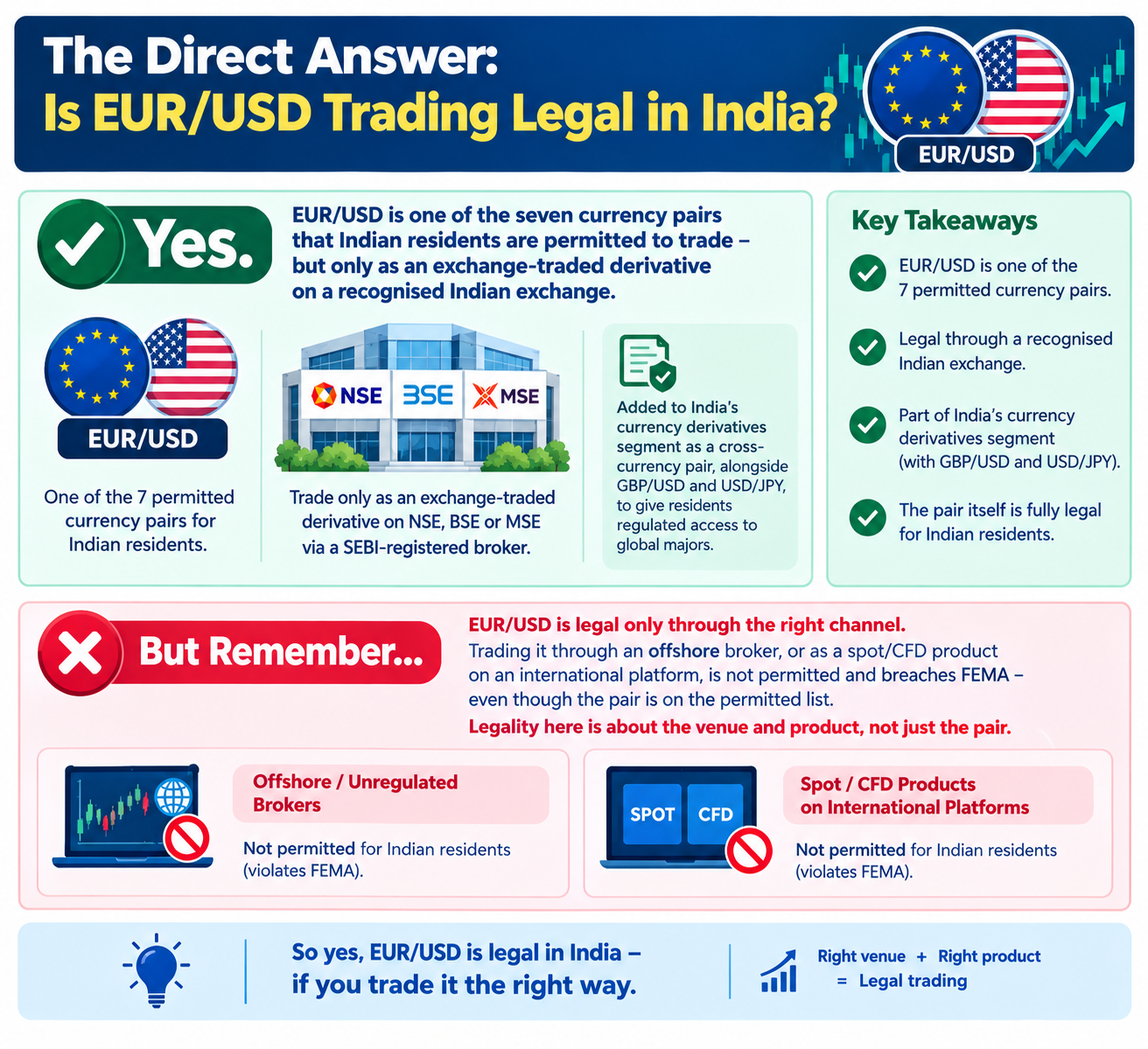
Yes. EUR/USD is one of the seven currency pairs that Indian residents are permitted to trade – but only as an exchange-traded derivative on a recognised Indian exchange. It was added to India’s currency derivatives segment as a cross-currency pair, alongside GBP/USD and USD/JPY, to give residents regulated access to global majors. So the pair itself is fully legal.
The crucial condition: EUR/USD is legal only through the right channel. Trading it through an offshore broker, or as a spot/CFD product on an international platform, is not permitted and breaches FEMA – even though the pair is on the permitted list. Legality here is about the venue and product, not just the pair.
The Key Distinction: Legal Route vs Illegal Route
This is the single idea that resolves all the confusion. The same pair – EUR/USD – can be perfectly legal or clearly illegal depending purely on how you trade it:
| Legal route | Illegal route |
|---|---|
| Exchange-traded on NSE, BSE or MSE | Offshore / international OTC broker |
| Through a SEBI-registered broker | Through an unauthorised platform |
| Currency futures & options | Spot forex or CFDs |
| Cash-settled in rupees | Settled in USD, offshore |
| Regulated, with recourse | No Indian recourse; breaches FEMA |
So when someone asks ‘is EUR/USD trading legal in India?’, the honest answer is: the pair is legal, the offshore route is not.
How EUR/USD Is Legal: The Exchange Route
On Indian exchanges, EUR/USD is available as a cross-currency future and option. Standard features (verify current specs with the exchange):
| Specification | Typical value |
|---|---|
| Instrument | Cross-currency futures & options |
| Contract size | EUR 1,000 (standard) |
| Quotation | In US dollars, to four decimals |
| Settlement | Cash-settled in INR at the RBI reference rate |
| Where | NSE, BSE, MSE via a SEBI-registered broker |
Because it is cash-settled in rupees, you never take delivery of euros or dollars – you simply gain or lose the rupee value of the price move. This keeps EUR/USD trading firmly inside India’s regulated, rupee-based system.
Why Offshore EUR/USD Is NOT Legal
The offshore version fails on several counts at once:
- Unauthorised brokers – international platforms offering EUR/USD are not RBI-authorised or SEBI-registered; several appear on the RBI Alert List.
- Wrong product – offshore EUR/USD is usually spot forex or a CFD, which fall outside the permitted exchange-traded framework.
- FEMA breach – remitting money abroad for margin or forex trading is not allowed under the Liberalised Remittance Scheme.
- No recourse – if an offshore platform freezes your funds, no Indian regulator can help you recover them.
In other words, the pair being permitted does not legalise the offshore route. The two questions – ‘is the pair allowed?’ and ‘is this platform allowed?’ – must both be answered yes.
EUR/USD on NSE vs Offshore
| Feature | EUR/USD on NSE (legal) | EUR/USD offshore (illegal) |
|---|---|---|
| Legal for residents | Yes – SEBI-regulated | No – breaches FEMA |
| Product | Exchange-traded F&O | Spot / CFD |
| Settlement | Cash in rupees | USD, offshore |
| Leverage | Exchange-set margins | Often extreme |
| Recourse if problems | SEBI / exchange | Effectively none |
How to Trade EUR/USD Legally (Checklist)
- Open a SEBI-registered broker account – and activate the currency derivatives segment.
- Find EUR/USD in the currency segment – trade it as a future or option on the NSE, BSE or MSE.
- Start small – use one contract and a fixed, small risk while you learn the pair.
- Avoid offshore platforms – check the RBI Alert List; ‘trade EUR/USD with 1:500 leverage’ is a red flag.
- Manage risk and records – use a stop-loss, size to your risk, and keep records for tax.
What Drives EUR/USD?
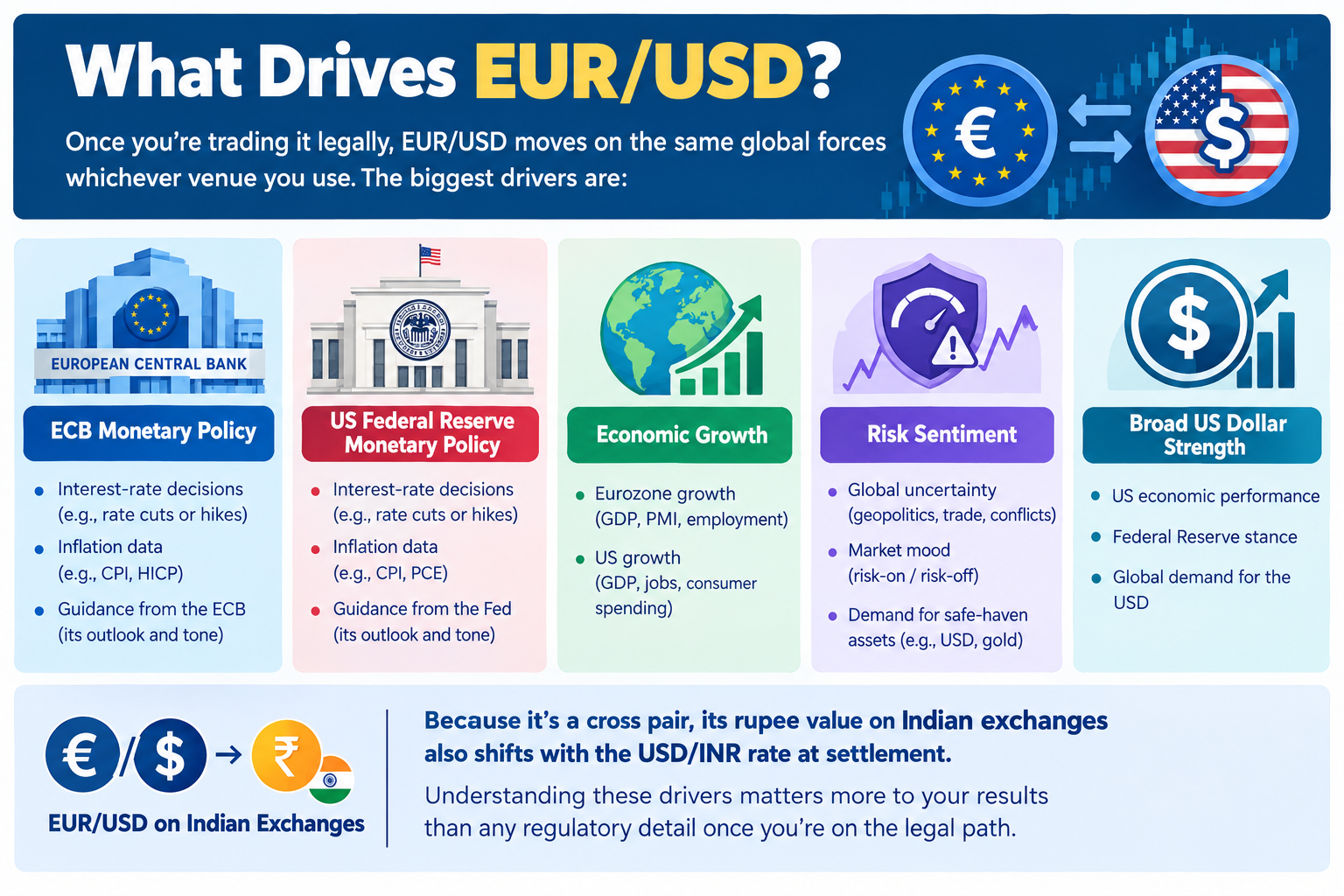
Once you’re trading it legally, EUR/USD moves on the same global forces whichever venue you use. The biggest drivers are the monetary-policy paths of the European Central Bank and the US Federal Reserve – interest-rate decisions, inflation data and guidance from each – along with growth, risk sentiment and the broad strength of the US dollar. Because it’s a cross pair, its rupee value on Indian exchanges also shifts with the USD/INR rate at settlement. Understanding these drivers matters more to your results than any regulatory detail once you’re on the legal path.
A Note on Tax
Income from exchange-traded EUR/USD derivatives is generally taxed as business income in India, added to your total income at your slab. The treatment can be nuanced depending on your overall trading activity, so confirm the specifics with a qualified chartered accountant rather than relying on a general rule.
Common Misconceptions
- ‘EUR/USD is banned in India.’ – False; it’s one of the seven permitted pairs on Indian exchanges.
- ‘Because EUR/USD is legal, any broker offering it is fine.’ – No; only SEBI brokers on recognised exchanges.
- ‘Offshore EUR/USD is a grey area.’ – It breaches FEMA; the pair being permitted doesn’t legalise the offshore route.
- ‘You take delivery of euros/dollars.’ – No; it’s cash-settled in rupees.
- ‘A VPN makes offshore EUR/USD legal.’ – It doesn’t; the FEMA position is unchanged.
Myths vs Facts
| Myth | Fact |
|---|---|
| EUR/USD trading is illegal in India. | It’s legal as an exchange-traded pair on NSE/BSE/MSE via SEBI brokers. |
| Any platform offering EUR/USD is legal. | Only SEBI-registered brokers on recognised exchanges are legal. |
| Offshore EUR/USD is allowed. | It breaches FEMA; the pair being permitted doesn’t legalise offshore trading. |
| EUR/USD is physically settled. | It’s cash-settled in rupees at the RBI reference rate. |
Compliance disclaimer
This article is for educational purposes only and is not legal, tax or investment advice. The list of permitted pairs, contract specifications and enforcement practice can change; details here were checked against 2026 sources but may since have changed. Always verify the current position with the NSE/BSE/MSE, SEBI and RBI, and consult a qualified professional before trading.
Learn more about Forex Poisition Size Calculator
Expert Analysis
EUR/USD is the perfect case study for how currency regulation actually works in India, because the intuitive question – ‘is the pair allowed?’ – is only half of it. India permits EUR/USD precisely because it wanted residents to have regulated access to the world’s benchmark pair; that’s why the cross-currency segment exists. But the state’s real concern is never the pair, it is the flow of capital and the supervisability of the venue. So it opens the pair on its own exchanges, where trades are rupee-settled and overseen, while keeping the offshore door firmly shut. The two-part test – permitted pair AND permitted venue – is the key that unlocks almost every ‘is X legal in India?’ question.
For the trader, this is genuinely good news, because the legal route is not a watered-down version of what offshore platforms offer – it is the same underlying exposure to the same global pair, minus the reckless leverage and the total absence of recourse. The euro-dollar rate an Indian exchange settles against is the same rate the world trades; what changes is that a SEBI-registered broker and a recognised exchange stand behind your position. Choosing that route means you can trade the biggest pair in the world with a clear conscience and real protection – the offshore alternative offers neither, and no advertised bonus closes that gap.
Key Takeaways
- EUR/USD is legal in India – it’s one of the seven permitted currency pairs.
- It’s legal only as an exchange-traded cross-currency derivative on NSE/BSE/MSE via a SEBI broker.
- Trading EUR/USD through offshore or CFD platforms is not permitted and breaches FEMA.
- It’s cash-settled in rupees, so you never take delivery of euros or dollars.
- The two-part test: the pair must be permitted AND the venue must be authorised.
Frequently Asked Questions (FAQ)
Q: Is EUR/USD trading legal in India?
A: Yes, but only as an exchange-traded cross-currency derivative on a recognised exchange (NSE, BSE, MSE) through a SEBI-registered broker. Offshore EUR/USD is not permitted.
Q: Can I trade EUR/USD on NSE?
A: Yes. EUR/USD is available as a cross-currency future and option in the currency derivatives segment of Indian exchanges.
Q: Is EUR/USD one of the legal pairs in India?
A: Yes. It is one of the seven permitted pairs, alongside four rupee pairs and two other cross pairs (GBP/USD, USD/JPY).
Q: Why is offshore EUR/USD trading illegal?
A: Offshore platforms aren’t RBI-authorised or SEBI-registered, offer spot/CFDs outside the permitted framework, and funding them breaches FEMA.
Q: How is EUR/USD settled in India?
A: It is cash-settled in rupees using the RBI reference rate; you never take physical delivery of euros or dollars.
Q: What is the contract size for EUR/USD on Indian exchanges?
A: The standard contract is EUR 1,000; confirm current specifications with your exchange.
Q: Can I use an international broker for EUR/USD?
A: No. Only SEBI-registered brokers routing to recognised Indian exchanges are legal for residents.
Q: Is EUR/USD a cross-currency pair?
A: Yes, from an Indian perspective – it contains no rupee leg, unlike USD/INR or EUR/INR.
Q: Does a VPN make offshore EUR/USD legal?
A: No. A VPN hides your location but does not change your FEMA position; the activity remains unauthorised.
Q: What moves EUR/USD?
A: Mainly ECB and US Federal Reserve policy, inflation and growth data, risk sentiment and broad dollar strength.
Q: Is EUR/USD income taxable in India?
A: Yes. Income from currency derivatives is generally taxed as business income; consult a chartered accountant.
Q: What leverage applies to EUR/USD on NSE?
A: Exchange-set margins rather than the extreme leverage of offshore platforms, which makes it far less risky.
Q: Is trading EUR/USD good for beginners?
A: It’s liquid and widely covered, but driven by foreign factors; beginners often start with USD/INR first.
Q: How do I know if a platform is legal for EUR/USD?
A: Confirm the broker on SEBI’s registered list and ensure trades route through a recognised Indian exchange.
Q: Can I lose access to funds on an offshore EUR/USD platform?
A: Yes. Offshore platforms are outside Indian jurisdiction, so if funds are frozen or lost, Indian authorities cannot recover them.