Quick answer
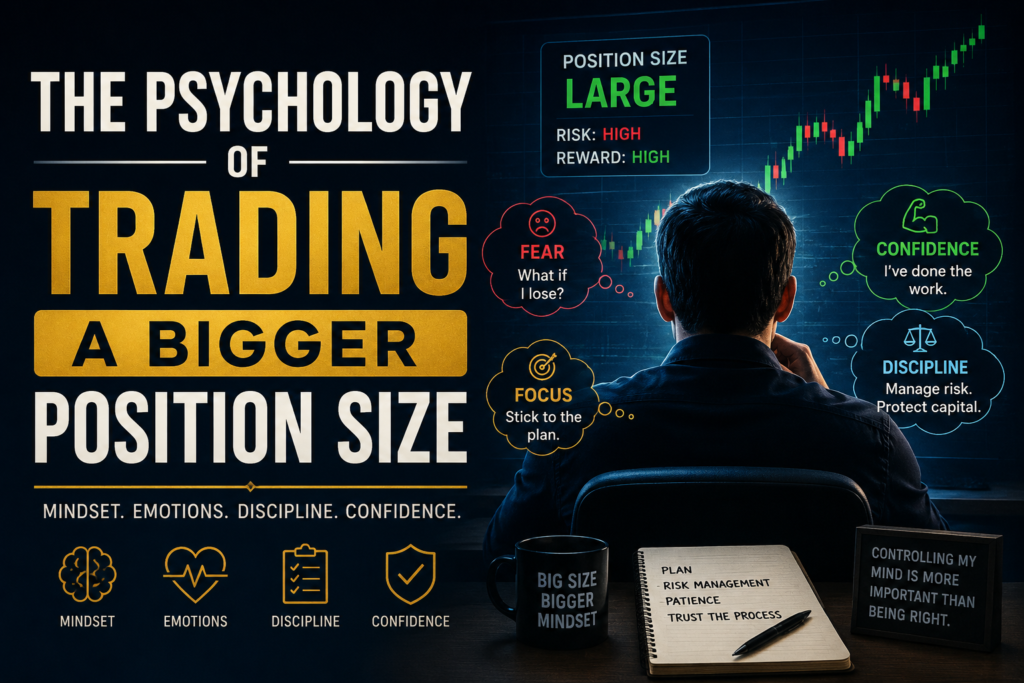
Learning how to trade bigger positions is mostly psychological, not technical. Larger size raises the money at stake, which amplifies fear and greed even at the same percentage risk. The fix is to scale up gradually, keep your risk percentage fixed, think in risk units rather than dollars, and let the mind adjust.
Introduction
A strategy that works flawlessly on a small account can fall apart the moment you size up. The setups are identical, the rules unchanged – yet suddenly you’re cutting winners early, hesitating on entries and feeling your heart rate climb. That is the psychology of position size, and understanding it is the key to learning how to trade bigger positions successfully.
This guide explains why bigger size feels so different, the mental traps it triggers, and a gradual, practical framework for scaling up without blowing up your account – or your composure. It is educational content, not financial advice.
Why Bigger Positions Feel So Different
Here is the paradox: if you always risk the same percentage of your account, a bigger position is no riskier in relative terms than a small one. Risking 1% is risking 1% whether that is $10 or $1,000. Yet the larger trade feels far more intense – because your brain reacts to the absolute money at stake, not the percentage.
| Account size | 1% risk per trade | How it tends to feel |
|---|---|---|
| $1,000 | $10 | Easy to stay calm |
| $10,000 | $100 | Noticeable pressure |
| $100,000 | $1,000 | Emotionally intense |
Same rule, same relative risk – wildly different emotions. This is why how to trade bigger positions is far more a psychological skill than a technical one.
The Psychology Behind the Struggle
Several well-known mental forces intensify as position size grows. Recognising them is the first step to managing them.
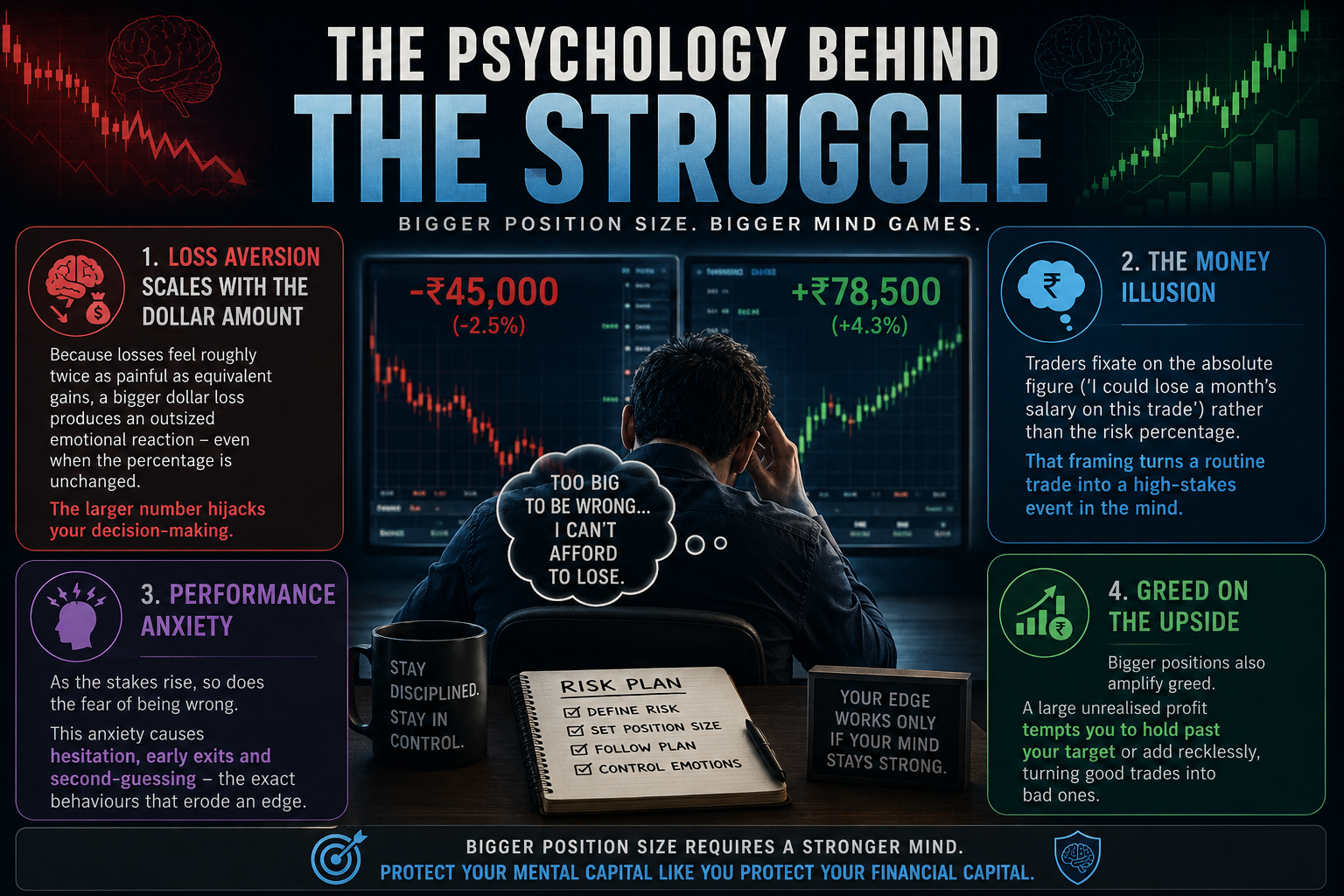
Loss aversion scales with the dollar amount
Because losses feel roughly twice as painful as equivalent gains, a bigger dollar loss produces an outsized emotional reaction – even when the percentage is unchanged. The larger number hijacks your decision-making.
The money illusion
Traders fixate on the absolute figure (‘I could lose a month’s salary on this trade’) rather than the risk percentage. That framing turns a routine trade into a high-stakes event in the mind.
Performance anxiety
As the stakes rise, so does the fear of being wrong. This anxiety causes hesitation, early exits and second-guessing – the exact behaviours that erode an edge.
Greed on the upside
Bigger positions also amplify greed. A large unrealised profit tempts you to hold past your target or add recklessly, turning good trades into bad ones.
How Bigger Size Makes Traders Self-Sabotage
When the emotional load rises, traders unconsciously break their own rules. Watch for these tells that size is getting to you:
- Cutting winners early to ‘lock in’ a now-larger profit, ruining your risk-reward.
- Moving or widening stops because a full-sized loss feels unbearable.
- Hesitating on valid entries, or skipping them entirely, out of fear.
- Micromanaging the trade – staring at every tick and reacting to noise.
- Snatching at revenge trades after a big loss to win the money back.
How to Trade Bigger Positions: A Gradual Framework
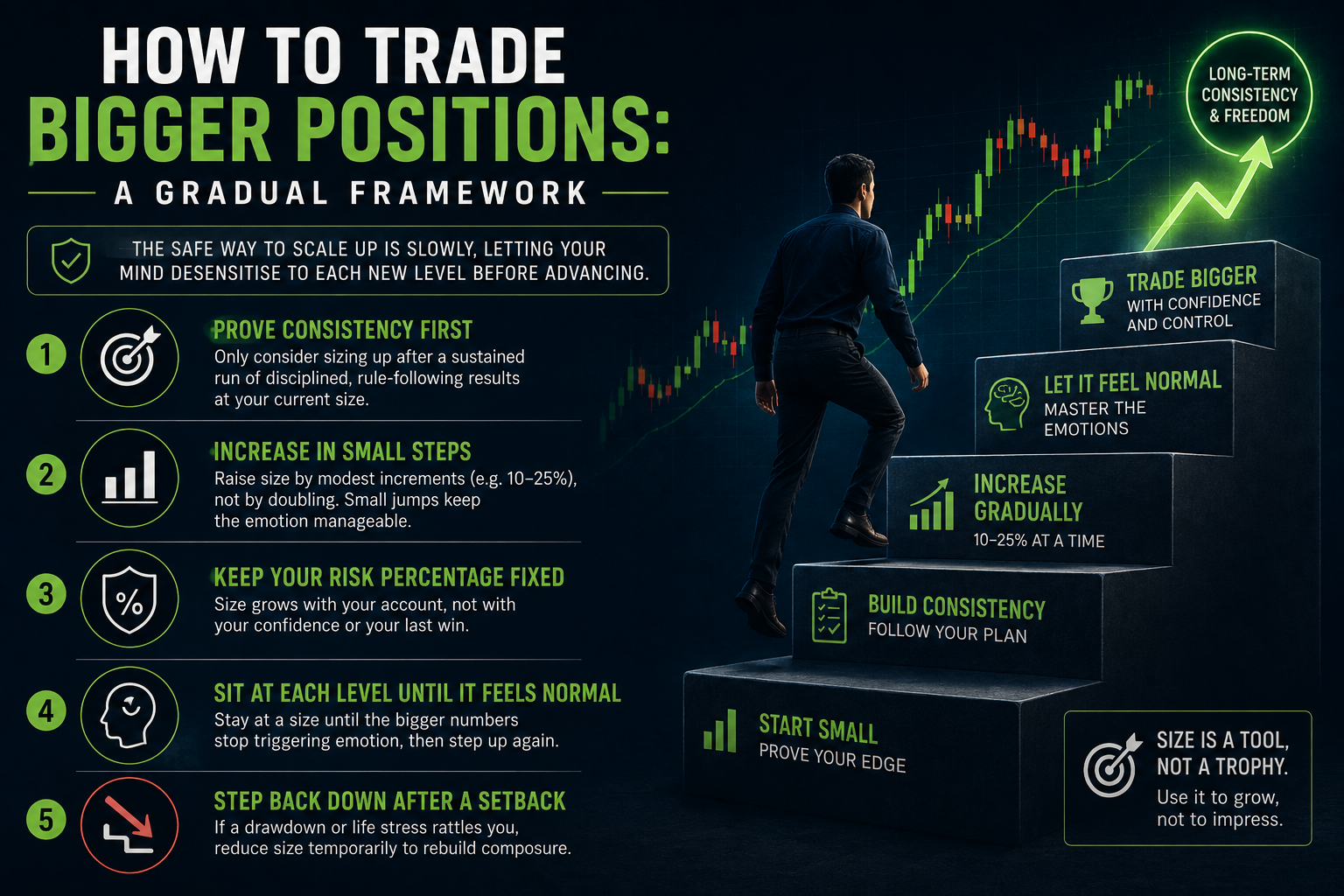
The safe way to scale up is slowly, letting your mind desensitise to each new level before advancing. Here is a step-by-step approach for how to trade bigger positions without losing control:
- Prove consistency first – only consider sizing up after a sustained run of disciplined, rule-following results at your current size.
- Increase in small steps – raise size by modest increments (e.g. 10-25%), not by doubling. Small jumps keep the emotion manageable.
- Keep your risk percentage fixed – size grows with your account, not with your confidence or your last win.
- Sit at each level until it feels normal – stay at a size until the bigger numbers stop triggering emotion, then step up again.
- Step back down after a setback – if a drawdown or life stress rattles you, reduce size temporarily to rebuild composure.
Mental Techniques That Make Size Easier
Alongside gradual scaling, these techniques directly reduce the emotional weight of a bigger position size:
- Think in R, not dollars – measure trades in risk units (1R = your fixed risk) so a win is ‘+2R’, not ‘+$2,000’. This decouples emotion from the dollar figure.
- Focus on the percentage – remind yourself the relative risk is unchanged from when the trade felt easy.
- Pre-accept the loss – before entering, fully accept losing the full risk amount. Acceptance removes the fear that drives mistakes.
- Automate exits – preset stops and targets so you don’t have to make emotional decisions on a large open trade.
- Journal the emotion – track how each new size level feels so you can see yourself adapting over time.
Learn more about How to Read the Economic Calendar for Forex Trading
When NOT to Size Up
Knowing how to trade bigger positions also means knowing when to hold off. Do not increase size:
- Right after a loss, to ‘win it back’ – that is revenge trading, not scaling.
- On a single high-conviction ‘sure thing’ – conviction is not a reason to break your sizing rules.
- When you’re tired, stressed or emotional – your tolerance for pressure is already lowered.
- Before you have a proven, consistent edge at your current size.
Myths vs Facts
| Myth | Fact |
|---|---|
| A bigger position is always riskier. | At the same fixed percentage, relative risk is unchanged; the difference is emotional. |
| Confidence means you should size up. | Size should follow account growth and consistency, not a feeling. |
| You should scale up fast to grow quickly. | Gradual increases let your psychology adapt and reduce blow-up risk. |
| If it feels scary, you’re not cut out for it. | The fear is normal; it fades as you desensitise to each new level. |
A note on wellbeing
If the size you’re trading causes real distress, sleeplessness, or an urge to chase losses, that is a sign to reduce it. Trade a size you can be calm with. If trading stress feels unmanageable, consider speaking with a mental-health professional or a problem-gambling helpline in your region.
Expert Analysis
The counter-intuitive truth about how to trade bigger positions is that the hard part is not the math – it is the nervous system. A trader’s risk model can say a position is perfectly sized, while their body screams that the dollar figure is dangerous. That gap between the rational plan and the emotional reaction is where scaling up goes wrong, and it explains why so many traders are profitable small and unprofitable large. The solution is not more willpower but graded exposure: the same principle used to overcome any fear, applied to money.
Practically, this means treating size as something you earn in small increments and then normalise before advancing. Thinking in risk units rather than currency is the single most powerful reframe, because it lets the mind evaluate a trade by its structure (‘a clean 1R risk for a 2R target’) instead of its price tag. Combine graded increases, fixed percentage risk and R-based thinking, and a bigger position size gradually stops feeling bigger at all – which is exactly the state in which a trader executes their edge cleanly.
Key Takeaways
- How to trade bigger positions is mainly a psychological skill, not a technical one.
- At a fixed risk percentage, a larger position is no riskier in relative terms – it just feels riskier.
- Bigger size amplifies loss aversion, the money illusion, performance anxiety and greed.
- Scale up gradually, keep risk percentage fixed, and let your mind adjust at each level.
- Think in risk units, pre-accept the loss, and never size up on tilt or without a proven edge.
Frequently Asked Questions (FAQ)
Q: How do I trade bigger positions without panicking?
A: Scale up gradually, keep your risk percentage fixed, think in risk units instead of dollars, and stay at each size until it feels normal before advancing.
Q: Why do I panic with a bigger position size?
A: Your brain reacts to the absolute money at stake, not the percentage, so a larger dollar figure amplifies fear even when relative risk is unchanged.
Q: Is a bigger position actually riskier?
A: At the same fixed percentage risk, relative risk is unchanged. The main difference between small and large positions is emotional, not mathematical.
Q: When should I increase my position size?
A: Only after a sustained run of disciplined, consistent results at your current size, and while keeping your risk percentage constant.
Q: How much should I increase size by?
A: In small increments – for example 10-25% at a time – rather than doubling, so your psychology can adapt to each new level.
Q: What does ‘think in R’ mean?
A: It means measuring trades in risk units, where 1R is your fixed risk amount, so outcomes read as +2R or -1R rather than emotional dollar figures.
Q: How do I overcome fear of larger positions?
A: Use graded exposure: increase size slowly, pre-accept the full loss before entering, and journal how each level feels until the fear fades.
Q: Should I size up when I’m very confident?
A: No. Confidence is not a sizing rule. Size should follow account growth and proven consistency, not a feeling about one trade.
Q: Why do I cut winners early on big trades?
A: A larger unrealised profit triggers fear of giving it back, so you exit early – which ruins your risk-reward. Preset targets help prevent this.
Q: Does keeping risk percentage fixed help?
A: Yes. A fixed percentage ties position size to your account, so it grows sensibly and no single trade becomes disproportionately large.
Q: What is the money illusion in trading?
A: Fixating on the absolute dollar amount at stake rather than the risk percentage, which makes a routine trade feel like a high-stakes event.
Q: Should I reduce size after a drawdown?
A: Often yes. Temporarily reducing size after a setback helps rebuild composure and protects your capital and judgement.
Q: Can I trade big positions as a beginner?
A: It is unwise before you have a proven, consistent edge at smaller size. Build discipline first, then scale gradually.
Q: How long does it take to get comfortable with bigger size?
A: It varies, but comfort comes from repeated exposure at each level. Sit at a size until it feels routine before stepping up.
Q: Is trading a bigger position size worth the stress?
A: Only if you can stay disciplined. If a size causes real distress, it is too big – trade a size you can execute calmly.