
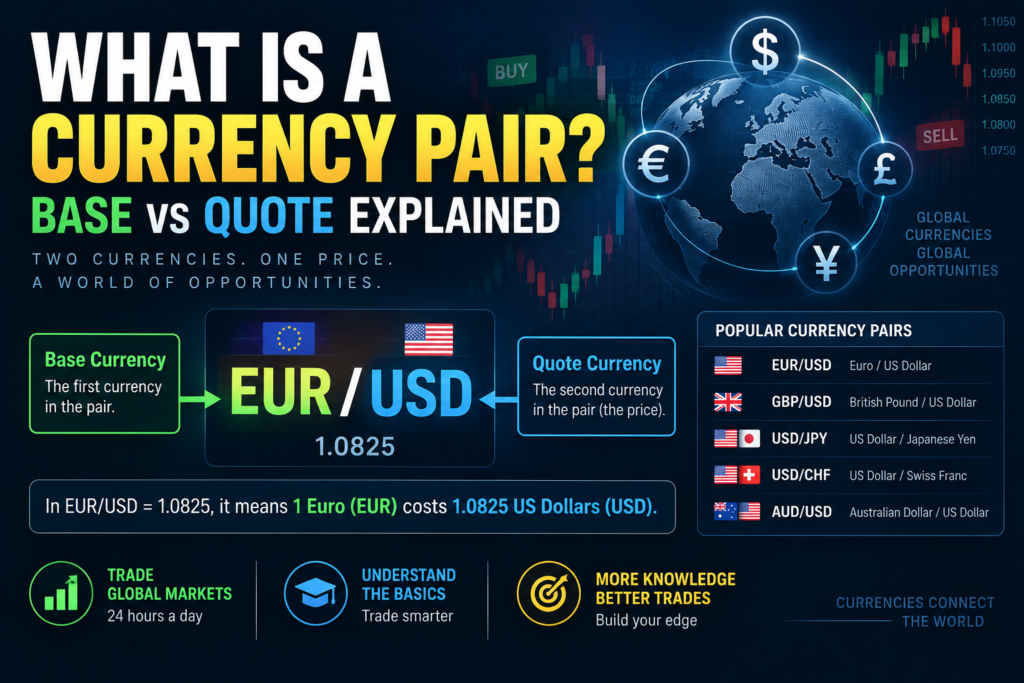
If you’ve ever looked at a forex screen and seen something like EUR/USD 1.0850, you’ve already met a currency pair — even if it looked like code. Currencies are never priced on their own; they’re always priced against another currency. So the first thing any new trader has to learn is exactly what is a currency pair, and how to read the two currencies inside it. Get that right, and quotes, charts and profit-and-loss all fall into place.
QUICK ANSWER
A currency pair is the quotation of one currency against another — for example EUR/USD. The first currency is the base and the second is the quote (or counter) currency. The price tells you how much of the quote currency it takes to buy one unit of the base. So EUR/USD 1.0850 means 1 euro costs 1.0850 US dollars.
What is a currency pair?
A currency pair is simply two currencies quoted together, showing how much one is worth in terms of the other. Because you can only measure a currency’s value relative to something else, forex is always traded in pairs — you’re never just “buying dollars,” you’re buying dollars with another currency. That relative structure is the single most important idea to grasp when you’re learning what is a currency pair.
Each pair has a shorthand built from two three-letter ISO codes — EUR (euro), USD (US dollar), GBP (British pound), JPY (Japanese yen), INR (Indian rupee), and so on — separated by a slash. When you trade the pair, you are simultaneously doing two things: taking a position in the first currency while taking the opposite position in the second. That’s why every currency pair is, at heart, a relationship rather than a single thing.
Base and quote currency: the anatomy of a pair
The two halves of every pair have names. The base currency comes first; the quote currency (also called the counter or terms currency) comes second. The number you see is always the price of one unit of the base, expressed in the quote currency. This base-and-quote structure never changes — once you internalise it, you can read any pair on any platform.
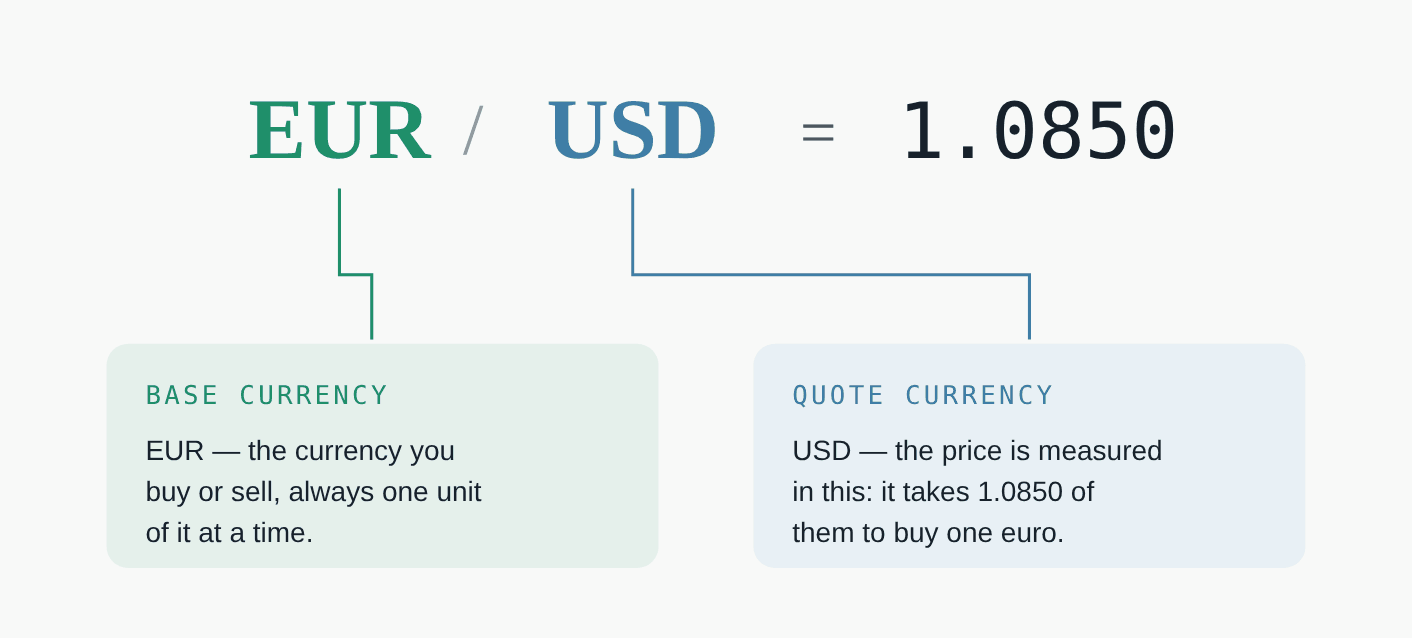
The anatomy of a quote: base currency first, quote currency second; the price is one unit of the base in quote terms.
How to read a currency pair quote
Reading a quote is a two-step habit. First, identify the base (the currency on the left). Second, read the number as the cost of one unit of that base in the quote currency. With EUR/USD 1.0850, one euro buys 1.0850 dollars. If the price rises to 1.0900, the euro has strengthened against the dollar; if it falls to 1.0800, the euro has weakened. Knowing how to read a currency pair this way means every price move immediately tells you which currency is winning.
When you “buy” a pair (go long), you buy the base currency and sell the quote currency — you’re betting the base will strengthen. When you “sell” a pair (go short), you do the reverse. The direction always refers to the base currency, never the quote.
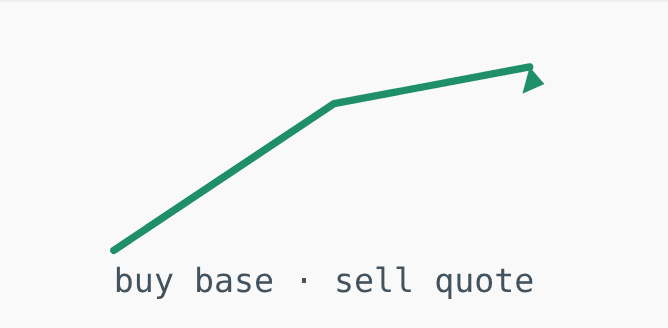
Go long: buy base, sell quote |
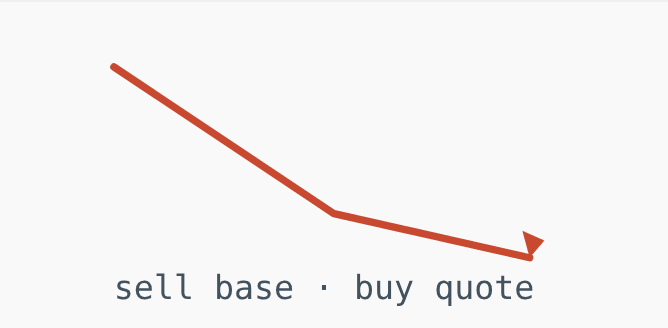
Go short: sell base, buy quote |
Bid, ask, and the spread
Look closely and a pair actually shows two prices, not one: the bid and the ask. The bid is the price at which you can sell the base currency; the ask (or offer) is the slightly higher price at which you can buy it. The small gap between them is the spread — effectively the cost of trading, and how brokers and market makers earn on each trade.
Two prices, always: you sell at the lower bid and buy at the higher ask; the gap is the spread.
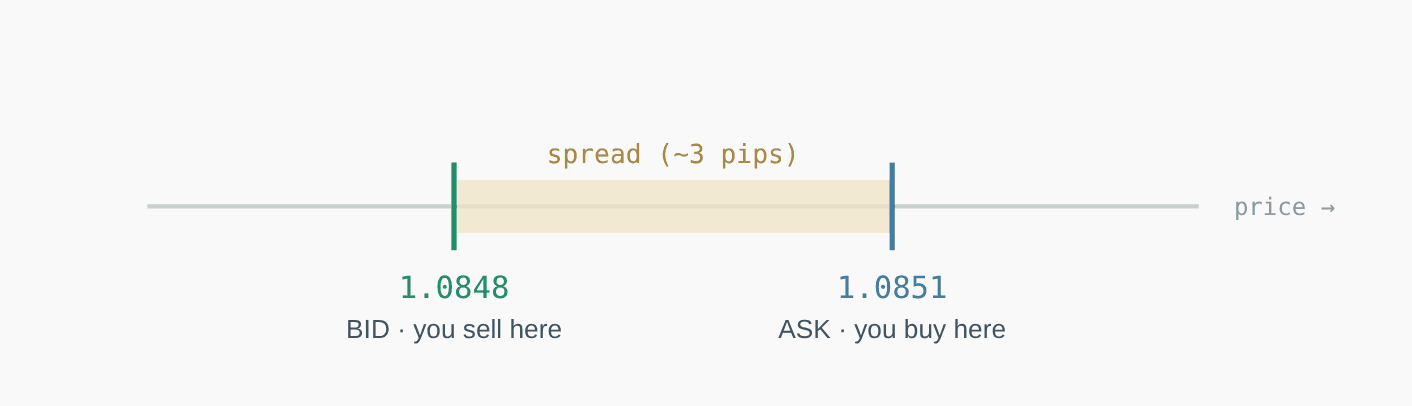
Pairs move in tiny increments called pips — usually the fourth decimal place (or the second for yen pairs). A move from 1.0850 to 1.0851 is one pip. Pips are how spreads, profits and losses are measured, but the key point for now is simply that a currency pair has a two-sided price and moves in very small steps.
Learn more about Premium and Discount Zone Strategy
The major currency pairs (and the rest)
Not all pairs are equal. Traders group them into three buckets by how heavily they’re traded. The major currency pairs all include the US dollar and account for most of global forex volume; the minors (or crosses) leave out the dollar; and the exotics combine a major currency with an emerging-market one, such as the Indian rupee.
| TYPE | WHAT IT IS | EXAMPLES |
|---|---|---|
| Majors | Most traded; every one includes USD | EUR/USD, USD/JPY, GBP/USD, USD/CHF, AUD/USD, USD/CAD |
| Minors / crosses | Major currencies without the USD | EUR/GBP, EUR/JPY, GBP/JPY |
| Exotics | A major plus an emerging-market currency | USD/INR, USD/ZAR, USD/TRY |
Majors tend to have the tightest spreads and the most liquidity, which is why beginners usually start there. Exotics like USD/INR can move sharply and cost more to trade, but for Indian traders the rupee pairs are naturally the most relevant.
Base vs quote across different pairs
The base-and-quote rule is universal, but which currency plays which role changes from pair to pair — and that trips up beginners. The dollar is the base in some pairs and the quote in others. Here’s the same reading habit applied across a few common pairs (rates are illustrative).
| PAIR & PRICE | BASE | QUOTE | WHAT THE PRICE MEANS |
|---|---|---|---|
| EUR/USD 1.0850 | EUR | USD | 1 euro = 1.0850 US dollars |
| USD/INR 95.50 | USD | INR | 1 US dollar = 95.50 rupees |
| GBP/USD 1.2700 | GBP | USD | 1 pound = 1.2700 US dollars |
| USD/JPY 148.00 | USD | JPY | 1 US dollar = 148.00 yen |
Notice how in USD/INR the dollar is the base, so the price shows rupees per dollar — when that number rises, the rupee is weakening. In EUR/USD the dollar is the quote, so a rising price means the dollar is weakening against the euro. Same currency, opposite reading, depending on where it sits in the pair.
A beginner’s reminder: understanding what is a currency pair is the foundation, not the finish line. Reading a quote correctly won’t by itself make a trade profitable — that still depends on analysis, risk management and a stop-loss. Learn the mechanics first, practise on a demo, and never risk money you can’t afford to lose.
For traders in India: you’ll mostly deal with rupee pairs like USD/INR. Residents can legally trade these as exchange-traded currency derivatives on NSE, BSE or MSE through a SEBI-registered broker; offshore spot forex is restricted under FEMA.
Key takeaways
- A currency pair prices one currency against another — forex is always traded in pairs.
- The base currency is first, the quote currency is second, and the price is one unit of the base in quote terms.
- Buying a pair means buying the base and selling the quote; selling is the reverse.
- Every pair shows a bid and an ask; the gap between them is the spread, your cost to trade.
- Pairs are grouped into majors, minors and exotics — majors (all with USD) are the most liquid.
- Which currency is base vs quote changes between pairs, so always read left-to-right.
Frequently asked questions
What is a currency pair in simple terms?
A currency pair is two currencies quoted together to show how much one is worth in terms of the other. For example, EUR/USD shows how many US dollars it takes to buy one euro. Forex is always traded in pairs because a currency’s value can only be measured against another.
What is the base currency and the quote currency?
The base currency is the first one in the pair; the quote (or counter) currency is the second. The price shown is the cost of one unit of the base, expressed in the quote currency.
How do you read a currency pair?
Read left to right: identify the base currency on the left, then read the number as how much of the quote currency (on the right) it takes to buy one unit of the base. A rising price means the base is strengthening.
What does it mean to buy or sell a currency pair?
Buying (going long) a pair means buying the base currency and selling the quote — you profit if the base strengthens. Selling (going short) is the opposite. The direction always refers to the base currency.
What are the major currency pairs?
The majors are the most heavily traded pairs, and each includes the US dollar: EUR/USD, USD/JPY, GBP/USD, USD/CHF, AUD/USD and USD/CAD. They generally have the tightest spreads and highest liquidity.
What is the bid-ask spread in a currency pair?
The bid is the price at which you can sell the base currency and the ask is the higher price at which you can buy it. The difference between them is the spread — effectively your cost of trading the pair.
Why is the US dollar sometimes the base and sometimes the quote?
By market convention, some pairs quote the dollar first (like USD/INR or USD/JPY) and others quote it second (like EUR/USD or GBP/USD). You simply read each pair left to right; the base is always whichever currency appears first.
Which currency pairs are most relevant for Indian traders?
Rupee pairs such as USD/INR, EUR/INR, GBP/INR and JPY/INR, which residents can trade as exchange-traded currency derivatives on Indian exchanges through a SEBI-registered broker.