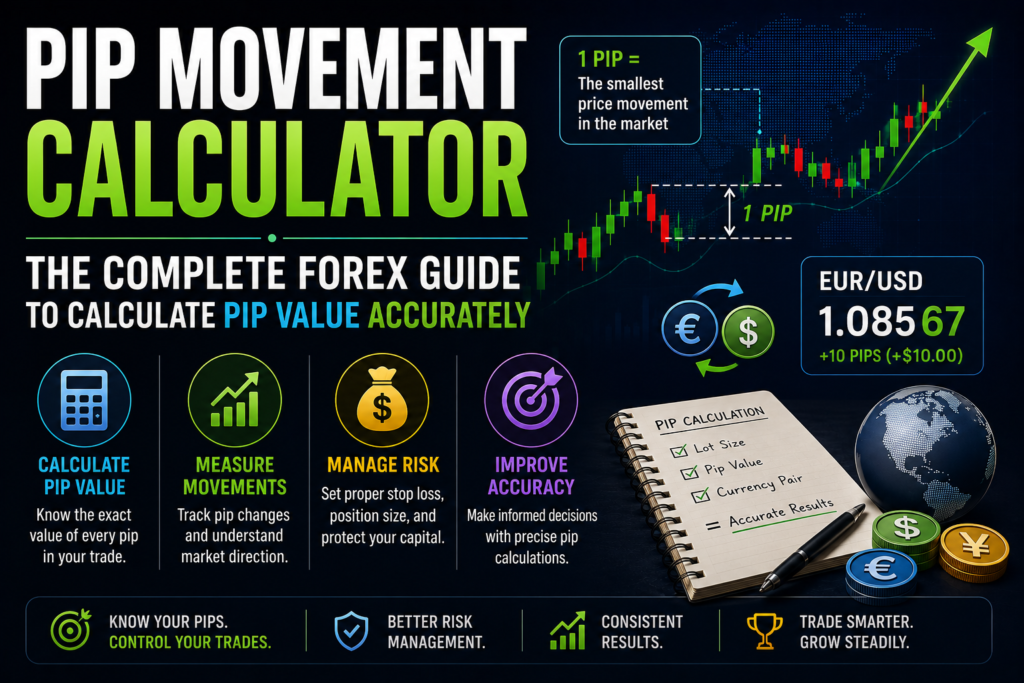
New traders obsess over entries and indicators, then pick their trade size almost at random. That’s backwards. Your lot size is what turns a chart into real money: it sets how much each pip is worth, and together with your stop-loss it fixes the exact rupees or dollars at risk. Get it right and a losing streak is survivable; get it wrong and one bad trade can wipe out weeks of gains. This is forex lot size explained the practical way — what a lot is, the sizes available, and a simple formula to choose the right one every time.
QUICK ANSWER
A lot is a standardised bundle of currency units. A standard lot is 100,000 units of the base currency; a mini lot is 10,000; a micro lot is 1,000; a nano lot is 100. Bigger lots mean a bigger pip value and bigger risk. To pick lot size, work backwards from risk: lot size = (account × risk %) ÷ (stop-loss in pips × pip value per lot).
What is a lot in forex?
Currencies trade in fixed quantities called lots, so brokers and exchanges can standardise contracts. Rather than buying “43,712 euros,” you buy a set number of lots, each a defined number of units of the base currency. The lot you choose scales everything downstream: a bigger lot controls more currency, so each one-pip move is worth more money, for better and for worse. That direct link between lot size and money-per-pip is the whole reason lot size matters.
Forex lot size explained: standard, mini, micro and nano
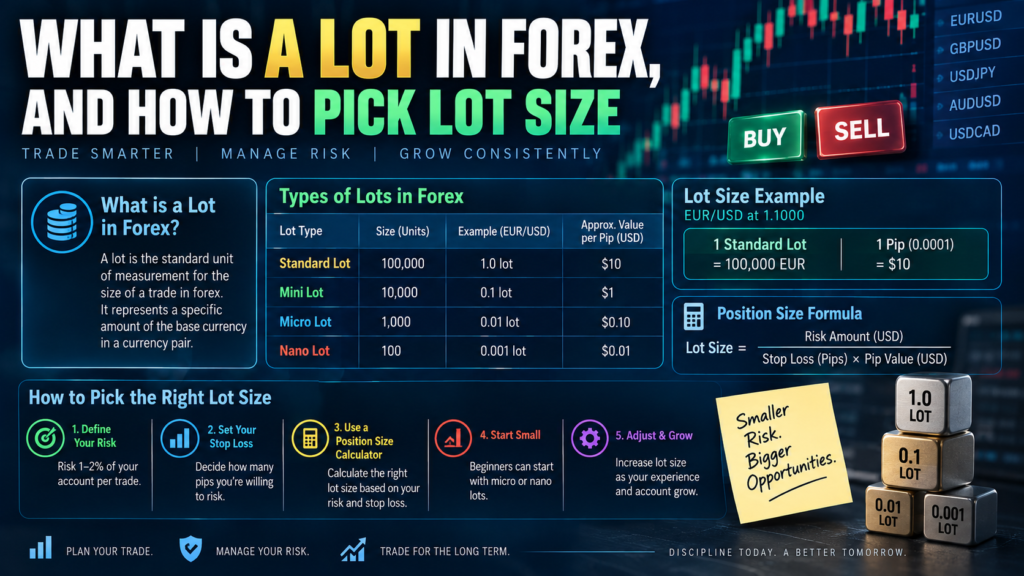
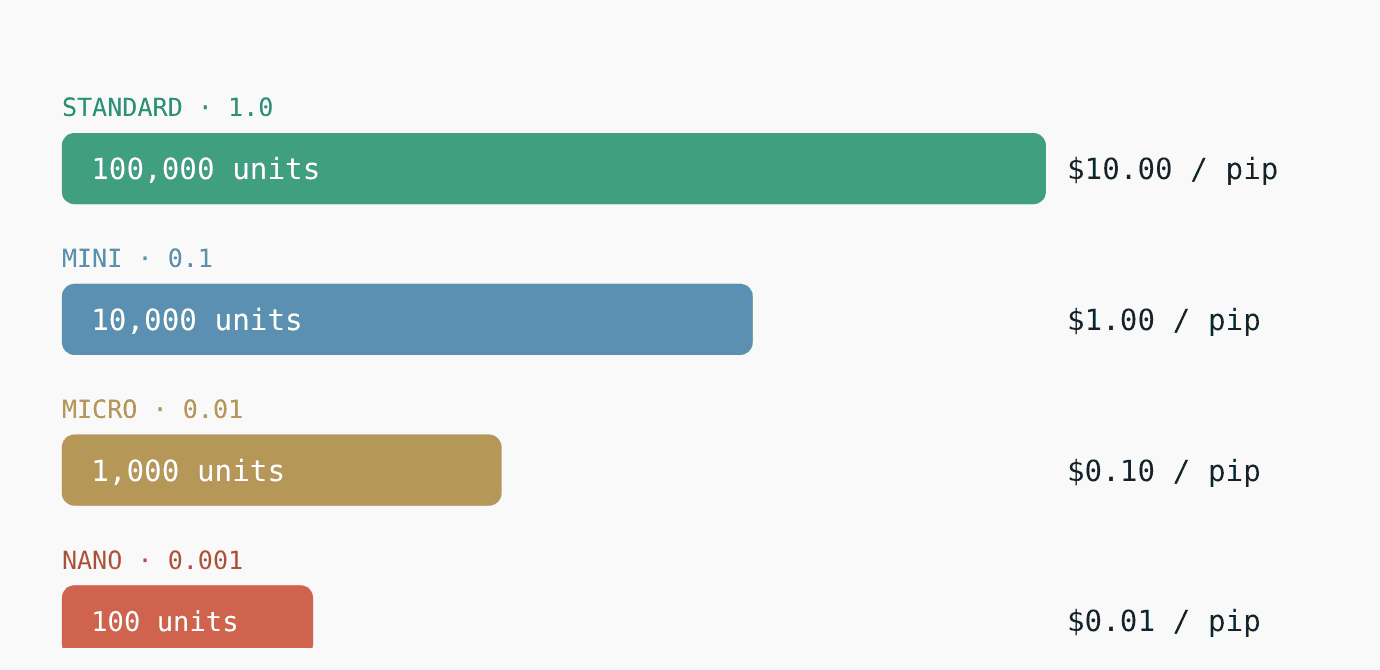
There are four common lot sizes, each ten times smaller than the last. Here is forex lot size explained at a glance — the units they represent, and what a single pip is worth on a US-dollar-quoted pair like EUR/USD.
| LOT | NOTATION | UNITS OF BASE | PIP VALUE (USD-QUOTED PAIR) |
|---|---|---|---|
| Standard | 1.0 | 100,000 | $10.00 |
| Mini | 0.1 | 10,000 | $1.00 |
| Micro | 0.01 | 1,000 | $0.10 |
| Nano | 0.001 | 100 | $0.01 |
Lot size, pips and money
The reason lot size deserves your attention is the chain it sits in: lot size → pip value → money at risk. On a USD-quoted pair, one pip on a standard lot is worth about $10, on a mini lot $1, on a micro lot 10 cents. So if your trade moves 30 pips against you, that’s a $300 loss on a standard lot but just $3 on a micro. Same chart, same pips — wildly different outcomes, decided entirely by the lot size you chose. Understanding that link is really what forex lot size explained comes down to.
How to pick your lot size: work backwards from risk
Here’s the shift that separates disciplined traders from gamblers. Don’t pick a lot size and see what happens — decide how much you’re willing to lose first, then let that dictate the lot. Most professionals risk a small, fixed fraction of their account per trade, commonly 1–2%. From there, the lot size is just arithmetic.
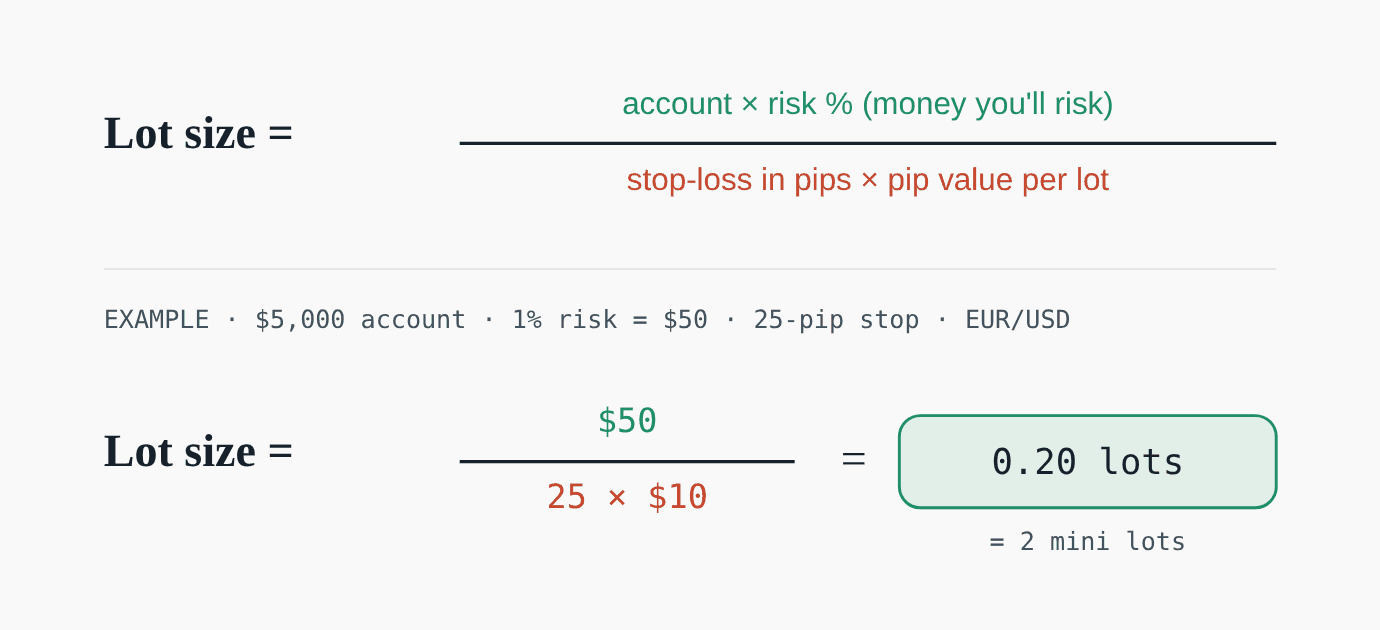
Walk through it: a $5,000 account risking 1% means $50 at risk on the trade. Your stop-loss on EUR/USD is 25 pips away, and one pip on a standard lot is $10 — so a full standard lot would lose 25 × $10 = $250 if stopped out, five times too much. Divide the $50 you’re willing to risk by that $250, and you get 0.20 lots — two mini lots. At that size, a 25-pip loss costs exactly $50, no more. That single calculation is how to calculate lot size properly, and it works for any account, pair or stop distance.
Lot size vs leverage: don’t confuse them
Beginners often mix up lot size and leverage, but they answer different questions. Lot size (with your stop) sets how much you can lose. Leverage only sets how much margin the broker asks you to put up to hold that position. Leverage of 1:30 lets you control a 0.2-lot position with a small deposit, but it does not change the fact that a 25-pip stop still risks $50. High leverage is dangerous only because it tempts traders into oversized lots — the risk always comes from lot size and stop distance, never from leverage by itself.
Common lot-size mistakes
- Trading too big. The number-one account killer. Sizing so a normal losing streak can’t blow up the account is the whole point of position sizing forex.
- Picking a round lot out of habit. “One lot” or “0.1 lot” isn’t a size — it should be calculated from your risk and stop each time.
- Ignoring the stop distance. A wider stop needs a smaller lot to keep the same money at risk; a tighter stop allows a larger one.
- Confusing leverage with position size. More leverage doesn’t mean you should trade bigger — it just lowers the margin required.
- Changing size emotionally. Doubling up to “win it back” after a loss is how small drawdowns become disasters.
The honest caveat: position sizing is risk control, not a profit machine. Choosing the right lot size won’t make a losing strategy win — it simply ensures no single trade can ruin you while you find out whether your edge is real. Keep per-trade risk small (many keep it at 1%), always pair a lot size with a stop-loss, and never size up just because a trade “feels” certain.
For traders in India: the 100,000-unit “standard lot” is the offshore/OTC convention. On Indian exchanges, currency futures use fixed contract sizes — for example, one USD/INR lot on the NSE is USD 1,000, where a one-paisa (₹0.01) move is worth about ₹10 per lot. Residents trade these exchange-traded currency derivatives through a SEBI-registered broker; offshore spot forex is restricted under FEMA.
Key takeaways
- A lot is a standardised block of currency: standard 100,000 units, mini 10,000, micro 1,000, nano 100.
- Lot size sets your pip value — about $10, $1, $0.10 and $0.01 per pip on USD-quoted pairs.
- Pick lot size from risk: (account × risk %) ÷ (stop pips × pip value per lot).
- Risk a small fixed fraction per trade — commonly 1–2% of the account.
- Lot size sets your risk; leverage sets your margin — they are not the same thing.
- In India, exchange-traded currency futures use fixed lots (e.g. USD/INR = USD 1,000), not the 100k standard lot.
Frequently asked questions
What is a lot in forex?
A lot is a standardised quantity of currency used to size a trade. The standard lot is 100,000 units of the base currency, with mini (10,000), micro (1,000) and nano (100) lots as smaller options. Your lot size determines how much each pip is worth.
What is the difference between standard, mini and micro lots?
They differ by a factor of ten: a standard lot is 100,000 units, a mini lot 10,000 (0.1), and a micro lot 1,000 (0.01). On a USD-quoted pair their pip values are roughly $10, $1 and $0.10 respectively.
How do I calculate the right lot size?
Divide the money you’re willing to risk by your loss-per-lot at your stop: lot size = (account × risk %) ÷ (stop-loss in pips × pip value per lot). For a $5,000 account risking 1% ($50) with a 25-pip stop on EUR/USD, that’s $50 ÷ (25 × $10) = 0.20 lots.
How much should I risk per trade?
A common, conservative rule is 1–2% of your account per trade. Keeping risk small means an ordinary run of losses won’t seriously damage the account, which is the main purpose of position sizing.
Is lot size the same as leverage?
No. Lot size (with your stop) determines how much you can lose; leverage only determines how much margin you must deposit to hold the position. You can trade a small, safe lot even with high leverage available.
What lot size is best for beginners?
Micro lots (1,000 units, about $0.10 per pip) are ideal for beginners because they keep the money at risk very small while you learn. Some brokers offer even smaller nano lots.
What is the lot size for USD/INR on Indian exchanges?
On the NSE, one USD/INR currency-futures contract is USD 1,000. A one-paisa (₹0.01) move is worth about ₹10 per lot. This is different from the offshore 100,000-unit standard lot.
Does lot size change pip value?
Yes — pip value scales directly with lot size. On a USD-quoted pair a pip is about $10 on a standard lot, $1 on a mini and $0.10 on a micro, so choosing the lot size is choosing your money-per-pip.