
Quick answer
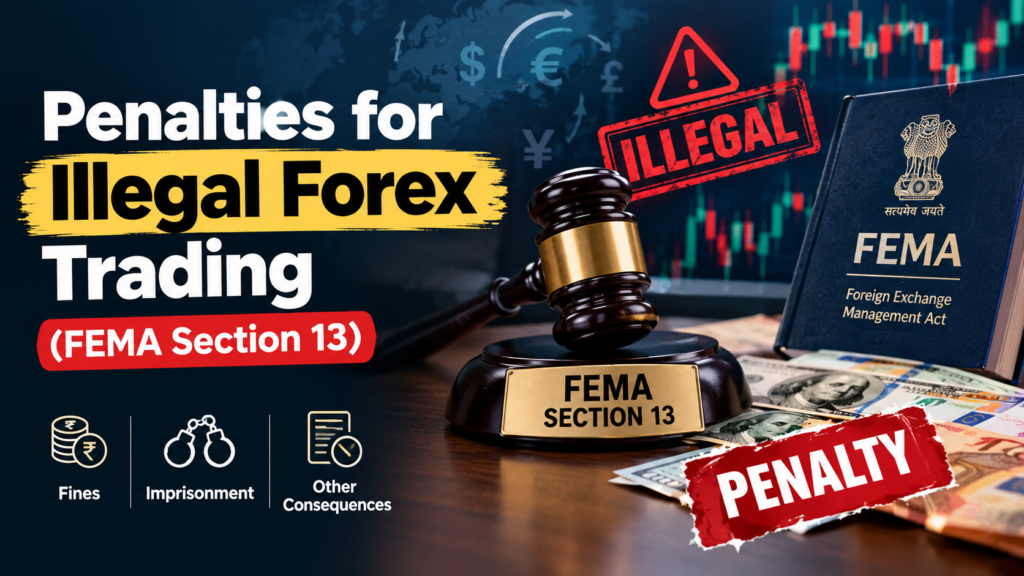
The main forex trading penalty in India comes from FEMA Section 13: up to three times the amount involved (or up to Rs 2 lakh where not quantifiable), plus Rs 5,000 per day for a continuing breach. FEMA is civil law, so the first consequence is a fine, not jail – but illegal offshore forex cannot be compounded.
Introduction
Offshore forex apps rarely mention what happens if things go wrong with the law – so most Indian traders have no idea what they’re actually risking. The forex trading penalty in India for using unauthorised platforms is real, defined, and can dwarf any profit you hoped to make. It flows mainly from one provision: Section 13 of FEMA.
This guide explains exactly what that penalty is, whether you can go to jail, how enforcement works, and the one settlement route that is – crucially – closed to illegal forex. Details were verified against current 2026 sources, but the law and its enforcement evolve, so confirm with a qualified professional. This is educational information, not legal advice.
First: Is Illegal Forex a Crime or a Civil Offence?
This is the most important thing to understand, because it defuses a lot of fear-mongering. FEMA (the Foreign Exchange Management Act, 1999) is a civil law. It replaced the older FERA, which was criminal, precisely to move from prosecution-first to penalty-first. So a FEMA contravention – including illegal forex trading – is primarily a civil matter, and the first consequence is a monetary penalty, not an automatic jail sentence. Imprisonment only enters the picture at a later stage, and only for failing to pay a penalty (more on that below).
What Counts as ‘Illegal Forex Trading’?
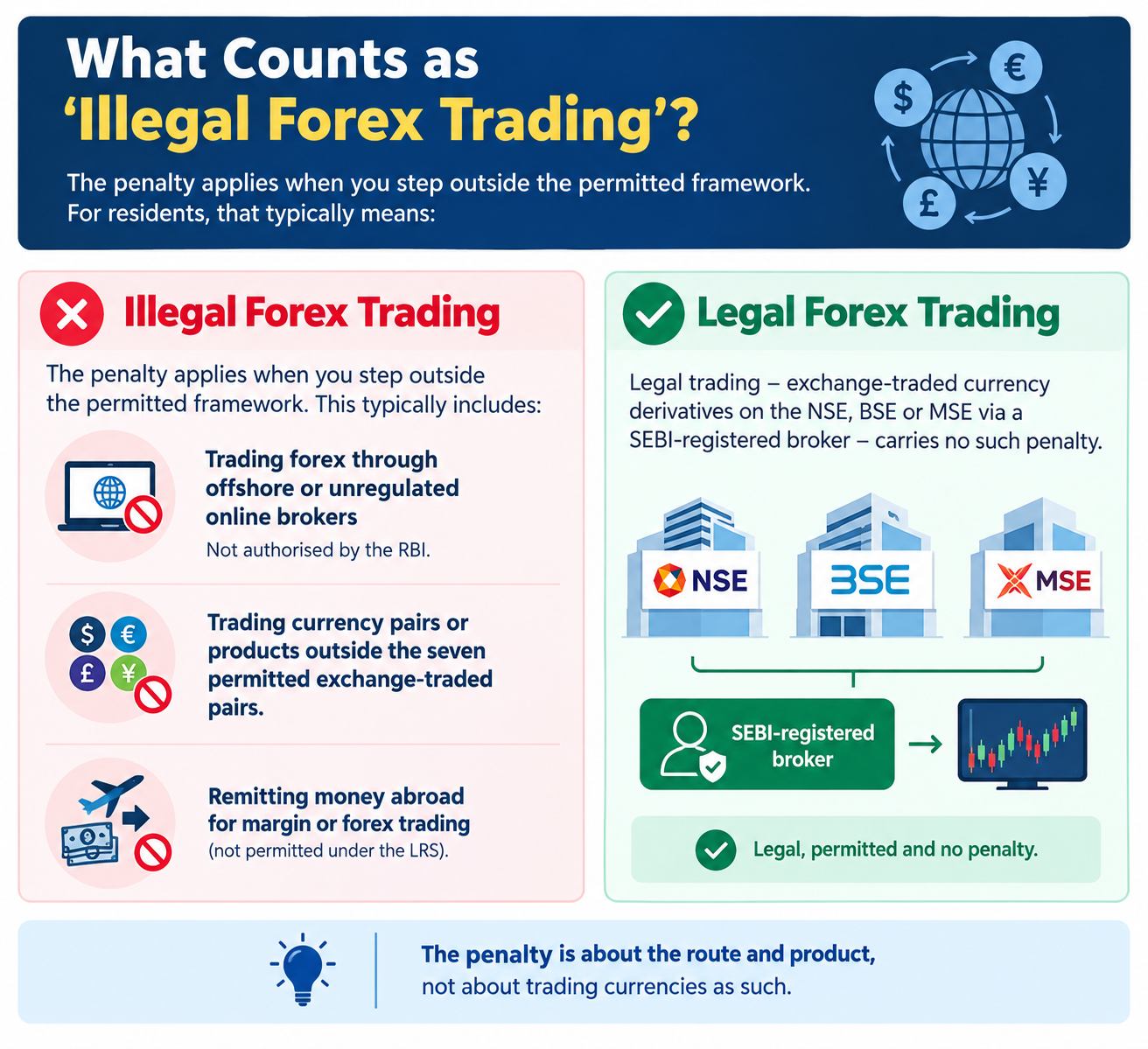
The penalty applies when you step outside the permitted framework. For residents, that typically means:
- Trading forex through offshore or unregulated online brokers not authorised by the RBI.
- Trading currency pairs or products outside the seven permitted exchange-traded pairs.
- Remitting money abroad for margin or forex trading (not permitted under the LRS).
Legal trading – exchange-traded currency derivatives on the NSE, BSE or MSE via a SEBI-registered broker – carries no such penalty. The penalty is about the route and product, not about trading currencies as such.
FEMA Section 13: The Core Penalty
Section 13(1) is the heart of the forex trading penalty in India. On adjudication, a person who contravenes FEMA is liable to pay:
| Situation | Maximum penalty |
|---|---|
| Amount is quantifiable | Up to 3 times the sum involved in the contravention |
| Amount is not quantifiable | Up to Rs 2,00,000 (Rs 2 lakh) |
| Continuing contravention | A further up to Rs 5,000 per day after the first day |
Worked example (illustrative): if a resident traded roughly Rs 10 lakh through an unauthorised offshore platform, the maximum Section 13 penalty could be up to 3 x Rs 10 lakh = Rs 30 lakh – plus Rs 5,000 for each day the breach continued. These are ceilings; the Adjudicating Authority sets the actual figure based on the facts.
The Extra Bite for Illegal Forex: Section 3(a)
Here’s the point most articles miss. Dealing in foreign exchange through an unauthorised person – which is exactly what using an offshore broker is – is a contravention of Section 3(a) of FEMA. And Section 3(a) contraventions are specifically excluded from compounding (the settlement route explained below). In plain terms, routine paperwork lapses can be quietly settled; illegal offshore forex generally cannot. That places it in the most serious category, with maximum exposure to full adjudication and enforcement action rather than a soft landing.
Section 14: What Happens If You Don’t Pay
If a penalty is imposed and not paid within the prescribed period (generally 90 days), Section 14 kicks in. The authorities can recover the amount, and in some cases the defaulter can face civil imprisonment. This is the only route by which a FEMA matter leads to jail – and note the trigger: it is the non-payment of the penalty, not the act of trading itself. The distinction matters, because it means the realistic risk for most people is financial, provided any penalty is dealt with.
Section 15: Compounding (and Why It’s Closed to Illegal Forex)
FEMA offers a settlement mechanism called compounding under Section 15. It lets a person admit a contravention and pay a compounding amount – usually far lower than the adjudication maximum – to close the matter, after which no further penalty or proceedings apply. The RBI compounds most reporting and procedural lapses; applications are filed through the RBI’s digital portal and are meant to be decided within 180 days.
The catch for forex traders
Compounding is not available for Section 3(a) contraventions – dealing in forex through unauthorised persons. So the very category most retail ‘illegal forex’ falls into is the one that generally cannot be settled by compounding, unlike ordinary corporate reporting delays.
Who Enforces It?
Enforcement runs through a defined chain. The Directorate of Enforcement (ED) investigates FEMA contraventions, including unauthorised forex dealing. An Adjudicating Authority determines the penalty after giving the person an opportunity to respond (usually at least 30 days). Appeals go to the Special Director (Appeals) and then the Appellate Tribunal, with a further appeal to the High Court on questions of law. For companies, Section 42 makes the responsible directors and officers personally liable.
Beyond the Penalty: The Bigger Losses
The Section 13 fine is only part of the cost of illegal forex. In practice, the larger loss is usually the money itself: offshore platforms sit outside Indian jurisdiction, so if withdrawals freeze or funds vanish, no Indian authority can recover them for you. Add potential tax complications, the stress and expense of ED proceedings, and the reputational hit if you run a business, and the maths turns firmly against the offshore route – regardless of any advertised leverage or bonus.
The Jail Myth
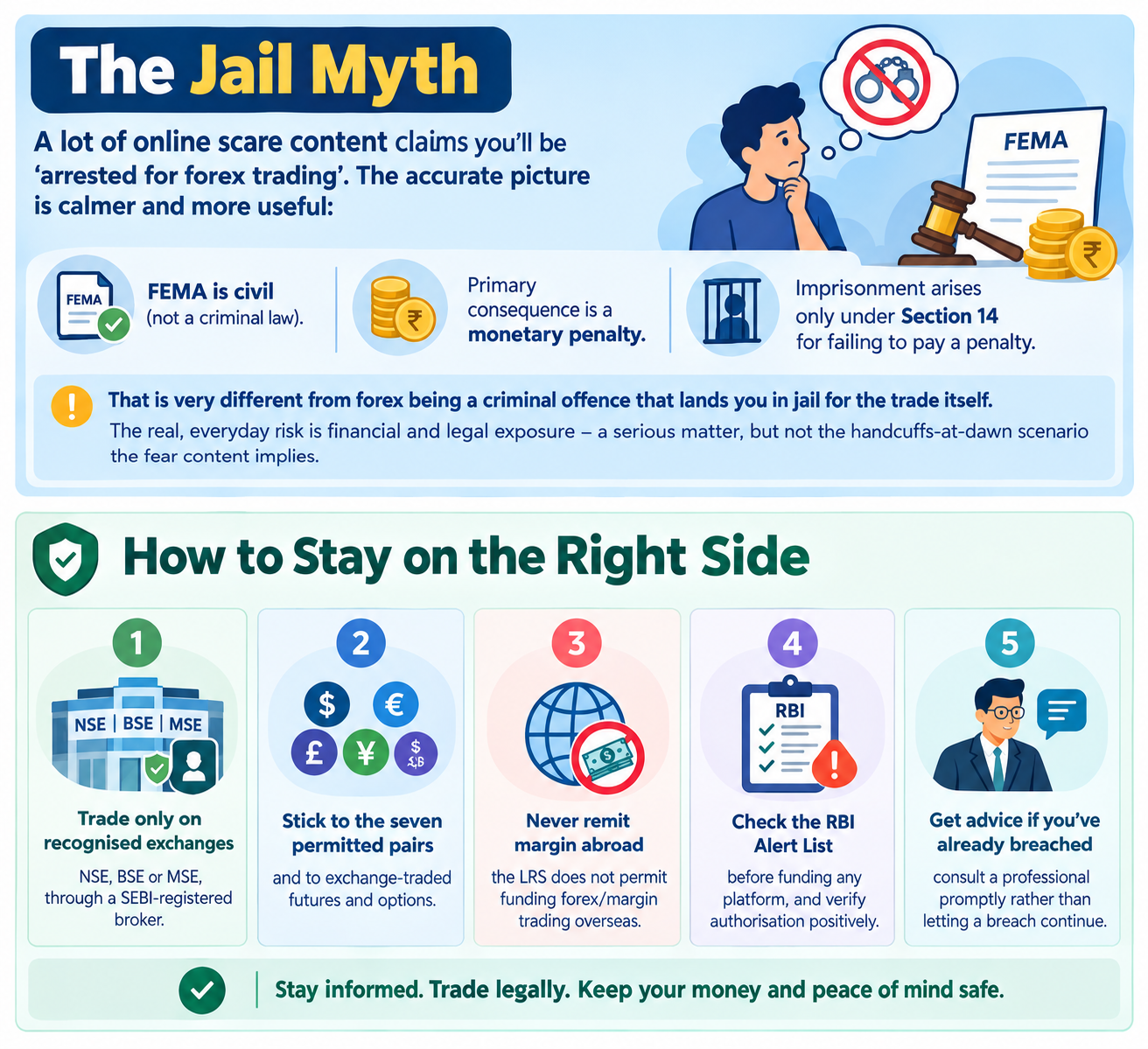
A lot of online scare content claims you’ll be ‘arrested for forex trading’. The accurate picture is calmer and more useful: FEMA is civil, the primary consequence is a monetary penalty, and imprisonment arises only under Section 14 for failing to pay a penalty. That is very different from forex being a criminal offence that lands you in jail for the trade itself. The real, everyday risk is financial and legal exposure – a serious matter, but not the handcuffs-at-dawn scenario the fear content implies.
How to Stay on the Right Side
- Trade only on recognised exchanges – NSE, BSE or MSE, through a SEBI-registered broker.
- Stick to the seven permitted pairs – and to exchange-traded futures and options.
- Never remit margin abroad – the LRS does not permit funding forex/margin trading overseas.
- Check the RBI Alert List – before funding any platform, and verify authorisation positively.
- Get advice if you’ve already breached – consult a professional promptly rather than letting a breach continue.
Common Misconceptions
- ‘You get arrested for forex trading.’ – FEMA is civil; the first consequence is a penalty, not jail.
- ‘Any FEMA breach can be settled.’ – Section 3(a) illegal forex generally cannot be compounded.
- ‘The penalty is a small fine.’ – It can be up to three times the amount involved, plus daily add-ons.
- ‘Only the broker is liable.’ – The resident bears the FEMA exposure; company officers can be personally liable.
- ‘If I’m not caught, there’s no risk.’ – Beyond the law, offshore funds have no recovery route if lost.
Myths vs Facts
| Myth | Fact |
|---|---|
| Illegal forex is a jailable crime. | FEMA is civil; jail arises only for non-payment of a penalty under Section 14. |
| The fine is minor. | Section 13 allows up to 3x the amount, plus Rs 5,000/day for continuing breaches. |
| You can always compound a breach. | Section 3(a) unauthorised forex dealing generally can’t be compounded. |
| The offshore broker carries the risk. | The resident bears the FEMA penalty and the loss if funds vanish. |
Compliance disclaimer
This article is for educational purposes only and is not legal, tax or investment advice. FEMA penalty provisions, compounding rules and enforcement practice change; details here were checked against 2026 sources but may since have changed. Always verify the current position with the RBI and a qualified professional (such as a lawyer or chartered accountant) before acting, and seek advice promptly if you may have contravened FEMA.
Expert Analysis
The forex trading penalty in India is widely misunderstood in both directions. On one side, offshore brokers downplay it to nothing; on the other, scare content inflates it into imminent arrest. The accurate reading sits between: FEMA is a civil statute whose main weapon is a large monetary penalty – up to three times the amount involved – with jail reserved for those who refuse to pay. For a resident, that means the honest risk of illegal forex is best thought of as a potential multiple of the money you moved, not a criminal record for the act of trading. Once framed that way, the economics become obvious: a penalty of up to 3x plus daily add-ons can erase not just your gains but several times your capital.
What sharpens the picture is Section 3(a) and the compounding carve-out. Ordinary FEMA lapses – a late filing, a missed form – are routinely and cheaply settled through compounding, which is why compliance advisers treat most contraventions as manageable. Unauthorised forex dealing is deliberately excluded from that relief, signalling that the state treats it as a serious breach rather than a technicality. For the trader, the takeaway is unusually clear-cut: the legal route (SEBI-registered brokers, recognised exchanges, the seven permitted pairs) carries zero FEMA penalty risk, while the offshore route carries the most serious, least-forgivable category of exposure. There is no version of the risk-reward calculation in which the offshore path wins.
Key Takeaways
- The main forex trading penalty in India is FEMA Section 13: up to 3x the amount, or up to Rs 2 lakh if not quantifiable.
- A continuing contravention adds up to Rs 5,000 per day after the first day.
- FEMA is civil – the first consequence is a fine; jail only arises under Section 14 for non-payment.
- Illegal offshore forex is a Section 3(a) contravention and generally cannot be compounded.
- Trading legally on NSE/BSE/MSE via a SEBI broker carries no such penalty risk.
Learn more about FEMA and Forex
Frequently Asked Questions (FAQ)
Q: What is the penalty for illegal forex trading in India?
A: Under FEMA Section 13, up to three times the amount involved (or up to Rs 2 lakh if not quantifiable), plus Rs 5,000 per day for a continuing contravention.
Q: Is forex trading a criminal offence in India?
A: No. FEMA is a civil law, so illegal forex is a civil contravention; the first consequence is a monetary penalty, not a criminal conviction.
Q: Can I go to jail for forex trading in India?
A: Not for the trading itself. Imprisonment can arise only under Section 14 for failing to pay a penalty that has been imposed.
Q: What is FEMA Section 13?
A: The provision that sets penalties for contravening FEMA – up to three times the sum involved, or up to Rs 2 lakh where not quantifiable, plus daily add-ons.
Q: How is the penalty calculated?
A: The Adjudicating Authority sets it up to the ceiling – three times the amount for quantifiable breaches – based on the facts and gravity of the case.
Q: What is a continuing contravention penalty?
A: Where a breach persists, a further penalty of up to Rs 5,000 per day can apply for each day after the first that it continues.
Q: Can a FEMA forex violation be compounded?
A: Most FEMA breaches can be, but dealing in forex through unauthorised persons (Section 3(a)) is generally excluded from compounding.
Q: What is compounding under FEMA?
A: A settlement route under Section 15 where you admit a contravention and pay a compounding amount to close it, usually far below the adjudication maximum.
Q: Who enforces FEMA penalties?
A: The Directorate of Enforcement investigates, an Adjudicating Authority imposes penalties, and appeals go to the Appellate Tribunal and then the High Court.
Q: Is only the broker liable, or me too?
A: The resident bears the FEMA exposure. For companies, responsible directors and officers can be personally liable under Section 42.
Q: What if I can’t pay the penalty?
A: Under Section 14 the authorities can recover it, and in some cases civil imprisonment can follow non-payment.
Q: Does trading legally carry any penalty?
A: No. Exchange-traded currency derivatives on NSE/BSE/MSE via a SEBI-registered broker are fully compliant and carry no FEMA penalty.
Q: How much could a Rs 10 lakh illegal trade cost?
A: Illustratively, up to 3x = Rs 30 lakh under Section 13, plus daily add-ons – a ceiling set by the authority, not a fixed figure.
Q: Should I disclose a past breach?
A: Getting professional advice promptly is wise; letting a contravention continue can add daily penalties and worsen exposure.
Q: Will I lose my money on an offshore platform?
A: Possibly. Offshore platforms are outside Indian jurisdiction, so if funds are frozen or lost, Indian authorities cannot recover them.