Quick answer
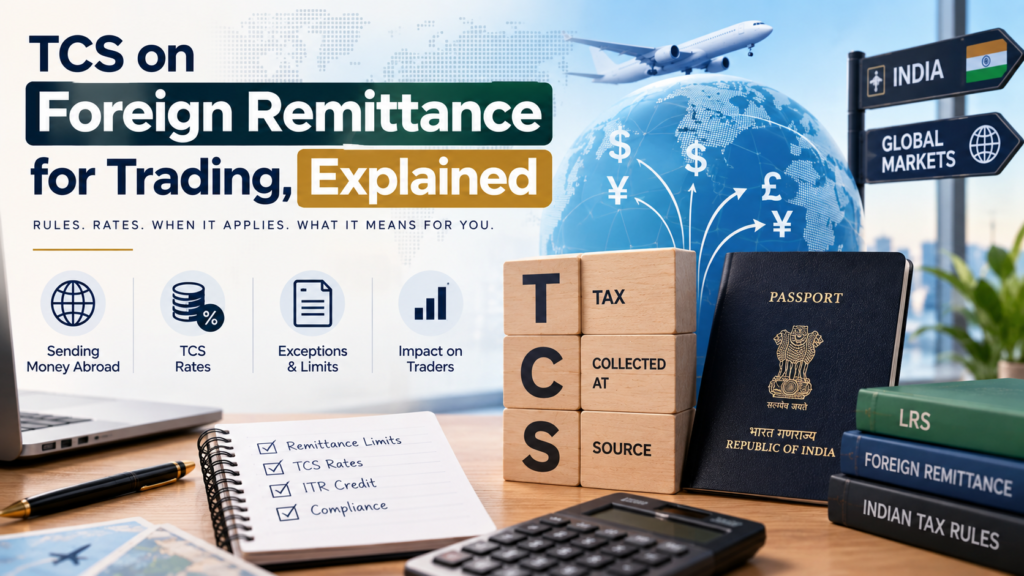
TCS (Tax Collected at Source) is collected by your bank on money you send abroad under the LRS – 20% above ₹10 lakh a year for investments, and it’s refundable against your tax. But TCS on foreign remittance forex traders imagine doesn’t legalise offshore forex: forex trading isn’t a permitted LRS purpose at all
Introduction
If you’ve sent money abroad – or been tempted to fund an offshore trading account – you’ve likely met TCS. It’s the tax your bank quietly collects on outward remittances, and it’s widely misunderstood, especially around trading. Getting clear on TCS on foreign remittance forex-related questions raise matters for two reasons: to plan legitimate overseas investing, and to see through the myth that paying TCS somehow makes offshore forex legal.
This guide explains what TCS is, the current FY 2026-27 rates, how to get it back, and exactly how it applies (and doesn’t) to trading. Details were verified against current 2026 sources, but tax rules change with every Budget, so confirm the latest and consult a chartered accountant. This is educational information, not tax advice.
What Is TCS on Foreign Remittance?
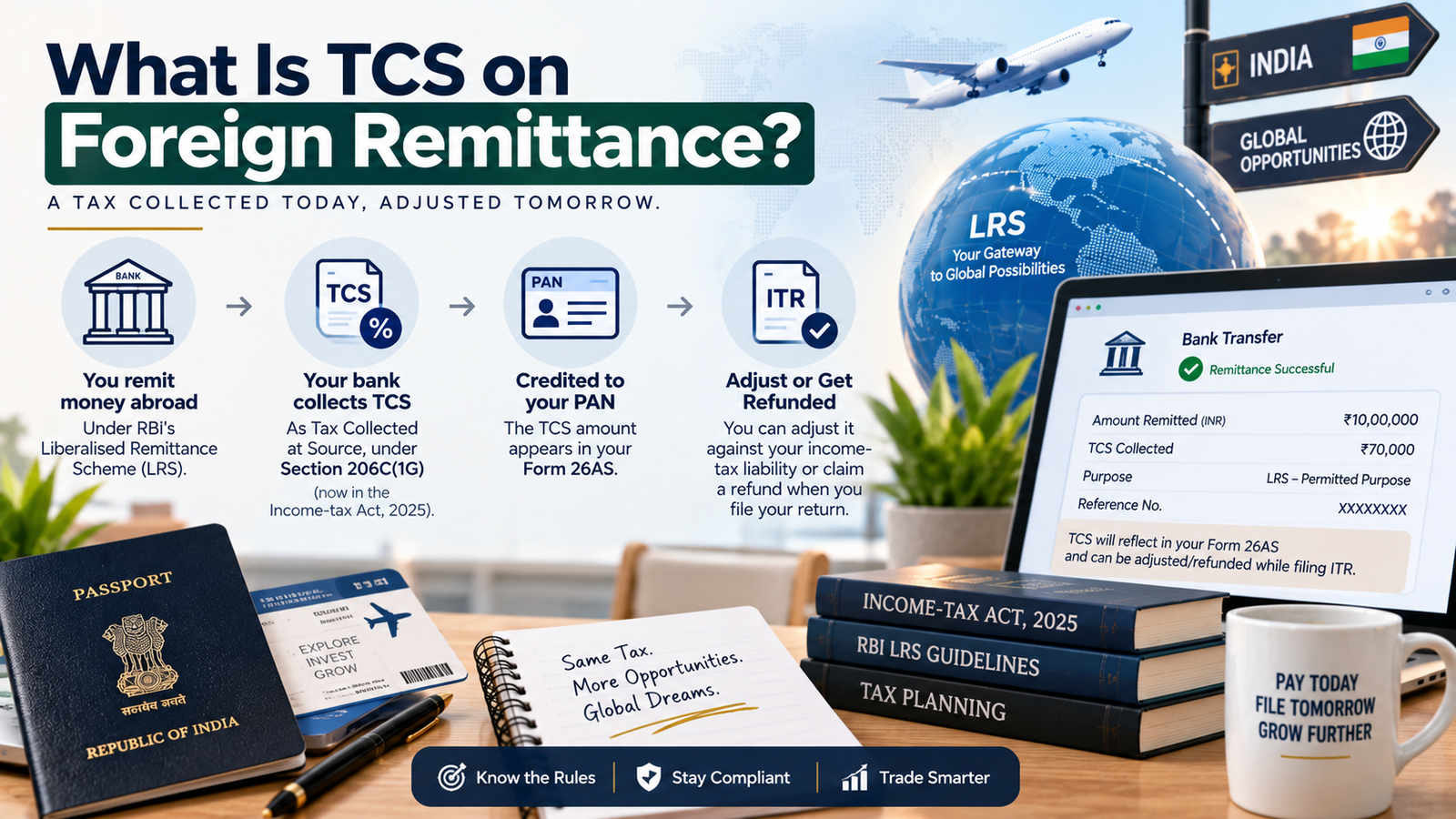
TCS – Tax Collected at Source – is a tax your bank or authorised dealer collects at the moment you remit money abroad under the RBI’s Liberalised Remittance Scheme (LRS). It was introduced under Section 206C(1G) of the income-tax law (carried into the new Income-tax Act, 2025), and it applies to resident individuals sending funds overseas for permitted purposes. Crucially, TCS is not an extra, lost tax – it’s collected against your PAN, shows up in your Form 26AS, and can be adjusted against your income-tax liability or refunded when you file your return.
How the LRS and TCS Fit Together
A quick recap: the LRS lets a resident individual remit up to USD 250,000 abroad per financial year for permitted purposes. TCS is the tax layered on top of certain of those remittances above a threshold. Key mechanics:
- Your bank collects TCS at the time of remittance and deposits it against your PAN.
- It applies to resident individuals only – not NRIs, and not to money you receive from abroad.
- You get Form 27D as proof, and the amount reflects in your Form 26AS.
- Without a PAN, or if your PAN isn’t linked to Aadhaar (or you’re a non-filer), the TCS rate can be doubled.
Current TCS Rates (FY 2026-27)
The rates were rationalised by the Finance Act 2026, effective 1 April 2026. The current position (confirm before remitting, as rules change):
| Purpose of LRS remittance | TCS rate (FY 2026-27) |
|---|---|
| Investment (foreign shares/ETFs), gifts, property, maintenance | 20% on the amount above ₹10 lakh |
| Education (self-funded) or medical treatment | 2% on the amount above ₹10 lakh |
| Education funded by an approved loan | Nil (fully exempt) |
| Overseas tour packages | Flat 2% from the first rupee (no threshold) |
The ₹10 lakh threshold: for most purposes there is no TCS on the first ₹10 lakh you remit in a financial year (aggregated across all banks); TCS applies only to the excess. Tour packages are the exception – TCS from the first rupee.
The Big Question: Is There TCS on Forex Trading?
This is where most confusion lives – and the honest answer surprises people. There is no ‘TCS for forex trading’ because you cannot legally remit for forex trading in the first place. Forex and margin trading are expressly excluded from the purposes the LRS permits. So the question ‘how much TCS on a forex remittance?’ has no legitimate answer: the remittance itself isn’t allowed, TCS or no TCS.
The myth to ignore
Offshore brokers and their affiliates sometimes tell Indian traders to ‘just pay the TCS and remit under the LRS’ to fund forex. This is false. Paying TCS does not make a prohibited purpose legal. Funding an offshore forex account remains a FEMA contravention regardless of any tax collected on the way out.
Where TCS Genuinely Applies to a ‘Trader’
There is a real scenario where an investor faces TCS: remitting abroad for permitted overseas investment, such as buying US shares or ETFs through a legitimate route. That IS a permitted LRS purpose, and it attracts 20% TCS above ₹10 lakh. For example:
Remit ₹15 lakh to buy US stocks (a permitted LRS investment)
Threshold: first ₹10 lakh -> no TCS
Excess: ₹5 lakh
TCS at 20%: ₹5,00,000 x 20% = ₹1,00,000 collected
That ₹1,00,000 is credited to your PAN and adjusted
against your income tax (or refunded) when you file.
So a resident investing in foreign stocks plans around TCS; a resident ‘funding forex’ isn’t planning around TCS at all, because that route is closed. The distinction between legitimate overseas investing and prohibited forex is the whole point.
TCS Is Refundable (It’s an Advance-Tax Credit)
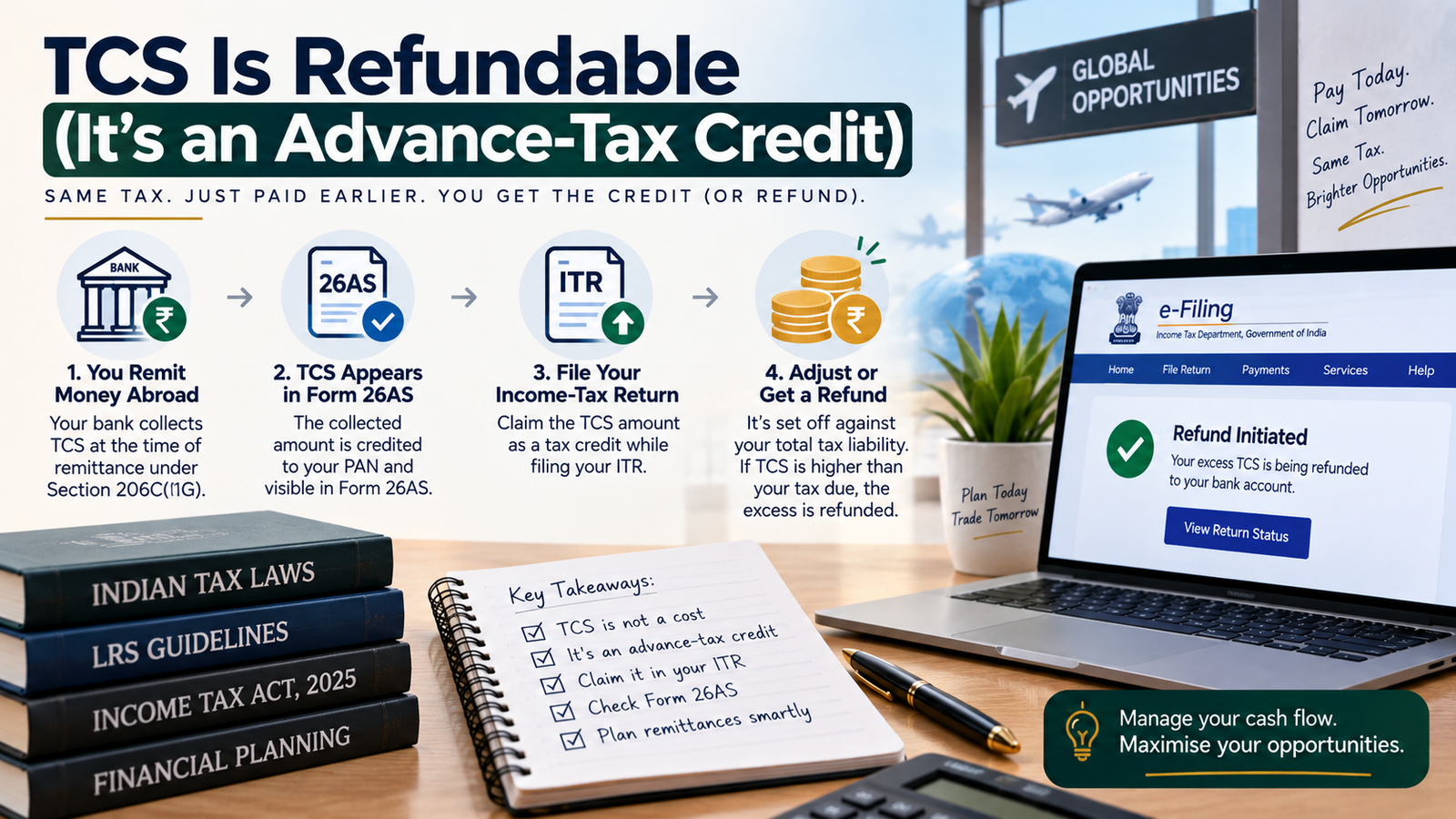
A reassuring point: TCS is not money lost. It behaves like advance tax paid on your behalf. When you file your income-tax return, you claim credit for the TCS collected (visible in Form 26AS), set it off against your total tax liability, and any excess is refunded. So a high TCS deduction on a large remittance affects your cash flow up front – the money is blocked until you file – but not your final tax burden. Planning the timing of large remittances around this can save you from unnecessarily locking up funds.
The PAN and Aadhaar Trap
One avoidable mistake can double your TCS. If you don’t provide a PAN, if your PAN isn’t linked to Aadhaar, or if you’re treated as a non-filer, higher-rate provisions can apply – turning a 20% rate into 40%. Before making any large LRS remittance, confirm your PAN is valid and linked to Aadhaar and your returns are up to date, so you’re charged the normal rate and can smoothly claim the credit later.
Who TCS Does and Doesn’t Apply To
- Applies to – resident individuals making outward LRS remittances above the threshold.
- Doesn’t apply to – money you receive from abroad (inward remittances).
- Doesn’t apply to NRIs – they’re outside the LRS; NRO-to-NRE transfers follow FEMA with Form 15CA/15CB.
- Not for companies – businesses use current-account FEMA routes, not LRS, for overseas payments.
Compliance Checklist
- Don’t remit for forex trading – it’s a prohibited LRS purpose; TCS doesn’t change that.
- Plan legitimate remittances around the threshold – the first ₹10 lakh (most purposes) is TCS-free.
- Link PAN to Aadhaar and file returns – to avoid the doubled rate.
- Keep Form 27D and check Form 26AS – so you can claim the TCS credit.
- Claim the credit in your ITR – set off TCS against tax and get any excess refunded.
Common Misconceptions
- ‘Pay TCS and offshore forex becomes legal.’ – No; forex isn’t a permitted LRS purpose.
- ‘TCS is an extra tax I lose.’ – It’s refundable/adjustable against your income tax.
- ‘TCS applies to money I receive from abroad.’ – No; only to outward LRS remittances.
- ‘NRIs pay this TCS too.’ – No; it targets resident LRS remittances.
- ‘The ₹10 lakh threshold is per bank.’ – It’s aggregated across all your banks.
Myths vs Facts
| Myth | Fact |
|---|---|
| Paying TCS legalises offshore forex. | Forex isn’t a permitted LRS purpose; TCS is irrelevant to that. |
| TCS is a permanent extra cost. | It’s an advance-tax credit – adjustable and refundable via your ITR. |
| All LRS remittances have a ₹10 lakh threshold. | Tour packages attract flat 2% from the first rupee, no threshold. |
| TCS applies to inward money and NRIs. | It applies only to resident outward LRS remittances. |
Tax disclaimer
This article is for educational purposes only and is not tax, legal or investment advice. TCS rates, thresholds and rules change with every Budget – the Finance Act 2026 and new Income-tax Act 2025 revised them from 1 April 2026 – and individual situations vary. Details here were checked against 2026 sources but may since have changed. Do not treat this as confirmation that any offshore forex funding is permitted. Verify current rules with your bank and the Income Tax Department, and consult a qualified chartered accountant.
Expert Analysis
TCS is one of the most misrepresented rules in Indian personal finance, and the misrepresentation clusters exactly around trading. The mechanism itself is benign – a withholding tax on outward remittances that you fully recover when you file – but it gets weaponised into a false permission. The offshore pitch runs: ‘the LRS lets you send $250,000, just pay the TCS, and trade forex abroad.’ Every clause is individually plausible and the conclusion is entirely wrong, because it skips the one fact that decides the matter – forex trading isn’t a purpose the LRS permits. TCS is a toll on roads you’re allowed to travel; it says nothing about roads that are closed. A resident who understands this stops asking ‘how much TCS to trade forex offshore?’ and starts asking the right question – ‘is this remittance even a permitted purpose?’ – whose answer, for forex, is no.
For the legitimate side of the picture – overseas investing – the practical wisdom is about cash flow and paperwork rather than tax burden. Because TCS on a large investment remittance is refundable, the real cost is the temporary blocking of capital between remittance and refund, which is a planning problem, not a tax problem: time your remittances, keep the first ₹10 lakh in mind, ensure your PAN-Aadhaar linkage so you aren’t hit at the doubled rate, and reconcile Form 26AS so you actually claim the credit. Handled that way, TCS is a mild inconvenience on lawful foreign investing and a complete non-answer to offshore forex. The single sentence worth remembering is that TCS is a tax on permitted remittances, never a licence for prohibited ones – and no amount of it turns an illegal forex deposit into a legal one.
Key Takeaways
- TCS is a refundable tax your bank collects on outward LRS remittances, credited to your PAN.
- FY 2026-27 rates: 20% above ₹10 lakh for investment/general; 2% for education/medical; flat 2% for tour packages.
- Forex trading is not a permitted LRS purpose, so paying TCS never legalises offshore forex.
- The real trader scenario is overseas stock investing – permitted, and taxed at 20% above ₹10 lakh.
- Link PAN to Aadhaar to avoid a doubled rate, and claim the TCS credit in your ITR.
Frequently Asked Questions (FAQ)
Q: What is TCS on foreign remittance?
A: A Tax Collected at Source that your bank collects when you remit money abroad under the LRS. It’s credited to your PAN and refundable against your income tax.
Q: Is there TCS on forex trading?
A: No – because you can’t legally remit for forex trading under the LRS at all. Forex and margin trading are prohibited LRS purposes.
Q: Does paying TCS make offshore forex legal?
A: No. TCS is a tax on permitted remittances; it doesn’t make a prohibited purpose like forex trading legal. Offshore forex remains a FEMA breach.
Q: What is the TCS rate in 2026?
A: For FY 2026-27: 20% above ₹10 lakh for investment/general remittances, 2% for self-funded education/medical, nil for loan-funded education, and a flat 2% for tour packages.
Q: What is the TCS threshold?
A: ₹10 lakh per financial year for most purposes (aggregated across all banks); TCS applies only above it. Tour packages have no threshold.
Q: Can I claim TCS back?
A: Yes. TCS is an advance-tax credit – claim it in your ITR, set it off against your tax, and any excess is refunded.
Q: Does TCS apply to overseas stock investing?
A: Yes. Investing in foreign shares or ETFs is a permitted LRS purpose and attracts 20% TCS above ₹10 lakh.
Q: Does TCS apply to money I receive from abroad?
A: No. Section 206C(1G) TCS applies only to outward LRS remittances, not inward ones.
Q: Do NRIs pay this TCS?
A: No. It targets resident LRS remittances; NRIs are outside the LRS, and NRO-to-NRE transfers follow FEMA with Form 15CA/15CB.
Q: Why might my TCS be doubled?
A: If you don’t provide a PAN, your PAN isn’t linked to Aadhaar, or you’re a non-filer, higher-rate provisions can double the TCS.
Q: Is TCS an extra tax?
A: No. It’s collected in advance and adjusted against your final tax liability, with any excess refunded – not an additional permanent cost.
Q: Where can I see the TCS collected?
A: In your Form 26AS, and your bank issues Form 27D as proof of collection.
Q: Does TCS apply to companies?
A: No. Businesses use current-account FEMA routes (with Form 15CA/15CB) for overseas payments, not the LRS and its TCS.
Q: Is the ₹10 lakh limit per bank or overall?
A: Overall – it’s aggregated across all your banks for the financial year, so you can’t reset it by using multiple banks.
Q: How do I legally trade foreign currencies then?
A: Trade exchange-traded currency derivatives on Indian exchanges via a SEBI-registered broker – it’s rupee-settled and needs no overseas remittance.