
Quick answer
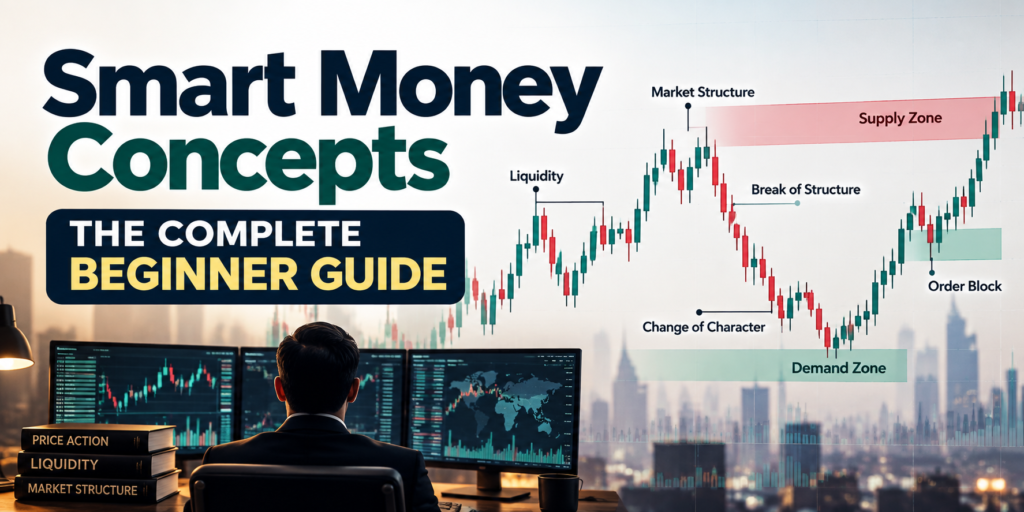
Smart Money Concepts (SMC) is a trading approach that reads the footprints of large institutions on the chart. With Smart Money Concepts explained through market structure, liquidity, order blocks and fair value gaps, traders aim to enter where ‘smart money’ does – after price sweeps liquidity and returns to an institutional zone.
Introduction
Somewhere between raw price action and rigid indicators sits a way of reading charts that has taken the trading world by storm: Smart Money Concepts. The premise is seductive and simple – big institutions move markets, they leave traces, and if you learn to read those traces you can trade alongside them instead of becoming their exit liquidity. This guide has Smart Money Concepts explained from the ground up, in plain language, so a beginner can actually follow it.
We’ll build the picture piece by piece – who ‘smart money’ is, then market structure, liquidity, order blocks and fair value gaps – and finish with how a trade comes together and an honest look at what SMC can and can’t do. This is educational content, not investment advice, and no framework guarantees profits.
What Are Smart Money Concepts?
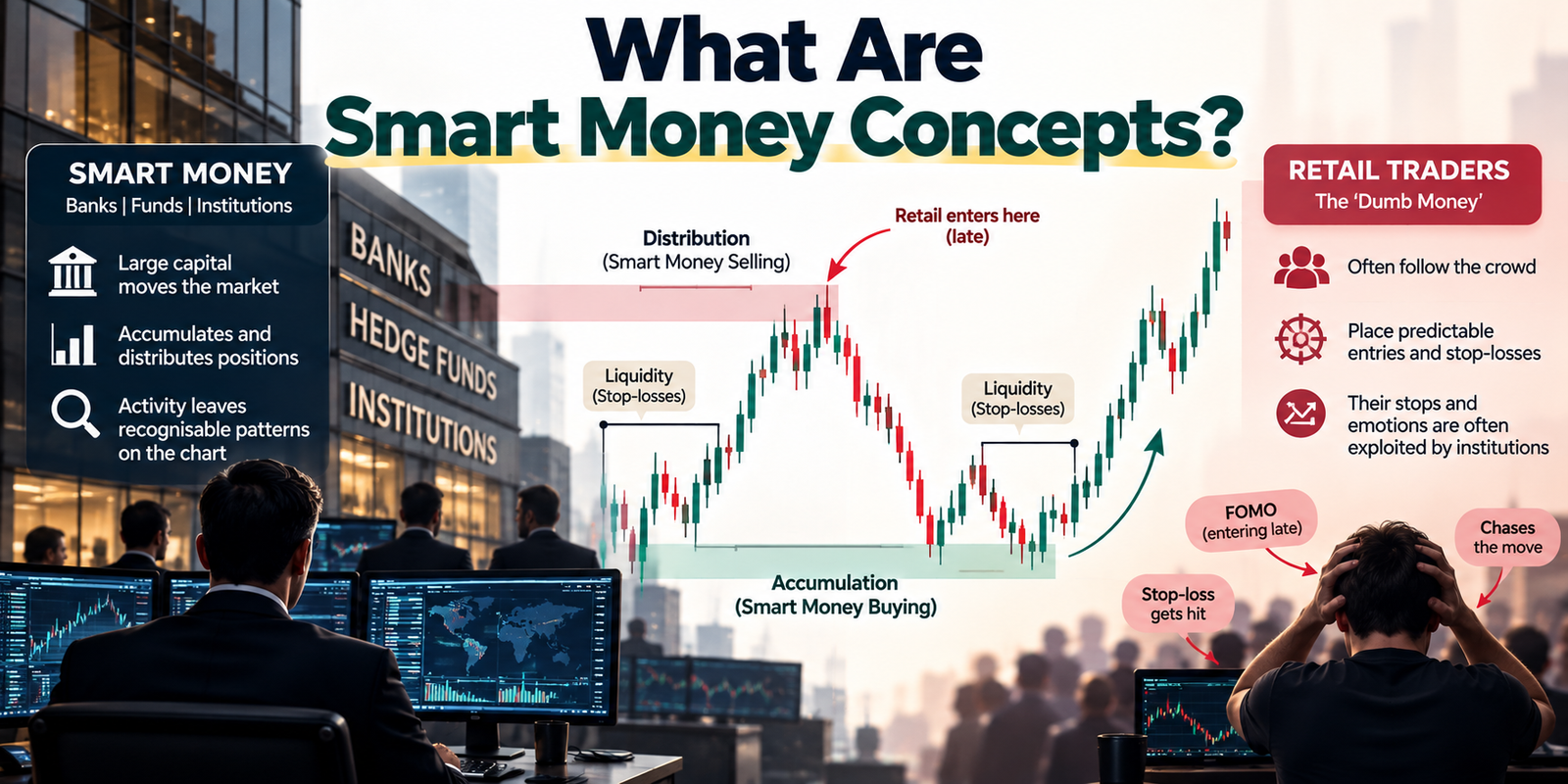
Smart Money Concepts is a chart-reading methodology, popularised from institutional and ICT-style trading ideas, built on one belief: the market is driven by ‘smart money’ – banks, funds and other large players – whose activity leaves recognisable patterns. Retail traders, by contrast, are the ‘dumb money’ whose stop-losses and predictable entries the big players exploit. SMC tries to flip that: instead of trading like the crowd, you learn to spot where institutions are likely accumulating or distributing, and position with them.
It’s important to say up front that SMC is a discretionary framework, not a mechanical system. It gives you a lens and a vocabulary; it does not give you certainty. Used with discipline it can sharpen your reads, but it’s a way of thinking, not a money machine.
Smart Money vs Retail Money
The whole method rests on this contrast:
- Smart money – large institutions that must accumulate big positions quietly, often by pushing price to where retail stop-losses sit, then reversing.
- Retail money – individual traders who tend to buy breakouts, sell breakdowns and cluster their stops in obvious places – exactly the liquidity institutions target.
SMC teaches you to think like the former: where would big players hunt stops, and where would they realistically enter? Answer those, and the chart starts to look different.
Building Block 1: Market Structure (BOS and CHoCH)
Everything in SMC starts with market structure – the sequence of highs and lows that defines the trend. Two events matter most:
- Break of Structure (BOS) – price breaks a previous high (in an uptrend) or low (in a downtrend), confirming the trend is continuing.
- Change of Character (CHoCH) – the first break against the prevailing trend, hinting the trend may be reversing – the market’s ‘character’ has changed.
Reading structure tells you the direction to favour: you look for buys in a bullish structure and sells in a bearish one, and treat a CHoCH as an early warning of a turn.
Building Block 2: Liquidity (the Fuel)
Liquidity is the heart of SMC. It refers to clusters of orders – mostly stop-losses and pending orders – that sit at obvious places like above recent highs or below recent lows. Institutions need liquidity to fill large positions, so price is often drawn to these pools:
- Liquidity pools – resting orders above equal highs or below equal lows, where retail stops gather.
- Liquidity sweep (or grab) – price spikes through a pool to trigger those stops, then sharply reverses – the classic ‘stop hunt’.
- Buy-side / sell-side liquidity – resting buy stops above price, and sell stops below it, respectively.
The SMC trader waits for a sweep – the market grabbing liquidity – as a signal that the real move may be about to begin in the opposite direction.
Building Block 3: Order Blocks
An order block is where SMC tries to pinpoint institutional entries. It’s typically the last opposing candle (or cluster) before a strong, structure-breaking move – the footprint of big orders being placed. The idea is that institutions left unfilled orders there, so when price returns to that zone, they defend it and the move resumes. Traders mark these blocks and look to enter when price ‘mitigates’ (revisits) them in the direction of the trend, placing a stop just beyond the block.
Building Block 4: Fair Value Gaps (Imbalances)
A fair value gap (FVG), or imbalance, is a gap left when price moves so fast that it skips levels, leaving a three-candle pattern with an unfilled space in the middle. SMC holds that the market tends to return to ‘rebalance’ these gaps before continuing. So an FVG becomes both a potential target (price may come back to fill it) and a potential entry zone (a place to join the move when price revisits it). Combined with an order block, an FVG strengthens the case for a level.
Building Block 5: Premium vs Discount
SMC borrows a simple valuation idea: within a price range, mark the 50% level as equilibrium. Above it is ‘premium’ (relatively expensive), below it is ‘discount’ (relatively cheap). The principle is to buy in discount and sell in premium – just as institutions would prefer to accumulate longs cheaply and shorts expensively. This keeps you from buying at the top of a range or selling at the bottom, aligning entries with where value is better.
The SMC Glossary (Quick Reference)
| Term | What it means |
|---|---|
| Smart money | Large institutional players (banks, funds) that move markets |
| Market structure | The sequence of highs and lows that defines the trend |
| BOS (Break of Structure) | A break of a prior high/low that confirms trend continuation |
| CHoCH (Change of Character) | The first break against the trend – a possible reversal |
| Liquidity | Clusters of stop and pending orders price is drawn to |
| Liquidity sweep / stop hunt | A spike that triggers stops, then reverses |
| Order block | The last opposing candle before a strong move – an institutional zone |
| Fair value gap (FVG) | An imbalance/gap that price tends to return to fill |
| Premium / discount | Above / below the 50% equilibrium of a range |
| Inducement | A trap that lures retail in before the real move |
How an SMC Trade Comes Together
The concepts click into a routine. A simplified bullish example:
- Read structure – identify a bullish market structure (higher highs and lows), so you favour buys.
- Wait for a liquidity sweep – price dips below a recent low, grabbing sell-side liquidity (stops).
- Look for a shift – a change of character or break back up signals the sweep is done.
- Find the zone – mark a bullish order block or fair value gap in discount to enter from.
- Enter with risk defined – buy at the zone, stop just below it, target the next liquidity/structure high.
The mirror image applies for a bearish trade. Notice that every step is about waiting for confluence, not chasing – patience is the method’s real engine.
Does Smart Money Concepts Work? An Honest Take
SMC has passionate believers and sharp critics, and the honest answer sits in between. On one hand, its core observations are real: markets do hunt obvious stops, price does react at supply/demand zones, and imbalances do often get filled – these aren’t mystical, they’re how liquidity works. On the other hand, SMC is highly discretionary, its terms are loosely defined, and charts can be drawn to fit any outcome in hindsight (‘everything is an order block if you look hard enough’). It is not a guaranteed system, and much of the online hype around it is marketing. Treated as a disciplined lens – combined with strict risk management, backtesting and patience – it can genuinely improve how you read a chart. Treated as a magic formula, it will disappoint. The edge, as always, comes from execution and risk control, not the labels.

Common Mistakes
- Marking order blocks and FVGs everywhere until the chart ‘confirms’ any bias.
- Trading against clear structure because a single zone looked tempting.
- Skipping the liquidity sweep and entering too early.
- Treating SMC as certainty rather than probability – and dropping the stop-loss.
- Overloading the chart with every SMC term at once instead of a few clean reads.
Myths vs Facts
| Myth | Fact |
|---|---|
| SMC is a guaranteed winning system. | It’s a discretionary lens; edge comes from execution and risk control. |
| Every candle is an order block. | Valid zones are specific; over-marking is a common trap. |
| You can ignore risk management with SMC. | No method removes the need for stops and position sizing. |
| SMC only works on forex. | It applies to any liquid market, including currency derivatives. |
Risk disclaimer
This article is for educational purposes only and is not investment advice. Smart Money Concepts is a discretionary framework, not a guaranteed system, and much online promotion around it is marketing. Trading involves risk of loss, and most retail traders lose money. Always backtest, use a stop-loss and sound position sizing, trade only through SEBI-registered brokers on recognised exchanges, and consult a qualified professional before trading.
Expert Analysis
The most useful way to hold Smart Money Concepts is as a vocabulary for something experienced traders already sense: that price is pulled toward pools of resting orders and reacts at zones where large participants transacted. Stripped of the mystique, SMC is a structured way of asking ‘where is the liquidity, and where would a big player want to enter?’ – and those are genuinely good questions. The framework’s real contribution to a beginner is discipline of sequence: read structure first, wait for liquidity to be taken, then look for a precise zone in the right part of the range. That patience-first routine is worth more than any single concept, because it stops the impulsive, crowd-following behaviour that empties most retail accounts.
Where SMC goes wrong is when its flexibility becomes an excuse. Because its terms are loosely defined and every chart contains dozens of candidate order blocks, fair value gaps and liquidity pools, it is dangerously easy to construct a convincing story after the fact and mistake hindsight for skill. The antidote is exactly what the hype tends to skip: pick a small, clearly-defined set of the concepts, define your rules precisely, backtest them honestly, and measure results over many trades rather than admiring the winners. And none of it replaces risk management – a beautifully-reasoned order-block entry with no stop-loss is still a way to lose an account. Approached as a disciplined lens layered on top of solid risk control, Smart Money Concepts can sharpen a trader’s reads; approached as a shortcut to guaranteed profits, it becomes just another expensive story. The concepts point at real market behaviour, but the trader still has to do the unglamorous work.
Key Takeaways
- Smart Money Concepts reads institutional footprints – liquidity, structure and key zones – to trade with big players.
- Core tools: market structure (BOS/CHoCH), liquidity sweeps, order blocks, fair value gaps and premium/discount.
- A typical trade waits for a liquidity sweep, then enters an order block/FVG in the trend’s direction.
- SMC is a discretionary lens, not a guaranteed system – much of its hype is marketing.
- Edge comes from patience, backtesting and risk management, not the labels.
Frequently Asked Questions (FAQ)
Q: What are Smart Money Concepts?
A: A chart-reading methodology that tries to follow the footprints of large institutions – using liquidity, market structure and key zones to trade with them.
Q: What is smart money in trading?
A: Large institutional participants – banks, funds and big players – whose activity moves markets and leaves recognisable patterns on the chart.
Q: What is market structure in SMC?
A: The sequence of highs and lows that defines the trend; a Break of Structure confirms it, a Change of Character warns of a reversal.
Q: What is a liquidity sweep?
A: When price spikes through a cluster of stop-losses to trigger them, then sharply reverses – the classic ‘stop hunt’.
Q: What is an order block?
A: The last opposing candle before a strong, structure-breaking move – marked as a zone where institutions likely entered and may again.
Q: What is a fair value gap?
A: An imbalance left when price moves so fast it skips levels; SMC holds that price often returns to fill the gap.
Q: What is premium vs discount?
A: Relative to a range’s 50% equilibrium: premium is above (expensive), discount is below (cheap). Traders buy discount, sell premium.
Q: What is BOS and CHoCH?
A: Break of Structure confirms trend continuation; Change of Character is the first break against the trend, hinting at a reversal.
Q: What is inducement in SMC?
A: A trap that lures retail traders into an obvious move so institutions can take the opposite side before the real move.
Q: Does Smart Money Concepts really work?
A: Its core observations about liquidity are real, but it’s discretionary and not guaranteed; edge comes from disciplined execution and risk control.
Q: Is SMC good for beginners?
A: The ideas are learnable, but the discretion and hype make it easy to misuse; start small, backtest, and always manage risk.
Q: Does SMC work on forex and Indian markets?
A: Yes. The concepts apply to any liquid market, including forex and Indian currency-derivative charts.
Q: How is SMC different from supply and demand?
A: It overlaps heavily; SMC adds a liquidity-and-structure framework and specific terms like order blocks and fair value gaps.
Q: Do I still need risk management with SMC?
A: Absolutely. No method removes the need for a stop-loss and sound position sizing – SMC included.
Q: What timeframe is best for SMC?
A: Many traders read higher timeframes for structure and drop to lower ones for entries; higher timeframes are generally more reliable.