Quick answer
Under FEMA, Indian residents can trade currency only as exchange-traded derivatives on recognised Indian exchanges, and can send up to USD 250,000 abroad each year under the LRS for permitted purposes. They cannot trade forex through offshore brokers or remit money abroad for margin or forex trading – both breach FEMA.
Introduction
Foreign currency touches far more of an Indian resident’s life than just trading – travel, education fees, overseas investments and gifts all involve moving money across borders. All of it sits under one law: FEMA. Understanding FEMA forex trading in India means understanding where the legal line runs, because crossing it – often unknowingly, via a slick offshore app – can carry real penalties.
This guide explains, in plain English, what the Foreign Exchange Management Act lets residents do and what it forbids, with a clear can/can’t breakdown. Details were checked against current 2026 sources, but rules change – always confirm with the RBI or a qualified professional. This is educational information, not legal, tax or investment advice.
What Is FEMA?
FEMA – the Foreign Exchange Management Act, 1999 – is the law that governs all foreign-exchange transactions involving India. It replaced the older, stricter FERA and shifted the approach from control to management, with the aim of facilitating legitimate trade and payments while conserving and regulating the country’s foreign currency. The Reserve Bank of India (RBI) administers FEMA and issues the detailed rules that decide which transactions are free, which need approval, and which are prohibited.
For anyone asking whether a forex activity is legal, FEMA is the starting point – and for retail currency trading, it works alongside SEBI, which regulates the exchanges and brokers.
Who Is a ‘Resident’ Under FEMA?
FEMA’s rules apply based on residency, and its definition is not the same as the Income Tax Act’s. Broadly, under FEMA a ‘person resident in India’ is someone who has resided in India for more than 182 days during the preceding financial year, subject to certain exceptions for people leaving for or returning from work, business or other purposes abroad. This matters because the LRS and many permissions are available only to resident individuals – NRIs use different FEMA channels such as NRE and NRO accounts. Because the day-count test differs from income-tax residency, it’s worth confirming your status before relying on any LRS permission.
The Two Buckets: Current vs Capital Account
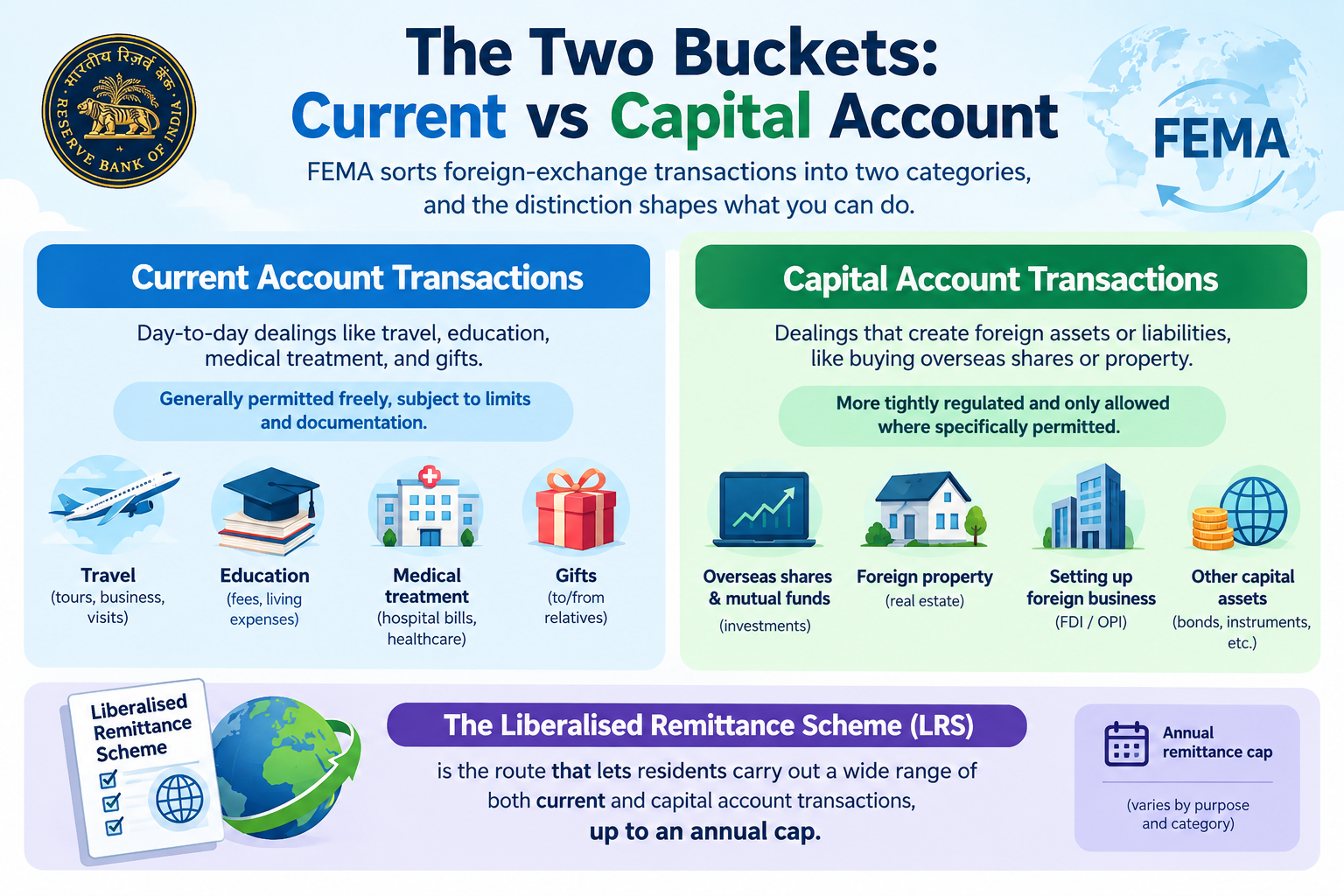
FEMA sorts foreign-exchange transactions into two categories, and the distinction shapes what you can do:
- Current account transactions – day-to-day dealings like travel, education, medical treatment, and gifts. These are generally permitted freely, subject to limits and documentation.
- Capital account transactions – dealings that create foreign assets or liabilities, like buying overseas shares or property. These are more tightly regulated and only allowed where specifically permitted.
The Liberalised Remittance Scheme is the route that lets residents carry out a wide range of both, up to an annual cap.
The LRS: Your USD 250,000 Annual Allowance
The Liberalised Remittance Scheme (LRS) is the single most important permission for most residents. It lets each resident individual remit up to USD 250,000 per financial year (1 April to 31 March) abroad for permitted purposes, without needing separate RBI approval each time. Key features:
- It is a cumulative cap across all purposes combined – travel, education, medical, gifts, maintenance of relatives, and investment in overseas shares or property.
- It resets on 1 April and cannot be carried forward; unused headroom is lost.
- It applies to resident individuals only (including minors, with a guardian’s countersignature); companies and firms use other FEMA routes.
- It is tracked PAN-wise across all banks, so you cannot multiply it by using several banks.
- Remittances go through an authorised dealer (bank) with Form A2 and purpose documentation; TCS may apply above certain thresholds.
The LRS limit has stood at USD 250,000 since 2015. Crucially, the LRS is exactly where the forex line is drawn – because some uses of it are explicitly banned.
What Indian Residents CAN and CANNOT Do
Here is the practical heart of FEMA forex trading in India – a side-by-side of the permitted and the prohibited:
| What you CAN do | What you CANNOT do |
|---|---|
| Trade currency futures & options on NSE, BSE or MSE via a SEBI-registered broker | Trade forex through offshore / unregulated online brokers |
| Trade the seven approved pairs (USD/INR, EUR/INR, GBP/INR, JPY/INR, EUR/USD, GBP/USD, USD/JPY) | Trade spot forex, CFDs or binary options on foreign platforms |
| Remit up to USD 250,000 a year under the LRS for permitted purposes | Remit money abroad for margin trading or margin calls |
| Invest in foreign shares, ETFs or property under the LRS | Use the LRS to fund forex trading abroad (specifically prohibited) |
| Use forex for travel, education, medical treatment and gifts | Exceed the USD 250,000 limit or split it across banks/relatives |
| Hold and operate permitted foreign-currency accounts as allowed | Route business forex through a personal LRS allowance |
The Forex-Specific Rule (in Brief)
For currency trading specifically, FEMA and the RBI permit residents to trade only exchange-traded currency derivatives on recognised Indian exchanges (NSE, BSE, MSE), through SEBI-registered brokers, in the seven approved pairs. Everything offshore – the global retail platforms that advertise heavily in India – falls outside this framework. The LRS cannot be used to fund such accounts, and doing so is a FEMA contravention, not a grey area. (For the exchange mechanics and pair details, see our dedicated guide to SEBI’s forex trading rules.)
Why the LRS Bans Forex and Margin Trading
Many residents are surprised that the LRS – which allows overseas share and property investment – specifically forbids remitting money for forex or margin trading abroad. The logic is capital-control policy: leveraged forex margin sent to an overseas counterparty is high-risk, hard to monitor, and moves capital outside India’s regulated system. So even though an offshore broker may accept your deposit (sometimes via cards or UPI), funding it for forex margin trading breaches FEMA regardless of whether the payment goes through. Legality depends on the purpose and route, not on whether a transfer succeeds.
Penalties for Breaking FEMA
A FEMA contravention is a civil offence with real financial consequences. Where the amount is quantifiable, penalties can reach up to three times the sum involved; additional penalties may apply for continuing contraventions. Contraventions can often be ‘compounded’ – settled with the RBI on payment of a penalty – but that is at the regulator’s discretion and still costs money. Beyond the legal exposure, the bigger practical risk is losing your funds entirely: offshore and scam platforms sit outside Indian jurisdiction, so if money vanishes, neither the RBI nor SEBI can help recover it.
Tax and Disclosure (Briefly)
Two tax points sit alongside FEMA compliance. First, TCS (tax collected at source) can apply to LRS remittances above a threshold – the TCS-free limit was raised to ₹10 lakh per financial year from April 2025, with rates varying by purpose. Second, if you hold foreign assets (say, overseas shares bought under the LRS), you must disclose them in Schedule FA of your income-tax return. Both areas are nuanced and change with each Budget, so confirm current rates and requirements with a qualified chartered accountant.
How to Stay Compliant (Checklist)
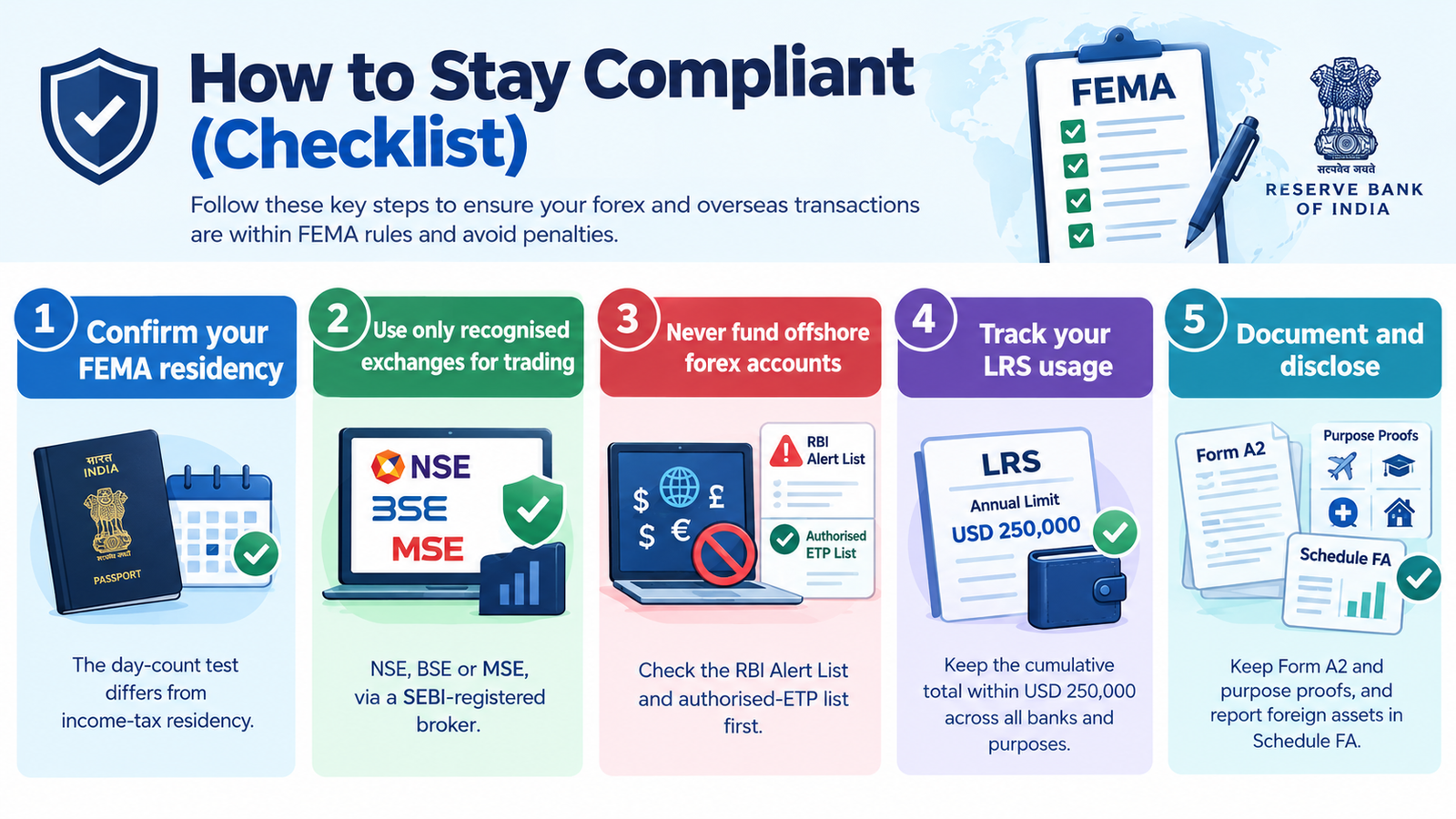
- Confirm your FEMA residency – the day-count test differs from income-tax residency.
- Use only recognised exchanges for trading – NSE, BSE or MSE, via a SEBI-registered broker.
- Never fund offshore forex accounts – check the RBI Alert List and authorised-ETP list first.
- Track your LRS usage – keep the cumulative total within USD 250,000 across all banks and purposes.
- Document and disclose – keep Form A2 and purpose proofs, and report foreign assets in Schedule FA.
Common Misconceptions
- ‘The LRS lets me do anything abroad.’ – It excludes forex/margin trading, lottery and a few other purposes.
- ‘A VPN or an app makes offshore forex legal.’ – It doesn’t; the activity still breaches FEMA.
- ‘I can use several banks to exceed USD 250,000.’ – The limit is tracked PAN-wise across all banks.
- ‘FEMA and Income Tax residency are the same.’ – They use different tests; check FEMA residency separately.
- ‘All forex is illegal in India.’ – Exchange-traded currency derivatives are perfectly legal.
Myths vs Facts
| Myth | Fact |
|---|---|
| FEMA bans all forex for residents. | It permits exchange-traded currency derivatives on Indian exchanges. |
| The LRS can fund overseas forex trading. | The LRS specifically prohibits forex and margin trading abroad. |
| Offshore brokers are a legal grey area. | Using them breaches FEMA; there is no grey area for residents. |
| FEMA breaches are criminal jail offences. | They are civil contraventions with monetary penalties, often compoundable. |
| a qualified professional (such as a chartered accountant) before trading, remitting funds or investing abroad. |
Compliance disclaimer
This article is for educational purposes only and is not legal, tax or investment advice. FEMA, LRS and TCS rules change and are enforced strictly. Details here were checked against 2026 sources but may since have changed. Always verify current rules directly with the RBI and consult
Expert Analysis
The most useful way to think about FEMA forex trading in India is as a question of purpose and route, not product. Residents often assume that if an activity is legal in itself – like trading a currency pair – then doing it anywhere must be fine. FEMA flips that logic: the same trade can be lawful on an Indian exchange and unlawful through an offshore broker, because what FEMA governs is how foreign currency crosses the border and whether it stays within a monitored system. Once you internalise that the rules are about capital flows rather than about trading per se, the pattern of what’s allowed becomes predictable.
This also explains why the LRS is generous in some directions and firmly closed in others. India is happy to let residents invest abroad or fund education because those flows are visible, documented and broadly one-way; it blocks forex and margin trading because leverage sent to an overseas counterparty is opaque, fast-moving and prone to abuse. For the individual, the safe path is therefore the documented one: trade currencies on a recognised Indian exchange, use the LRS only for its permitted purposes, keep records, and treat any platform promising easy offshore forex access as both a legal risk and, very often, a financial trap.
Key Takeaways
- FEMA (1999), administered by the RBI, governs all forex activity by Indian residents.
- Residents can trade currency only as exchange-traded derivatives on NSE/BSE/MSE via SEBI-registered brokers.
- The LRS allows USD 250,000 abroad per year for permitted purposes – but not for forex or margin trading.
- Offshore forex brokers, spot forex and CFDs are prohibited; using them breaches FEMA.
- Penalties can reach up to three times the amount involved; verify status and disclose foreign assets.
Frequently Asked Questions (FAQ)
Q: Is forex trading legal under FEMA?
A: Yes, but only as exchange-traded currency derivatives on recognised Indian exchanges (NSE, BSE, MSE) through SEBI-registered brokers. Offshore forex trading is not permitted.
Q: What is FEMA?
A: The Foreign Exchange Management Act, 1999 – the law, administered by the RBI, that governs all foreign-exchange transactions involving India.
Q: What can Indian residents do under FEMA?
A: Trade approved currency derivatives on Indian exchanges, and remit up to USD 250,000 a year under the LRS for travel, education, medical, gifts and overseas investment.
Q: What can’t Indian residents do under FEMA?
A: Trade forex through offshore brokers, use spot forex/CFDs, or remit money abroad for forex or margin trading – all breach FEMA.
Q: What is the LRS limit?
A: USD 250,000 per resident individual per financial year (1 April to 31 March), cumulative across all permitted purposes and tracked PAN-wise.
Q: Can I use the LRS for forex trading?
A: No. The LRS specifically prohibits remittances for forex trading and for margin or margin calls to overseas exchanges.
Q: Who counts as a resident under FEMA?
A: Broadly, someone residing in India more than 182 days in the preceding financial year, with exceptions. It differs from Income Tax Act residency.
Q: What is the difference between current and capital account transactions?
A: Current account covers day-to-day items (travel, education, gifts), generally free; capital account covers foreign assets/liabilities and is more regulated.
Q: Are offshore forex brokers legal for Indian residents?
A: No. They are not authorised for residents, and funding or trading with them is a FEMA contravention.
Q: What is the penalty for a FEMA violation?
A: A civil penalty of up to three times the amount involved where quantifiable, with possible additional penalties; contraventions may be compounded with the RBI.
Q: Can I exceed the LRS limit using multiple banks?
A: No. The USD 250,000 limit is tracked PAN-wise across all banks, so it cannot be multiplied.
Q: Does TCS apply to LRS remittances?
A: TCS can apply above a threshold (the TCS-free limit was raised to ₹10 lakh from April 2025); rates vary by purpose – consult a CA.
Q: Do I have to declare foreign investments?
A: Yes. Foreign assets held under the LRS must be disclosed in Schedule FA of your income-tax return.
Q: Can NRIs use the LRS?
A: No. The LRS is for resident individuals; NRIs use separate FEMA channels such as NRE and NRO accounts.
Q: Is using a VPN to trade offshore forex legal?
A: No. A VPN hides your location but does not change the law; the activity still breaches FEMA.