Quick answer
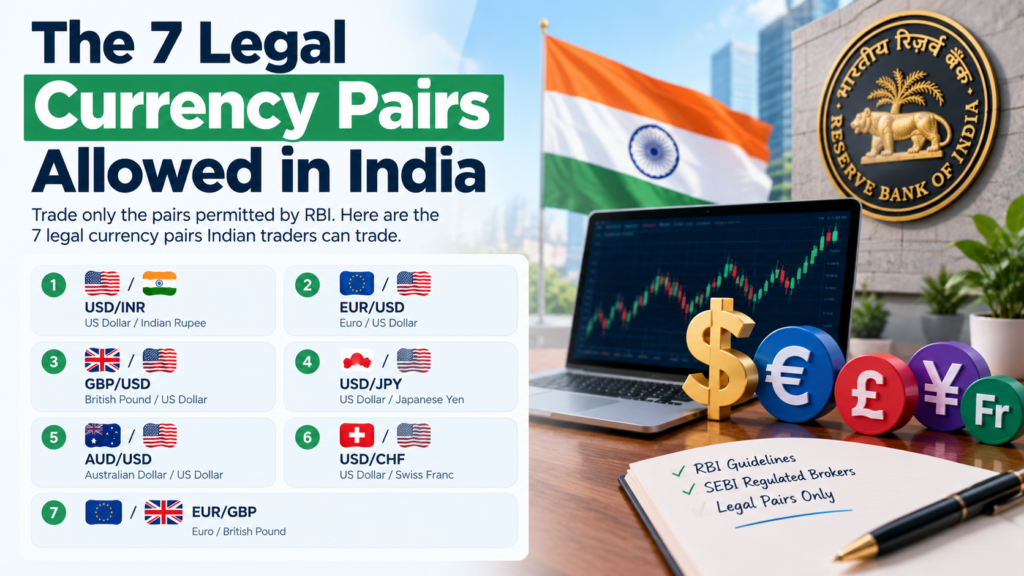
There are seven legal currency pairs in India for residents: four rupee pairs – USD/INR, EUR/INR, GBP/INR and JPY/INR – and three cross pairs – EUR/USD, GBP/USD and USD/JPY. All are traded as exchange-traded futures and options on recognised exchanges (NSE, BSE, MSE) through SEBI-registered brokers.
Introduction
Ask how many currency pairs you can trade and a global broker will say ‘dozens’. In India, the honest answer is exactly seven. The legal currency pairs in India are a small, deliberate set – four involving the rupee and three cross-currency pairs – and knowing them precisely is the first step to trading currencies without breaking the law.
This guide lists all seven, explains what each one is, sets out how the contracts work, and helps you decide which to start with. Details were verified against current 2026 sources, but contract specifications can be revised, so confirm the latest with your exchange. This is educational information, not investment advice.
Why Only Seven?
The number is a product of India’s regulatory framework. Currency trading by residents is governed by FEMA and overseen by the RBI and SEBI, which permit trading only as exchange-traded currency derivatives on recognised exchanges. Within that system, the exchanges list a limited menu: four pairs quoting the rupee against major currencies, plus three cross pairs added to broaden access to global majors. Everything else – and every offshore platform offering ‘all pairs’ – falls outside the permitted framework. So the seven are not arbitrary; they are the complete set the regulated market offers.
The 7 Legal Currency Pairs at a Glance
Here are all seven legal currency pairs in India, with their standard contract sizes (verify current specs with the exchange):
| Pair | Type | Standard contract size |
|---|---|---|
| USD/INR | Rupee pair | USD 1,000 |
| EUR/INR | Rupee pair | EUR 1,000 |
| GBP/INR | Rupee pair | GBP 1,000 |
| JPY/INR | Rupee pair | JPY 100,000 |
| EUR/USD | Cross pair | EUR 1,000 |
| GBP/USD | Cross pair | GBP 1,000 |
| USD/JPY | Cross pair | USD 1,000 |
All seven are cash-settled in rupees – you never take delivery of foreign currency – which keeps them firmly within India’s rupee-based system.
The Four Rupee (INR) Pairs
These pairs quote a major currency against the Indian rupee, so their value is directly tied to how the rupee moves.
USD/INR – the flagship
By far the most traded of the legal currency pairs in India, USD/INR reflects the dollar’s value in rupees. It is the most liquid, most watched, and the natural starting point for beginners.
EUR/INR, GBP/INR and JPY/INR
These track the euro, British pound and Japanese yen against the rupee respectively. They are less liquid than USD/INR but useful for traders with a view on those specific currencies or on the rupee’s broader strength. Note that JPY/INR uses a larger contract (100,000 yen) because the yen is a low-unit-value currency.
The Three Cross-Currency Pairs
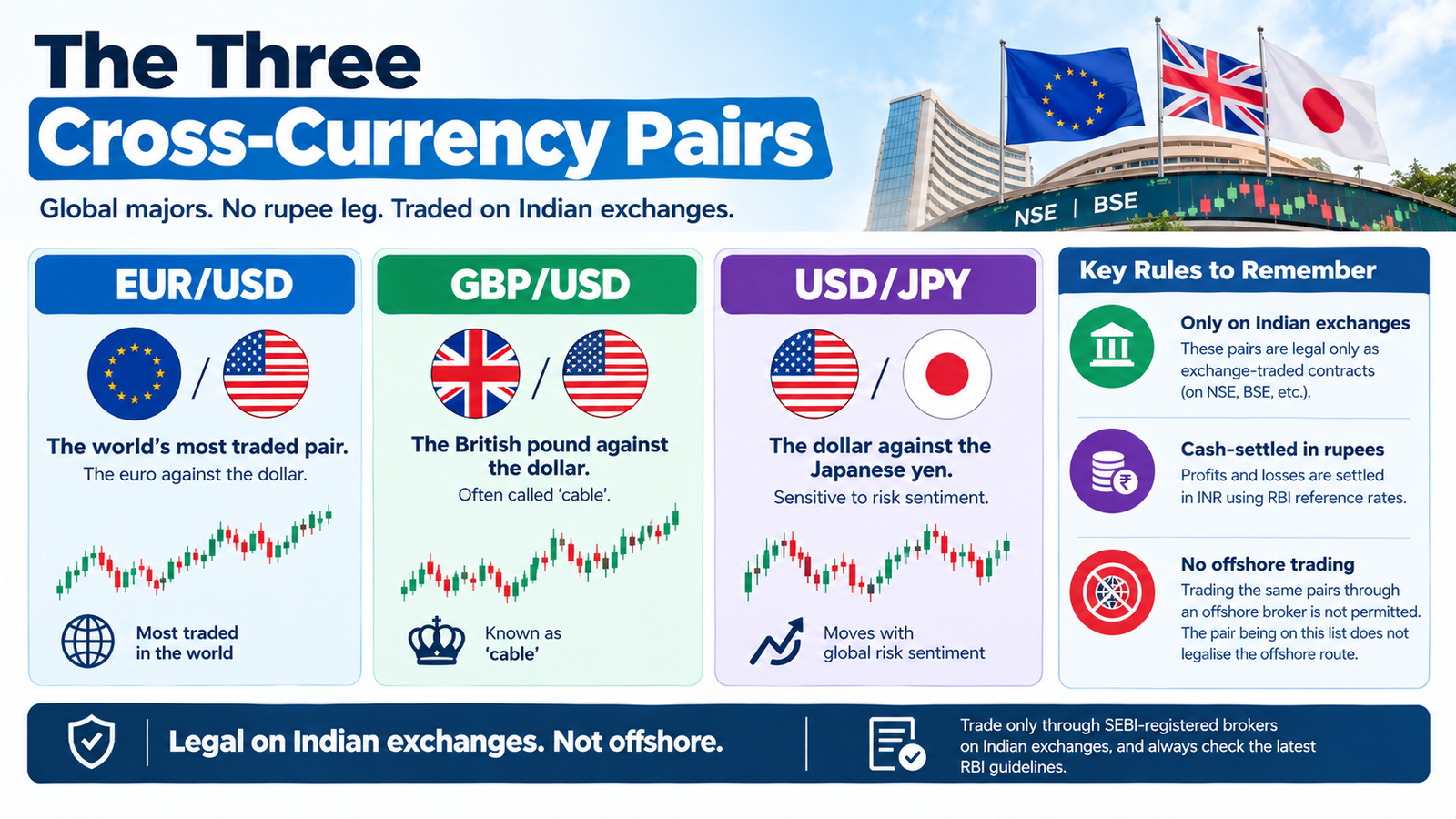
Introduced on Indian exchanges to give residents regulated access to global majors, the three cross pairs – EUR/USD, GBP/USD and USD/JPY – contain no rupee leg at all. Instead, they track two foreign currencies against each other, exactly as the global forex market quotes them.
- EUR/USD – the world’s most traded pair, the euro against the dollar.
- GBP/USD – the British pound against the dollar (often called ‘cable’).
- USD/JPY – the dollar against the Japanese yen, sensitive to risk sentiment.
Crucially, these are legal only as exchange-traded contracts on Indian exchanges, and are cash-settled in rupees using RBI reference rates. Trading the same pairs through an offshore broker is not permitted – the pair being on this list does not legalise the offshore route.
Contract Specifications (Standard)
Beyond contract size, the seven share a common structure. Typical specifications (confirm current details with the NSE, BSE or MSE):
| Specification | Typical value |
|---|---|
| Instruments | Futures and options |
| Settlement | Cash-settled in INR at the RBI reference rate |
| Quotation | Four decimals (two for JPY pairs) |
| Tick size | Small, e.g. 0.0025 for USD/INR |
| Trading hours | Approx. 9:00 a.m.-5:00 p.m. IST (cross pairs may run later) |
| Where | NSE, BSE and MSE via SEBI-registered brokers |
Which Pair Should You Trade?
For most residents, the answer is USD/INR. It offers the deepest liquidity, the tightest spreads, and the most accessible information flow, and its value is driven by factors Indians follow anyway – RBI policy, crude oil and the dollar. Beginners are usually best served starting there, at the smallest lot size, before exploring the other rupee pairs or the cross pairs. The cross pairs suit traders who specifically want exposure to global majors and are comfortable that their moves are driven by foreign, not Indian, factors.
What Is NOT Allowed
The flip side of the legal currency pairs in India is a long list of prohibited ones. Any pair outside these seven – AUD/USD, USD/CAD, GBP/JPY, EUR/GBP and so on – cannot legally be traded by residents. Nor can even these seven be traded through offshore or unregulated online brokers, which breaches FEMA regardless of the pair. If a platform offers you ‘all pairs’ or exotic crosses, that is a clear sign it is operating outside Indian law. (See our guides to SEBI’s forex rules, FEMA, and the RBI Alert List for the enforcement side.)
How to Trade the Legal Pairs (Checklist)
- Open a SEBI-registered broker account – and activate the currency derivatives segment.
- Stick to the seven pairs – trade only these as futures or options on the NSE, BSE or MSE.
- Start with USD/INR, small size – build experience on the most liquid pair before branching out.
- Avoid offshore platforms – check the RBI Alert List; ‘all pairs’ offers are a red flag.
- Manage risk and records – size to a fixed risk, use a stop-loss, and keep records for tax.

Common Misconceptions
- ‘I can trade any pair I want.’ – Only the seven listed pairs are legal for residents.
- ‘Cross pairs mean I can use a global broker.’ – No; they’re legal only on Indian exchanges.
- ‘All seven are equally liquid.’ – USD/INR dominates; the others are thinner.
- ‘These pairs settle in dollars.’ – All are cash-settled in rupees at RBI reference rates.
- ‘More pairs abroad means more opportunity.’ – It means more risk and no legal recourse.
Myths vs Facts
| Myth | Fact |
|---|---|
| India allows dozens of currency pairs. | Only seven are legal for residents as exchange-traded derivatives. |
| Cross pairs have a rupee component. | EUR/USD, GBP/USD and USD/JPY contain no rupee leg. |
| You take delivery of the currency. | All seven pairs are cash-settled in rupees, not physically delivered. |
| Any broker offering these pairs is legal. | They’re legal only via SEBI brokers on NSE/BSE/MSE, not offshore. |
Learn more about Currency Correlation
Compliance disclaimer
This article is for educational purposes only and is not legal or investment advice. The list of permitted pairs and their contract specifications are set by regulators and exchanges and can change. Details here were checked against 2026 sources but may since have changed. Verify the current pairs and specs with the NSE, BSE, MSE, SEBI and RBI, and consult a qualified professional before trading.
Expert Analysis
The short menu of legal currency pairs in India is often seen as a limitation, but for most retail traders it is quietly a feature. Global forex offers dozens of pairs, many thin, exotic and volatile, and beginners routinely lose money spreading themselves across instruments they don’t understand. India’s framework forces focus: a handful of major, liquid pairs, dominated by one – USD/INR – that is deeply covered and driven by domestic factors a resident already tracks. Constraint, here, nudges traders toward exactly the disciplined, narrow focus that experienced traders arrive at anyway.
The cross pairs are the interesting addition, because they reveal the regulatory logic. India was willing to open access to the world’s biggest majors – EUR/USD, GBP/USD, USD/JPY – but only inside its own supervised, rupee-settled exchanges, never through the offshore OTC market. That design lets residents express a view on global currencies while keeping the capital and the settlement within India’s monitored system. Understanding that intent makes the whole framework predictable: the state will broaden what you can trade, but rarely where you can trade it. For the trader, the takeaway is simple – the pair list tells you what’s allowed, and the venue tells you whether you’re legal.
Key Takeaways
- There are seven legal currency pairs in India: USD/INR, EUR/INR, GBP/INR, JPY/INR, EUR/USD, GBP/USD and USD/JPY.
- Four are rupee pairs; three are cross pairs with no rupee leg.
- All are exchange-traded derivatives, cash-settled in rupees on NSE/BSE/MSE via SEBI brokers.
- USD/INR is the most liquid and the best starting point for beginners.
- Any other pair, or any offshore platform, is outside the law – even for these seven.
Frequently Asked Questions (FAQ)
Q: Which currency pairs are legal in India?
A: Seven: USD/INR, EUR/INR, GBP/INR and JPY/INR (rupee pairs), plus EUR/USD, GBP/USD and USD/JPY (cross pairs).
Q: How many currency pairs can I legally trade in India?
A: Exactly seven, all as exchange-traded currency derivatives on recognised Indian exchanges.
Q: Can I trade EUR/USD in India?
A: Yes, but only as an exchange-traded contract on the NSE, BSE or MSE – not through an offshore broker.
Q: What are cross-currency pairs?
A: Pairs with no rupee leg – EUR/USD, GBP/USD and USD/JPY – that track two foreign currencies against each other.
Q: Which currency pair is best for beginners in India?
A: USD/INR, because it is the most liquid, most covered and driven by familiar domestic factors.
Q: Are these pairs physically settled?
A: No. All seven are cash-settled in rupees using RBI reference rates; you never take delivery of foreign currency.
Q: Can I trade pairs like AUD/USD or GBP/JPY in India?
A: No. Those are outside the seven permitted pairs and cannot be legally traded by residents.
Q: Where can I trade the legal currency pairs?
A: On the NSE, BSE and MSE, through a SEBI-registered broker’s currency derivatives segment.
Q: What is the contract size for USD/INR?
A: The standard contract is USD 1,000; confirm current specifications with your exchange.
Q: Why is JPY/INR’s contract larger?
A: Because the yen has a low unit value, so the contract uses 100,000 yen to be comparable in size to the others.
Q: Are cross pairs legal only on Indian exchanges?
A: Yes. EUR/USD, GBP/USD and USD/JPY are legal as Indian exchange-traded contracts, not through offshore platforms.
Q: Do all seven pairs have the same liquidity?
A: No. USD/INR is by far the most liquid; the other rupee and cross pairs trade in lower volumes.
Q: Can I trade options on these pairs?
A: Yes. Currency options as well as futures are available on the permitted pairs.
Q: Is trading these pairs taxable?
A: Yes. Income from currency derivatives is generally taxed as business income; consult a chartered accountant.
Q: What happens if I trade a non-permitted pair offshore?
A: It breaches FEMA and carries penalty risk, and offshore platforms offer no recourse if funds are lost.