
Introduction
When price moves very fast in one direction, it often leaves behind an area where buying and selling were badly out of balance. On a chart, that area shows up as a gap between candle wicks. Traders who follow smart money concepts (SMC) call it a fair value gap, or FVG.
The idea behind the Fair Value Gap (FVG) Trading Strategy is simple: markets often return to these inefficient areas to “rebalance” before continuing in the original direction. If you can identify valid gaps and wait for price to come back into them, you can find entries with tight stops and clear targets. A good FVG trading strategy is therefore as much about patience as about pattern recognition.
This guide explains:
- What a fair value gap is and why it forms
- How to identify bullish and bearish FVGs
- Which gaps are worth trading and which to ignore
- Entry, stop-loss and target rules
- A worked example and common mistakes
What Is a Fair Value Gap?
A fair value gap is a three-candle pattern that shows an imbalance between buyers and sellers. It forms when the middle candle moves so strongly that the wicks of the first and third candles do not overlap.
- Bullish FVG: The low of the third candle is above the high of the first candle. The gap between them is the FVG. In ICT terminology this is sometimes called a BISI (buy-side imbalance, sell-side inefficiency).
- Bearish FVG: The high of the third candle is below the low of the first candle. The gap between them is the FVG, sometimes called a SIBI (sell-side imbalance, buy-side inefficiency).
Inside that gap, price traded in only one direction with little opposing activity. The market is said to have “skipped” fair value, and it often returns later to fill or partly fill the gap.
Why Fair Value Gaps Form
FVGs usually appear during displacement, a strong, fast move driven by large orders. Common causes include:
- Institutional buying or selling that overwhelms available liquidity
- High-impact news releases
- Liquidity sweeps, where price takes out stops and then reverses sharply
- Breakouts from tight ranges
Because these moves reflect strong intent, the gaps they leave behind can act as support in an uptrend or resistance in a downtrend when price comes back.
How the Fair Value Gap (FVG) Trading Strategy Works
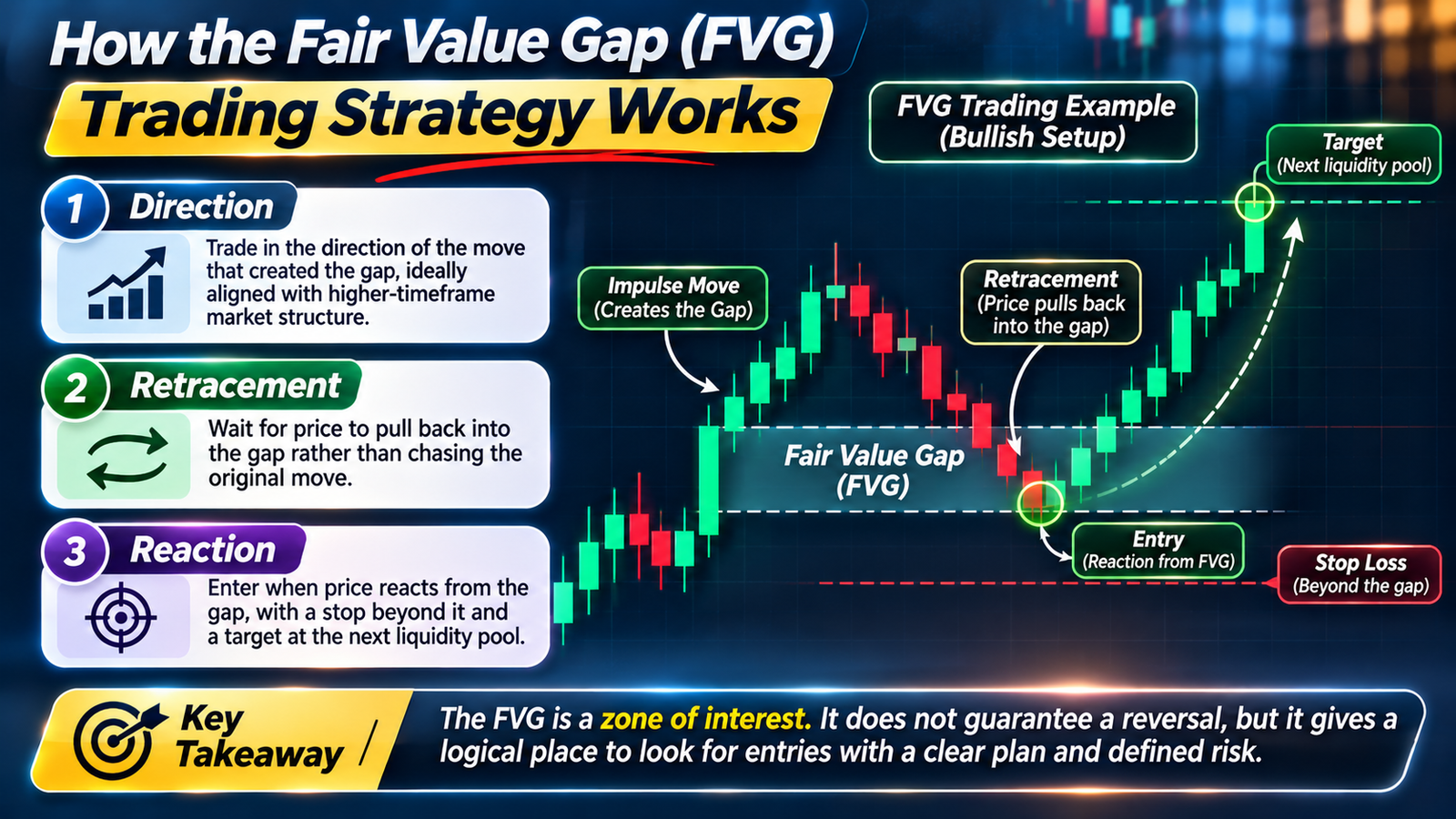
The Fair Value Gap (FVG) Trading Strategy is built on three ideas:
- Direction: Trade in the direction of the move that created the gap, ideally aligned with higher-timeframe market structure.
- Retracement: Wait for price to pull back into the gap rather than chasing the original move.
- Reaction: Enter when price reacts from the gap, with a stop beyond it and a target at the next liquidity pool.
In a well-built FVG trading strategy, the gap acts as a zone of interest. It does not guarantee a reversal, but it gives a logical place to look for entries with defined risk.
How to Identify a Valid FVG
Not every gap is worth trading. Applying the Fair Value Gap (FVG) Trading Strategy to every imbalance on the chart leads to many losing trades. Filters that improve quality include:
1. Displacement
The middle candle should be large and decisive, with a body much bigger than recent candles. Small gaps in choppy markets are mostly noise.
2. Break of structure
The strongest gaps form during a move that breaks a recent swing high or low. A bullish FVG created as price breaks structure to the upside has more meaning than one inside a range.
3. Liquidity sweep before the move
Gaps that form right after price sweeps a prior low or high, taking out stops, often mark the start of a new leg.
4. Premium and discount
In a bullish setup, look for gaps in the discount half of the range (below the 50% level of the swing). In a bearish setup, look in the premium half.
5. Unmitigated
A fresh gap that price has not yet returned to is generally more reliable than one that has already been tested several times.
6. Timeframe alignment
Gaps on higher timeframes, such as the 4-hour or daily, carry more weight. Many traders mark higher-timeframe FVGs and then use lower timeframes to time entries.
Key Concepts in the Fair Value Gap (FVG) Trading Strategy
| Concept | Meaning |
|---|---|
| Consequent encroachment (CE) | The 50% midpoint of the gap. Many traders use it as an entry level or a test of whether the gap will hold. |
| Mitigation | When price returns into the gap. A partial fill is common. |
| Full fill | When price trades through the entire gap. |
| Inverse FVG (IFVG) | A gap that price closes fully through, which then flips role, for example a failed bullish FVG acting as resistance. |
| Balanced price range (BPR) | An area where a bullish and a bearish FVG overlap, often treated as a strong zone. |
Fair Value Gap (FVG) Trading Strategy: Step by Step
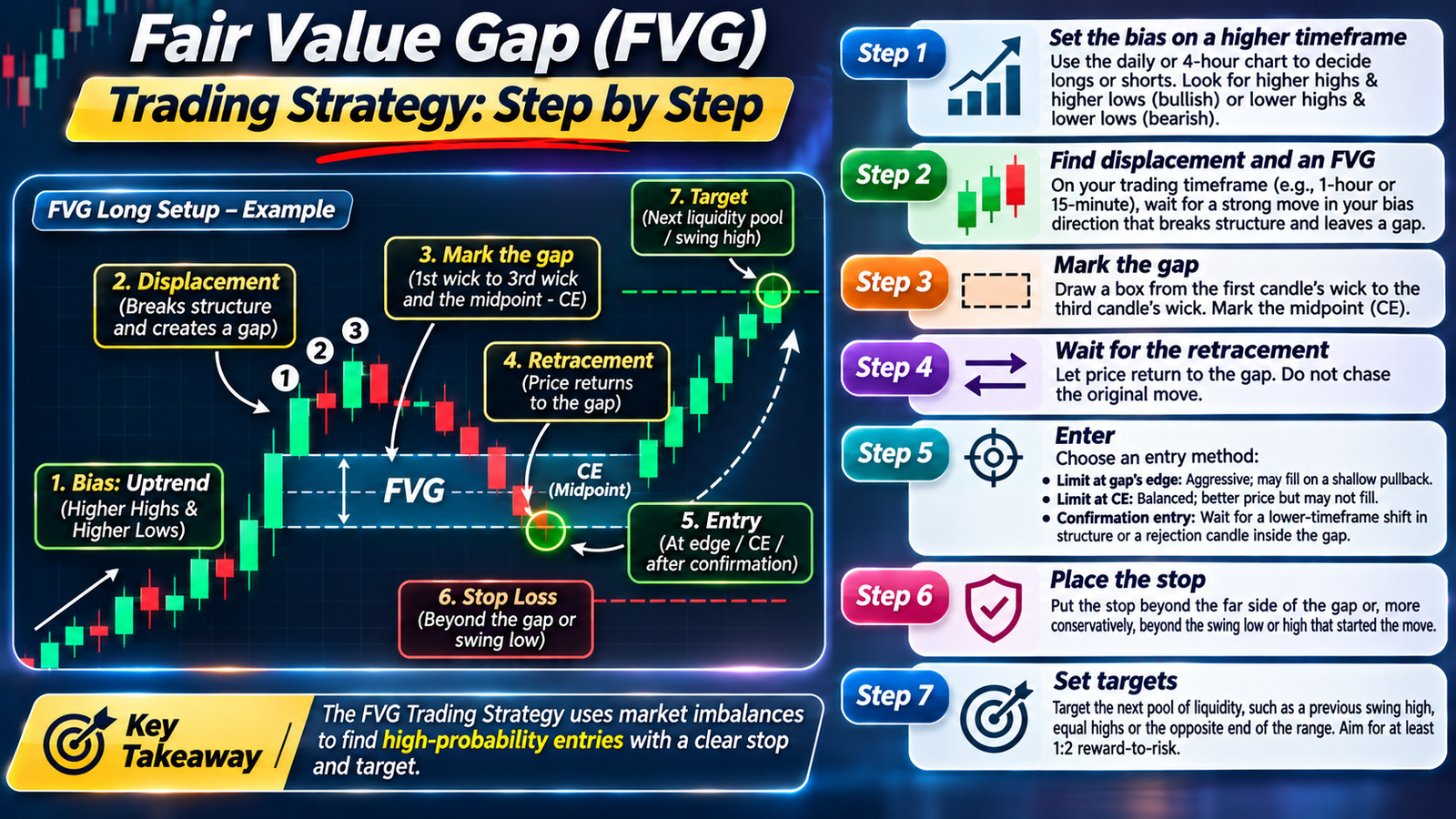
Step 1: Set the bias on a higher timeframe
Use the daily or 4-hour chart to decide whether you are looking for longs or shorts. Look for higher highs and higher lows (bullish) or lower highs and lower lows (bearish).
Step 2: Find displacement and an FVG
On your trading timeframe, such as the 1-hour or 15-minute chart, wait for a strong move in the direction of your bias that breaks structure and leaves a gap.
Step 3: Mark the gap
Draw a box from the first candle’s wick to the third candle’s wick. Mark the midpoint (CE).
Step 4: Wait for the retracement
Let price return to the gap. Do not chase the original move.
Step 5: Enter
Common entry methods:
- Limit order at the gap’s edge: Aggressive; may fill on a shallow pullback.
- Limit order at CE: Balanced; better price but may not fill.
- Confirmation entry: Wait for a lower-timeframe shift in structure or a rejection candle inside the gap.
Step 6: Place the stop
Place the stop beyond the far side of the gap or, more conservatively, beyond the swing low or high that started the move.
Step 7: Set targets
Target the next pool of liquidity, such as a previous swing high, equal highs or the opposite end of the range. Aim for at least 1:2 reward-to-risk.
Worked Example of the Fair Value Gap (FVG) Trading Strategy
Here is how the Fair Value Gap (FVG) Trading Strategy might look on a real chart. Suppose the 4-hour EUR/USD chart is bullish, with higher highs and higher lows. On the 1-hour chart:
- Price sweeps a previous low at 1.1608, taking out sell stops, and then rallies sharply.
- The rally breaks the last swing high at 1.1655.
- During the rally, three candles form a bullish FVG: the first candle’s high is 1.1620 and the third candle’s low is 1.1645. The gap runs from 1.1620 to 1.1645, with CE at about 1.1632.
- Price later pulls back into the gap. The trader places a buy limit at 1.1632.
- The stop goes below the swept low at 1.1605 (27 pips of risk).
- The target is the previous high at 1.1700 (68 pips).
- Price holds the gap, rallies and reaches 1.1700.
The trade gains 68 pips on 27 pips of risk, about 2.5 times the risk.
This example is illustrative and uses hypothetical prices.
Combining the Fair Value Gap (FVG) Trading Strategy With Other SMC Tools
- Order blocks: An FVG sitting next to or inside a valid order block creates a stronger zone of confluence.
- Break of structure (BOS) and change of character (CHoCH): These confirm whether the move that created the gap reflects a real shift in control.
- Liquidity: Gaps formed after a liquidity sweep are more meaningful, and liquidity pools make logical targets.
- Premium and discount: Buying gaps in discount and selling gaps in premium keeps risk-reward favourable.
- Session timing: Many FVGs form during the London and New York sessions, when volume is highest.
Inverse Fair Value Gaps
Sometimes price does not respect a gap. Instead, it closes fully through it. That failed gap can flip roles and become an inverse FVG.
For example, if a bullish FVG is broken by a strong bearish candle that closes below it, the area may later act as resistance when price retraces upward. Some traders use inverse FVGs as entries in the new direction, especially after a change of character.
Inverse gaps are a useful reminder that no zone is guaranteed. When the Fair Value Gap (FVG) Trading Strategy fails, the failure itself can give information.
Best Timeframes and Markets for the Fair Value Gap (FVG) Trading Strategy
- Higher timeframes (daily, 4-hour): Mark key gaps and set bias.
- Intraday (1-hour, 15-minute): Find tradable gaps aligned with that bias.
- Lower timeframes (5-minute, 1-minute): Fine-tune entries inside the gap.
- Markets: FVGs appear in forex, indices, commodities and crypto. They tend to work best in liquid markets with clear trends.
Common Mistakes With the Fair Value Gap (FVG) Trading Strategy
- Trading every gap: Small gaps without displacement or a structure break rarely hold.
- Ignoring higher-timeframe bias: Buying a bullish gap in a strong downtrend is low probability.
- Expecting gaps to fill completely: Many gaps are only partly filled before price moves on.
- Stops too tight: Placing stops just beyond the gap invites stop hunts. Consider the swing point.
- Entering during news spikes: Gaps formed in news volatility can be unreliable, and spreads widen.
- Overcomplicating: Stacking too many SMC concepts leads to analysis paralysis.
- No backtesting: Test your exact rules on historical data before trading live.
Fair Value Gap (FVG) Trading Strategy for Indian Traders
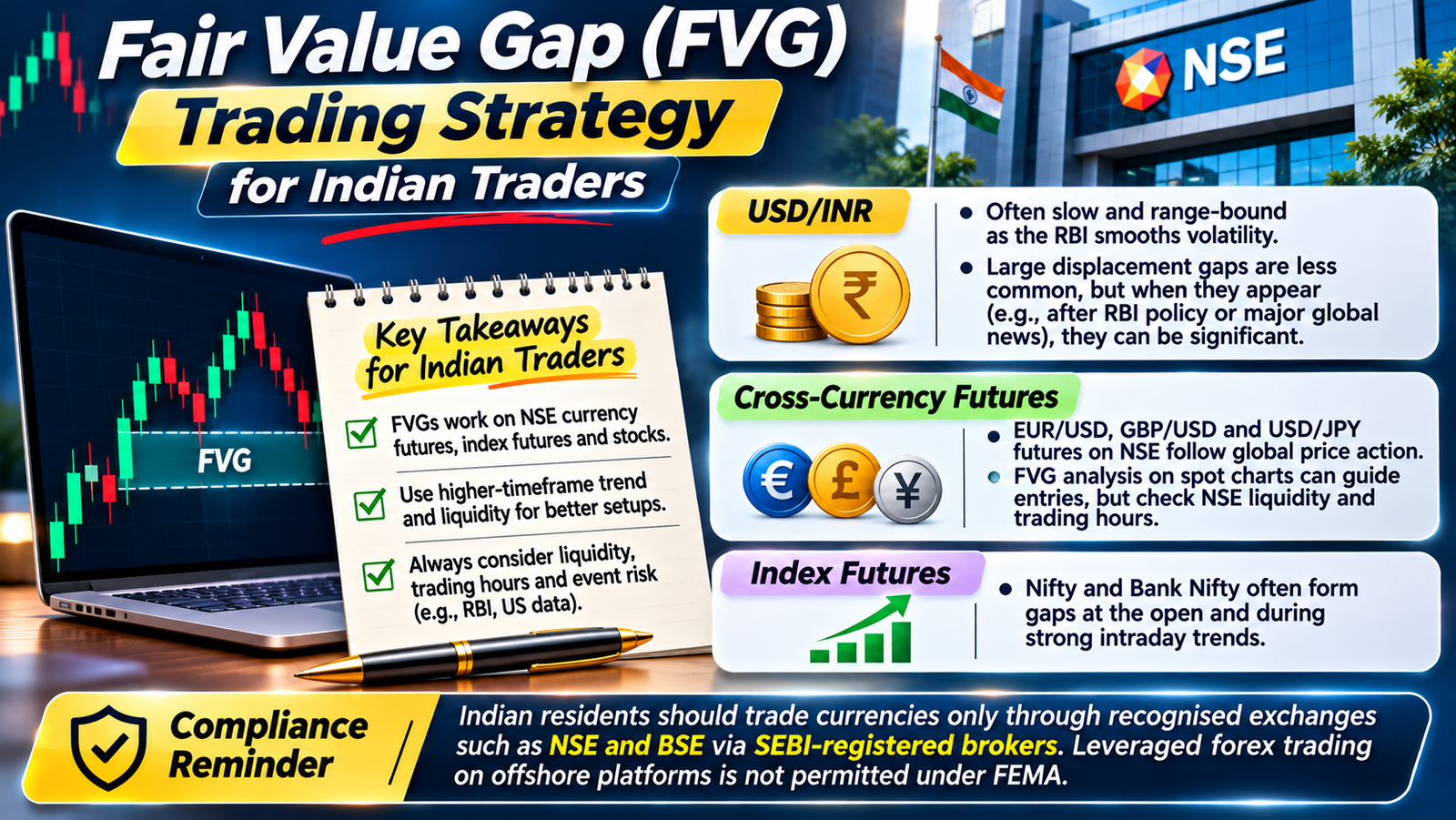
FVGs appear on any liquid chart, including NSE currency futures, Nifty and Bank Nifty futures, and stocks.
- USD/INR: Moves are often slow and range-bound because the RBI smooths volatility, so large displacement gaps are less common. When they do appear, often after RBI policy or major global news, they can be significant.
- Cross-currency futures: EUR/USD, GBP/USD and USD/JPY futures on NSE follow global price action, so FVG analysis on spot charts can guide entries, but check NSE liquidity and trading hours.
- Index futures: Nifty and Bank Nifty often form gaps at the open and during strong intraday trends.
Indian residents should trade currencies only through recognised exchanges such as NSE and BSE via SEBI-registered brokers. Leveraged forex trading on offshore platforms is not permitted under FEMA.
Risk Management Rules for the Fair Value Gap (FVG) Trading Strategy
- Risk no more than 1% of your account per trade.
- Only trade gaps with at least 1:2 reward-to-risk.
- Cancel limit orders if price reaches your target area without filling.
- Avoid holding through major news unless your plan allows it.
- Keep a journal of every FVG trade, including screenshots, to see which conditions work best.
Fair Value Gap (FVG) Trading Strategy Checklist
- Is the higher-timeframe bias clear?
- Did the gap form during displacement with a break of structure?
- Was there a liquidity sweep before the move?
- Is the gap in discount (for longs) or premium (for shorts)?
- Is the gap fresh and unmitigated?
- Is the stop beyond a logical swing point?
- Is reward-to-risk at least 1:2?
FAQs
What is the Fair Value Gap (FVG) Trading Strategy?
It is an approach that identifies price imbalances shown by three-candle gaps and enters trades when price retraces into those gaps, in the direction of the original move.
How do I identify a fair value gap?
Look for three candles where the wicks of the first and third candles do not overlap. The space between them is the FVG.
What is consequent encroachment?
It is the 50% midpoint of the gap, often used as an entry level or a test of the gap’s strength.
Do all fair value gaps get filled?
No. Many are only partly filled, and some are never revisited, especially in strong trends.
Is an FVG trading strategy suitable for beginners?
It can be, provided beginners learn market structure first, apply strict filters and practise on a demo account before risking real money.
Which timeframe is best for FVG trading?
Use higher timeframes for bias and key gaps, and 1-hour or 15-minute charts for entries.
Conclusion
The Fair Value Gap (FVG) Trading Strategy gives traders a structured way to use market imbalances. By focusing on gaps that form during displacement, after liquidity sweeps and in line with higher-timeframe structure, you can find entries with tight stops and clear targets.
Like any method, the Fair Value Gap (FVG) Trading Strategy works best as part of a complete plan with strict risk management. Start by marking gaps on historical charts, backtest your rules and practise on a demo account before trading live.