Introduction
Most trading accounts are not destroyed by one bad trade. They are destroyed by one bad day: a loss, then an attempt to win it back, then a bigger loss, then a desperate final trade. By the evening, weeks of careful progress are gone.
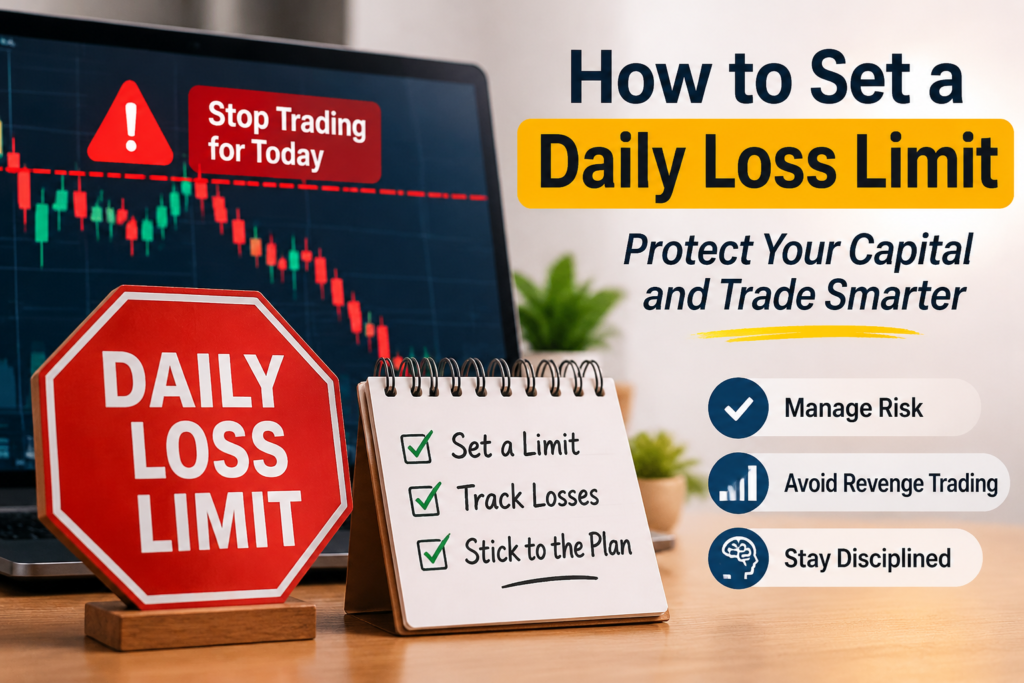
A daily loss limit is the simplest defence against those days. It is a maximum amount you are allowed to lose in a single trading day. Once you hit it, you stop trading until the next session, no exceptions.
This guide explains how daily loss limit trading works and how to build it into your plan:
- What a daily loss limit is and why it matters
- How to calculate the right limit for your account
- How it connects to risk per trade and position sizing
- How prop firm daily drawdown rules work
- Worked examples and practical ways to enforce your limit
What Is a Daily Loss Limit?
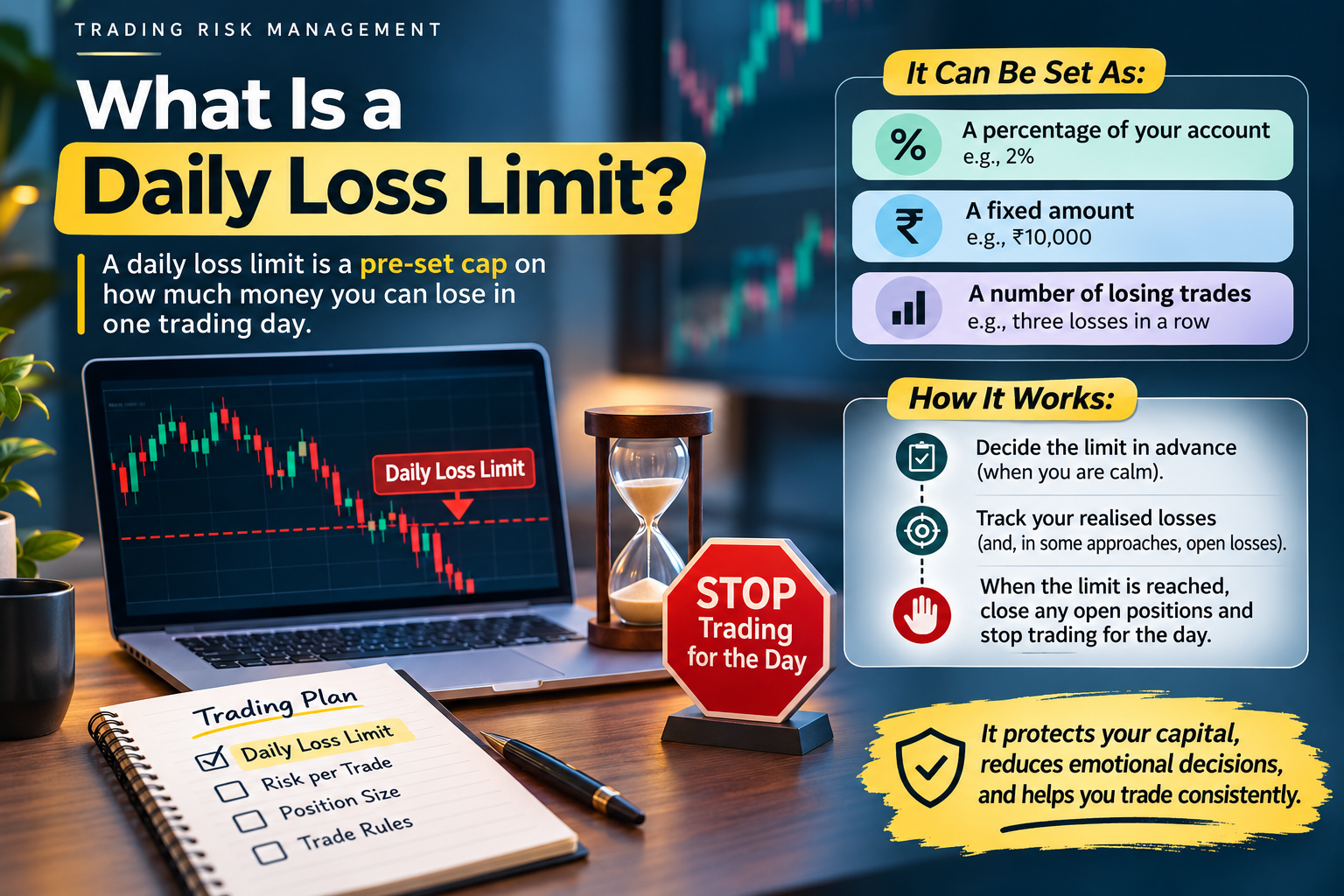
A daily loss limit is a pre-set cap on how much money you can lose in one trading day. It can be expressed as:
- A percentage of your account, such as 2%
- A fixed amount, such as ₹10,000
- A number of losing trades, such as three losses in a row
When realised losses (and, in some approaches, open losses) reach the limit, you close any open positions and stop trading for the day. The rule is decided in advance, when you are calm, so it can protect you when you are not.
Why Daily Loss Limit Trading Matters
1. It stops small losses becoming large ones
Losing days are normal. What matters is how big they get. A daily cap keeps a bad day small enough to recover from easily.
2. It prevents revenge trading
After a loss, many traders feel an urge to “get it back” immediately. They increase size, take lower-quality setups and break their own rules. Daily loss limit trading removes the option: once the limit is hit, the day is over.
3. It protects your confidence
A huge loss can shake your belief in a strategy that works perfectly well over time. Keeping losses contained helps you stay consistent.
4. It makes recovery maths manageable
| Loss on the account | Gain needed to recover |
|---|---|
| 2% | 2.04% |
| 5% | 5.26% |
| 10% | 11.1% |
| 20% | 25% |
| 50% | 100% |
A 2% losing day is easy to recover. A 20% losing day can take months.
5. It is required by most prop firms
Funded trading programmes almost always include a daily drawdown rule. Practicing daily loss limit trading on your own account prepares you for those rules.
How to Calculate Your Daily Loss Limit
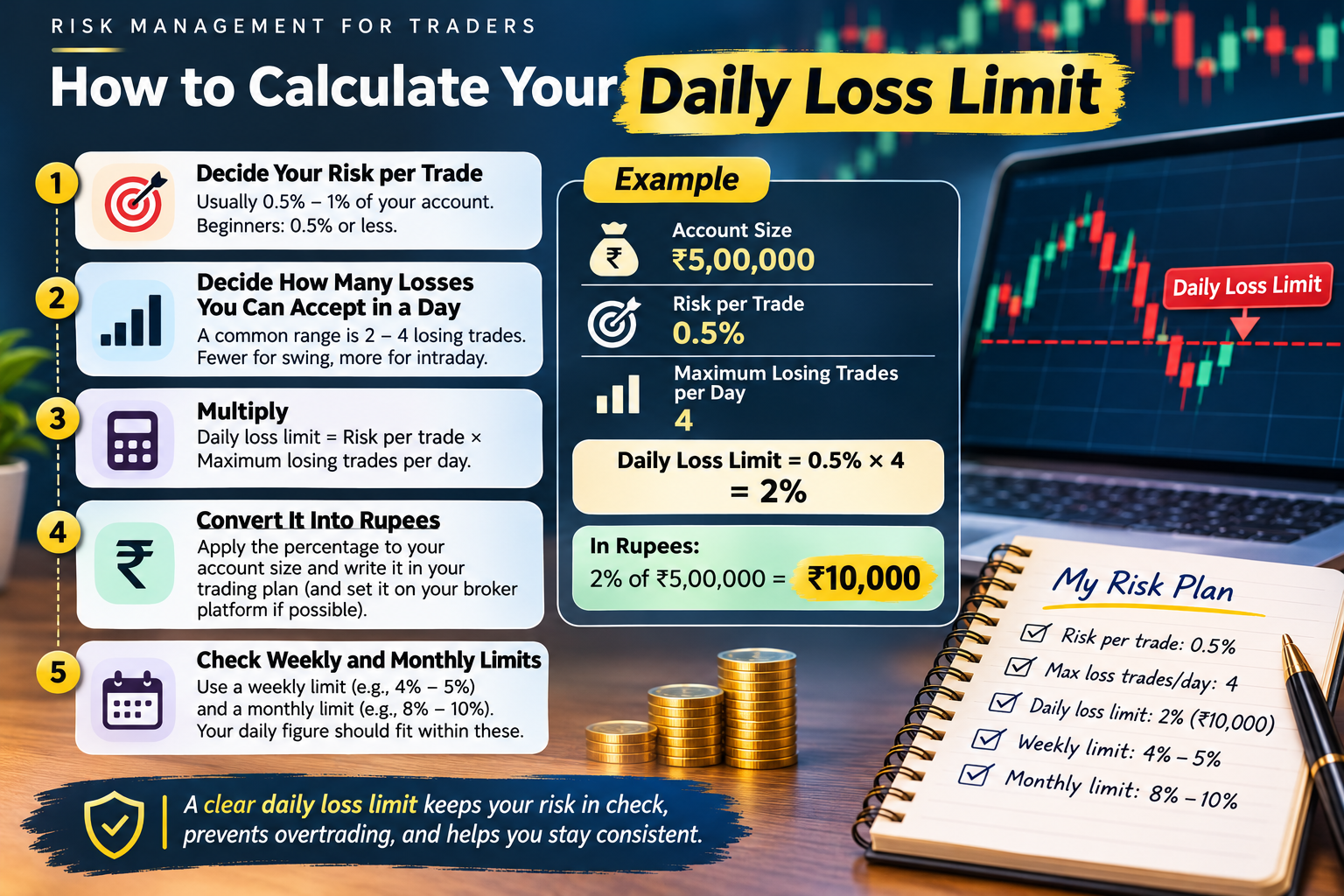
Step 1: Decide your risk per trade
The foundation of daily loss limit trading is your risk per trade. Most experienced traders risk between 0.5% and 1% of their account on a single trade. Beginners often do best at 0.5% or less.
Step 2: Decide how many full losses you can accept in a day
Two to four losing trades is a common range. Fewer trades suits swing traders; more suits active intraday traders.
Step 3: Multiply
Daily loss limit = Risk per trade × Maximum losing trades per day
For example, 0.5% risk per trade × 4 trades = a 2% daily loss limit.
Step 4: Convert it into rupees
On a ₹5,00,000 account, 2% equals ₹10,000. Write this number down in your trading plan and set it in your broker platform if possible.
Step 5: Check it against your weekly and monthly limits
Many traders also use a weekly limit, such as 4% to 5%, and a monthly limit, such as 8% to 10%. Your daily figure should sit comfortably within these.
Typical Ranges in Daily Loss Limit Trading
| Trader type | Typical risk per trade | Typical daily loss limit |
|---|---|---|
| Beginner | 0.25% – 0.5% | 1% – 1.5% |
| Intermediate | 0.5% – 1% | 1.5% – 2.5% |
| Experienced | 0.5% – 1% | 2% – 3% |
| Prop firm challenge | Lower than the firm’s rule | Set well inside the firm’s daily drawdown |
These are general guidelines, not rules. The right number depends on your strategy, win rate and how often you trade.
Percentage vs Fixed Amount in Daily Loss Limit Trading
| Method | Advantages | Disadvantages |
|---|---|---|
| Percentage of account | Scales automatically as the account grows or shrinks | Changes daily, so you need to recalculate |
| Fixed rupee amount | Simple to remember and set in software | Needs manual review as the account changes |
| Number of losing trades | Easy to follow in the moment | Ignores trade size; three small losses differ from three large ones |
Many traders combine methods, for example: “Stop at 2% of the account or after three consecutive losses, whichever comes first.” Combining rules makes daily loss limit trading more robust.
Daily Loss Limit Trading and Position Sizing
A daily loss limit only works if each trade is sized correctly. If your limit is ₹10,000 but a single trade could lose ₹15,000, one bad fill breaks your rule.
Use this formula to size trades:
Position size = Risk per trade (₹) ÷ Stop-loss distance (₹ per unit)
For USD/INR futures, each paise move is worth ₹10 per lot. If you risk ₹2,500 on a trade with a 10-paise stop, you can trade 25 lots (₹2,500 ÷ ₹100 per lot). Sizing every trade this way makes it impossible for one trade to blow through your daily limit, barring gaps or slippage.
Worked Example of Daily Loss Limit Trading
A trader has a ₹5,00,000 account and these rules:
- Risk per trade: 0.5% (₹2,500)
- Daily loss limit: 2% (₹10,000)
- Extra rule: stop after three consecutive losses
Their day goes like this:
| Trade | Result | Day’s running P&L |
|---|---|---|
| 1 | −₹2,500 | −₹2,500 |
| 2 | +₹4,000 | +₹1,500 |
| 3 | −₹2,500 | −₹1,000 |
| 4 | −₹2,500 | −₹3,500 |
| 5 | −₹2,500 | −₹6,000 |
After Trade 5, the trader has three consecutive losses, so they stop, even though the ₹10,000 limit has not been reached. The day ends at −₹6,000, or 1.2% of the account. Without the rules, the next few trades could easily have been oversized attempts to recover.
This example is illustrative and uses hypothetical figures.
Daily Loss Limit Trading in Prop Firms
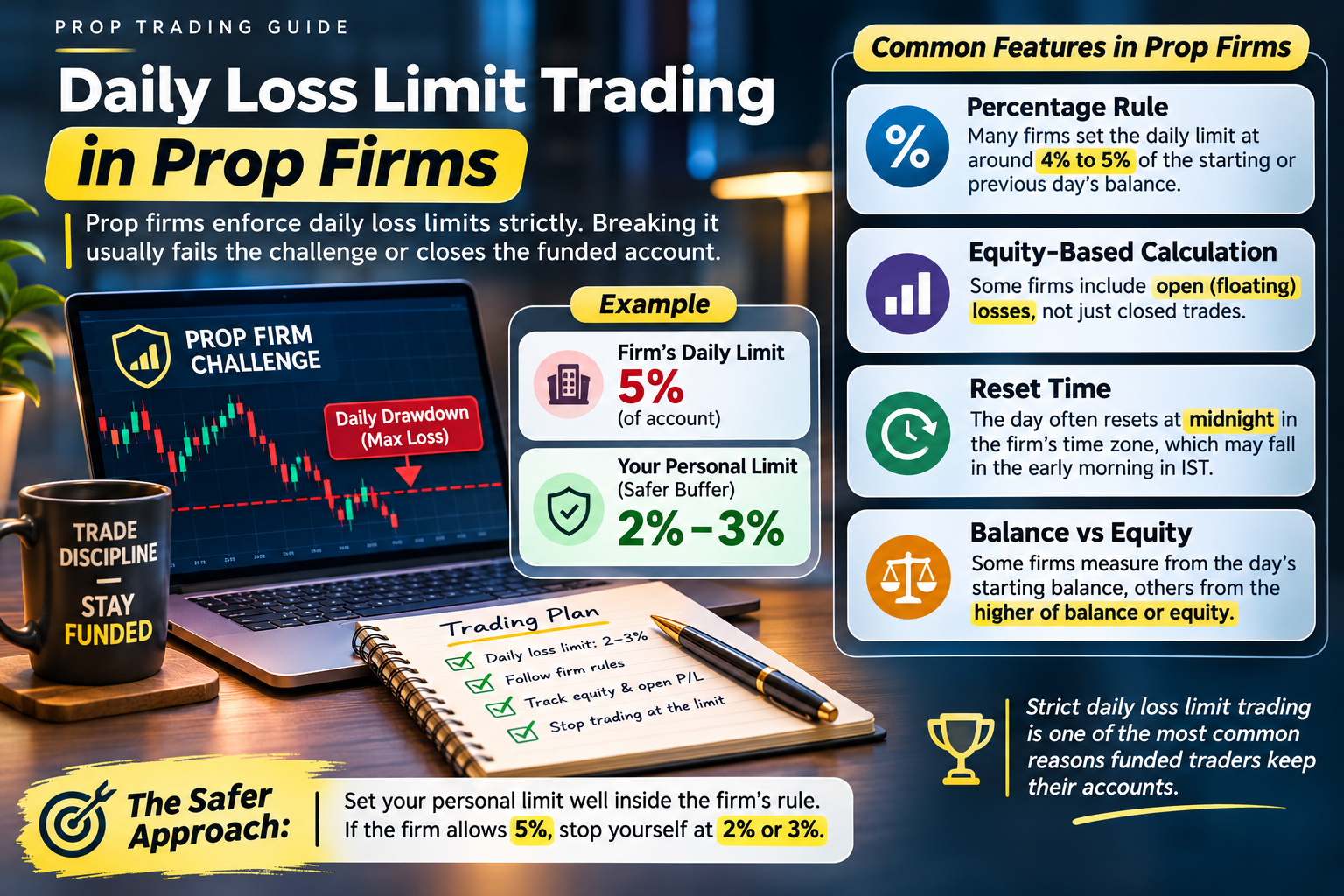
Prop firms enforce daily limits strictly, often called a daily drawdown or maximum daily loss. Breaking it usually fails the challenge or closes the funded account immediately.
Common features include:
- Percentage rule: Many firms set the daily limit at around 4% to 5% of the starting or previous day’s balance. Check your firm’s exact figure.
- Equity-based calculation: Some firms include open (floating) losses, not just closed trades.
- Reset time: The day often resets at midnight in the firm’s time zone, which may fall in the early morning in IST.
- Balance vs equity: Some firms measure from the day’s starting balance, others from the higher of balance or equity.
The safest approach is to set your personal limit well inside the firm’s rule. If the firm allows 5%, stop yourself at 2% or 3%. That buffer protects you from slippage, news spikes and open losses you did not expect. Strict daily loss limit trading is one of the most common reasons funded traders keep their accounts.
How to Stick to Your Daily Loss Limit
Setting a number is easy; following it under pressure is the hard part of daily loss limit trading. These habits help:
- Write it down: Put the number, in rupees, at the top of your trading plan.
- Use platform tools: Some brokers and trading platforms let you set a daily loss or kill-switch feature that blocks new orders after a set loss. Check what your broker offers.
- Track P&L in real time: Keep a running total of the day’s result visible on screen.
- Close the platform: When the limit is hit, close positions, log out and step away.
- Use an accountability partner: Tell a friend or mentor your limit and report breaches.
- Review in your journal: Note every day you hit the limit and what led to it.
- Never move the limit during the day: Changes are allowed only during your weekly review.
Daily Loss Limit Trading and Psychology
Hitting a limit feels bad, but it is a sign that your risk management is working, not that you failed. Many professional traders say the days they stopped early were among their most important, because they protected capital for better opportunities.
Watch for warning signs that you are close to breaking the rule:
- Increasing position size after a loss
- Taking trades that do not meet your setup criteria
- Removing or widening stop-losses
- Feeling angry, rushed or desperate
If you notice any of these, stop trading even if the limit has not been hit.
Common Daily Loss Limit Trading Mistakes
- Setting the limit too high: A 10% daily limit offers little protection.
- Ignoring open losses: Closed losses of ₹6,000 plus open losses of ₹8,000 already exceed a ₹10,000 limit.
- No link to position size: Oversized trades make the limit meaningless.
- Resetting after a winning trade: The limit applies to the whole day’s net result, not just from the last win.
- Trading on another account: Switching accounts to keep trading breaks the spirit of the rule.
- Only having a daily limit: Add weekly and monthly limits to catch slow, steady drawdowns.
Weekly and Monthly Limits
Daily loss limit trading works best as part of a layered system:
| Limit | Example | Action when hit |
|---|---|---|
| Daily | 2% | Stop for the day |
| Weekly | 5% | Stop until next week and review trades |
| Monthly | 8% – 10% | Stop, reduce size by half and review the strategy |
Layered limits ensure no single day, week or month can do serious damage.
Daily Loss Limit Trading for Indian Traders
- Indian brokers increasingly offer risk tools such as loss-based order blocking. Check your broker’s settings.
- For NSE currency futures, remember that USD/INR moves ₹10 per paise per lot, so size accordingly.
- F&O option buyers can lose the full premium quickly, so set limits based on premium at risk.
- Trade currencies only through recognised exchanges via SEBI-registered brokers. Offshore leveraged forex platforms are not permitted under FEMA.
Daily Loss Limit Trading Checklist
- What is my risk per trade?
- How many losing trades will I accept in a day?
- What is my daily limit in percent and in rupees?
- Do I include open losses?
- Is my limit set in my broker or platform?
- What are my weekly and monthly limits?
- What will I do when the limit is hit?
FAQs
What is daily loss limit trading?
It is a risk management approach where you stop trading for the day once your losses reach a pre-set amount or percentage.
What is a good daily loss limit?
Many traders use 1% to 3% of their account, depending on experience, strategy and risk per trade.
Should I include open trades in my daily loss?
Yes, ideally. Many prop firms include floating losses, and it gives a more honest picture of risk.
What should I do after hitting my limit?
Close positions, stop trading, record what happened in your journal and return the next day with a fresh mind.
Is a daily loss limit the same as a stop-loss?
No. A stop-loss caps the loss on one trade. A daily loss limit caps total losses across all trades in a day.
Conclusion
Daily loss limit trading is one of the simplest and most effective risk management habits you can build. It turns bad days into small setbacks, stops revenge trading and keeps your account alive long enough for your edge to work.
Set your limit based on risk per trade, write it down in rupees, link it to position sizing, use platform tools where possible and back it up with weekly and monthly limits. Most importantly, treat it as non-negotiable. The day you need it most is the day you will be most tempted to ignore it.