

Quick answer: The ICT Silver Bullet is a one-hour, time-based setup taught by ICT (Inner Circle Trader). Inside each window, you wait for price to grab liquidity, then enter on a pullback into a fair value gap. In IST, the windows are 12:30–1:30 PM, 7:30–8:30 PM and 11:30 PM–12:30 AM (US summer time).
The ICT Silver Bullet is popular because it gives you fixed hours to watch instead of staring at charts all day. But most guides list New York times, and most Indian traders get the conversion wrong.
This guide gives you the correct IST timings, explains every term, and shows a full worked example on an NSE contract. It also tells you which window you can legally trade from India, which most guides skip.
Trading carries a risk of loss. This article is education, not financial advice.
What is the ICT Silver Bullet strategy?
ICT stands for Inner Circle Trader, the name used by trading educator Michael J. Huddleston. His ideas form a big part of Smart Money Concepts (SMC). If you are new to SMC, start with our complete guide to Smart Money Concepts.
The Silver Bullet is one of his simplest setups. It works on one idea: at certain times of day, large players push price to where many orders are waiting, then move it the other way.
The setup has three parts:
- A fixed time window of one hour.
- A liquidity grab, where price briefly breaks a recent high or low.
- A fair value gap entry, where you enter on a small pullback after a strong move.
You take at most one or two trades per window. If the setup does not appear, you do nothing.
What do liquidity, fair value gaps and displacement mean?
You need four terms before you trade this setup.
Liquidity means a cluster of pending orders, mostly stop-losses, sitting above a recent high or below a recent low. Think of it like the Tatkal counter at a railway station at 10 AM. Everyone queues at the same spot, so big players know exactly where to find orders.
- Buy-side liquidity sits above highs (stops of sellers).
- Sell-side liquidity sits below lows (stops of buyers).
Liquidity sweep means price pokes just past that high or low, triggers those stops, and then reverses. Read more in our guide on liquidity sweeps in ICT trading.
Displacement means a fast, strong candle or series of candles that moves sharply in one direction. It shows real buying or selling pressure, not random noise.
Fair value gap (FVG) is a three-candle pattern. The wick of candle one and the wick of candle three do not overlap, leaving a “gap” next to candle two. Price often comes back to fill part of this gap. See fair value gap explained for chart examples.
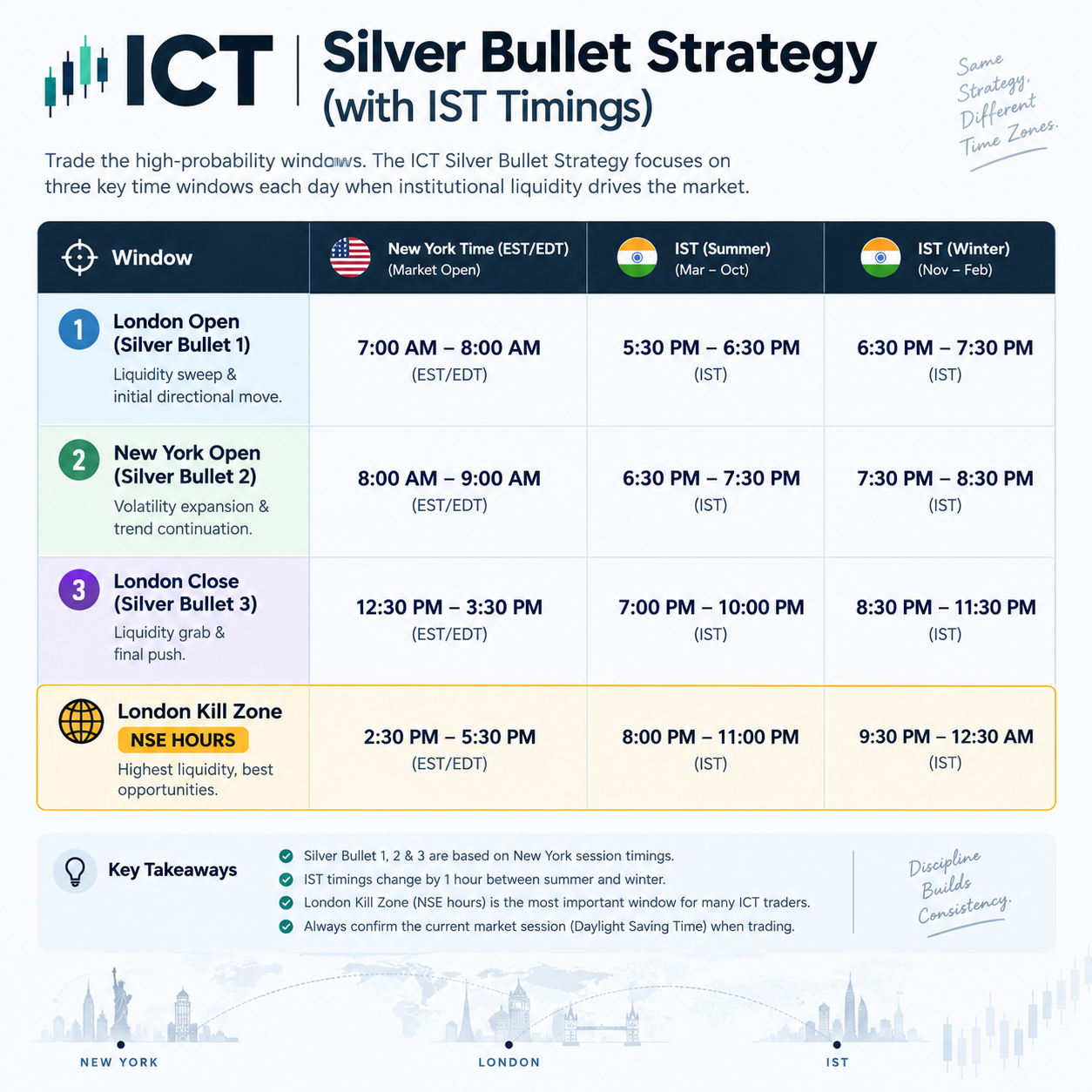
What are the ICT Silver Bullet timings in IST?
ICT defines the three windows in New York time. India does not change its clocks, but the US does. So the IST timings shift by one hour twice a year.
In 2026, US clocks move back on Sunday, 1 November. From Monday, 2 November, use the winter column until US clocks move forward on 14 March 2027.
| Window | New York time | IST (US summer time) | IST (US winter time) | Open on NSE cross-currency? |
|---|---|---|---|---|
| London Open Silver Bullet | 3:00–4:00 AM | 12:30–1:30 PM | 1:30–2:30 PM | Yes |
| New York AM Silver Bullet | 10:00–11:00 AM | 7:30–8:30 PM | 8:30–9:30 PM | No (closes 7:30 PM) |
| New York PM Silver Bullet | 2:00–3:00 PM | 11:30 PM–12:30 AM | 12:30–1:30 AM | No |
To check the live session times for any date, use our Forex Market Hours tool. It converts global sessions to IST automatically, so you do not have to track US clock changes yourself.
Which ICT Silver Bullet window can Indian traders actually use?
This is the most important section for you.
As an Indian resident, you may trade currency derivatives only through a SEBI-registered broker on a recognised exchange like NSE or BSE. The permitted pairs are USD/INR, EUR/INR, GBP/INR, JPY/INR, EUR/USD, GBP/USD and USD/JPY.
Exchange trading hours are:
- INR pairs (USD/INR, EUR/INR, GBP/INR, JPY/INR): 9:00 AM to 5:00 PM IST
- Cross-currency pairs (EUR/USD, GBP/USD, USD/JPY): 9:00 AM to 7:30 PM IST
So the London Open Silver Bullet is the only window that falls inside Indian exchange hours. The New York AM and PM windows open after the market closes.
Many offshore apps advertise 24-hour forex trading to Indians so you can catch the New York windows. Trading on them is not permitted for residents. The RBI keeps an Alert List of unauthorised forex platforms.
You can still study the New York windows on charts to learn how the pattern behaves. Just do not trade them through unauthorised platforms.
How are profits taxed?
Profits from exchange-traded currency derivatives are generally treated as non-speculative business income under section [corresponding section, Income-tax Act, 2025] (section 43(5), Income-tax Act, 1961). Tax rules change; confirm with a chartered accountant.
How do you trade the ICT Silver Bullet step by step?
Follow these steps for every window.
- Mark the key levels before the window opens. Note the Asian session high and low, plus the previous day’s high and low. These are your liquidity pools.
- Decide the likely target. ICT calls this the “draw on liquidity”, the level price is most likely heading toward. Use the higher timeframe trend (for example, the 1-hour chart) to pick it.
- Wait for the sweep. Inside the window, watch for price to break one of your marked levels and quickly reverse.
- Look for displacement. After the sweep, you want a strong move in the opposite direction that leaves a fair value gap on the 1-minute or 5-minute chart.
- Enter on the pullback. Place a limit order inside the FVG. Do not chase the strong move.
- Set your stop-loss. Put it just beyond the sweep high or low.
- Set your target. Aim for the opposite liquidity pool. Many traders want at least twice the risk.
- Size your position. Risk a fixed small share of your capital, such as 1%. See our position sizing for forex traders guide.
If no sweep and displacement appear within the hour, skip the day.
Worked example: ICT Silver Bullet on NSE EUR/USD futures
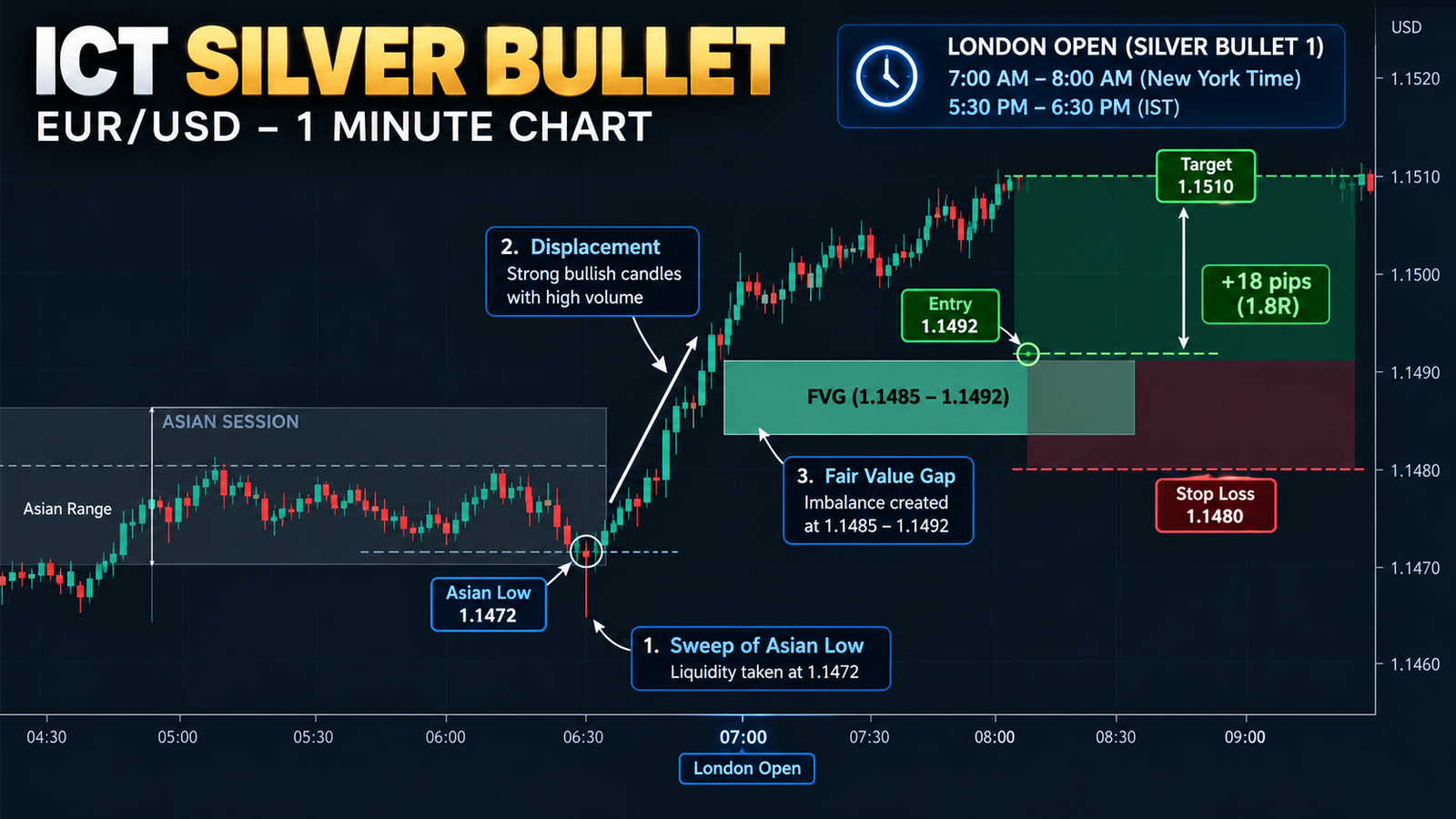
Here is a London Open Silver Bullet on an NSE EUR/USD futures contract, during US summer time. All prices are round numbers for learning only.
Contract facts:
- 1 lot = EUR 1,000
- Price is quoted in USD; profits and losses settle in INR
- Smallest move (1 tick) = 0.0001 = USD 0.10 per lot
- Assume USD 1 = ₹88 for easy maths, so 1 tick = ₹8.80 per lot
Your account: ₹1,00,000 capital, 1% risk per trade = ₹1,000.
Step 1: Before 12:30 PM IST. You mark the Asian session low at 1.1480 and the previous day’s high at 1.1530. The 1-hour trend is up, so your draw on liquidity is 1.1530.
Step 2: 12:45 PM IST. Price drops to 1.1472, breaking below 1.1480. Stops below the Asian low are triggered. This is the sell-side liquidity sweep.
Step 3: 12:55 PM IST. Price jumps quickly to 1.1505 in three strong candles. This is displacement. It leaves a fair value gap between 1.1485 and 1.1492.
Step 4: Plan the trade.
| Item | Level | Distance |
|---|---|---|
| Entry (buy limit inside FVG) | 1.1490 | – |
| Stop-loss (below sweep low) | 1.1470 | 20 ticks |
| Target (previous day high) | 1.1530 | 40 ticks |
| Risk to reward | – | 1:2 |
Step 5: Position size.
- Risk per lot = 20 ticks × ₹8.80 = ₹176
- Lots = ₹1,000 ÷ ₹176 = 5.68, round down to 5 lots
- Actual risk = 5 × ₹176 = ₹880
- Potential reward = 40 ticks × ₹8.80 × 5 = ₹1,760
Step 6: 1:05 PM IST. Price pulls back to 1.1490 and your order fills.
If price reaches 1.1530, you gain about ₹1,760. If it hits 1.1470, you lose about ₹880. Both figures are before brokerage, exchange fees and taxes. Margin is also needed to hold the position. [VERIFY: current NSE margin per lot for EUR-USD futures + source]
If neither level is hit, close the trade before 7:30 PM IST. Do not hold it overnight without a plan.
| Calculate it yourself
Before your next session, open our Forex Market Hours tool and check today’s London open in IST. Then mark the Asian high and low on your chart, and practise spotting a sweep and FVG inside the window. Paper trade at least 20 setups before risking real money. |
What are the common ICT Silver Bullet mistakes?
- Using the wrong IST time. Many traders forget the US clock change and watch the wrong hour. Fix: check the session times each week with a converter, especially in early November and mid-March.
- Forcing a trade every day. No sweep means no setup. Fix: write “no trade” as a valid outcome in your trading journal.
- Chasing the displacement candle. Buying after a big green candle gives a poor entry and a wide stop. Fix: wait for price to return to the fair value gap.
- Risking too much. A tight stop tempts you to load up on lots. Fix: calculate lots from your rupee risk every time, never by feel.
- Using offshore apps for New York windows. It may seem like the only way to trade the evening setups. Fix: stick to SEBI-registered brokers and the London window. Use the other windows for chart study only.
Does the ICT Silver Bullet strategy really work?
No strategy wins every time, and this one is no different. There is no reliable, independent data on its win rate.
What the setup does give you is structure. You know when to look, what to look for, and where your stop goes. That discipline helps many learners more than the pattern itself.
Your results depend on how well you read liquidity, how strictly you follow rules, and how you manage risk. Backtest and paper trade first. Learn related setups like [INTERNAL LINK: ICT kill zones in IST] to see how timing fits the bigger picture.
Key takeaways
- The ICT Silver Bullet is a one-hour setup: liquidity sweep, displacement, then entry in a fair value gap.
- In US summer time, the IST windows are 12:30–1:30 PM, 7:30–8:30 PM and 11:30 PM–12:30 AM. Add one hour in US winter time.
- Only the London Open window (12:30 or 1:30 PM IST) falls within NSE trading hours for Indian residents.
- Size every trade from a fixed rupee risk, such as 1% of capital.
- Trade only through SEBI-registered brokers on NSE or BSE, and check the RBI Alert List before trusting any app.
FAQs
What time is the ICT Silver Bullet in India?
From mid-March to early November (US summer time), the windows are 12:30–1:30 PM, 7:30–8:30 PM and 11:30 PM–12:30 AM IST. From early November to mid-March, add one hour: 1:30–2:30 PM, 8:30–9:30 PM and 12:30–1:30 AM IST. India does not change its clocks, but the US does.
Is the ICT Silver Bullet legal to trade in India?
The strategy itself is just a method, so studying it is fine. What matters is where you trade. Indian residents may trade currency derivatives only through SEBI-registered brokers on NSE or BSE, in permitted pairs. Using offshore forex apps is not allowed. Check the RBI Alert List for unauthorised platforms.
Which currency pairs work best for the Silver Bullet in India?
On NSE, EUR/USD and GBP/USD futures suit the London Open window well, since Europe is active then and contracts trade until 7:30 PM IST. USD/INR also trades during the window, but it often moves in a narrow range. Always check liquidity and spreads before choosing a contract.
Can beginners use the ICT Silver Bullet strategy?
Yes, if you already understand candlesticks, stop-losses and position sizing. The setup has clear rules and fixed hours, which helps beginners stay disciplined. Start by marking setups on past charts, then paper trade at least 20 times. Use real money only after your results stay consistent, and keep risk small.
Conclusion
The ICT Silver Bullet gives you a clear, time-based routine: mark liquidity, wait for a sweep and displacement, then enter in the fair value gap. For Indian traders, the key is getting the IST timings right and trading only the London window through a SEBI-registered broker.
Master the building blocks first. Our Smart Money Concepts guide explains liquidity, order blocks and market structure in detail, so every ICT Silver Bullet setup you take rests on solid ground.