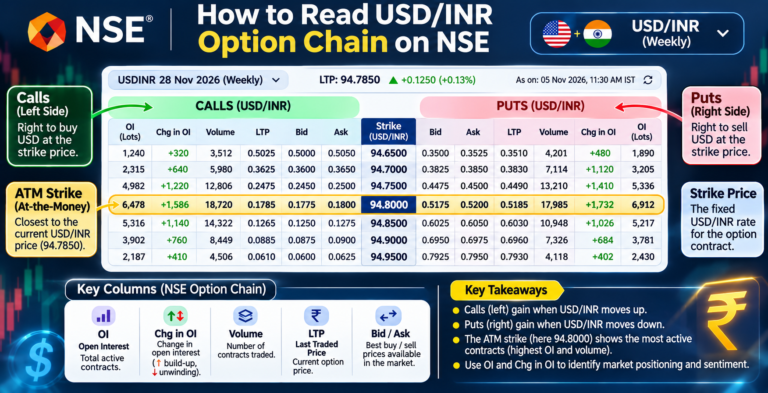

Introduction of Currency futures lot size NSE
Currency futures and options on the National Stock Exchange (NSE) are the main legal route for Indian residents to trade currency movements. Before placing a single trade, every trader needs to understand the contract: how big one lot is, how much one tick is worth, when contracts expire and how they settle.
Getting these basics wrong can lead to oversized positions, unexpected losses or confusion on expiry day. This guide brings together everything you need to know about currency futures lot size on NSE and the key contract specifications for both INR pairs and cross-currency pairs.
You will learn:
- Lot sizes for each currency pair
- Tick sizes and tick values
- How to calculate profit and loss
- Trading hours, expiry and settlement rules
- Currency options basics
- Margins, position limits and recent RBI changes
What Are Currency F&O Contracts?
Currency futures are exchange-traded contracts to buy or sell a currency pair at a set price on a future date. Currency options give the buyer the right, but not the obligation, to buy or sell at a set strike price. On NSE, these contracts are cash-settled in Indian rupees, so no foreign currency changes hands.
Contracts are standardised. Each one represents a fixed amount of the base currency, called the lot size or unit. Understanding the currency futures lot size NSE uses is the starting point for sizing every position.
Currency Futures Lot Size NSE: INR Pairs
| Pair | Lot size (1 unit) | Quotation | Tick size | Value of 1 tick per lot |
|---|---|---|---|---|
| USD/INR | USD 1,000 | Rupees per US dollar | ₹0.0025 (0.25 paise) | ₹2.50 |
| EUR/INR | EUR 1,000 | Rupees per euro | ₹0.0025 | ₹2.50 |
| GBP/INR | GBP 1,000 | Rupees per pound | ₹0.0025 | ₹2.50 |
| JPY/INR | JPY 100,000 | Rupees per 100 yen | ₹0.0025 | ₹2.50 |
A key point: although the lot sizes differ in currency terms, the value of one tick is the same, ₹2.50, for all four INR pairs. That is because JPY/INR is quoted per 100 yen, so a 100,000-yen lot equals 1,000 quoting units, just like the other pairs.

What is a 1-paise move worth?
One paise equals four ticks of 0.25 paise. So a 1-paise move is worth ₹10 per lot (4 × ₹2.50) on any INR pair. This simple rule makes it easy to understand the currency futures lot size NSE uses in practical terms.
Currency Futures Lot Size NSE: Cross-Currency Pairs
| Pair | Lot size (1 unit) | Quotation | Tick size |
|---|---|---|---|
| EUR/USD | EUR 1,000 | US dollars per euro | 0.0001 |
| GBP/USD | GBP 1,000 | US dollars per pound | 0.0001 |
| USD/JPY | USD 1,000 | Yen per US dollar | 0.01 |
For cross-currency pairs, profit and loss is first calculated in the quote currency (US dollars for EUR/USD and GBP/USD, yen for USD/JPY) and then converted to rupees for settlement. One tick on EUR/USD or GBP/USD is worth $0.10 per lot (0.0001 × 1,000), and one tick on USD/JPY is worth ¥10 per lot (0.01 × 1,000), before conversion to rupees.
Liquidity in cross-currency contracts is generally lower than in USD/INR, so check volumes and spreads before trading.
Currency Futures Lot Size NSE: How to Calculate Profit and Loss
Formula for INR pairs
P&L = (Exit price − Entry price) × Lot size × Number of lots
For JPY/INR, use 1,000 as the multiplier, because the price is quoted per 100 yen.
Example 1: USD/INR
You buy 5 lots of USD/INR futures at ₹88.0000 and sell at ₹88.1500.
- Price move: ₹0.15 (15 paise)
- P&L: 0.15 × 1,000 × 5 = ₹750, before brokerage and taxes
Example 2: EUR/INR
You sell 2 lots of EUR/INR at ₹102.5000 and buy back at ₹102.2000.
- Price move: ₹0.30 in your favour
- P&L: 0.30 × 1,000 × 2 = ₹600, before costs
Example 3: JPY/INR
You buy 3 lots of JPY/INR at ₹58.0000 (per 100 yen) and sell at ₹58.1000.
- Price move: ₹0.10
- P&L: 0.10 × 1,000 × 3 = ₹300, before costs
Prices in these examples are illustrative.
Contract Value: Why Currency Futures Lot Size NSE Matters
The notional value of a contract equals the price multiplied by the lot size. For example, one USD/INR lot at ₹88 has a notional value of about ₹88,000. Ten lots represent about ₹8.8 lakh of exposure.
Because you only post margin, not the full notional value, currency futures are leveraged. Small price moves can create meaningful gains or losses relative to your margin. Knowing the currency futures lot size NSE contracts use helps you calculate exposure accurately and avoid taking on more risk than you intend.
Trading Hours
The currency futures lot size NSE sets is the same throughout the session, but liquidity varies by time of day.
| Segment | Trading hours (IST) |
|---|---|
| INR pairs (futures and options) | 9:00 am – 5:00 pm, Monday to Friday |
| Cross-currency pairs | Check current hours with NSE or your broker |
NSE’s specification pages have listed different hours for cross-currency contracts over time, so confirm the current timings before planning evening trades.
Expiry and Settlement Rules
Lot size tells you how big a position is; expiry rules tell you how long it can last.
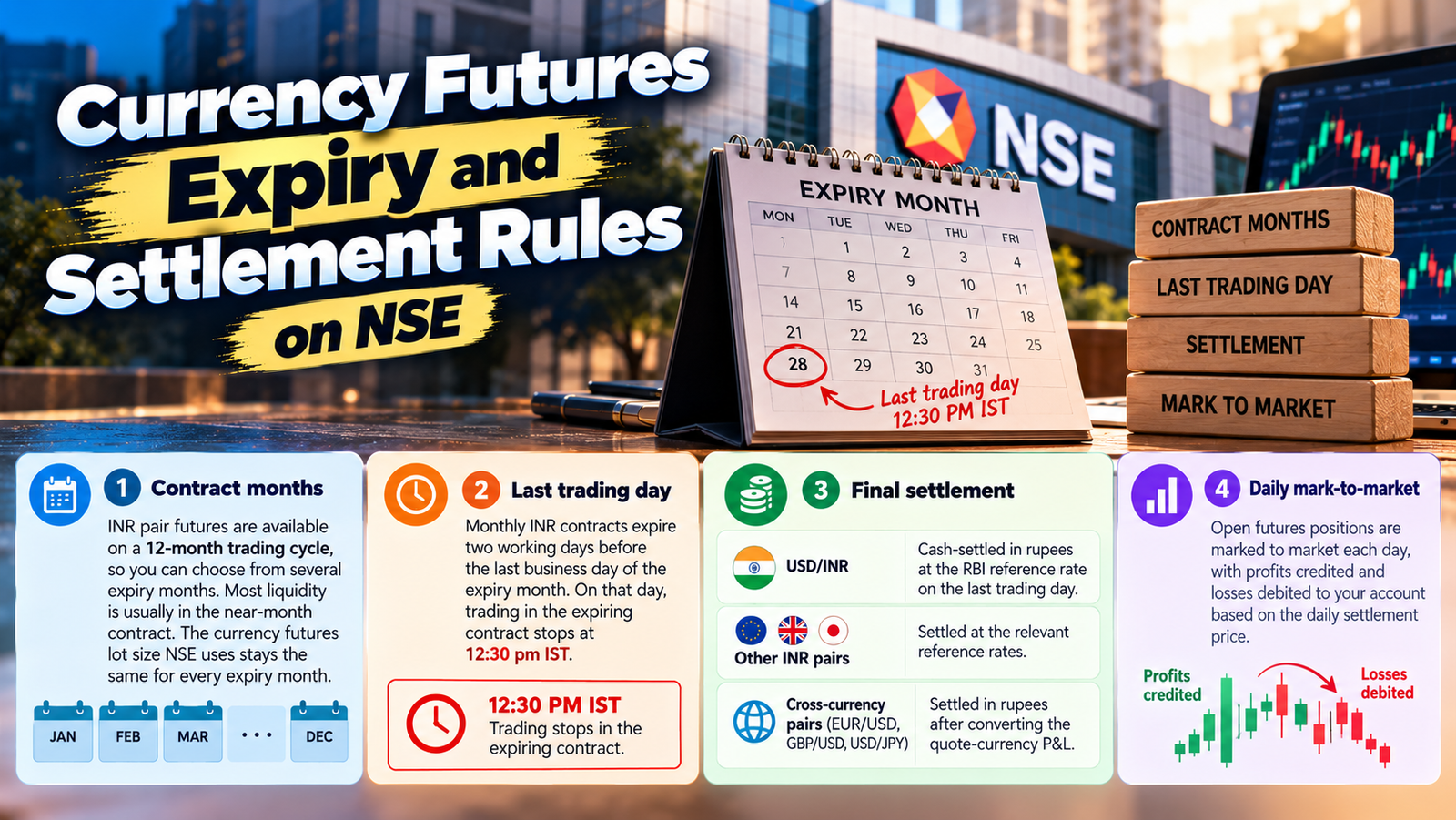
Contract months
INR pair futures are available on a 12-month trading cycle, so you can choose from several expiry months. Most liquidity is usually in the near-month contract. The currency futures lot size NSE uses stays the same for every expiry month.
Last trading day
Monthly INR contracts expire two working days before the last business day of the expiry month. On that day, trading in the expiring contract stops at 12:30 pm IST.
Final settlement
- USD/INR: Cash-settled in rupees at the RBI reference rate on the last trading day.
- Other INR pairs: Settled at the relevant reference rates.
- Cross-currency pairs: Settled in rupees after converting the quote-currency P&L.
Daily mark-to-market
Open futures positions are marked to market each day, with profits credited and losses debited to your account based on the daily settlement price.
Currency Options on NSE
NSE also offers options on currency pairs, most actively on USD/INR. Key features include:
- Lot size: The same as the currency futures lot size NSE sets for the pair, for example USD 1,000 for USD/INR.
- Style: European options, which can only be exercised at expiry.
- Premium: Quoted in rupees for INR pairs.
- Settlement: Cash-settled in rupees.
- Expiries: Monthly options, and weekly options on some pairs such as USD/INR.
Option buyers pay the premium upfront, and their maximum loss is limited to that premium. Option sellers receive the premium but face larger potential losses and must post margin.
Option example
You buy one USD/INR call option with a strike of ₹88.00 for a premium of ₹0.20. Your cost is 0.20 × 1,000 = ₹200. If USD/INR settles at ₹88.50 at expiry, the option is worth 0.50 × 1,000 = ₹500, giving a profit of ₹300 before costs. If it settles below ₹88.00, the option expires worthless and you lose the ₹200 premium.
This example is illustrative.
Margins
To trade currency futures or sell options, you must deposit margin with your broker. Margins usually include:
- Initial margin (SPAN): Based on the potential one-day loss, calculated by the clearing corporation.
- Exposure or extreme loss margin: An additional buffer.
Because margin is charged per lot, the currency futures lot size NSE uses directly affects how much capital you need. Margin requirements change with market volatility and can differ by broker. Check your broker’s margin calculator for current figures. Remember that margin is not your maximum loss; losses can exceed the margin posted.
Position Limits and RBI Rules
Exchanges and regulators set limits on how large a position you can hold. In addition, the RBI governs participation in exchange-traded currency derivatives.
According to reports on RBI circulars issued in October 2026, the limit for taking positions in INR currency derivatives without proving an underlying exposure was cut from USD 100 million to USD 5 million, across all exchanges combined, effective from 10 October 2026. Positions above that level need a demonstrated underlying exposure. For most retail traders, this limit is well above typical position sizes, but check with your broker how it is applied.
Costs to Consider
- Brokerage charged by your broker
- Exchange transaction charges
- SEBI turnover fees
- Stamp duty
- GST on brokerage and charges
Costs are charged per trade and per lot, so they scale with the currency futures lot size NSE contracts use and the number of lots you trade. Securities Transaction Tax (STT) does not apply to currency derivatives, which helps keep costs lower than in equity derivatives. Even so, frequent trading in small sizes can make costs significant relative to profits.
Quick Reference: Currency Futures Lot Size NSE
| Pair | Lot size | Tick | Tick value | 1-paise or 1-pip move |
|---|---|---|---|---|
| USD/INR | $1,000 | ₹0.0025 | ₹2.50 | ₹10 per paise |
| EUR/INR | €1,000 | ₹0.0025 | ₹2.50 | ₹10 per paise |
| GBP/INR | £1,000 | ₹0.0025 | ₹2.50 | ₹10 per paise |
| JPY/INR | ¥100,000 | ₹0.0025 | ₹2.50 | ₹10 per paise |
| EUR/USD | €1,000 | 0.0001 | $0.10 | $0.10 per pip |
| GBP/USD | £1,000 | 0.0001 | $0.10 | $0.10 per pip |
| USD/JPY | $1,000 | 0.01 | ¥10 | ¥10 per pip |
Currency Futures Lot Size NSE vs Global Forex Lots
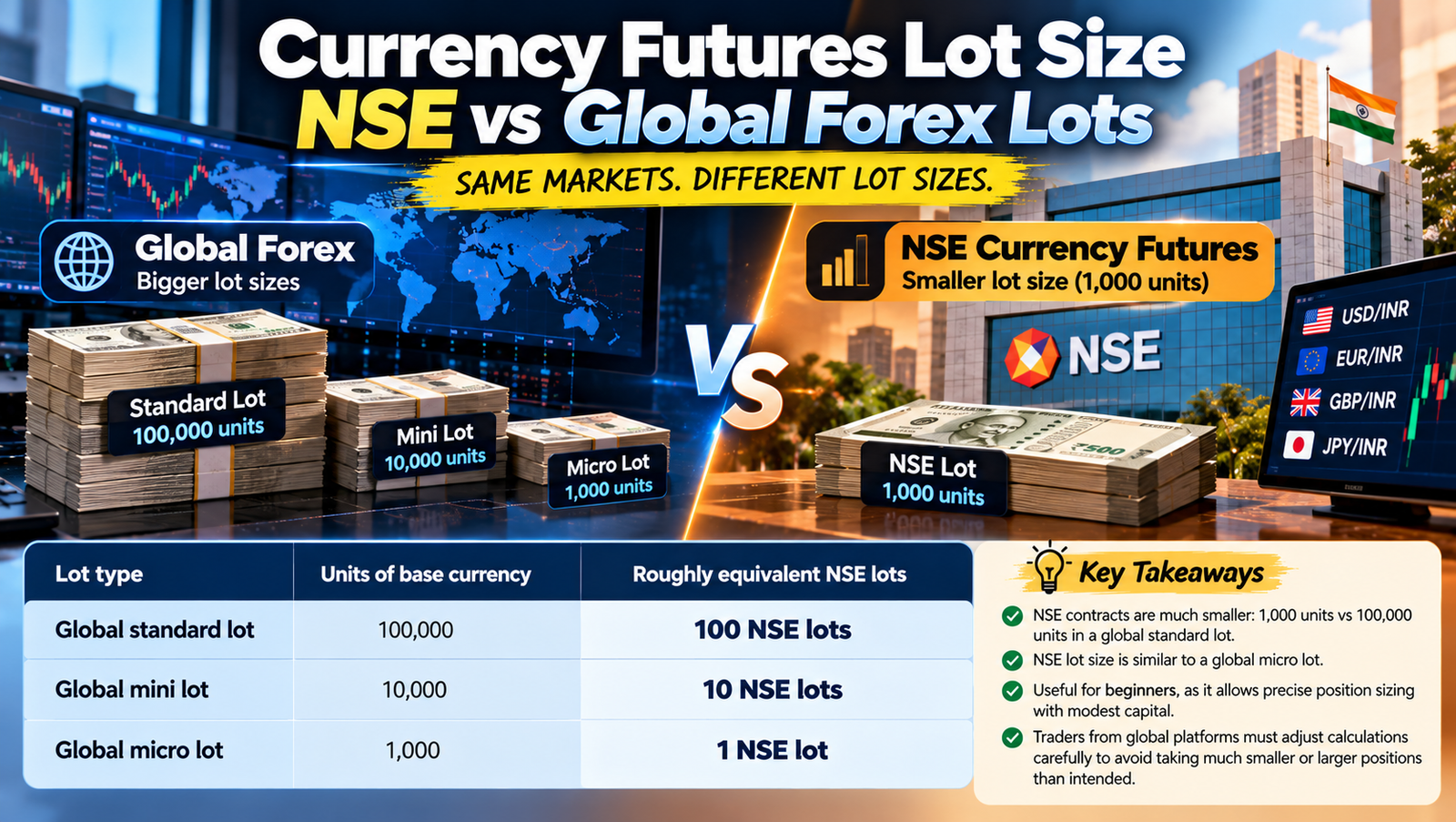
Traders coming from global forex charts often think in standard lots of 100,000 units. The currency futures lot size NSE uses is much smaller: just 1,000 units of the base currency for most pairs. That makes NSE contracts similar in size to a global “micro lot”.
| Lot type | Units of base currency | Roughly equivalent NSE lots |
|---|---|---|
| Global standard lot | 100,000 | 100 NSE lots |
| Global mini lot | 10,000 | 10 NSE lots |
| Global micro lot | 1,000 | 1 NSE lot |
The small currency futures lot size NSE offers is useful for beginners, because it allows precise position sizing with modest capital. It also means traders used to global lot sizes must adjust their calculations carefully to avoid taking far smaller, or far larger, positions than intended.
Tips for Trading Currency F&O on NSE
- Size by risk, not by lots: Decide how much you will risk, then calculate how many lots fit your stop-loss.
- Start small: One or two lots keeps risk manageable while you learn.
- Watch the expiry cut-off: Roll or close positions before 12:30 pm on expiry day.
- Track RBI activity: The RBI can intervene to smooth sharp rupee moves.
- Check liquidity: Stick to active contracts, especially in cross-currency pairs.
- Confirm broker access: Not every broker offers currency derivatives, so check before opening an account.
Position sizing example
Suppose you are willing to risk ₹1,500 on a USD/INR trade with a 10-paise stop-loss. Each lot loses ₹100 for a 10-paise move (10 × ₹10). Dividing ₹1,500 by ₹100 gives 15 lots. Matching your position to the currency futures lot size NSE uses in this way keeps your risk under control.
FAQs
What is the currency futures lot size on NSE for USD/INR?
One lot is USD 1,000.
What is the lot size for JPY/INR?
One lot is JPY 100,000, and the price is quoted per 100 yen.
How much is one tick worth on INR pairs?
One tick of ₹0.0025 is worth ₹2.50 per lot, and a 1-paise move is worth ₹10 per lot.
When do currency futures expire?
Monthly INR contracts expire two working days before the last business day of the month, with trading stopping at 12:30 pm on that day.
Is STT charged on currency derivatives?
No. STT does not apply, but brokerage, exchange charges, stamp duty and GST do.
Are currency options available on NSE?
Yes, with USD/INR the most actively traded. They are European-style and cash-settled in rupees.
Conclusion
Understanding the currency futures lot size NSE uses is the foundation of trading currency F&O safely. For INR pairs, one lot is 1,000 units of the base currency (100,000 for yen), one tick of 0.25 paise is worth ₹2.50, and a 1-paise move is worth ₹10 per lot. Cross-currency pairs use their own tick sizes, with profit and loss converted to rupees.
Combine this knowledge with careful position sizing, an awareness of expiry rules and margins, and the latest regulatory limits. Always confirm current specifications with NSE or your SEBI-registered broker before trading.