
Introduction
GBP/USD is one of the oldest and most actively traded currency pairs in the world. It shows how many US dollars are needed to buy one British pound. Traders call it “Cable”, a name that dates back to the 1800s, when exchange rates between London and New York were sent by a telegraph cable under the Atlantic.
The pair is popular because it is liquid, moves well during the day and reacts strongly to news from two major economies. Those same qualities make GBP USD trading challenging: price can swing sharply, and stops can be hit quickly if you are not prepared.
This guide covers:
- How the GBP/USD pair works and how to read its price
- The main factors that move Cable
- The best sessions for GBP USD trading in Indian time
- Practical strategies, risk management and common mistakes
- How Indian traders can access the pair legally
Understanding the Basics of GBP/USD Trading
In GBP/USD, the British pound (GBP) is the base currency and the US dollar (USD) is the quote currency. If GBP/USD is at 1.3000, one pound buys 1.30 dollars.
- If GBP/USD rises: The pound is strengthening against the dollar, or the dollar is weakening.
- If GBP/USD falls: The pound is weakening, or the dollar is strengthening.
Every move in the pair is a tug of war between two currencies. Successful GBP USD trading means watching both sides: news from the UK and news from the US.
Pips and pip value
GBP/USD is quoted to four decimal places, with a fifth “fractional” digit on many platforms. One pip is 0.0001. For a standard lot of 100,000 pounds, one pip is worth $10. For a mini lot (10,000), it is $1, and for a micro lot (1,000), it is $0.10.
| Lot size | Units of GBP | Value of 1 pip |
|---|---|---|
| Standard | 100,000 | $10 |
| Mini | 10,000 | $1 |
| Micro | 1,000 | $0.10 |
Why Traders Like GBP/USD
- High liquidity: It is among the most traded pairs, so spreads are usually tight during active hours.
- Good volatility: Cable tends to move more than EUR/USD, offering more opportunity for intraday traders.
- Clear news drivers: Central bank decisions and economic data from both countries create regular trading opportunities.
- Strong technical behaviour: Many traders find that Cable respects key support and resistance levels.
The trade-off is risk. The same volatility that attracts traders can cause sharp losses. GBP USD trading rewards preparation and punishes careless position sizing.
What Moves GBP/USD? Key Drivers for GBP USD Trading
1. Bank of England and Federal Reserve policy
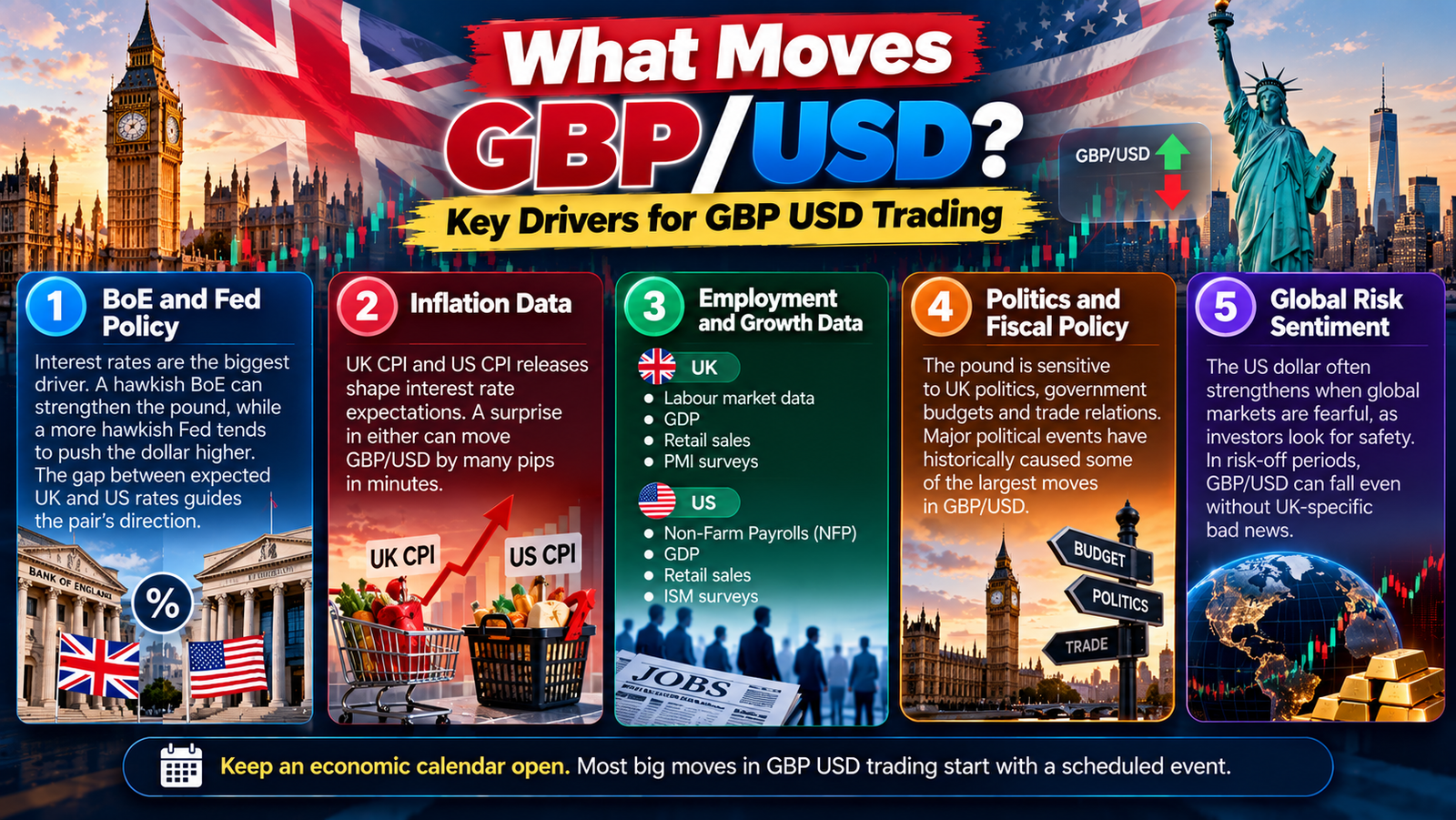
Interest rates are the most important long-term driver. When the Bank of England (BoE) raises rates or signals that rates will stay high, the pound tends to strengthen. When the Federal Reserve takes a more hawkish stance than the BoE, the dollar tends to gain. The gap between expected UK and US rates is one of the best guides to the pair’s direction.
2. Inflation data
UK CPI and US CPI releases matter because they shape interest rate expectations. A surprise in either can move Cable by many pips in minutes.
3. Employment and growth data
- UK: Labour market data, GDP, retail sales and PMI surveys
- US: Non-Farm Payrolls (NFP), GDP, retail sales and ISM surveys
4. Politics and fiscal policy
The pound is sensitive to UK politics, government budgets and trade relations. Major political events have historically caused some of the largest moves in GBP/USD.
5. Global risk sentiment
The US dollar often strengthens when global markets are fearful, as investors look for safety. In risk-off periods, GBP/USD can fall even without UK-specific bad news.
Keep an economic calendar open. Most big moves in GBP USD trading start with a scheduled event.
Best Times for GBP USD Trading in India (IST)
Forex trades almost 24 hours a day, but Cable is most active when London and New York are open. Session times shift with daylight saving in the UK and US. The UK moved to winter time on 25 October 2026 and the US does so on 1 November 2026.
| Session | Approximate IST (UK and US winter time) | What to expect |
|---|---|---|
| Asian session | 5:30 am – 1:30 pm | Quieter, often range-bound |
| London open | From about 1:30 pm | Volume rises sharply; breakouts are common |
| New York open and London overlap | About 6:30 pm – 10:00 pm | Highest liquidity and volatility |
| Late New York | After about 10:00 pm | Activity fades |
During UK and US summer time, these times move about one hour earlier. Between 25 October and 1 November 2026, the New York open is about 5:30 pm IST.
For most Indian traders, the afternoon and evening work well: the London open after lunch and the London–New York overlap in the evening are the prime windows for GBP USD trading.
GBP/USD Trading Strategies
There is no single best method for GBP USD trading. The right strategy depends on your schedule, your risk tolerance and how long you want to hold trades. Here are five approaches that many traders use, from fast intraday setups to multi-day swing trades. Test any of them on a demo account before using real money.
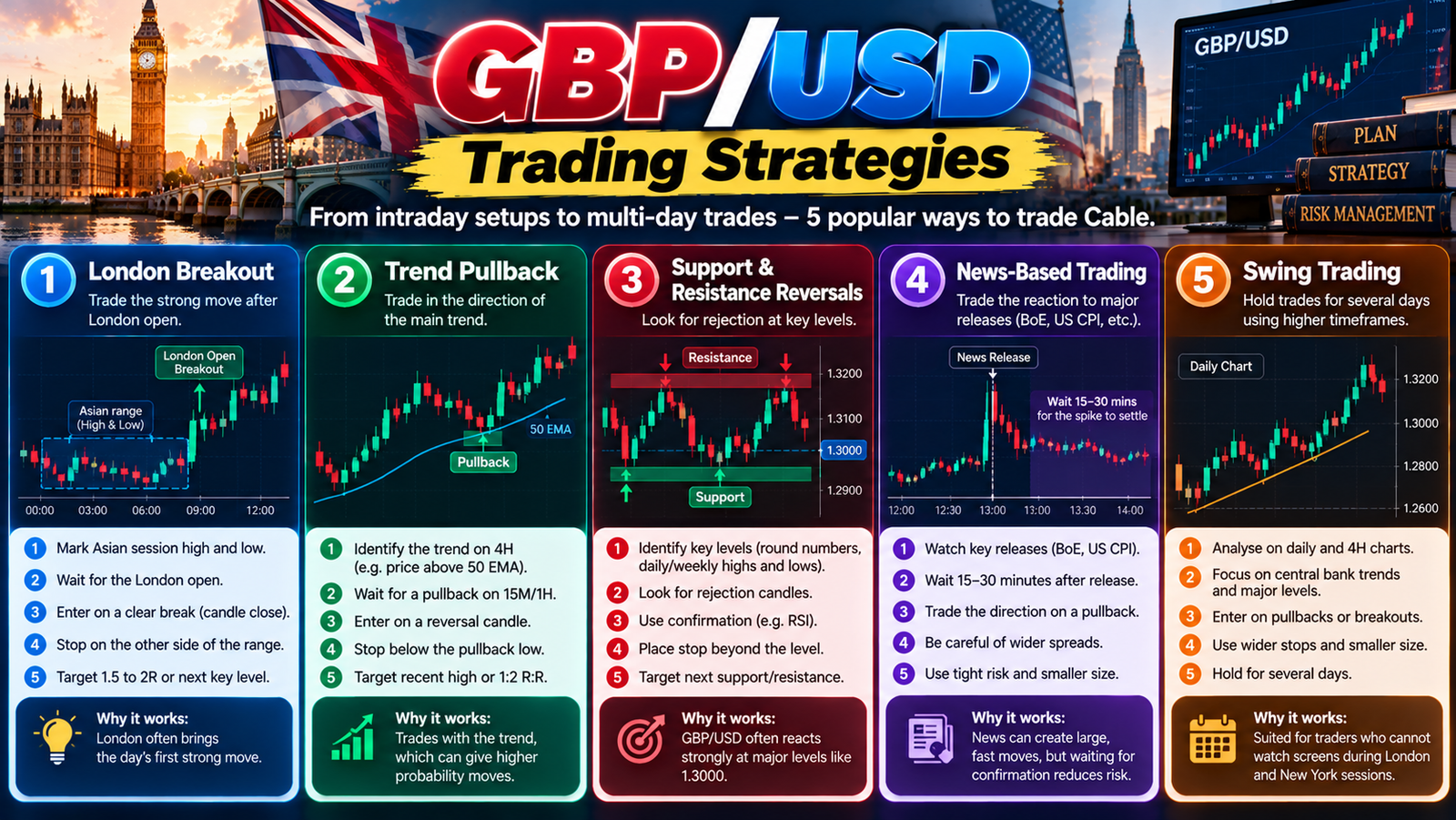
1. London breakout
- Mark the high and low of the Asian session range.
- Wait for the London open.
- Enter in the direction of a clear break of the range, ideally on a candle close.
- Place the stop on the other side of the range or below the breakout candle.
- Target 1.5 to 2 times your risk, or the next key level.
This is one of the most widely used GBP USD trading setups, because London often brings the day’s first strong move.
2. Trend pullback
- Identify the trend on the 4-hour chart, for example price above a rising 50 EMA.
- On the 15-minute or 1-hour chart, wait for a pullback to support, the moving average or a previous breakout level.
- Enter on a bullish reversal candle (or bearish in a downtrend).
- Place the stop below the pullback low.
- Target the recent high or a 1:2 risk-reward ratio.
3. Support and resistance reversals
Cable often reacts at round numbers (such as 1.3000), previous daily highs and lows, and weekly levels. Look for rejection candles at these areas, with confirmation from an oscillator such as RSI.
4. News-based trading
Some traders trade the reaction to major releases, such as BoE decisions or US CPI. A safer approach is to wait 15 to 30 minutes after the release, let the spike settle, and then trade the direction of the move on a pullback. Spreads can widen sharply around news, so be careful.
5. Swing trading
Swing traders hold positions for several days, using daily and 4-hour charts. They focus on central bank trends and major levels. This approach suits people who cannot watch screens during the London and New York sessions.
Technical Tools for GBP USD Trading
- Moving averages: 20, 50 and 200 EMAs help define the trend.
- RSI and stochastic: Useful for spotting overbought and oversold conditions.
- Average True Range (ATR): Helps you set stops that suit current volatility.
- Fibonacci retracements: Help identify pullback zones in trends.
- Pivot points: Popular with intraday traders for daily support and resistance.
Keep your chart simple. Two or three tools that you understand well are better than ten that conflict with each other.
Risk Management for Cable
Because of its volatility, risk management is essential in GBP USD trading.
- Risk a small percentage: Many traders risk 0.5–1% of their account per trade.
- Use ATR-based stops: Stops that are too tight get hit by normal noise.
- Size positions correctly: Calculate lot size from your stop distance and risk amount.
- Watch the calendar: Avoid holding large positions into major announcements unless that is part of your plan.
- Set a daily loss limit: Stop trading for the day after a set loss.
Position sizing example
Suppose your account is $5,000 and you risk 1% per trade, or $50. Your stop is 25 pips away. Dividing $50 by 25 pips gives $2 per pip, which is 0.2 standard lots, or two mini lots.
A GBP USD Trading Example
Imagine GBP/USD has been in an uptrend on the 4-hour chart. During the Asian session, it trades in a range between 1.3010 and 1.3040. At the London open, price breaks above 1.3040 and closes at 1.3048 on the 15-minute chart.
A trader buys at 1.3048, places a stop at 1.3018 (30 pips) and sets a target at 1.3108 (60 pips), a 1:2 risk-reward ratio. If the target is hit, the trade gains twice the amount risked.
This example is illustrative and uses hypothetical prices.
Common GBP USD Trading Mistakes
- Using stops that are too tight: Cable’s normal swings can stop you out before the trade works.
- Overtrading quiet hours: The Asian session often gives false signals.
- Ignoring US news: GBP/USD reacts to US data as much as UK data.
- Trading every news spike: Spreads widen and slippage is common.
- Oversizing positions: High volatility plus large size can lead to fast losses.
- No written plan: Without clear rules, emotions take over.

How Indian Traders Can Trade GBP/USD Legally
This is a crucial point. Under FEMA, Indian residents may not send money abroad for leveraged forex or CFD trading. The RBI has also published an Alert List of unauthorised forex trading platforms. Trading GBP/USD through an offshore CFD broker can put you at legal risk.
Legal routes include:
- GBP/USD cross-currency futures and options on NSE: According to NSE’s contract specifications, one GBP/USD futures lot is 1,000 pounds, the tick size is 0.0001, prices are quoted in dollars and contracts are cash-settled in Indian rupees. Check current trading hours with your broker.
- GBP/INR futures and options: These let you trade the pound against the rupee on Indian exchanges.
Use a SEBI-registered broker for any currency derivatives trading.
Building a GBP/USD Trading Plan
A written plan turns this guide into daily action. Include:
- Which sessions you will trade (for example, the London open and the overlap)
- Your chosen setups and exact entry rules
- Your risk per trade and daily loss limit
- Which news events you will avoid or trade
- How you will review trades in a journal
A plan also makes GBP USD trading easier to review, because you can compare each trade with your own rules. Test the plan on a demo account first, then trade small and scale up only when your results are consistent.
FAQs
Why is GBP/USD called Cable?
The nickname comes from the 19th-century transatlantic telegraph cable used to send exchange rates between London and New York.
What is the best time for GBP USD trading in India?
The London open (around 1:30 pm IST in winter) and the London–New York overlap (around 6:30 pm to 10:00 pm IST in winter) are usually the most active periods.
Is GBP/USD good for beginners?
It is liquid and well covered, but more volatile than EUR/USD. Beginners should use small size and wider, ATR-based stops.
What moves GBP/USD the most?
Interest rate expectations at the Bank of England and the Federal Reserve, inflation data, employment data, UK politics and global risk sentiment.
Can I trade GBP/USD legally in India?
Yes, through GBP/USD cross-currency derivatives on Indian exchanges via SEBI-registered brokers. Trading through offshore CFD platforms is risky under FEMA.
Conclusion
GBP/USD offers liquidity, strong intraday moves and clear news drivers, which is why it is one of the most popular pairs in the world. But its volatility demands respect. Successful GBP USD trading comes down to trading the right sessions, understanding what moves both currencies, using sensible stops and keeping risk small.
For Indian traders, the best approach is to trade during the London and New York sessions, use the legal exchange-traded routes, and follow a written plan. Practise on a demo account, review every trade, and build your skills step by step.