
Introduction
Few moments in the currency market are as dramatic as the seconds after a major economic release. A US jobs report or inflation figure can move EUR/USD 50 to 100 pips in minutes, while quiet days might see half that move in a full session.
News trading forex aims to profit from these moves by trading around scheduled economic releases and central bank decisions. It can be rewarding, but it is also one of the riskiest ways to trade, thanks to sudden spikes, wide spreads and slippage.
This guide explains:
- How economic news moves currencies
- Using an economic calendar and the key releases to watch
- Release times in IST for Indian traders
- Four practical news trading strategies
- Risk management, a worked example and common mistakes
What Is News Trading Forex?
News trading forex means placing trades based on economic data releases, central bank announcements and other scheduled events. Traders look for differences between what the market expected and what actually happened, because that surprise is what drives price.
There are two broad approaches:
- Trading the release itself: Entering just before or immediately after the number is published to catch the initial spike.
- Trading the reaction: Waiting for the dust to settle and trading the trend or reversal that forms afterwards.
How Economic News Moves Currencies
Expectations vs actual
Markets price in expectations before a release. Economists’ forecasts, often shown as “consensus” on an economic calendar, are already reflected in the exchange rate. What matters is the surprise:
- Better than expected: Usually supports the currency.
- Worse than expected: Usually weakens the currency.
- In line with expectations: Often leads to a muted or confused reaction.
The interest rate link
Most currency reactions come back to interest rates. Strong jobs or inflation data make rate hikes (or fewer cuts) more likely, which tends to strengthen a currency. Weak data does the opposite. This is why central bank decisions and inflation releases are the biggest events in news trading forex.
Revisions and details
The headline number is not the whole story. Revisions to previous months, wage growth within a jobs report or core inflation within a CPI release can reverse the initial reaction.

Using an Economic Calendar for News Trading Forex
An economic calendar lists upcoming releases with their time, the previous figure, the forecast and an impact rating. Free calendars are available on major forex news sites and trading platforms.
Key columns to watch:
| Column | What it tells you |
|---|---|
| Time | When the data is released (set the calendar to IST) |
| Currency | Which currency is most affected |
| Impact | Low, medium or high expected volatility |
| Previous | The last reading |
| Forecast | Consensus expectation |
| Actual | The released figure |
Check the calendar every Sunday and each morning so you know which events could affect your trades.
High-Impact Releases for News Trading Forex
| Release | Country | Approximate time (IST, winter) | Why it matters |
|---|---|---|---|
| Non-Farm Payrolls (NFP) | US | 7:00pm, first Friday of the month (usually) | Jobs and wage growth drive Fed expectations |
| Consumer Price Index (CPI) | US | 7:00pm | Inflation is central to rate decisions |
| FOMC rate decision | US | 12:30am (following night) | Sets US interest rates; press conference follows |
| ECB rate decision | Eurozone | 6:45pm | Moves EUR pairs |
| Bank of England decision | UK | 5:30pm | Moves GBP pairs |
| Bank of Japan decision | Japan | Varies, usually Indian morning | Moves JPY pairs |
| RBI monetary policy | India | 10:00am | Moves USD/INR and Indian markets |
| GDP, retail sales, PMIs | Various | Varies | Signal economic strength |
Times move by an hour when Europe and the US switch between summer and winter time, so always confirm on your calendar.
News Trading Forex Strategies
1. The pre-release straddle
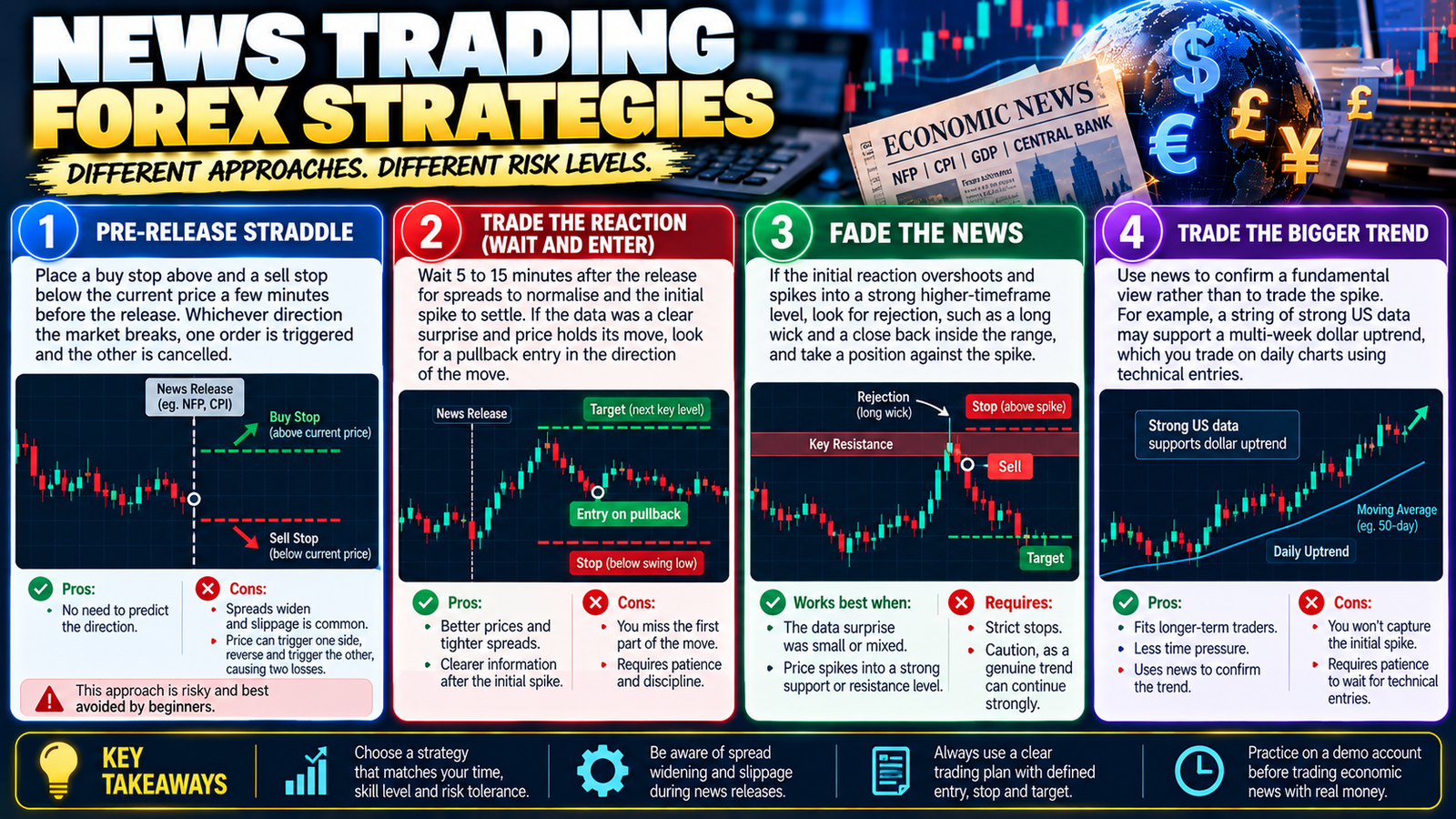
Some traders place a buy stop above and a sell stop below the current price a few minutes before a release. Whichever direction the market breaks, one order is triggered and the other is cancelled.
- Pros: No need to predict the direction.
- Cons: Spreads widen and slippage is common. Price can trigger one side, reverse and trigger the other, causing two losses.
This approach is risky and best avoided by beginners.
2. Trade the reaction (wait and enter)
A more conservative approach is to wait 5 to 15 minutes after the release for spreads to normalise and the initial spike to settle. Then:
- If the data was a clear surprise and price holds its move, look for a pullback entry in the direction of the move.
- Place the stop beyond the post-release high or low.
- Target the next key support or resistance level.
This sacrifices the first part of the move but gives better prices, tighter spreads and clearer information.
3. Fade the news
Sometimes the initial reaction overshoots. If price spikes into a strong higher-timeframe level and then shows rejection, such as a long wick and a close back inside the range, some traders take a position against the spike.
- Works best when the data surprise was small or mixed.
- Requires strict stops, because a genuine trend can continue strongly.
4. Trade the bigger trend
Longer-term traders use news to confirm a fundamental view rather than to trade the spike. For example, a string of strong US data may support a multi-week dollar uptrend, which they trade on daily charts using technical entries. This slower style of news trading forex suits traders who cannot watch screens at release time.
Central Bank Press Conferences and Speeches
The rate decision is often only half the event. After the FOMC, ECB and Bank of England announce decisions, the governor or chair usually holds a press conference. Comments about future policy, known as forward guidance, can move currencies more than the decision itself, especially when the rate change was fully expected.
Unscheduled or lightly flagged speeches by central bank officials can also cause sharp moves. In news trading forex, treat press conferences as a second high-volatility window: keep positions small until the conference ends, and watch for reversals when the tone differs from the written statement.
Building a News Trading Forex Plan
A written plan turns news trading from guesswork into a repeatable process. For each high-impact event, note in advance:
- The forecast, previous reading and what result would count as a clear surprise
- The pair you will trade and the key support and resistance levels around current price
- Your approach: no trade, wait for the reaction, fade or trend
- Maximum position size and loss for the event
- What will make you stay out, such as mixed data or spreads that do not normalise
After the event, record what happened in your journal. Over months, this record shows which releases and setups suit your news trading forex style and which ones to skip.
Risks Specific to News Trading Forex
- Spread widening: Spreads can widen sharply around releases, making entries expensive.
- Slippage: Stop and market orders may fill far from the requested price.
- Whipsaws: Price can move sharply one way and then reverse within seconds.
- Gaps: In exchange-traded futures, prices can jump between ticks with no fills in between.
- Liquidity drop: Many participants pull orders just before releases.
- Data revisions and details: The headline may be reversed by details or revisions.
Risk Management for News Trading Forex
- Reduce position size: Use half or less of your normal size around major news.
- Always use a stop-loss, but expect that it may slip in fast markets.
- Avoid trading in the first minute unless you have a tested plan and accept slippage.
- Know your exposure: Check whether open positions will be affected by an upcoming release.
- Set a maximum loss per event: Decide in advance how much you are prepared to lose.
- Prop firm rules: Some prop firms restrict trading around high-impact news, so read your rulebook.
Worked Example of News Trading Forex
Suppose US CPI is due at 7:00pm IST. The forecast is 0.3% month on month, and EUR/USD is trading at 1.1650 ahead of the release.
- At 7:00pm, CPI comes in at 0.5%, well above forecast. The dollar strengthens, and EUR/USD drops to 1.1590 within minutes.
- The trader does not chase the spike. At 7:10pm, spreads have returned to normal.
- Price retraces to 1.1610, a former support level that now acts as resistance, and forms a bearish rejection candle on the 5-minute chart.
- The trader sells at 1.1607, with a stop at 1.1632 above the retracement high (25 pips of risk).
- The target is 1.1557, the next support level (50 pips).
- Over the next two hours, as US traders digest the data, EUR/USD falls to 1.1557 and the target is hit.
The trade gains 50 pips on 25 pips of risk, a 2:1 reward-to-risk ratio, without entering during the most chaotic first minutes.
This example is illustrative and uses hypothetical data and prices.

News Trading Forex for Indian Traders
Legal route
Indian residents can trade currency derivatives on NSE and BSE through SEBI-registered brokers. Rupee pairs (USD/INR, EUR/INR, GBP/INR, JPY/INR) and cross-currency pairs (EUR/USD, GBP/USD, USD/JPY) are available. Leveraged forex or CFD trading on offshore platforms is not permitted under FEMA.
Timing challenges
NSE rupee currency derivatives trade from 9:00am to 5:00pm IST, so major US releases at around 7:00pm IST and FOMC decisions after midnight fall outside the session. The reaction then shows up at the next morning’s open, often as a gap. This makes the “wait and trade the reaction” or “trade the bigger trend” approaches more practical than trading the release itself.
Domestic news
RBI policy announcements, usually at 10:00am IST, fall during market hours and can move USD/INR. Indian inflation and GDP data also matter, although the RBI often smooths sharp rupee moves.
Tax
Profits from exchange-traded currency derivatives are generally treated as non-speculative business income, taxed at your slab rate and reported in ITR-3.
Common News Trading Forex Mistakes
- Trading every release: Focus on a few high-impact events and skip the rest.
- Ignoring the forecast: The reaction depends on the surprise, not the absolute number.
- Chasing the first spike: Entering late into a sharp move often means buying the top.
- Oversizing: Volatility makes losses larger than usual.
- Holding through news by accident: Check the calendar before keeping trades open.
- Relying only on the headline: Read the details and revisions.
News Trading Forex Checklist
- Which high-impact releases are due this week, and at what time in IST?
- What is the forecast and previous figure?
- Which pairs will be most affected?
- Will I trade the release, the reaction or the bigger trend?
- Have I reduced position size?
- Where is my stop, and can I accept some slippage?
- Do my broker’s or prop firm’s rules limit news trading?
FAQs
What is news trading forex?
It is trading currencies around scheduled economic releases and central bank decisions, aiming to profit from the volatility created by surprises against expectations.
Which news moves forex the most?
Central bank rate decisions, US Non-Farm Payrolls and inflation (CPI) releases are usually the biggest movers.
Is news trading good for beginners?
Trading the initial spike is risky for beginners. Waiting for the reaction and trading with reduced size is safer.
Do I need special tools for news trading forex?
No. A free economic calendar set to IST, a reliable news feed and a platform with stop-loss orders are enough to start.
What time is NFP in India?
Usually 7:00pm IST in winter and 6:00pm IST in summer, on the first Friday of the month in most months.
Can I trade news on NSE currency futures?
Yes, for releases during NSE hours, such as RBI policy. Many US releases fall after the rupee session closes, so their impact appears at the next open.
Conclusion
News trading forex can offer some of the biggest and fastest moves in the currency market, but it also brings wide spreads, slippage and sudden reversals. The traders who succeed focus on a few high-impact events, understand expectations, wait for clear reactions and cut their position size.
Use an economic calendar set to IST, plan each event in advance and practise on a demo account before trading live. Treat news as a tool for timing and confirmation, not a lottery ticket.