Introduction
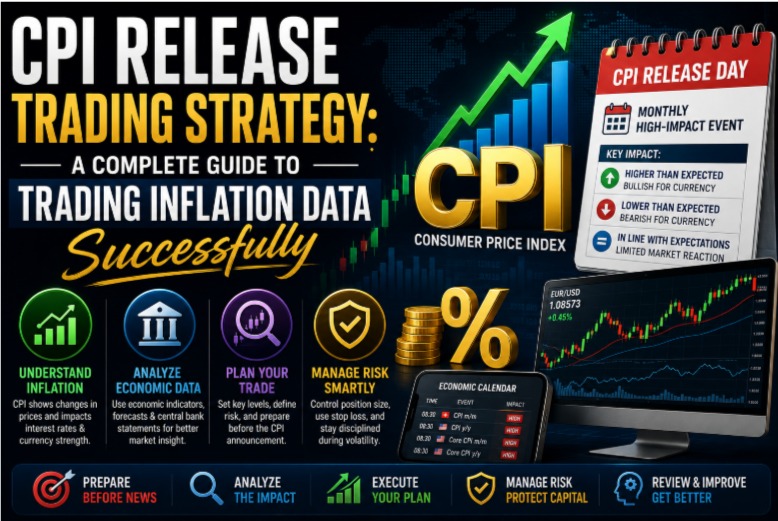
Inflation reports are among the most influential economic releases in the global financial markets. Every month, traders, institutional investors, central banks, and financial analysts closely monitor the Consumer Price Index (CPI) because it provides valuable insight into the overall direction of inflation within an economy. Since inflation directly affects monetary policy, interest rates, and currency valuations, CPI announcements frequently trigger substantial price movements across major forex pairs.
Developing an effective CPI trading strategy allows traders to prepare for these high-impact events instead of making emotional decisions after the announcement. While inflation releases create excellent opportunities, they also introduce higher volatility, wider spreads, and rapid market fluctuations that require careful planning. Traders who understand how inflation influences market expectations can position themselves more effectively while reducing unnecessary risks.
This guide explains the significance of CPI reports, how inflation impacts currency prices, and the methods traders use to approach these announcements with confidence and discipline.
Understanding the Consumer Price Index
The Consumer Price Index measures changes in the average prices paid by consumers for goods and services over a specific period. Governments publish CPI reports monthly to monitor inflation and evaluate the purchasing power of consumers.
For financial markets, inflation is far more than a simple economic statistic. It serves as one of the most important economic indicators used by central banks when making interest rate decisions. Higher inflation often encourages tighter monetary policies, while slowing inflation may lead policymakers to maintain or reduce interest rates.
Because currency values are strongly influenced by monetary policy expectations, traders pay close attention to every CPI release before making investment decisions.
Why Inflation Matters in Forex Trading
Inflation directly affects the strength of a nation’s currency because it influences borrowing costs, consumer spending, and long-term economic growth. When inflation rises faster than expected, investors often anticipate higher interest rates, increasing demand for the country’s currency.
This relationship forms the foundation of inflation trading, where traders evaluate whether published inflation data exceeds, matches, or falls below market expectations. Stronger-than-expected inflation may strengthen a currency if investors expect central banks to adopt a more aggressive monetary policy.
However, inflation data should never be analyzed in isolation. Employment growth, GDP, consumer spending, and manufacturing activity all contribute to the broader economic outlook that ultimately drives long-term currency movements.
Preparing Before the CPI Announcement
Preparation is essential for every successful CPI trading strategy. Professional traders begin their analysis long before the inflation report is released. They review previous CPI reports, study economist forecasts, analyze recent central bank statements, and evaluate current market sentiment.
Market expectations often determine price movement more than the inflation number itself. If investors already expect strong inflation, the market may react only if the released figures differ significantly from forecasts.
Many traders also identify important technical levels before the announcement. Support and resistance zones frequently become decision points after inflation data enters the market because institutional traders often respond near these areas.
Preparing in advance reduces emotional decision-making while improving confidence during periods of increased market activity.
Understanding Market Expectations
Financial markets constantly anticipate future economic conditions. Analysts publish inflation forecasts several days before the official report, allowing institutions to adjust their positions accordingly.
The actual CPI number becomes important only when compared with these forecasts. Sometimes inflation exceeds expectations but currency prices decline because investors expected even stronger results. Similarly, weaker inflation data may still support a currency if market participants had prepared for a much larger decline.
Understanding expectations allows traders to interpret market reactions more accurately instead of focusing solely on headline numbers.
The Relationship Between Inflation and Interest Rates
Central banks rely heavily on inflation data when determining monetary policy. Their primary objective is maintaining price stability while supporting sustainable economic growth.
When inflation remains above target levels, policymakers may increase interest rates to slow economic activity and reduce price pressures. Higher interest rates often attract international investment, strengthening the national currency.
Conversely, lower inflation may encourage central banks to reduce borrowing costs, potentially weakening the currency if investors anticipate looser monetary policy.
This close relationship explains why CPI announcements consistently receive significant attention from financial markets around the world.
Using Economic Indicators Together
Although inflation reports receive considerable attention, experienced traders understand the importance of analyzing multiple economic indicators together. Employment reports, retail sales, GDP growth, manufacturing indexes, and consumer confidence surveys all provide valuable information about the health of an economy.
No single report provides a complete picture of economic conditions. Instead, professional traders combine multiple sources of information before making investment decisions.
Studying several reports together creates a more balanced understanding of market conditions while reducing the likelihood of relying too heavily on one economic announcement.
Managing Volatility During CPI Releases

Inflation announcements frequently generate sudden market activity because institutional investors adjust their expectations immediately after new information becomes available. Currency pairs involving the US Dollar often experience substantial price swings within seconds of the report.
This environment creates attractive opportunities for volatility trading, but it also introduces considerable risk. Wide spreads, rapid price fluctuations, and temporary liquidity shortages can significantly influence trade execution.
Rather than entering positions immediately after the announcement, many experienced traders wait for initial volatility to stabilize before confirming market direction. This approach helps reduce unnecessary exposure to unpredictable price spikes.
Combining Technical and Fundamental Analysis
Technical analysis remains valuable even during major economic announcements. While inflation reports influence market sentiment, support levels, resistance zones, moving averages, and candlestick patterns continue to provide useful confirmation before entering trades.
Many traders combine fundamental analysis with chart-based confirmation to improve decision-making. This balanced approach reduces emotional reactions and increases confidence during uncertain market conditions.
Instead of assuming every inflation surprise will create a sustained trend, disciplined traders wait for technical confirmation before committing capital.
Risk Management During High-Impact Events
Risk management is essential when trading major economic announcements. Market conditions often become unpredictable immediately after inflation reports, making capital preservation the highest priority.
Professional traders carefully determine their position size before entering the market. Smaller positions help reduce overall account exposure while allowing participation in potential opportunities.
Stop-loss placement also becomes particularly important because rapid market fluctuations may trigger unexpected price movements before trends become established.
Consistent profitability depends less on maximizing individual trades and more on protecting trading capital throughout changing market conditions.
Understanding the Role of Forex News
Inflation reports represent only one component of the broader flow of forex news that influences currency markets every day. Central bank speeches, geopolitical developments, employment data, retail sales, GDP releases, and manufacturing surveys all contribute to changing market expectations.
Successful traders continuously monitor forex news rather than focusing exclusively on CPI reports. Remaining informed allows them to understand whether inflation data supports the existing market trend or contradicts previous economic developments.
This broader perspective helps traders make better-informed decisions while reducing the likelihood of reacting emotionally to individual headlines.
Common Mistakes Traders Should Avoid
One of the most common mistakes traders make is entering positions immediately before inflation announcements without preparing for increased volatility. Unexpected price swings often trigger unnecessary losses when positions are opened without a structured plan.
Another frequent mistake involves ignoring market expectations. Strong inflation data does not always strengthen a currency if investors had already anticipated similar results before the announcement.
Many traders also attempt to recover losses by increasing position sizes after unsuccessful trades. This emotional approach frequently leads to even greater losses during volatile market conditions.
Patience, preparation, and disciplined execution consistently produce better results than impulsive decision-making.
Building Long-Term Consistency
Long-term success requires continuous learning rather than attempting to predict every inflation announcement perfectly. Reviewing previous trades, studying historical CPI reactions, and maintaining a detailed trading journal help traders improve their decision-making over time.
Every inflation report provides valuable experience that strengthens analytical skills and increases confidence during future announcements.
Successful traders understand that consistency comes from following a structured process instead of relying on luck or emotional instincts.
Conclusion
Inflation reports remain among the most influential events in the forex market because they directly affect monetary policy expectations and currency valuations. A disciplined CPI trading strategy combines preparation, market analysis, technical confirmation, and responsible risk management to navigate these high-impact announcements effectively.
Understanding inflation trading, monitoring multiple economic indicators, staying informed through reliable forex news, and managing opportunities during volatility trading all contribute to better trading decisions. While no strategy guarantees success, maintaining discipline, protecting trading capital, and continuously improving analytical skills provide a strong foundation for navigating inflation-driven market movements with confidence.