
Introduction of Cross Currency futures NSE
For years, Indian traders who wanted to trade popular global pairs such as EUR/USD faced a problem. Offshore forex platforms are not permitted under FEMA, and exchange-traded currency derivatives in India covered only rupee pairs. That changed when SEBI and the RBI allowed exchanges to launch derivatives on cross-currency pairs, which do not involve the rupee at all.
Today, cross-currency futures NSE contracts give Indian residents a legal, exchange-regulated way to trade EUR/USD, GBP/USD and USD/JPY through a SEBI-registered broker, with profits and losses settled in rupees.
This guide explains:
- What cross-currency futures are and why they matter
- Contract specifications, lot sizes and tick values
- How settlement and INR conversion work
- Margins, trading hours and expiry
- Worked examples for each pair
- Tax, regulation and risks
What Are Cross-Currency Futures?
A cross-currency pair is an exchange rate between two currencies, neither of which is the Indian rupee. EUR/USD, for example, shows how many US dollars one euro buys.
A futures contract is an agreement to buy or sell a set amount of an asset at a fixed price on a future date. Cross-currency futures NSE contracts let you take a view on these global exchange rates without ever exchanging the currencies. They are cash-settled, and all payments are made in rupees.
The three cross-currency pairs available on NSE are:
- EUR/USD: the euro against the US dollar, the world’s most traded pair
- GBP/USD: the British pound against the US dollar, often called “Cable”
- USD/JPY: the US dollar against the Japanese yen

Why Cross-Currency Futures NSE Contracts Matter for Indian Traders
- Legal access to global pairs: They offer a permitted route to trade major forex pairs without using offshore platforms.
- Exchange guarantee: Trades are cleared through the exchange’s clearing corporation, reducing counterparty risk.
- Transparency: Prices, volumes and open interest are visible on the exchange.
- Diversification: Global pairs react to US, European, UK and Japanese news, not just Indian factors.
- Hedging: Businesses with euro, pound or yen exposure can use them alongside INR pairs.
Cross-Currency Futures NSE Contract Specifications
| Feature | EUR/USD | GBP/USD | USD/JPY |
|---|---|---|---|
| Lot size | €1,000 | £1,000 | $1,000 |
| Quotation | US dollars per euro | US dollars per pound | Japanese yen per dollar |
| Tick size | 0.0001 | 0.0001 | 0.01 |
| Value of one tick | $0.10 | $0.10 | ¥10 |
| Contract months | Monthly contracts (up to 12 months) | ||
| Settlement | Cash-settled in INR | ||
| Final settlement price | Derived from RBI reference rates | ||
Because the lot size is only 1,000 units of the base currency, each contract is small. That makes cross-currency futures accessible for traders with modest capital, but it also means you need several lots to make meaningful profits.
How Cross-Currency Futures NSE Settlement and INR Conversion Work
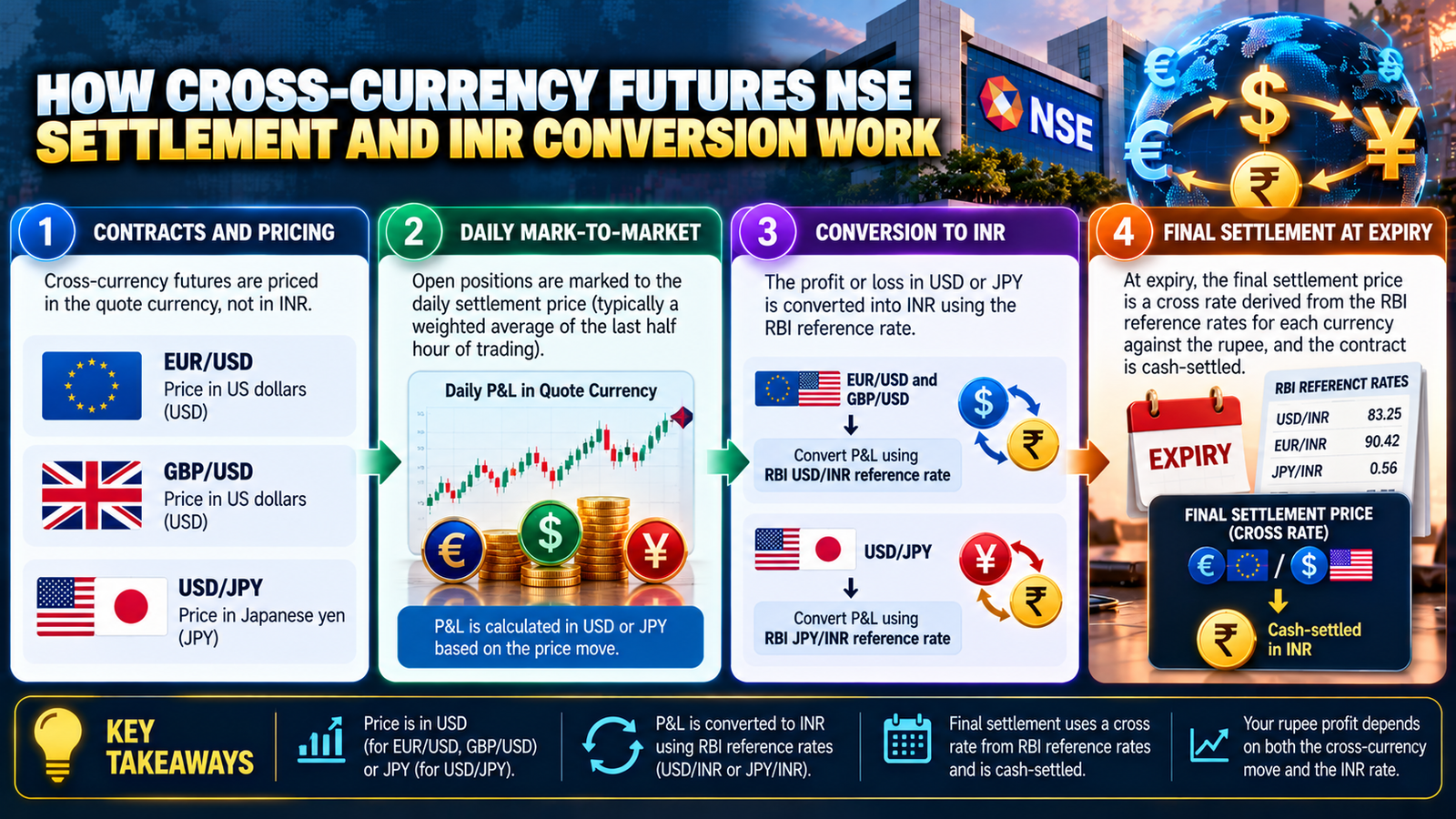
Cross-currency futures are priced in the quote currency, US dollars for EUR/USD and GBP/USD and yen for USD/JPY, but your account is in rupees. The conversion works like this:
- Daily mark-to-market: Open positions are marked to the daily settlement price, typically a weighted average of the last half hour of trading. The profit or loss in USD or JPY is converted into INR using the RBI reference rate.
- EUR/USD and GBP/USD: P&L in US dollars is converted using the RBI USD/INR reference rate.
- USD/JPY: P&L in yen is converted using the RBI JPY/INR reference rate.
- Final settlement: At expiry, the final settlement price is a cross rate derived from the RBI reference rates for each currency against the rupee, and the contract is cash-settled.
This means your rupee profit depends slightly on the USD/INR or JPY/INR rate as well as the cross-currency move itself.
Cross-Currency Futures NSE Trading Hours and Expiry
When NSE launched these contracts, cross-currency derivatives traded from 9:00am to 7:30pm IST, longer than the 9:00am to 5:00pm window for rupee pairs, so that traders could cover part of the European session. Sources differ on whether those extended hours still apply, so check the current timings on NSE’s website or your broker’s platform.
Near-month contracts expire two working days before the last business day of the month, with trading closing at 12:30pm on the expiry day. This mirrors the expiry pattern for rupee currency futures.
Cross-Currency Futures NSE Margins and Leverage
Margins for cross-currency futures NSE contracts are set by the exchange and clearing corporation, typically as an initial (SPAN) margin plus an extreme loss margin. Margins are a small percentage of the contract value, which gives leverage.
Margins are blocked in rupees. Because each lot is small, the margin per lot is usually modest. Check your broker’s margin calculator for current figures, as margins change with volatility.
Leverage magnifies both profit and loss. Even on exchange-traded contracts, using too many lots relative to your capital can lead to large drawdowns.
Worked Examples of Cross-Currency Futures NSE Trades
The examples below show how cross-currency futures NSE profits and losses translate into rupees.
These examples are illustrative. They use hypothetical prices and assume an RBI USD/INR reference rate of ₹88 and a JPY/INR rate of ₹58 per 100 yen for conversion. Costs are ignored.
Example 1: EUR/USD
- A trader buys 10 lots of EUR/USD futures at 1.1600.
- Price rises to 1.1650 and the trader exits.
- Move: 0.0050, or 50 ticks.
- Profit per lot: 50 × $0.10 = $5.
- Total profit: $5 × 10 lots = $50, or about ₹4,400 at ₹88 per dollar.
Example 2: GBP/USD
- A trader sells 5 lots of GBP/USD futures at 1.3200.
- Price falls to 1.3120 and the trader buys back.
- Move: 0.0080, or 80 ticks.
- Profit per lot: 80 × $0.10 = $8.
- Total profit: $8 × 5 lots = $40, or about ₹3,520.
Example 3: USD/JPY
- A trader buys 5 lots of USD/JPY futures at 150.00.
- Price falls to 149.20, and the trader exits at a loss.
- Move: 0.80, or 80 ticks.
- Loss per lot: 80 × ¥10 = ¥800.
- Total loss: ¥800 × 5 lots = ¥4,000, or about ₹2,320 at ₹58 per 100 yen.
These examples show how small each lot is. A 50-pip move in EUR/USD is worth only around ₹440 per lot, so position sizing should be planned in rupee terms.
Cross-Currency Options
Alongside cross-currency futures NSE contracts, the exchange also offers options on the same three pairs. They are European-style, meaning they can only be exercised at expiry, and premiums are quoted in the quote currency (US dollars for EUR/USD and GBP/USD, yen for USD/JPY). Strike intervals are 0.005 for EUR/USD and GBP/USD and 0.50 for USD/JPY. Liquidity in options is usually lower than in futures, so check bid-ask spreads before trading.
Cross-Currency Futures NSE vs INR Pairs
| Feature | INR pairs (USD/INR, EUR/INR, GBP/INR, JPY/INR) | Cross pairs (EUR/USD, GBP/USD, USD/JPY) |
|---|---|---|
| Rupee involved | Yes | No |
| Main price drivers | Indian economy, RBI intervention, global dollar moves | US, European, UK and Japanese economies and central banks |
| Volatility | Low for USD/INR | Typically higher |
| Liquidity on NSE | High, especially USD/INR | Lower; spreads can be wider |
| P&L currency | INR | USD or JPY, converted to INR |
The biggest practical issue with cross-currency futures NSE contracts is liquidity. Volumes are much lower than in USD/INR, so use limit orders and avoid large positions in thin markets.
Strategies for Cross-Currency Futures NSE Traders
- Trend following: EUR/USD and GBP/USD often trend over weeks in response to interest rate differences. Daily charts and moving averages can help.
- News trading with caution: Central bank decisions from the US Federal Reserve, the European Central Bank, the Bank of England and the Bank of Japan move these pairs. Lower exchange liquidity can make news spikes harder to trade.
- Swing trading: Use global spot charts for analysis and NSE futures for execution, keeping in mind that futures prices include a small forward premium or discount.
- Hedging: Exporters and importers with euro, pound or yen exposure can combine cross pairs with INR pairs to manage risk.
 Regulation: Who Can Trade and Position Limits
Resident Indians can trade cross-currency futures NSE contracts, along with options and the equivalent BSE contracts, through SEBI-registered brokers with a currency derivatives segment enabled. Leveraged forex or CFD trading on offshore platforms remains prohibited under FEMA, and the RBI maintains an Alert List of unauthorised forex trading platforms.
Users of exchange-traded currency derivatives can take positions up to a set limit without having to establish an underlying exposure. The RBI reduced this limit from $100 million to $5 million with effect from 10 October 2026. This is far above what most retail traders use, but it is worth knowing, and your broker may ask for declarations. Exchanges also set position limits per client.
Tax on Cross-Currency Futures NSE Profits
- Profits and losses from exchange-traded currency derivatives are generally treated as non-speculative business income.
- Income is taxed at your slab rate, and you usually file ITR-3.
- Trading expenses such as brokerage, exchange charges and data subscriptions can be claimed.
- Losses can be set off against other non-salary income and carried forward for up to 8 years if you file on time.
- There is no STT on currency derivatives, though exchange charges, stamp duty and GST apply.
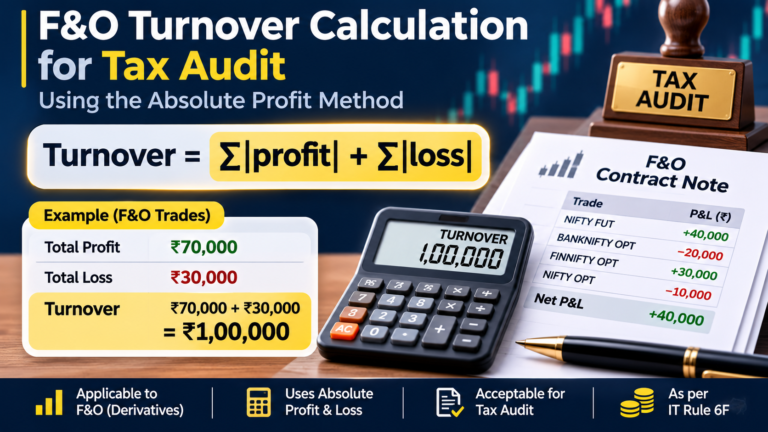
- Turnover for tax audit purposes is generally calculated as the absolute sum of profits and losses.
Consult a chartered accountant for your specific situation.
Risks of Cross-Currency Futures NSE Trading
- Low liquidity: Wide spreads and slippage can eat into small profits.
- Limited hours: The exchange session does not cover the full New York session, so big moves can happen while the market is closed.
- Gap risk: Prices can gap at the next open after major overnight news.
- Conversion effect: USD/INR and JPY/INR rates slightly change your rupee P&L.
- Leverage: Small margins encourage over-trading.
How to Start Trading Cross-Currency Futures NSE Contracts
- Open an account with a SEBI-registered broker that offers currency derivatives.
- Activate the currency segment, which may require income proof.
- Study the contract specifications, margins and current trading hours.
- Practise analysis on spot EUR/USD, GBP/USD and USD/JPY charts.
- Start with one or two lots and use stop-losses on every trade.
- Keep a trading journal and review results weekly.
When choosing a broker, check whether its platform shows cross-currency contracts clearly, offers a margin calculator for them and allows limit orders with stop-losses. Some brokers support INR pairs well but treat cross pairs as an afterthought, with limited charting or delayed data. A demo or paper-trading feature is useful while you learn how tick values convert into rupees.
FAQs
What are cross-currency futures NSE contracts?
They are exchange-traded futures on EUR/USD, GBP/USD and USD/JPY, cash-settled in rupees, available to Indian residents through SEBI-registered brokers.
What is the lot size?
€1,000 for EUR/USD, £1,000 for GBP/USD and $1,000 for USD/JPY.
How is profit converted into rupees?
Profit or loss in US dollars or yen is converted using the RBI reference rate for USD/INR or JPY/INR.
Is trading EUR/USD legal in India?
Yes, through cross-currency futures and options on NSE or BSE. Trading EUR/USD on offshore leveraged platforms is not permitted under FEMA.
Are cross-currency futures liquid?
Liquidity is lower than in USD/INR. Use limit orders and check the bid-ask spread before trading.
Conclusion
Cross-currency futures NSE contracts open the door to the world’s most popular currency pairs, EUR/USD, GBP/USD and USD/JPY, through a legal, exchange-regulated route. Small lot sizes make them accessible, while cash settlement in rupees keeps things simple.
Before trading, understand how tick values convert into rupees, check current margins and trading hours, and allow for lower liquidity than rupee pairs. Start small, use stop-losses and keep detailed records for tax purposes.