
Introduction of Analysis Paralysis Trading
You see a setup forming. It matches your strategy. But before you enter, you check another timeframe. Then another indicator. Then a news site, a forum and a trading group. By the time you feel ready, price has already moved, and the opportunity is gone. Or worse, you finally enter late, at a poor price, just before the move reverses.
This is analysis paralysis, and it is one of the most frustrating problems traders face. It feels responsible, because you are “doing your research”. But in reality, overthinking can be just as damaging as impulsive trading.
This guide explains:
- What analysis paralysis is and why it happens
- The warning signs to look for
- How it affects your results
- A practical framework to overcome it
- Habits that help you trade with clarity and confidence
What Is Analysis Paralysis in Trading?
Analysis paralysis happens when a trader over analyses a situation to the point where they cannot make a decision, or make it too late. Instead of acting on a clear set of rules, they keep searching for more confirmation, more data or more certainty.
The problem is that markets never offer certainty. Every trade involves risk, and no amount of extra analysis can guarantee a win. When a trader tries to remove all doubt before acting, they often end up not acting at all. That is the core of analysis paralysis trading behaviour: confusing more information with better decisions.
Why Analysis Paralysis Trading Happens
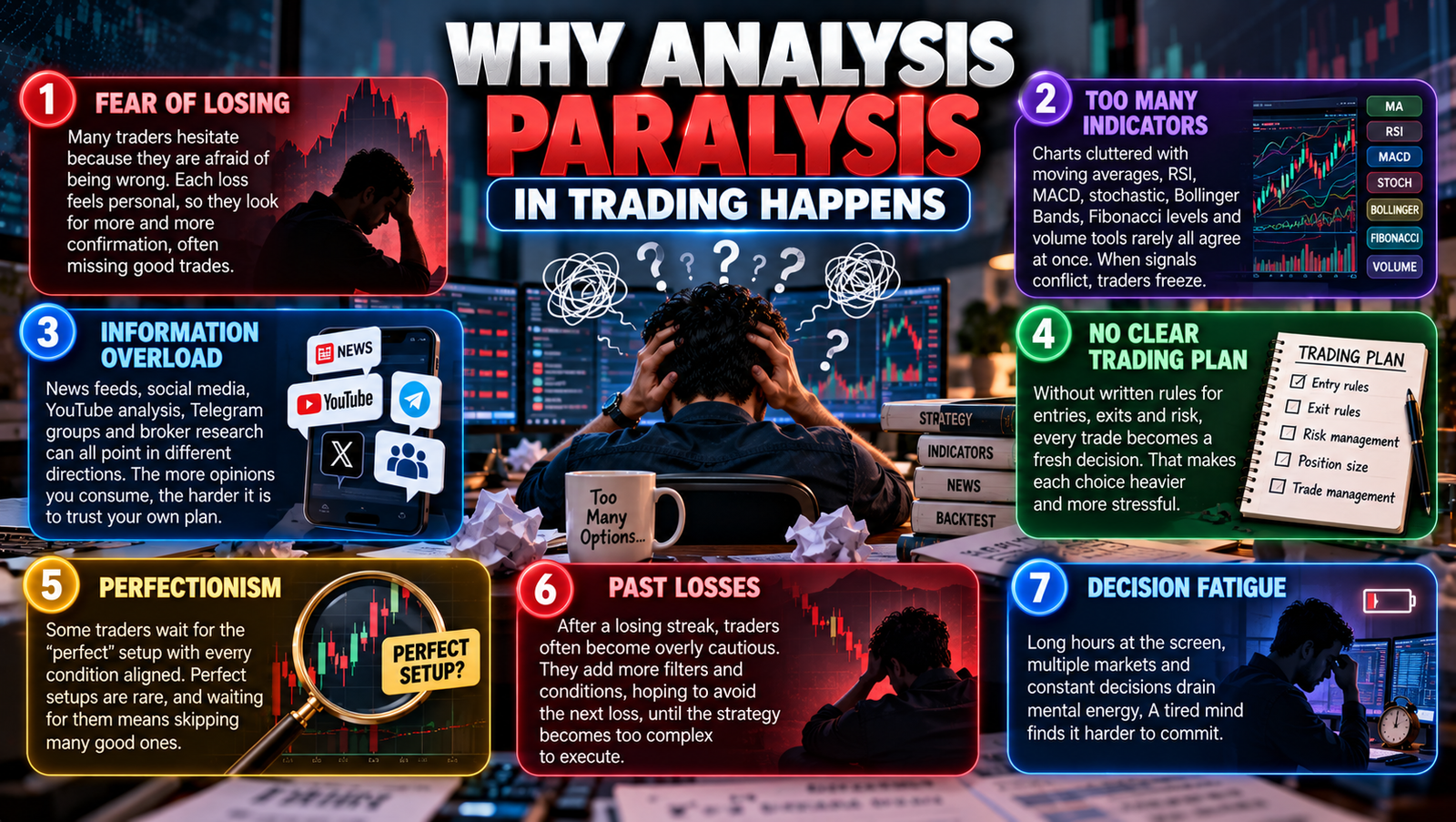
1. Fear of losing
Many traders hesitate because they are afraid of being wrong. Each loss feels personal, so they look for more and more confirmation to avoid it. Ironically, this often leads to missed winners rather than fewer losses.
2. Too many indicators
Charts cluttered with moving averages, RSI, MACD, stochastic, Bollinger Bands, Fibonacci levels and volume tools rarely all agree at once. When signals conflict, the trader freezes.
3. Information overload
News feeds, social media, YouTube analysis, Telegram groups and broker research can all point in different directions. The more opinions you consume, the harder it is to trust your own plan.
4. No clear trading plan
Without written rules for entries, exits and risk, every trade becomes a fresh decision. That makes each choice heavier and more stressful.
5. Perfectionism
Some traders wait for the “perfect” setup with every condition aligned. Perfect setups are rare, and waiting for them means skipping many good ones.
6. Past losses
After a losing streak, traders often become overly cautious. They add more filters and conditions, hoping to avoid the next loss, until the strategy becomes too complex to execute.
7. Decision fatigue
Long hours at the screen, multiple markets and constant decisions drain mental energy. A tired mind finds it harder to commit.
Warning Signs of Analysis Paralysis Trading
- You regularly miss trades that match your setup
- You enter late, after much of the move has happened
- You check several timeframes and indicators before every decision, even when your plan does not require it
- You keep adding new indicators or rules to your strategy
- You read several opinions before every trade
- You close trades early because a new signal looks doubtful
- You spend hours analysing but take very few trades
- You feel anxious and tired after a session with no trades
If several of these sound familiar, analysis paralysis trading habits may be holding you back.
How Analysis Paralysis Trading Hurts Your Results
Analysis paralysis can damage performance in several ways:
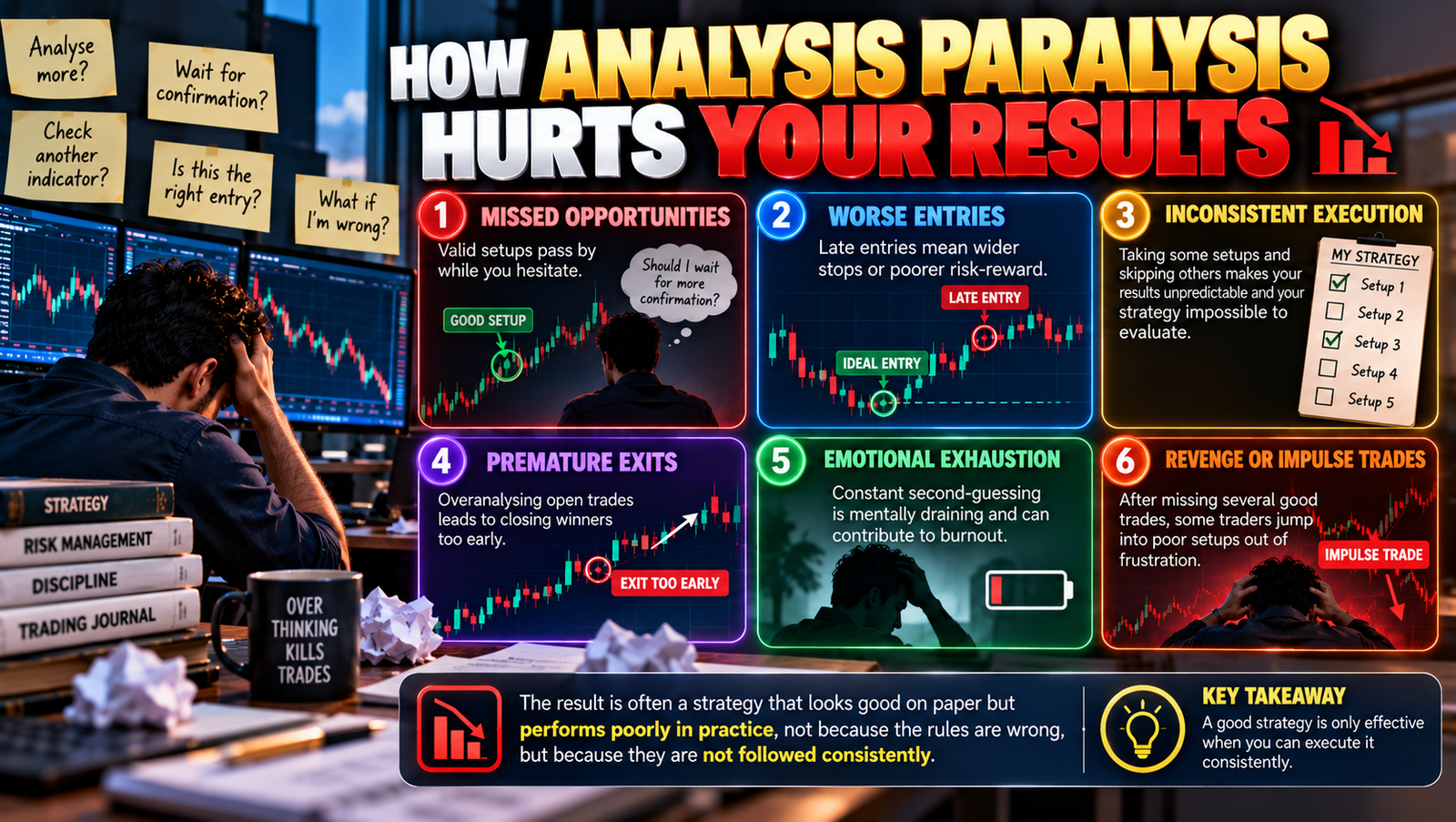
- Missed opportunities: Valid setups pass by while you hesitate.
- Worse entries: Late entries mean wider stops or poorer risk-reward.
- Inconsistent execution: Taking some setups and skipping others makes your results unpredictable and your strategy impossible to evaluate.
- Premature exits: Over analysing open trades leads to closing winners too early.
- Emotional exhaustion: Constant second-guessing is mentally draining and can contribute to burnout.
- Revenge or impulse trades: After missing several good trades, some traders jump into poor setups out of frustration.
The result is often a strategy that looks good on paper but performs poorly in practice, not because the rules are wrong, but because they are not followed consistently.
A Practical Framework to Overcome Analysis Paralysis Trading
Beating analysis paralysis in trading is about structure, not willpower.
Step 1: Simplify your chart
Remove indicators you do not actively use in your rules. Many successful traders use only two or three tools, such as a moving average for trend, key support and resistance levels, and one momentum indicator. A clean chart makes decisions faster.
Step 2: Write a clear trading plan
Your plan should answer these questions in advance:
- Which markets and timeframes do I trade?
- What exact conditions must be present for an entry?
- Where will I place my stop-loss?
- How will I take profits?
- How much will I risk per trade?
When the rules are written down, each decision becomes a check against the plan rather than a new debate.
Step 3: Use a short checklist
Turn your entry rules into a checklist of three to five items. If all are met, you take the trade. If not, you skip it. There is no third option.
Step 4: Limit timeframes
Use a maximum of two or three timeframes: one for trend, one for setup and, if needed, one for entry. Checking more creates conflicting signals.
Step 5: Cut information sources
Choose one or two trusted sources for news and an economic calendar. Mute trading groups and social media during your session.
Step 6: Accept uncertainty
Remind yourself that every trade has an uncertain outcome. Your edge comes from following your rules over many trades, not from being right on each one.
Step 7: Size positions so losses feel acceptable
If a potential loss feels too big, you will hesitate. Reducing risk to 0.5–1% per trade can make it much easier to act.
Step 8: Set a time limit for decisions
When a setup appears, give yourself a short, fixed window to check your checklist and decide. If you cannot decide in that time, skip the trade and review why later.
Think in Probabilities to Beat Analysis Paralysis in Trading
One of the most powerful mindset shifts for analysis paralysis trading is learning to think in probabilities. Imagine a strategy that wins 45% of the time, with average winners twice the size of average losers. Over 100 trades, that strategy can be profitable, even though more than half the trades lose.
Seen this way, any single trade matters very little. What matters is executing the strategy consistently across many trades. Once you accept that losses are a normal part of the process, the pressure to “get every trade right” fades.
| Mindset | Certainty thinking | Probability thinking |
|---|---|---|
| Goal of each trade | Must win | Follow the plan |
| Reaction to a loss | “I was wrong” | “Normal part of the edge” |
| Need for confirmation | Endless | Defined by checklist |
| Result | Hesitation and missed trades | Consistent execution |
 Practical Exercises for Analysis Paralysis Trading
1. Backtest your rules
Go back through historical charts and apply your checklist mechanically. Seeing how the strategy performs over 50 or 100 examples builds confidence that you do not need extra confirmation.
2. Demo trade with strict rules
Spend a set period on a demo account where your only goal is to take every valid setup. Track how many you take versus how many you skip.
3. Keep a hesitation journal
Each time you skip or delay a trade, write down why. Over time, you will see patterns, such as fear after losses or confusion from conflicting indicators.
4. Review missed trades weekly
In your weekly review, look at setups you skipped. Were they valid? How would they have performed? This feedback shows the real cost of hesitation.
Simple vs Complex Strategies and Analysis Paralysis Trading
Many traders believe a more complex strategy must be better. In practice, simple strategies are often easier to execute consistently.
| Feature | Simple strategy | Complex strategy |
|---|---|---|
| Number of rules | 3–5 | 10 or more |
| Decision speed | Fast | Slow |
| Execution consistency | High | Often low |
| Ease of review | Easy | Difficult |
| Risk of analysis paralysis | Lower | Higher |
A simple strategy that you follow consistently usually beats a complex one you hesitate to use. If your current rules feel overwhelming, try removing one condition at a time and backtesting the result. You may find that several filters add little value while making analysis paralysis trading far more likely.
Real-World Examples of Analysis Paralysis in Trading
Example 1: The indicator overload. A trader’s plan says to buy pullbacks to the 50 EMA in an uptrend. A valid setup appears, but RSI is near 60, MACD is flat and the stochastic is overbought. The trader waits for “everything to line up”, price rallies without them, and the trade is missed. The plan never required those extra indicators.
Example 2: The opinion collector. Before every USD/INR trade, a trader checks three analysts and two Telegram groups. When opinions differ, they skip the trade. Over a month, they take only two of ten valid setups, and their results become impossible to judge.
In both cases, the fix is the same: trade the written rules and remove the extra inputs that the plan does not need.
Daily Routine to Prevent Analysis Paralysis Trading
- Before the session: Mark key levels, check the economic calendar and note your bias.
- During the session: Watch only your chosen markets and wait for your checklist conditions.
- When a setup appears: Run the checklist, decide within your time limit and act.
- After the trade: Let the stop or target do the work; avoid over analysing every tick.
- After the session: Journal your trades and any hesitation.
When Caution Is Healthy, Not Analysis Paralysis in Trading
Not every pause is analysis paralysis. Skipping a trade because it does not meet your rules, or stepping aside before major news, is good discipline. The difference is that healthy caution follows your plan, while paralysis ignores or overrides it.
A useful test is to ask: “Am I skipping this because my rules say so, or because I am afraid?” If it is fear, the problem is psychological, not strategic.
Analysis Paralysis Trading in Indian Markets
These ideas apply to any market, including NSE currency futures such as USD/INR, Nifty and Bank Nifty F&O, and MCX commodities. Indian traders often face heavy information flow from TV channels, social media and tip groups. Limiting these sources and trading from a written plan can make a big difference.
Indian residents should trade currencies only through recognised exchanges such as NSE and BSE, via SEBI-registered brokers. Leveraged forex trading through offshore CFD platforms is not permitted under FEMA.
FAQs
What is analysis paralysis trading?
It is when a trader overanalyses a situation to the point of failing to make a decision, or making it too late, often because of fear, too many indicators or information overload.
How do I stop overthinking trades?
Simplify your chart, write a clear plan, use a short checklist, limit timeframes and information sources, and keep risk per trade small.
How many indicators should I use?
Many traders find two or three tools are enough. More indicators often create conflicting signals.
Is it bad to skip trades?
Not if your rules say to skip them. It becomes a problem when you skip valid setups because of fear or doubt.
Can analysis paralysis lead to burnout?
Yes. Constant second-guessing is mentally exhausting and can contribute to frustration and burnout over time.
Conclusion
Analysis paralysis trading problems come from a natural desire for certainty in an uncertain market. More indicators, more opinions and more timeframes rarely lead to better decisions. Instead, they slow you down, cause missed trades and make your results inconsistent.
The cure for analysis paralysis trading is simplicity and structure: a clean chart, a written plan, a short checklist, sensible risk and a probability mindset. Practise executing your rules consistently on historical charts and a demo account, review your hesitation honestly, and you will build the confidence to act decisively when your setup appears.