Introduction
A few profitable weeks on a demo account can make going live feel like the obvious next step. But many traders find that the same strategy behaves differently once real money is at stake: they hesitate, exit early, move stops, or size up to “make it worth it”. Knowing when to go live in forex trading is less about a date on the calendar and more about meeting clear, measurable conditions first.
Quick answer: You’re ready to go live when you have a written plan, a meaningful sample of practice trades (often 50–100 or more) showing positive expectancy after realistic costs, rule adherence of around 90% or better, drawdowns you can tolerate, and money you can afford to lose. Then go live small, with minimum size and fixed risk, and scale up in stages only if live results and discipline hold. In India, trade only permitted currency pairs on NSE or BSE through a SEBI-registered broker.
Why this matters for Indian beginners
- Fact: SEBI found that over 91% of individual equity F&O traders made net losses in FY25, and 71% of individual intraday traders in the equity cash segment made net losses in FY23.
- Analysis: These figures aren’t about currency derivatives specifically, but they show how hard active trading is for individuals. Going live before you’re ready usually means paying tuition to the market.
- Opinion: A demo account can’t prove you’ll be profitable. It can prove you can follow your rules. That’s the real test to pass before risking money.
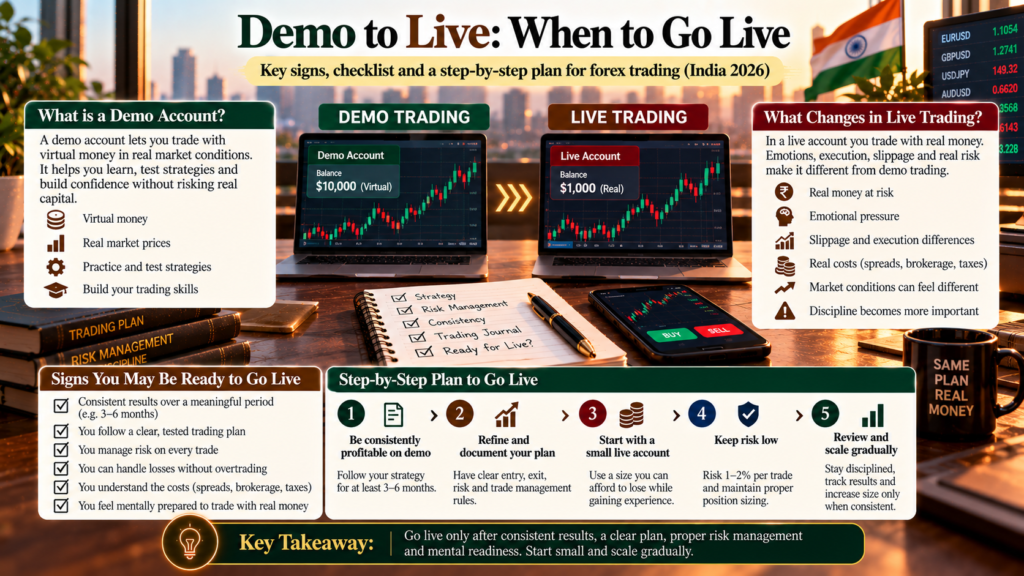
Demo vs live: what actually changes
| Demo or paper trading | Live trading | |
|---|---|---|
| Emotions | Low; losses feel abstract | Fear and greed are real |
| Fills | Often at the displayed price | Slippage and partial fills |
| Costs | Often ignored | Brokerage, taxes, exchange fees, spread |
| Discipline | Easy to follow rules | Rules tested under pressure |
| Position size | Often unrealistically large | Limited by real capital and margin |
| Mistakes | Cost nothing | Cost money, and often trigger more mistakes |
Key point: demo trading tests your strategy logic and routine. Live trading tests your behaviour. The goal of practice is to arrive at live trading with the routine so automatic that pressure changes as little as possible.
The go-live readiness checklist
Tick every item before you trade with real money.
| # | Test | How to measure | Suggested bar |
|---|---|---|---|
| 1 | Written trading plan | Rules for setup, entry, stop, target, size and limits | Complete and unchanged for your test period |
| 2 | Sample size | Number of practice trades using the same rules | At least 50, ideally 100 or more |
| 3 | Expectancy after costs | Average R per trade, minus realistic costs and slippage | Positive |
| 4 | Rule adherence | Trades that followed every rule ÷ total trades | Around 90% or higher |
| 5 | Drawdown tolerance | Largest peak-to-trough drop in practice | One you could accept emotionally and financially with real money |
| 6 | Risk plan | Risk per trade, daily and weekly loss limits | Written and small (for example, 0.5–1% per trade) |
| 7 | Journal | Every trade logged with R and rules followed | Maintained without gaps |
| 8 | Money you can afford to lose | Capital separate from savings, emergency fund and borrowed money | Yes |
These bars are practical guidelines, not official standards. Stricter is fine.
Why small samples mislead
Imagine a strategy that truly wins 50% of the time. How much could your measured win rate vary just by chance?
| Practice trades | Likely range of measured win rate (approx. 95%) |
|---|---|
| 20 | 28% to 72% |
| 50 | 36% to 64% |
| 100 | 40% to 60% |
| 200 | 43% to 57% |
Calculated using the normal approximation for a true 50% win rate.
After 20 trades, a coin-flip strategy could easily look brilliant or terrible. That’s why a few good weeks on demo prove very little, and why larger samples matter before real money is involved.
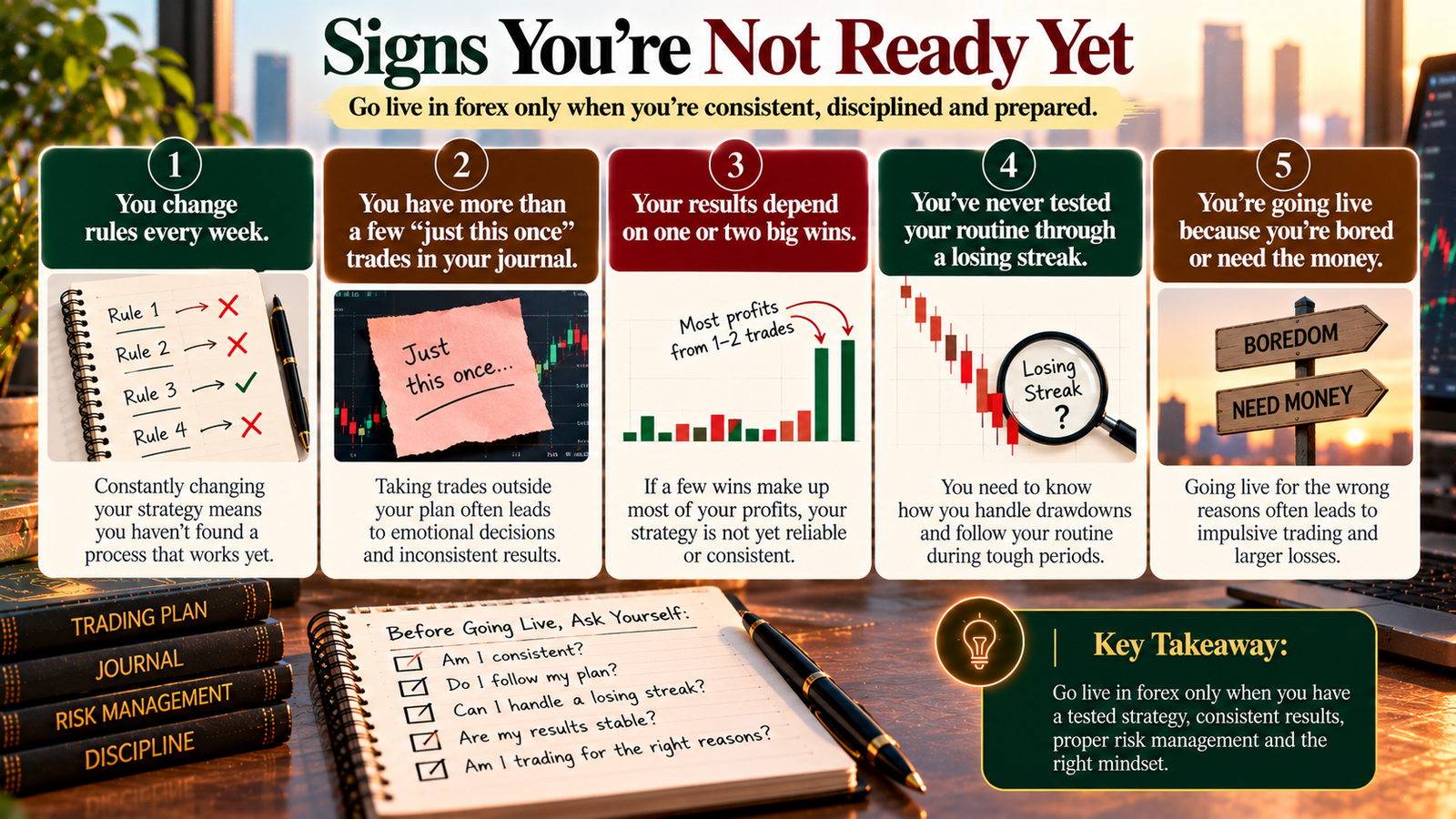
Signs you’re not ready yet
- You change rules every week.
- You have more than a few “just this once” trades in your journal.
- Your results depend on one or two big wins.
- You’ve never tested your routine through a losing streak.
- You’re going live because you’re bored or need the money.
The India angle: practising and going live legally
Where to practise
- Manual paper trading: record hypothetical trades in your journal in real time, with entry, stop, target and result, as if they were live. It’s slow, but it builds the exact routine you’ll use later.
- Chart replay and backtesting: many charting tools let you replay historical price data bar by bar to practise setups.
- Broker tools: some brokers offer practice or simulation features. Check what yours provides.
Fact: In May 2024, SEBI restricted stock exchanges and registered intermediaries from sharing real-time price data with third parties that offer virtual trading or fantasy games based on live prices. Sharing for investor education is permitted with a one-day lag and no financial incentives. In practice, be wary of “virtual trading” apps that offer cash rewards on live prices.
Where to go live
- Resident Indians may trade permitted currency pairs (such as USD/INR, EUR/INR, GBP/INR, JPY/INR and certain cross-currency pairs) as exchange-traded derivatives on NSE or BSE through a SEBI-registered broker.
- For rupee pairs, RBI rules are designed around users with an underlying currency exposure; check the current requirements with your broker.
- Leveraged trading on offshore forex platforms isn’t permitted for residents. The RBI publishes an alert list of unauthorised entities.
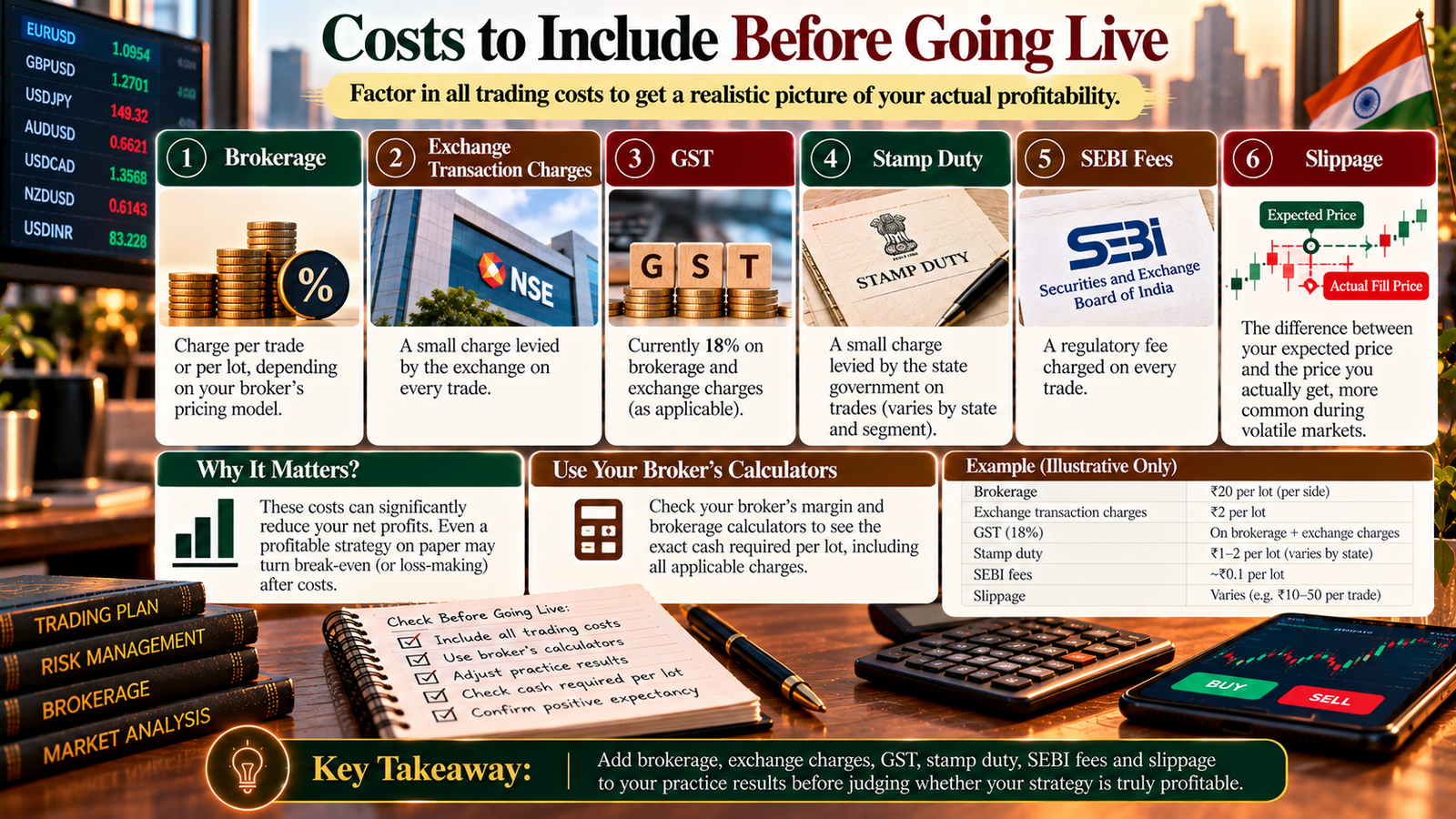
Costs to include before going live
Brokerage, exchange transaction charges, GST, stamp duty, SEBI fees and slippage. Add these to your practice results before judging whether your expectancy is really positive. Use your broker’s margin and brokerage calculators to see the cash needed per lot.
A staged plan to go live (illustrative)
Assume capital of ₹1,00,000 set aside purely for trading, trading NSE USD/INR futures (one lot = $1,000, so a ₹0.01 move = ₹10 per lot), with a typical stop of 20 paise.
| Stage | Size | Risk per trade | Risk as % of capital | Move on when… |
|---|---|---|---|---|
| 1. First live trades | 1 lot | ₹200 | 0.2% | 30 or more trades with at least 90% rule adherence |
| 2. Build confidence | 2 lots | ₹400 | 0.4% | At least 50 further trades, positive expectancy after costs, drawdown within limit |
| 3. Normal size | 3 lots | ₹600 | 0.6% | Review every 50 trades; only increase if results and adherence hold |
Step-down rule: if you break your daily loss limit twice in a week, or adherence falls below 80%, go back one stage. Treat that as part of the plan, not a failure.
What to expect in the first month live
- More hesitation and early exits than on demo. Your journal’s “emotion” column will show it.
- Slippage and costs that shrink your results compared with practice.
- The urge to increase size after a few wins. Stick to the stage rules.
For your first live trades, success means following the plan with real money, not making a profit.
Expert analysis
Fact: SEBI’s studies show most individual traders in India’s equity derivatives and intraday segments lose money. Small practice samples can produce misleading win rates purely by chance: after 20 trades, a 50% strategy could plausibly show anywhere from about 28% to 72%. SEBI’s May 2024 circular restricts sharing real-time price data with third-party virtual trading platforms.
Analysis: The demo-to-live gap is mostly behavioural and cost-related. Demo results usually overstate live results, because they leave out slippage, costs and the emotional pressure that leads to rule-breaking. The more realistic your practice (costs included, journal kept, same size you’d use live), the smaller the gap.
Opinion: The best readiness test isn’t “am I profitable on demo?” but “can I follow my plan for 100 trades without improvising?” If the answer is yes, going live small is a reasonable next step. If the answer is no, real money will make it worse, not better. There’s no prize for going live early.
Common mistakes
- Going live after a short winning streak. Small samples mislead.
- Ignoring costs and slippage in practice results.
- Starting live at full size. Start at minimum size and scale in stages.
- Changing the strategy when going live. Trade exactly what you practised.
- Using money you can’t afford to lose, including borrowed money or emergency savings.
- Treating demo as a game. Unrealistic sizes and careless trades teach bad habits.
- Using unregulated offshore apps because they’re easier to open. For residents, they aren’t permitted.
- Never going back to practice. If live discipline slips, stepping down is smart, not shameful.
Myths vs facts
| Myth | Fact |
|---|---|
| “If I’m profitable on demo, I’ll be profitable live.” | Live trading adds costs, slippage and emotional pressure. Demo can’t prove live profitability. |
| “There’s a set number of months to demo trade.” | Readiness depends on sample size, adherence and results, not time alone. |
| “Small live trades are pointless.” | They’re the cheapest way to learn how you behave with real money. |
| “Paper trading is illegal in India.” | Manual paper trading and chart replay are fine. SEBI’s 2024 circular restricts sharing real-time price data with third-party virtual trading platforms. |
| “Going live sooner means learning faster.” | Going live unprepared often means learning expensive lessons. Practice can build most of the routine first. |
Key takeaways
- Demo tests your strategy and routine; live tests your behaviour under pressure.
- Go live only with a written plan, 50 to 100+ practice trades, positive expectancy after costs, about 90% rule adherence and money you can afford to lose.
- Small samples can make any strategy look good or bad by chance.
- Start live at minimum size, scale in stages, and step down if discipline slips.
- In India, go live only in permitted pairs on NSE or BSE through a SEBI-registered broker.
FAQs
- When should I go live in forex trading? When you have a written plan, a meaningful practice sample (often 50 to 100+ trades) with positive expectancy after costs, around 90% rule adherence, and capital you can afford to lose.
- How long should I demo trade before going live? There’s no fixed time. Focus on the number of trades and your discipline rather than weeks or months.
- Why do traders win on demo but lose live? Live trading adds real emotions, slippage and costs. Fear and greed lead to rule-breaking that doesn’t happen on demo.
- How many practice trades do I need? At least 50, and ideally 100 or more, using the same rules. Smaller samples can look good or bad purely by chance.
- What rule-adherence score should I aim for? Around 90% or higher before going live is a practical guideline.
- How much money should I start with? Only money you can afford to lose, kept separate from savings and emergency funds. Start with minimum position size regardless of account size.
- Is paper trading legal in India? Manual paper trading and chart replay are fine. SEBI’s May 2024 circular restricts sharing real-time price data with third-party virtual trading or fantasy platforms, especially those offering rewards.
- Where can Indian residents trade forex legally? In permitted currency pairs as exchange-traded derivatives on NSE or BSE, through a SEBI-registered broker.
- Can I use offshore forex apps with a demo-to-live bonus? Leveraged trading on offshore forex platforms isn’t permitted for residents. Check the RBI alert list of unauthorised entities.
- What size should my first live trade be? The minimum possible, for example one USD/INR lot ($1,000), with a small fixed risk per trade.
- When should I increase size after going live? Only at scheduled reviews, such as every 50 trades, if expectancy after costs is positive and adherence stays high.
- What if I start losing when I go live? Check your journal: is it the strategy or rule-breaking? If discipline has slipped, reduce size or return to practice.
- Should I include costs in demo results? Yes. Add brokerage, charges, taxes and a slippage estimate so your practice expectancy reflects live conditions.
- Is it OK to go back to demo after going live? Yes. Stepping down to practice when discipline slips is a sign of good risk management.
- Does a profitable demo account guarantee live profits? No. It shows your strategy and routine may work, but live conditions add costs and emotional pressure.
- What’s the biggest risk when going live? Trading too big too soon, then breaking rules under pressure. Staged sizing reduces this risk.
- Can I go live if I’ve only backtested? Backtesting helps, but also do forward practice in real time. It tests your routine and decision-making, not just the rules.