
Introduction
Most beginners don’t lose money because they picked the “wrong” indicator. They lose because of a handful of predictable mistakes: trading on the wrong platform, risking too much, trading without a plan, and letting emotions take over after a loss. The good news is that the most common forex trading mistakes beginners make are well known, and each has a practical fix.
Quick answer: The biggest beginner forex mistakes are using unauthorised offshore platforms, over-leveraging, trading without a stop-loss, risking too much per trade, trading without a written plan, overtrading, revenge trading after losses, ignoring costs and news, and giving up or changing strategy too quickly. Fix them with a regulated broker, small fixed risk per trade, a stop on every trade, a written plan and a trading journal.
Why this matters in India
- Fact: SEBI found that over 91% of individual equity F&O traders made net losses in FY25, and 71% of individual intraday traders in the equity cash segment did in FY23.
- Fact: The RBI maintains an alert list of unauthorised forex trading platforms and updates it periodically. The most recent update we found, dated 19 November 2025, added seven platforms.
- Fact: Resident Indians may trade forex only in permitted currency pairs on recognised Indian exchanges (NSE, BSE) through SEBI-registered brokers.
- Analysis: SEBI’s figures cover equity derivatives and intraday trading, not currency derivatives specifically, but the behaviours behind them apply to any leveraged trading.
Legal and platform mistakes
1. Trading on unauthorised offshore platforms
Social media ads and “signal” groups often push offshore apps offering high leverage and exotic pairs. For resident Indians, leveraged forex trading on these platforms isn’t permitted, and the RBI names many of them on its alert list.
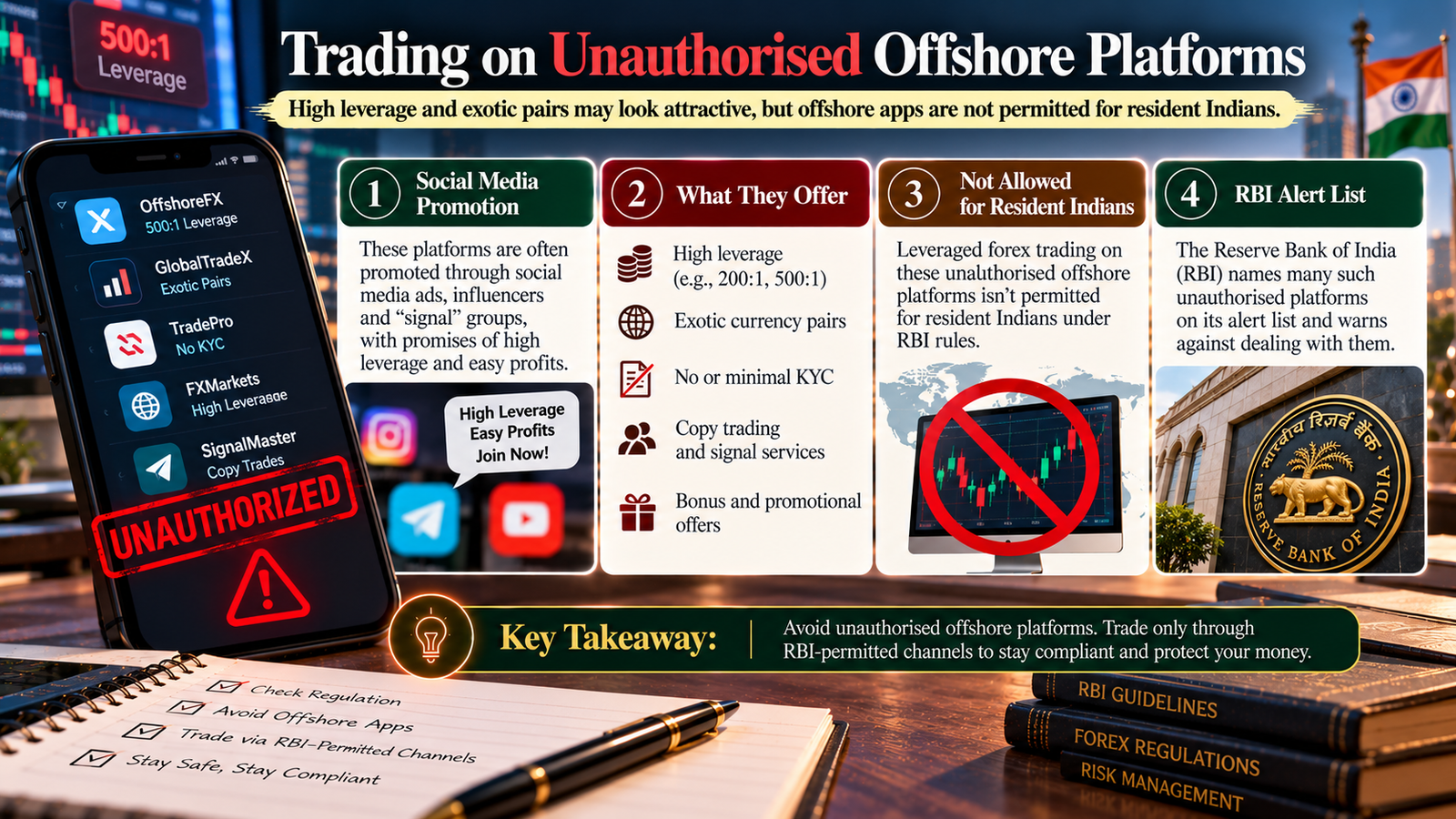
Fix: trade only permitted pairs on NSE or BSE through a SEBI-registered broker. Check any platform against the RBI alert list and SEBI’s list of registered intermediaries.
2. Following paid “signals” and tips
Telegram and WhatsApp groups promising sure-shot calls rarely disclose their full track record, and you learn nothing by copying them.
Fix: build and test your own simple plan. Be sceptical of anyone guaranteeing returns.
Risk mistakes
3. Over-leveraging
Leverage magnifies both gains and losses. Beginners often open the largest position their margin allows.
Fix: size positions from your risk per trade, not from available margin.
4. Trading without a stop-loss
Without a stop, one bad trade can wipe out weeks of gains.
Fix: place a stop-loss the moment you enter, based on your setup, and never widen it.
5. Risking too much per trade
Risking 5–10% per trade means a normal losing streak can cause a deep drawdown.
Fix: many educators suggest risking around 0.5–2% of capital per trade. Beginners are often better starting at the lower end.
Strategy and execution mistakes
6. Trading without a written plan
Without rules for setup, entry, stop, target and size, every trade becomes a guess.
Fix: write a one-page plan and follow it for at least 50 trades before changing it.
7. Ignoring the economic calendar
Major releases, such as RBI and Fed decisions, US jobs data and inflation figures, can move currencies sharply and cause slippage.
Fix: check the calendar every morning and avoid entering just before high-impact events unless that’s part of your plan.
8. Using the wrong order types
Market orders during fast moves, or stop-limits with no room, can lead to bad fills or no fill.
Fix: use limit orders for planned entries and targets, and leave room between trigger and limit on stop-losses.
Mistakes 1 to 8 at a glance
| # | Mistake | Quick fix |
|---|---|---|
| 1 | Unauthorised offshore platforms | NSE/BSE via a SEBI-registered broker |
| 2 | Following paid signals | Build and test your own plan |
| 3 | Over-leveraging | Size from risk, not margin |
| 4 | No stop-loss | Stop on every trade, set at entry |
| 5 | Risking too much per trade | Around 0.5–2% per trade |
| 6 | No written plan | One-page plan, 50+ trades before changes |
| 7 | Ignoring the calendar | Check high-impact events daily |
| 8 | Wrong order types | Limit orders for entries; room on stops |
Psychology mistakes
9. Revenge trading after a loss
Trying to win back a loss immediately, often with bigger size, turns one loss into several.
Fix: set a daily loss limit and a rule to stop after two consecutive losses.
10. Overtrading
Taking trades out of boredom or FOMO adds costs and lowers trade quality. SEBI found the share of loss-makers among intraday traders rose to 80% for those making more than 500 trades a year.
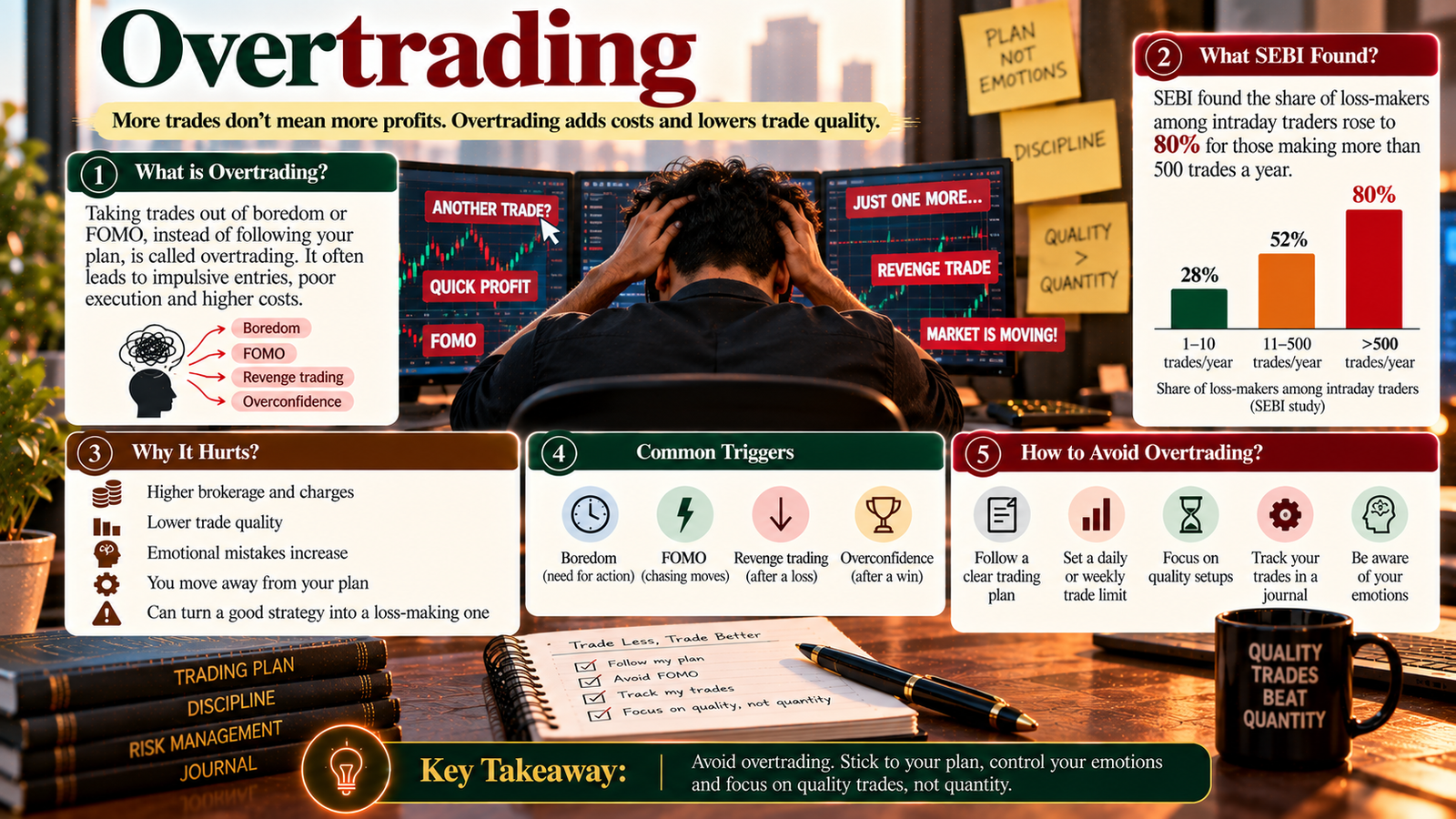
Fix: cap your trades per day and only trade setups written in your plan.
11. Overconfidence after wins
A winning streak tempts beginners to double size or skip rules, right before normal losses arrive.
Fix: keep risk per trade fixed and change size only at scheduled reviews.
12. Moving the stop-loss or exiting winners early
Widening stops to avoid a loss, or grabbing small profits out of fear, breaks your risk-reward maths.
Fix: set stop and target at entry, then use alerts instead of watching every tick.
Cost and learning mistakes
13. Ignoring costs and slippage
Brokerage, exchange charges, taxes and slippage add up, especially for frequent traders.
Fix: record every result net of costs and track average slippage in your journal.
14. Not keeping a trading journal
Without records, you can’t tell whether losses come from the strategy or from breaking rules.
Fix: log every trade: setup, entry, stop, exit, result in R, rules followed, and one lesson.
15. Going live too early, or switching strategies too often
A few good demo weeks prove little, and changing strategy after every loss means you never collect enough data.
Fix: practise for 50–100+ trades, go live at minimum size, and judge a strategy only over a meaningful sample.
What these mistakes cost: worked examples (illustrative)
Assume capital of ₹50,000 trading NSE USD/INR futures, where one lot is $1,000, so a ₹0.01 move equals ₹10 per lot.
| Mistake | Scenario | Loss | % of capital |
|---|---|---|---|
| Over-leverage | 10 lots, price moves 30 paise against you | ₹3,000 | 6.0% |
| Sensible size | 1 lot, same 30-paise move | ₹300 | 0.6% |
| No stop-loss | 2 lots long at 95.50; price falls to 94.50 | ₹2,000 | 4.0% |
| With a stop at 95.30 | Same trade, stopped out | ₹400 | 0.8% |
| Revenge trading | Lose ₹1,000, double size, lose ₹2,000, double again, lose ₹4,000 | ₹7,000 | 14.0% |
The revenge-trading row shows how three decisions made in frustration can cost as much as many planned losing trades.
Beginner’s pre-trade checklist
- Am I on a SEBI-registered broker, trading a permitted pair on NSE or BSE?
- Is this setup in my written plan?
- Have I checked the economic calendar?
- Is my stop-loss decided and placed?
- Is my size based on my risk per trade (e.g. 0.5–1%)?
- Am I within my daily loss limit and trade count?
- Am I calm, or am I trying to win back a loss?
Expert analysis
Fact: SEBI’s studies show most individual F&O and intraday traders in India lose money, with loss rates higher among very frequent intraday traders. The RBI maintains and periodically updates an alert list of unauthorised forex trading platforms. Resident Indians may trade forex only in permitted pairs on recognised Indian exchanges.
Analysis: Most beginner mistakes fall into two groups. Structural mistakes (wrong platform, too much leverage, no stops, no plan) can be fixed once, before you ever trade. Behavioural mistakes (revenge trading, overtrading, overconfidence, moving stops) need ongoing systems: loss limits, trade caps, checklists and a journal. Fixing the structural ones first removes the risk of a single catastrophic loss.
Opinion: If a beginner fixed only three things (a regulated broker, 0.5–1% risk per trade with a stop on every trade, and a daily loss limit), most account-ending disasters would be avoided. That doesn’t guarantee profits, but it buys time to learn.
Myths vs facts
| Myth | Fact |
|---|---|
| “Offshore apps are fine if everyone uses them.” | For resident Indians, leveraged forex trading on unauthorised platforms isn’t permitted, and many appear on the RBI alert list. |
| “More leverage means more profit.” | Leverage magnifies losses just as much as gains. |
| “Stop-losses just get hunted, so don’t use them.” | Without stops, a single move can cause a large loss. Place stops at logical levels and size accordingly. |
| “A good trader wins most trades.” | Profitability depends on win rate and the size of wins versus losses together. |
| “Paid signals are a shortcut to profits.” | Track records are rarely verifiable, and copying doesn’t build skill. |
| “If I trade more, I’ll learn faster.” | Unplanned trades repeat mistakes and add costs. |
Key takeaways
- Trade only permitted pairs on NSE or BSE through a SEBI-registered broker, and check the RBI alert list.
- Size positions from risk per trade, not available margin, and use a stop on every trade.
- Write a simple plan and follow it for at least 50 trades before changing it.
- Guard against revenge trading, overtrading and overconfidence with loss limits, trade caps and fixed risk.
- Count every cost, including slippage, and keep a journal.
- Go live small and judge results over a meaningful sample.
FAQs
- What is the most common forex mistake beginners make? Risking too much, whether through over-leverage, no stop-loss or oversized positions. In India, using unauthorised offshore platforms is an equally serious mistake.
- Is forex trading legal in India? Yes, in permitted currency pairs traded as derivatives on recognised Indian exchanges (NSE, BSE) through SEBI-registered brokers. Leveraged trading on offshore platforms isn’t permitted for residents.
- What is the RBI alert list? A list published by the RBI of entities not authorised to deal in forex or operate electronic trading platforms for forex. The RBI updates it periodically and notes it isn’t exhaustive.
- Why do most beginners lose money in forex? Common causes include excessive risk, no plan, emotional decisions after losses, overtrading and ignoring costs.
- How much should a beginner risk per trade? Many educators suggest 0.5–2% of capital. Starting at the lower end gives more room to learn.
- Should I always use a stop-loss? Yes. It limits losses in normal conditions, though slippage can make the actual loss slightly larger.
- What is revenge trading? Taking impulsive trades, often bigger, to recover a loss quickly. It usually leads to bigger losses.
- How do I stop overtrading? Set a maximum number of trades per day, trade only planned setups, and treat days with no setups as successful.
- Are forex signal groups worth it? Most can’t show a verifiable track record, and copying doesn’t build skill. Be cautious of anyone guaranteeing returns.
- Why is the economic calendar important? Major releases can move currencies sharply, widen spreads and cause slippage.
- How does leverage hurt beginners? It magnifies losses. A small adverse move on a large position can wipe out a significant share of capital.
- What should a beginner’s trading plan include? Instruments, sessions, setup, entry rules, stop-loss, target, position sizing, and daily and weekly loss limits.
- Why keep a trading journal? It shows whether losses come from the strategy or from breaking rules, so you know what to fix.
- When should a beginner go live? After 50–100+ practice trades with positive results after costs and high rule adherence, starting at minimum size.
- How often should I change my strategy? Not after every loss. Judge a strategy over at least 50 trades taken consistently.
- Do costs really matter for small traders? Yes. Brokerage, charges, taxes and slippage add up, especially if you trade frequently.
- What’s the single best habit for a beginner? Following a written plan with a fixed, small risk per trade, and recording every trade in a journal.