Introduction
You set a stop-loss at 95.30, price drops fast, and your contract note shows an exit at 95.27. Or you click “buy” on a trading app and get a message: “Requote – new price 1.1712. Accept?” Both are examples of the gap between the price you expect and the price you actually get. If you’ve wondered what slippage in forex is, and whether it means something went wrong, this guide explains it in plain terms.
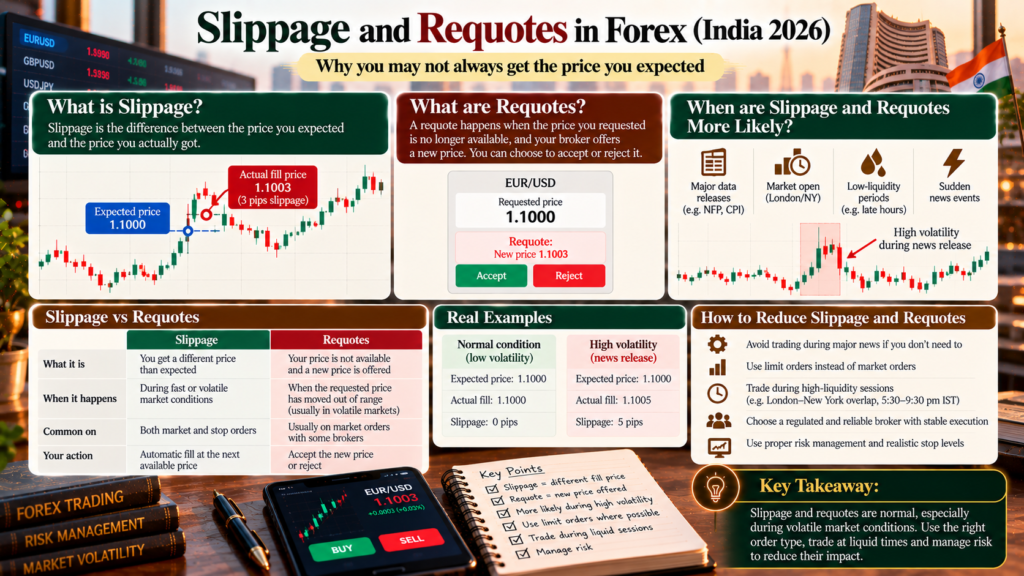
Quick answer: Slippage is the difference between the price you expected for an order and the price at which it actually filled. It happens because prices move between the moment you send an order and the moment it’s executed, or because there isn’t enough volume at your price. Slippage can be negative (worse price) or positive (better price). A requote happens on some dealer platforms: instead of filling your order at a new price, the platform offers you the new price and asks you to accept or reject it.
Why this matters
- Slippage is a real trading cost, just like spread and brokerage. It rarely appears as a separate line on your statement.
- It’s most likely at the moments beginners trade most: around news releases, at the open, and during sharp moves.
- For stop-losses, slippage means your actual loss can be larger than planned, which affects position sizing.
- Indian residents trading permitted currency pairs on NSE or BSE deal with an exchange order book, where requotes don’t exist but slippage still does.
What is slippage?
Slippage = actual fill price − expected price (the sign depends on whether you’re buying or selling).
| Type | Buying | Selling | Effect |
|---|---|---|---|
| Negative slippage | Filled higher than expected | Filled lower than expected | Costs you money |
| Positive slippage | Filled lower than expected | Filled higher than expected | Works in your favour |
| No slippage | Filled at expected price | Filled at expected price | — |
What causes slippage?
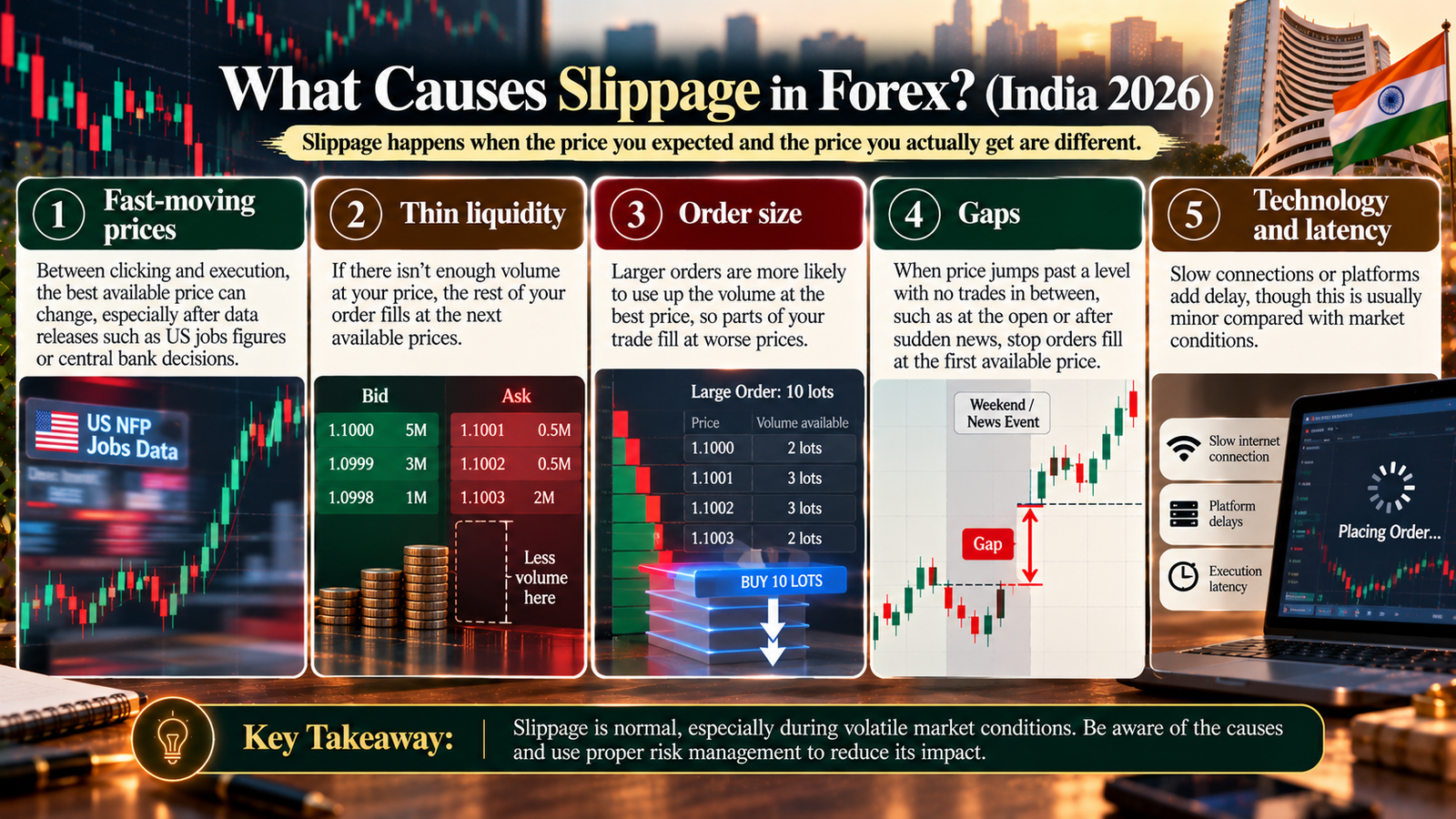
- Fast-moving prices. Between clicking and execution, the best available price can change, especially after data releases such as US jobs figures or central bank decisions.
- Thin liquidity. If there isn’t enough volume at your price, the rest of your order fills at the next available prices.
- Order size. Larger orders are more likely to use up the volume at the best price.
- Gaps. When price jumps past a level with no trades in between, such as at the open or after sudden news, stop orders fill at the first available price.
- Technology and latency. Slow connections or platforms add delay, though this is usually minor compared with market conditions.
Which orders are affected?
| Order type | Slippage possible? | Why |
|---|---|---|
| Market order | Yes | Fills at whatever price is available |
| Stop order (stop-loss market) | Yes | Becomes a market order once triggered |
| Limit order | No negative slippage | Fills only at your price or better; it may not fill at all |
| Stop-limit order | No beyond your limit | But may not fill if price jumps past your limit |
What is a requote?
A requote happens on some dealer (over-the-counter) platforms that use instant execution. When you place an order and the price has moved, the dealer doesn’t fill you at the new price automatically. Instead, it shows you the new price and asks you to accept or decline.
- Upside: you won’t be filled at a price you didn’t agree to.
- Downside: in fast markets you can get repeated requotes and miss the trade, or chase it at worse and worse prices.
Platforms using market execution don’t requote; they fill at the best available price, so slippage replaces requotes.
Dealer platforms vs exchanges
| Dealer platform (instant execution) | Dealer platform (market execution) | Exchange (e.g. NSE currency futures) | |
|---|---|---|---|
| Who you trade with | The dealer | The dealer or its liquidity providers | Other participants, via the exchange order book |
| Requotes | Possible | No | No |
| Slippage | Limited (requotes instead) | Yes | Yes, on market and triggered stop orders |
| Transparency | Depends on the dealer | Depends on the dealer | Public order book and exchange rules |
Fact: some regulators set rules on how dealers handle price changes. For example, the US National Futures Association’s Compliance Rule 2-43 requires forex dealer members that adjust executed customer orders to apply adjustments to all orders in the same pair and period, regardless of whether they were buys or sells, rather than selectively.
The India angle: slippage on NSE currency futures
On NSE, you trade against other participants through a central order book, so there are no requotes. Slippage can still happen:
- Market orders fill against the best available orders in the book. If your quantity is larger than what’s available at the best price, part of it fills at the next price levels.
- Stop-loss orders on NSE have a trigger price and a limit price. Once triggered, they enter the book as limit orders, so they can fill anywhere between the trigger and your limit, or not at all if price moves past your limit.
- SL-M (stop-loss market), where your broker offers it, fills at the market once triggered, so it can slip further but is more likely to execute.
- Price bands: NSE applies daily price bands to currency futures. Orders outside the band are not accepted, which limits how far a single order can go in extreme moves.
One NSE USD/INR lot is $1,000 and the tick size is ₹0.0025, so each 1 paisa (₹0.01) of slippage costs ₹10 per lot.
What slippage costs: worked examples (illustrative)
Example 1: a slipped stop-loss
You buy one lot of USD/INR futures at 95.50 with a stop at 95.30, a planned risk of ₹200 per lot. A sharp drop fills your stop at 95.27.
| Per lot | On 5 lots | |
|---|---|---|
| Planned loss (95.50 → 95.30) | ₹200 | ₹1,000 |
| Slippage (95.30 → 95.27) | ₹30 | ₹150 |
| Actual loss | ₹230 | ₹1,150 |
| Slippage as % of planned risk | 15% | 15% |
Example 2: slippage and expectancy
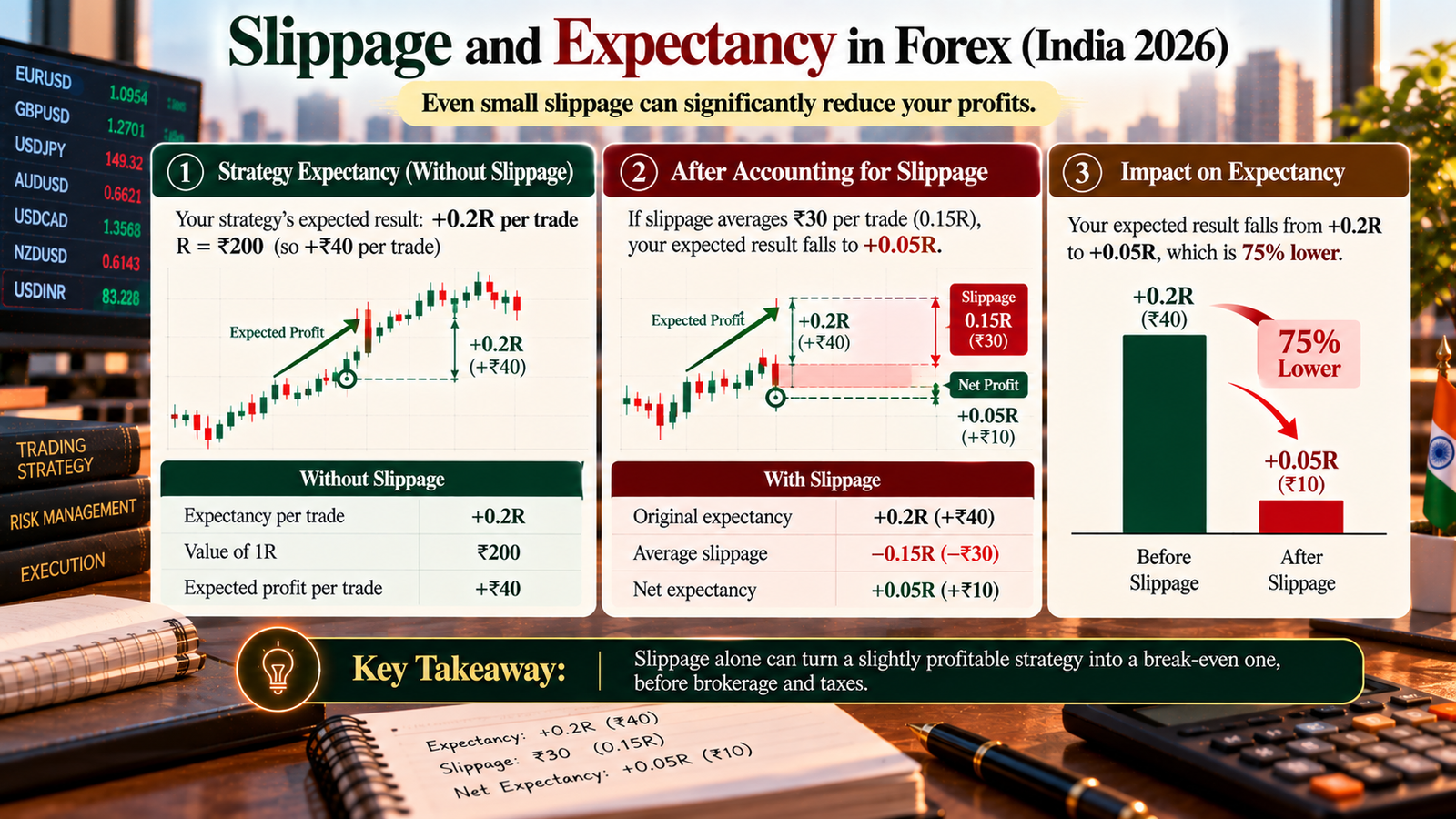
Suppose your strategy’s expected result is +0.2R per trade, where R is ₹200 (so +₹40 per trade). If slippage averages ₹30 per trade (0.15R), your expected result falls to +0.05R, which is 75% lower. Slippage alone can turn a slightly profitable strategy into a break-even one, before brokerage and taxes.
Example 3: over a year
If you average ₹25 of slippage per round trip on 2 lots, across 100 trades, that’s 100 × 2 × ₹25 = ₹5,000 a year. It’s easy to miss, because it never shows up as a separate charge.
How to reduce slippage
- Use limit orders for entries and profit targets where missing a fill is acceptable.
- Avoid trading in the minutes around major data releases unless your plan requires it. Check the economic calendar first.
- Trade liquid contracts and hours. On NSE, the near-month USD/INR contract usually has the most volume.
- Size sensibly. Large orders relative to available volume slip more.
- Leave room between the trigger and limit on stop-loss orders so they can fill in fast markets.
- Build slippage into position sizing. For example, assume your stop may fill a few ticks worse and size so that the worse fill still fits your risk limit.
- Record expected vs actual fills in your journal to measure your real average slippage.
- On global dealer platforms, check execution policies, including requotes, slippage handling and whether price improvement is passed on. Remember that resident Indians may trade forex only through permitted exchange-traded products in India.
Expert analysis
Fact: Slippage occurs when orders fill at a different price from the one expected, typically in fast or thin markets. Market orders and triggered stop orders are exposed to it; limit orders are not, but may not fill. Requotes occur on some dealer platforms that use instant execution, not on exchange order books such as NSE.
Analysis: Slippage is best understood as the price of certainty. When you insist on getting filled now (market order) or on getting out at all costs (stop-loss market), you accept whatever price the market offers. When you insist on a price (limit order), you accept that you may not get filled. Neither choice is free. The skill is choosing which risk matters more for each order.
Opinion: Beginners should treat slippage as a normal cost, not a scam, but they should measure it. A few trades with slippage are expected. Consistently large slippage, or slippage that only ever goes against you on a dealer platform, is worth investigating. For Indian traders, exchange-traded futures offer a transparent order book, which makes slippage easier to understand and audit.
Common mistakes
- Assuming a stop-loss guarantees the exit price. It doesn’t in fast markets or gaps.
- Using market orders around major news. That’s when spreads widen and slippage is largest.
- Setting a stop-limit with no room. A small gap can leave you unfilled and still in a losing trade.
- Ignoring slippage in position sizing. Your real risk per trade is slightly larger than your planned risk.
- Chasing requotes. Accepting worse and worse prices to get in usually leads to poor entries.
- Blaming every slip on the broker. Most slippage comes from market conditions; measure before concluding.
- Not tracking slippage. Without a record of expected vs actual fills, you can’t see what it costs.
Myths vs facts
| Myth | Fact |
|---|---|
| “Slippage is always negative.” | It can be positive when the market moves in your favour before execution. |
| “Slippage means my broker is cheating.” | It usually reflects fast markets or thin liquidity. Persistent one-way slippage is worth checking. |
| “Limit orders have slippage too.” | A limit order fills only at your price or better. The risk is not getting filled, not a worse price. |
| “Requotes happen on NSE.” | Exchange order books don’t requote; orders fill against available orders or wait in the book. |
| “A few paise of slippage doesn’t matter.” | It adds up. ₹25 per round trip on 2 lots over 100 trades is ₹5,000. |
Key takeaways
- Slippage is the difference between the expected price and the actual fill price. It can be negative or positive.
- It’s caused by fast markets, thin liquidity, order size and gaps.
- Market orders and triggered stops can slip; limit orders can’t slip against you but may not fill.
- Requotes happen on some dealer platforms with instant execution, not on exchange order books.
- On NSE USD/INR futures, each paisa of slippage costs ₹10 per lot.
- Reduce slippage with limit orders, avoiding news spikes, trading liquid contracts, and leaving room on stop-limits. Track it in your journal.
FAQs
- What is slippage in forex? The difference between the price you expected for an order and the price at which it actually filled.
- What causes slippage? Fast-moving prices, thin liquidity, large order size, price gaps, and to a lesser extent, delays in order transmission.
- Is slippage always bad? No. Positive slippage gives you a better price than expected. Negative slippage gives you a worse one.
- What is a requote? On some dealer platforms using instant execution, if the price changes before your order fills, you’re offered the new price to accept or reject instead of being filled automatically.
- What is the difference between slippage and a requote? With slippage, your order fills at a different price automatically. With a requote, you’re asked to approve the new price first.
- Do NSE currency futures have requotes? No. Orders go into the exchange order book and either match with available orders or wait there.
- Why did my stop-loss fill at a worse price? Price moved past your trigger faster than orders could fill at that level, often due to news, low liquidity or a gap.
- Can limit orders slip? Not against you. A limit order fills only at your price or better, but it may not fill at all.
- What is the difference between market execution and instant execution? Market execution fills at the best available price, so slippage is possible. Instant execution tries to fill at the requested price and may requote if it has changed.
- How much does slippage cost on USD/INR futures? Each 1 paisa (₹0.01) of slippage costs ₹10 per lot, because one NSE lot is $1,000.
- When is slippage most likely? Around major economic releases, central bank announcements, market opens, sudden news and periods of low liquidity.
- How can I reduce slippage? Use limit orders where possible, avoid trading right around big news, trade liquid contracts, size sensibly, and leave room on stop-limit orders.
- Should I use SL or SL-M orders? An SL (stop-limit) controls the price but may not fill in a fast move. An SL-M (stop-market), where available, is more likely to fill but can slip further. Many traders prefer certainty of exit for protective stops.
- Does slippage affect my position size? It should. Your real loss on a stop can exceed your planned risk, so allow a small buffer when calculating size.
- How do I measure my slippage? In your trading journal, record the expected price (trigger or quoted) and the actual fill for each order, then average the difference.
- Is slippage a sign of a bad broker? Not by itself. Occasional slippage is normal. Consistently large or one-directional slippage on a dealer platform deserves a closer look at its execution policy.
- Can I trade on offshore platforms to avoid slippage? Resident Indians may trade forex only in permitted pairs on recognised Indian exchanges through SEBI-registered brokers. Offshore leveraged platforms aren’t permitted, and they don’t eliminate slippage anyway.