

Quick answer
Yes. Forex trading income is taxable in India – profit from exchange-traded currency derivatives is generally non-speculative business income, added to your total income and taxed at your slab rate. It’s taxable regardless of how small the profit is, and even offshore (illegal) gains are taxable, though that activity separately breaches FEMA.
Introduction
It’s the question every new trader eventually asks, usually after a good month: is forex trading taxable in India, or is a bit of trading profit something the tax department overlooks? The answer is clearer – and stricter – than many hope. Understanding whether, and when, your trading income is taxable protects you from an unpleasant surprise, because the department increasingly sees your trades in its own records.
This guide answers the taxability question directly and then handles the situations people actually worry about: small profits, losing years, offshore income and the consequences of staying quiet. For the detailed rates and filing steps, see our full forex income-tax guide. This is educational information, not tax advice – consult a chartered accountant for your own case.
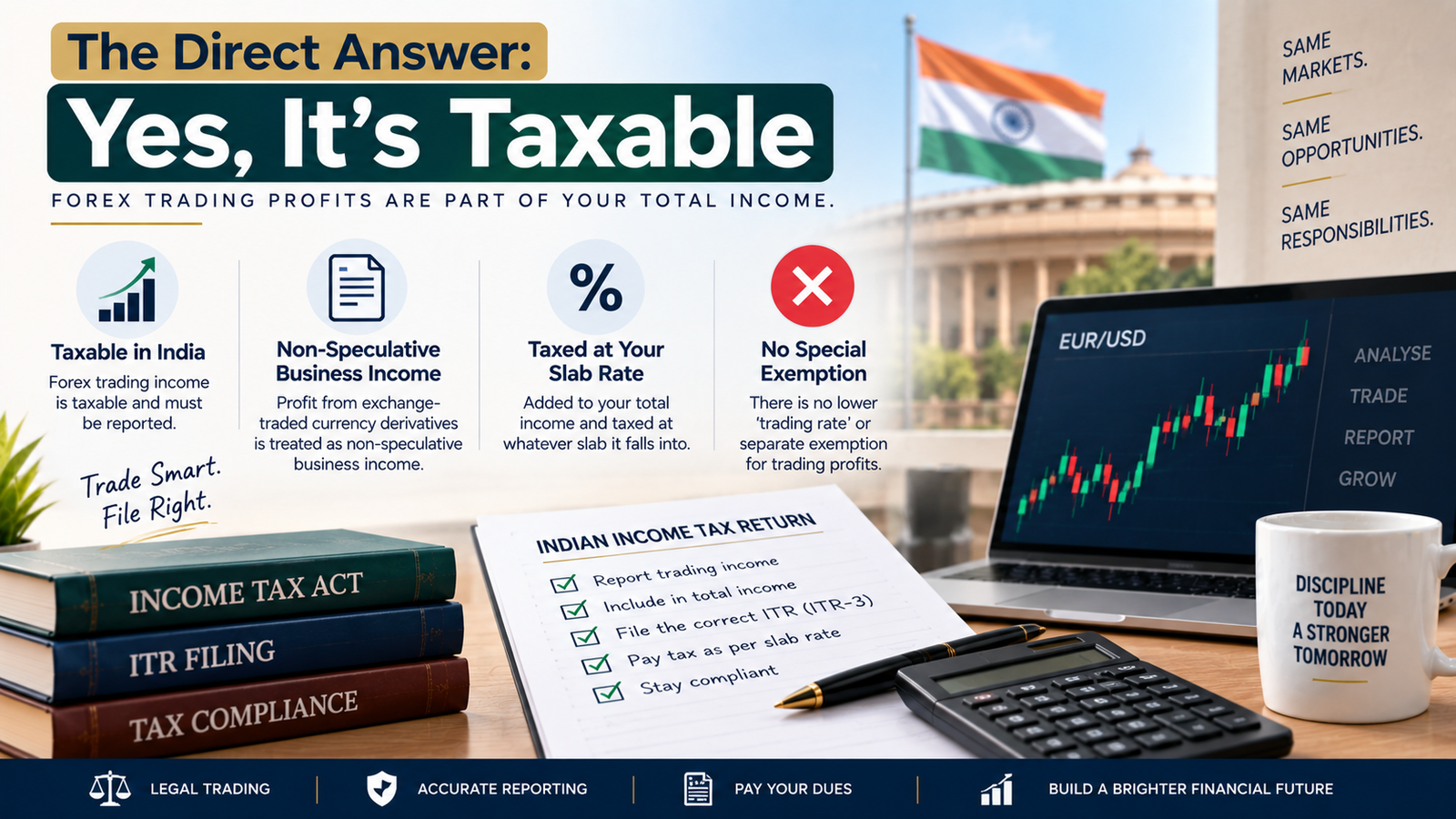
The Direct Answer: Yes, It’s Taxable
Forex trading income is taxable in India. Profit from legally traded, exchange-traded currency derivatives is treated as non-speculative business income, added to your total income and taxed at whatever slab that total falls into. There is no special exemption for trading profits and no lower ‘trading rate’ – the money simply becomes part of your taxable income for the year. So if you made money trading, that income is taxable and must be reported.
Why It’s Taxable Regardless of Amount
A common hope is that a small profit is too little to be taxable. That’s not how it works. Trading income is taxable from the first rupee of profit – what changes with the amount is only how much tax you ultimately pay, driven by your total income and slab. There’s no ‘hobby’ carve-out that makes small trading gains tax-free. If your overall income (including the trading profit) stays below the basic exemption limit, you may owe no tax – but the income is still taxable in principle and often still needs to be reported. Small doesn’t mean exempt.
How Is It Classified?
The taxability flows from the classification. Currency-derivative profit is business income – specifically non-speculative business income – not capital gains and not a special flat rate. That means it’s taxed at slab rates and reported on ITR-3, and it also means trading losses get the favourable eight-year carry-forward. (Our full tax guide covers the slab structure, audit and computation in detail.)
Is Offshore (Illegal) Forex Income Taxable?
This one surprises people: yes, even income from offshore forex platforms is taxable – income is taxable in India whether or not it was earned legally. But two things must be said clearly. First, the taxability doesn’t legalise the activity: using offshore forex platforms is a FEMA contravention regardless of whether you pay tax on the gains. Second, reporting income from an illegal source can itself invite scrutiny. So the answer isn’t to declare offshore gains and carry on – it’s to move to the legal exchange route, where the income is taxable in the normal, clean way and you’re not also breaching FEMA.
Is It Taxable If I Only Traded Once, or Made a Tiny Profit?
Yes. The classification as business income depends on the nature of the activity, not the frequency – even a single currency-derivative trade produces business income. A tiny profit is still taxable income; whether you actually pay tax depends on your total income and slab, but the profit doesn’t disappear from the tax net just because it was small or occasional. Report it, and let the slab maths determine the tax.
Is It Taxable If I Made a Loss?
If you made a net loss, there’s no tax to pay on it – but you should still report it, and here’s why it pays to. Non-speculative trading losses can be set off against most other income (except salary) in the same year, and carried forward for eight years to offset future business income – but only if you file your return on time. Skipping the filing in a loss year forfeits a valuable future tax benefit. So even with nothing to pay, filing a loss return is the financially smart move.
What Happens If You Don’t Report It?
Not reporting taxable trading income is a growing risk, because the tax department can already see much of it. The likely consequences:
- AIS mismatch and notices – your broker reports your trades, which appear in your Annual Information Statement; unreported income triggers questions.
- Penalties and interest – under-reporting or non-reporting attracts penalties and interest on the unpaid tax.
- Prosecution risk – wilful evasion of tax can, in serious cases, lead to prosecution.
- FEMA exposure too – if the income came from offshore forex, you also face FEMA consequences on top of the tax issue.
The safe course is simple: report your trading income (or loss) accurately and on time. It’s far cheaper than explaining an omission later.
When Might You Owe No Tax?
There are situations where forex income is taxable in principle but you end up paying little or nothing:
- Total income below the basic exemption limit – if your whole income for the year is under the threshold, there may be no tax, though filing can still be advisable.
- A net trading loss – no tax on a loss, but report it to carry it forward.
- Rebate under the applicable regime – a rebate can make income up to a threshold effectively tax-free; confirm the current threshold.
None of these make the income ‘not taxable’ as a category – they simply mean your particular tax works out to nil. The reporting obligation can still apply.

Compliance Checklist
- Treat trading profit as taxable income – from the first rupee, as business income.
- Report it on ITR-3 – even a small or one-off profit belongs on your return.
- File a loss return too – to preserve the 8-year carry-forward.
- Reconcile with your AIS – so your figures match what the department already sees.
- Use the legal route and a CA – trade on Indian exchanges and get professional help for filing.
Common Misconceptions
- ‘Small forex profits aren’t taxable.’ – They’re taxable from the first rupee; only the tax amount varies.
- ‘Offshore forex income isn’t taxable since it’s illegal.’ – It is taxable, and the activity still breaches FEMA.
- ‘A one-off trade isn’t business income.’ – It is; classification depends on nature, not frequency.
- ‘No tax means no need to file.’ – You may still need to file, especially to carry forward a loss.
- ‘The department won’t know.’ – Brokers report to the AIS; unreported income is easily flagged.
Myths vs Facts
| Myth | Fact |
|---|---|
| Forex trading income isn’t taxable. | It is – generally as non-speculative business income at slab rates. |
| Small or occasional profit is exempt. | Taxable from the first rupee; the tax amount depends on your slab. |
| Losses mean you can skip filing. | File a loss return to preserve the 8-year carry-forward. |
| Offshore forex income is untaxable. | It’s taxable, and using such platforms also breaches FEMA. |
Tax disclaimer
This article is for educational purposes only and is not tax, legal or investment advice. Tax rules, thresholds, rebates and reporting requirements change with every Budget, and the new Income-tax Act, 2025 applies from FY 2026-27. Individual situations vary. Details here were checked against 2026 sources but may since have changed. Always verify current rules with the Income Tax Department and consult a qualified chartered accountant.
Learn more about LRS Limit for Forex Trading
Expert Analysis
The reason the ‘is forex trading taxable in India?’ question keeps recurring is that new traders confuse two different ideas – whether income is taxable, and whether they will actually owe tax on it. Those are separate questions. Trading income is taxable as a category from the first rupee, but whether you pay depends on your total income, slab and any rebate. The mistake that costs people is collapsing the two: assuming that because a small profit produces little or no tax, it therefore isn’t taxable and needn’t be reported. In an era where brokers report every trade to the department’s records, that assumption is not just wrong but risky – the income is visible whether or not you declare it.
The subtler and more important point concerns offshore trading, where taxability is often misread as either a loophole or an amnesty. It is neither. Income earned illegally is still taxable, which surprises traders who assumed illegality put their gains outside the tax net – but paying tax on those gains does nothing to cure the underlying FEMA breach, and voluntarily surfacing income from a prohibited activity can draw exactly the scrutiny one hoped to avoid. The clean resolution is structural rather than clever: trade on the legal, exchange-traded route, where the income is ordinary taxable business income reported in the normal way, and the whole activity sits inside the law. A trader who internalises that trading income is always taxable, that reporting is non-negotiable regardless of amount, and that the legal route makes tax simple rather than fraught, has resolved the question for good.
Key Takeaways
- Yes – forex trading income is taxable in India, generally as non-speculative business income at slab rates.
- It’s taxable from the first rupee; small or one-off profits are not exempt.
- Offshore forex gains are taxable too – but the activity still breaches FEMA.
- A loss isn’t taxed, but report it to preserve the 8-year carry-forward.
- Not reporting risks AIS notices, penalties, interest and prosecution – report accurately and on time.
Frequently Asked Questions (FAQ)
Q: Is forex trading taxable in India?
A: Yes. Profit from exchange-traded currency derivatives is generally non-speculative business income, added to your total income and taxed at your slab rate.
Q: Is small forex profit taxable?
A: Yes, from the first rupee. Whether you actually pay tax depends on your total income and slab, but the profit is taxable and usually reportable.
Q: Is a one-off forex trade taxable?
A: Yes. The classification as business income depends on the nature of the activity, not the frequency, so even a single trade produces taxable income.
Q: Is offshore forex income taxable in India?
A: Yes – income is taxable whether or not earned legally. But using offshore platforms is a FEMA breach, so move to the legal exchange route.
Q: Do I pay tax if I made a forex loss?
A: No tax on a loss, but you should still file to set it off and carry it forward for eight years against future business income.
Q: What tax rate applies to forex profit?
A: Your applicable income-tax slab rate, because it’s business income added to your total income – not a special or flat rate.
Q: Which ITR form reports forex income?
A: ITR-3, the return for business or professional income, since currency-derivative profit is business income.
Q: What happens if I don’t report forex income?
A: Your broker reports trades to the AIS, so unreported income can trigger notices, penalties, interest and, in serious cases, prosecution.
Q: Is there a minimum amount below which forex income isn’t taxed?
A: No hobby exemption applies; income is taxable from the first rupee, though your total income may fall below the basic exemption limit.
Q: Do I have to file if I only made a small profit?
A: Often yes – filing may be required based on your total income and to report the business income correctly; check your obligation.
Q: Are forex trading losses useful for tax?
A: Yes. Non-speculative losses can offset most income (not salary) and carry forward eight years, if you file on time.
Q: Is currency-derivative income capital gains?
A: No. It’s business income; a derivatives contract isn’t a capital asset, so it’s never taxed as capital gains.
Q: Does the tax department know about my trades?
A: Largely yes – brokers report transactions to your AIS, so trading activity is visible to the department.
Q: Can I be prosecuted for not reporting?
A: Wilful tax evasion can, in serious cases, lead to prosecution, on top of penalties and interest – so report accurately.
Q: Where can I learn the exact tax computation?
A: See our full forex income-tax guide for slab rates, audit thresholds and step-by-step filing; and consult a chartered accountant.