
Introduction
Two traders can use the same chart, the same indicator and the same broker, and get completely different results. Usually the difference isn’t the strategy. It’s how they think about risk, losses and uncertainty, and the habits that follow. That’s what people mean by a trading mindset: a way of thinking that treats trading as a probability business run with rules, rather than a series of bets driven by hope and fear.
Quick answer: A professional trading mindset means thinking in probabilities (any single trade can lose), judging yourself on process rather than outcome, putting risk before reward, and following routines even when you don’t feel like it. Amateurs focus on the next trade’s profit, change strategies after losses, risk too much and trade on impulse. You build a pro mindset through habits: a written plan, fixed risk per trade, a pre-trade checklist, a journal and regular reviews.
Why this matters in India
- Fact: SEBI found that over 91% of individual equity F&O traders made net losses in FY25.
- Fact: In the equity cash segment, 71% of individual intraday traders made net losses in FY23, rising to 80% among those making more than 500 trades a year.
- Analysis: SEBI’s data doesn’t measure mindset directly, but the patterns it highlights, such as heavy trading and losses concentrated among frequent traders, are what amateur habits tend to produce.

“Professional” here means professional habits, not a job title. Anyone can adopt them, starting with their next trade.
Pro vs amateur habits
| Area | Amateur habit | Professional habit |
|---|---|---|
| Focus | “How much can I make?” | “How much can I lose, and is the trade worth it?” |
| Single trade | Expects it to win | Knows any single trade can lose |
| Judging results | By today’s P&L | By rule adherence and expectancy over many trades |
| Plan | In their head, changes often | Written, tested, changed only after review |
| Position size | Varies with mood and conviction | Fixed % risk per trade |
| Stop-loss | Optional, moved when hit | Placed at entry, never widened |
| After a loss | Revenge trades or quits | Journals it and takes the next valid setup |
| After a win | Sizes up, skips rules | Same size, same checklist |
| Trade frequency | Trades from boredom or FOMO | Waits for defined setups |
| Learning | Hunts for a new indicator | Reviews journal data |
| Information | Tips, signals, social media | Own tested process plus the economic calendar |
| Platform (India) | Offshore apps with high leverage | Permitted pairs on NSE/BSE via a SEBI-registered broker |
Four core mindset principles
1. Think in probabilities
No setup wins every time. A professional expects losses as a normal cost of doing business, the way a shop expects some stock to go unsold. What matters is whether wins outweigh losses over many trades.
2. Judge process, not outcome
Fact: In a 1988 study, Baron and Hershey found that people rated the same decision as better when it happened to turn out well and worse when it turned out badly, an effect known as outcome bias. A large online replication with 692 participants, published in the International Review of Social Psychology, confirmed the effect, even among participants who said outcomes shouldn’t influence their judgement.
Application: a trade that followed every rule and lost was a good trade. A trade that broke rules and won was a bad trade that got lucky. Score both honestly in your journal.
3. Risk first, reward second
Professionals decide how much they’re willing to lose before thinking about profit. Fixed risk per trade, stops at entry and daily loss limits keep any one mistake from becoming a disaster.
4. Consistency beats intensity
Fact: Barber and Odean’s study of 66,465 US households (1991–1996) found that those who traded most earned 11.4% a year against the market’s 17.9%. They linked excessive trading to overconfidence.
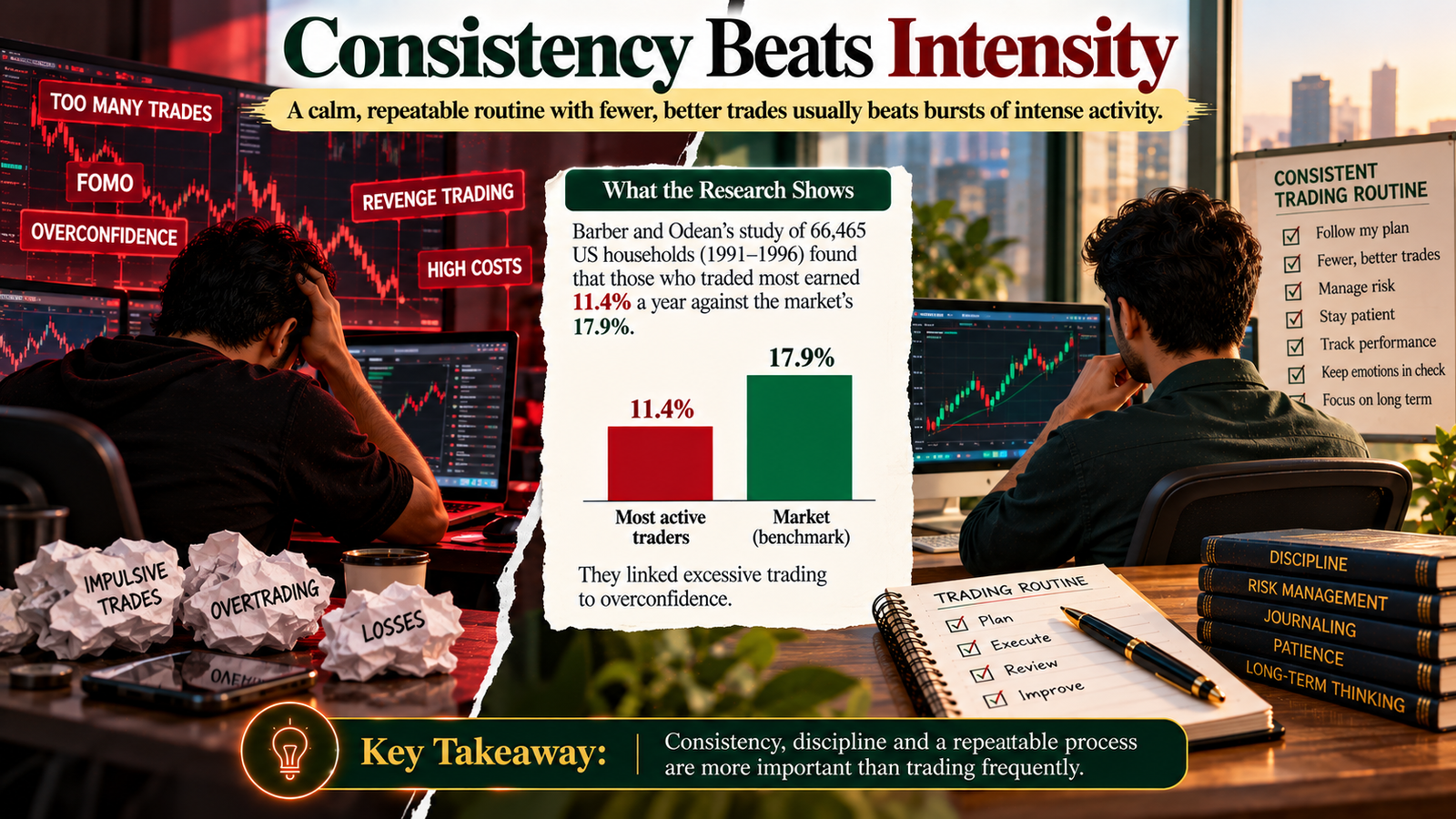
Application: a calm, repeatable routine with fewer, better trades usually beats bursts of intense activity.
Probabilistic thinking in numbers (illustrative)
Imagine a strategy that wins 40% of the time, makes 2R on winners and loses 1R on losers. Its expectancy is +0.2R per trade: 0.4 × 2 − 0.6 × 1. Over time, that’s a profitable strategy. But look at what it can feel like along the way.
| Question | Probability |
|---|---|
| At least one run of 5 straight losses within 20 trades | About 48% |
| At least one run of 5 straight losses within 100 trades | About 98% |
| Net loss after the first 10 trades | About 38% |
| Net loss after the first 20 trades | About 25% |
Calculated assuming independent trades with a 40% win rate and 2R wins vs 1R losses.
What this means: even a genuinely profitable strategy has roughly a one-in-four chance of being down after 20 trades, and a losing run of five is almost certain over 100 trades. An amateur abandons the strategy during those stretches. A professional expects them and keeps executing, while reviewing whether the rules are actually being followed.
Same trade, different outcomes
| Trade | Followed rules? | Result | Amateur verdict | Professional verdict |
|---|---|---|---|---|
| A | Yes | −1R | “Bad trade” | Good trade, normal loss |
| B | No (no stop, oversized) | +3R | “Great trade” | Bad trade, lucky outcome |
| C | Yes | +2R | “Good trade” | Good trade |
| D | No (revenge entry) | −2.5R | “Bad luck” | Bad trade; fix the behaviour |
The professional-minded trader’s routine
| When | Habit |
|---|---|
| Before the session | Read your rules; check the economic calendar; set daily loss limit and max trades |
| Before each trade | Checklist; stop and target set; size from fixed % risk; one-word emotion check |
| During the trade | Alerts, not tick-watching; no stop changes except by plan |
| After each trade | Journal: setup, R result, rules followed, lesson |
| End of day | Stop if limits hit; short reflection |
| Weekly | Review expectancy, adherence and biggest mistake; pick one improvement |
| Monthly | Compare rule-following vs rule-breaking trades; review sizing only on data |
A 30-day mindset plan
| Week | Focus | Action |
|---|---|---|
| 1 | Rules | Write a one-page plan; set risk per trade (e.g. 0.5–1%) and a daily loss limit |
| 2 | Routine | Use the checklist and journal on every trade, including practice trades |
| 3 | Process scoring | Score each trade on rule adherence as well as result; note outcome bias |
| 4 | Review | Review all trades; calculate adherence; choose one habit to improve next month |
The aim of the first month isn’t profit. It’s to make professional habits automatic.
Expert analysis
Fact: People tend to judge decisions by their outcomes even when the decision process was identical (outcome bias), a finding replicated with a large online sample. Heavy trading has been linked to lower returns among individual investors. SEBI’s data shows most individual F&O and intraday traders in India lose money.
Analysis: A trading mindset is less about personality and more about measurement. When you measure the right things (rule adherence, expectancy over large samples, drawdown), you naturally think like a professional. When you measure only today’s P&L, you naturally think like an amateur, because short-term outcomes are dominated by randomness, as the probability table shows.
Opinion: The fastest way for a beginner to change mindset is to change their scorecard. Start grading every trade on whether you followed the plan, and make that the number you care about for the first few months. Profit becomes a lagging result of good process, if the strategy has an edge. If it doesn’t, good process shows you that cheaply.
Learn more about Common Forex Trading Mistakes Beginners Make
Common mistakes
- Treating each trade as a test of your ability. One trade is mostly noise.
- Changing strategy after a short losing run. Losing runs are expected even for profitable systems.
- Calling rule-breaking wins “good trades”. That rewards bad habits.
- Copying pros’ tactics without their risk rules. Their stop-losses and sizing matter more than their entries.
- Letting mood set position size.
- Consuming endless content instead of reviewing your own data.
- Believing mindset alone creates profit. Mindset helps you execute an edge; it doesn’t replace one.
Myths vs facts
| Myth | Fact |
|---|---|
| “Pros rarely lose.” | Professionals lose often; they keep losses small and planned. |
| “A good trade is one that makes money.” | A good trade follows your plan. Outcome and decision quality are different things. |
| “Mindset is something you’re born with.” | It’s built through habits: rules, checklists, journals and reviews. |
| “If I lose five in a row, my strategy is broken.” | A profitable 40%-win strategy has about a 98% chance of a five-loss run within 100 trades. |
| “Positive thinking is the key to a trading mindset.” | Realistic thinking about risk and probability matters more than optimism. |
Key takeaways
- A trading mindset is thinking in probabilities, judging process over outcome, and putting risk first.
- Professionals and amateurs often differ more in habits (sizing, stops, journaling, reviews) than in strategy.
- Outcome bias makes us judge decisions by results; score trades on rule adherence instead.
- Losing runs are normal even for profitable strategies; judge performance over large samples.
- Build the mindset with routines: a written plan, checklist, fixed risk, journal and weekly review.
- In India, pair a pro mindset with regulated trading: permitted pairs on NSE/BSE through SEBI-registered brokers.
FAQs
- What is a trading mindset? A way of thinking that treats trading as a probability business: expecting losses, focusing on process and risk, and following rules consistently.
- How do professional traders think differently from amateurs? Professionals think in probabilities, put risk first, and judge themselves on process over many trades. Amateurs focus on the next trade’s profit and react emotionally to outcomes.
- How do I develop a trading mindset? Write a plan, fix your risk per trade, use a checklist, journal every trade, and review weekly. Habits shape mindset over time.
- What is outcome bias? Judging a decision by its result rather than by the quality of the decision itself. Research by Baron and Hershey (1988), later replicated, documented it.
- Why is thinking in probabilities important? Because any single trade can lose. Thinking in probabilities helps you accept losses and focus on results over many trades.
- Is a losing streak a sign my strategy doesn’t work? Not necessarily. A strategy winning 40% of the time with 2R wins has about a 98% chance of a five-loss run within 100 trades.
- How many trades before I judge my strategy? Often 50–100 or more, taken consistently. After 20 trades, even a profitable strategy in our example has about a 25% chance of showing a net loss.
- What habits do successful traders have? Fixed risk per trade, stops at entry, pre-trade checklists, journaling, regular reviews and patience with setups.
- Can mindset make a bad strategy profitable? No. Mindset helps you execute a strategy well; the strategy still needs a genuine edge.
- How do I stop judging myself on daily P&L? Score each trade on rule adherence and track expectancy over many trades. Make adherence your main daily metric.
- What is a good daily routine for traders? Review rules and the calendar before the session, use a checklist before each trade, journal after each trade, and stop when limits are hit.
- Should I read more trading books to improve my mindset? Learning helps, but reviewing your own journal data usually changes behaviour more.
- How do professionals handle losses? They keep losses small and planned, record them, and take the next valid setup without changing size or rules emotionally.
- Is positive thinking important in trading? Realistic thinking matters more. Confidence should come from tested process and data, not optimism.
- How long does it take to build a trading mindset? Habits take weeks to months to become automatic. A 30-day plan is a good start, not an end point.
- Do Indian traders need a different mindset? The principles are universal. In India, add regulatory discipline: trade only permitted pairs on NSE or BSE via SEBI-registered brokers.
- What’s the single most important mindset shift? Moving from “How much can I make on this trade?” to “Did I follow my process, and how much am I risking?”