Introduction
Your plan says to exit at the stop. But the screen shows −₹3,400, you think of what that money could have paid for, and suddenly you’re moving the stop “just a little”. Or you’re up ₹5,000 and grab the profit early because losing it would feel awful. This is what happens when money, not the plan, drives decisions. Learning emotional detachment in trading doesn’t mean becoming a robot. It means building a process where feelings don’t get to make the decisions.
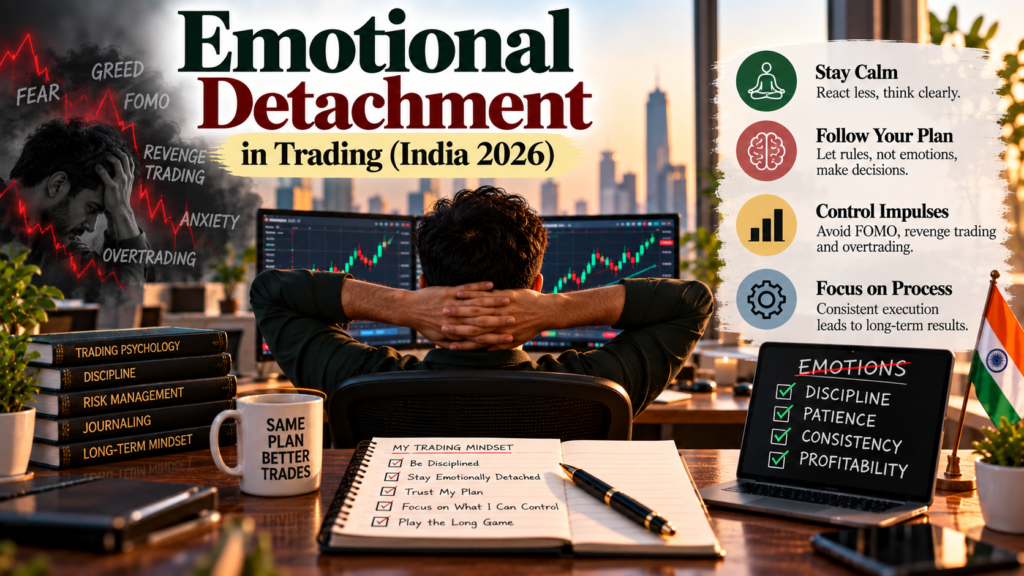
Quick answer: You can’t switch off emotions, but you can stop them controlling your trades. Size positions so a loss is small enough not to sting (often 0.5–1% of capital), think and record results in R (multiples of your risk) rather than rupees, set stops and targets before entry, hide the live P&L, follow a checklist, and name your emotions when they show up. If trading consistently causes distress, reduce size or take a break.
Why this matters
- Fact: Research on decision-making shows that losses tend to feel more intense than equal-sized gains. This is called loss aversion.
- Fact: SEBI found that over 91% of individual equity F&O traders made net losses in FY25.
- Analysis: Emotional decisions, such as moving stops, revenge trading and exiting winners early, are among the most common ways a reasonable plan turns into losses. Detachment is a risk-management skill, not just a mindset.
Why money triggers such strong emotions
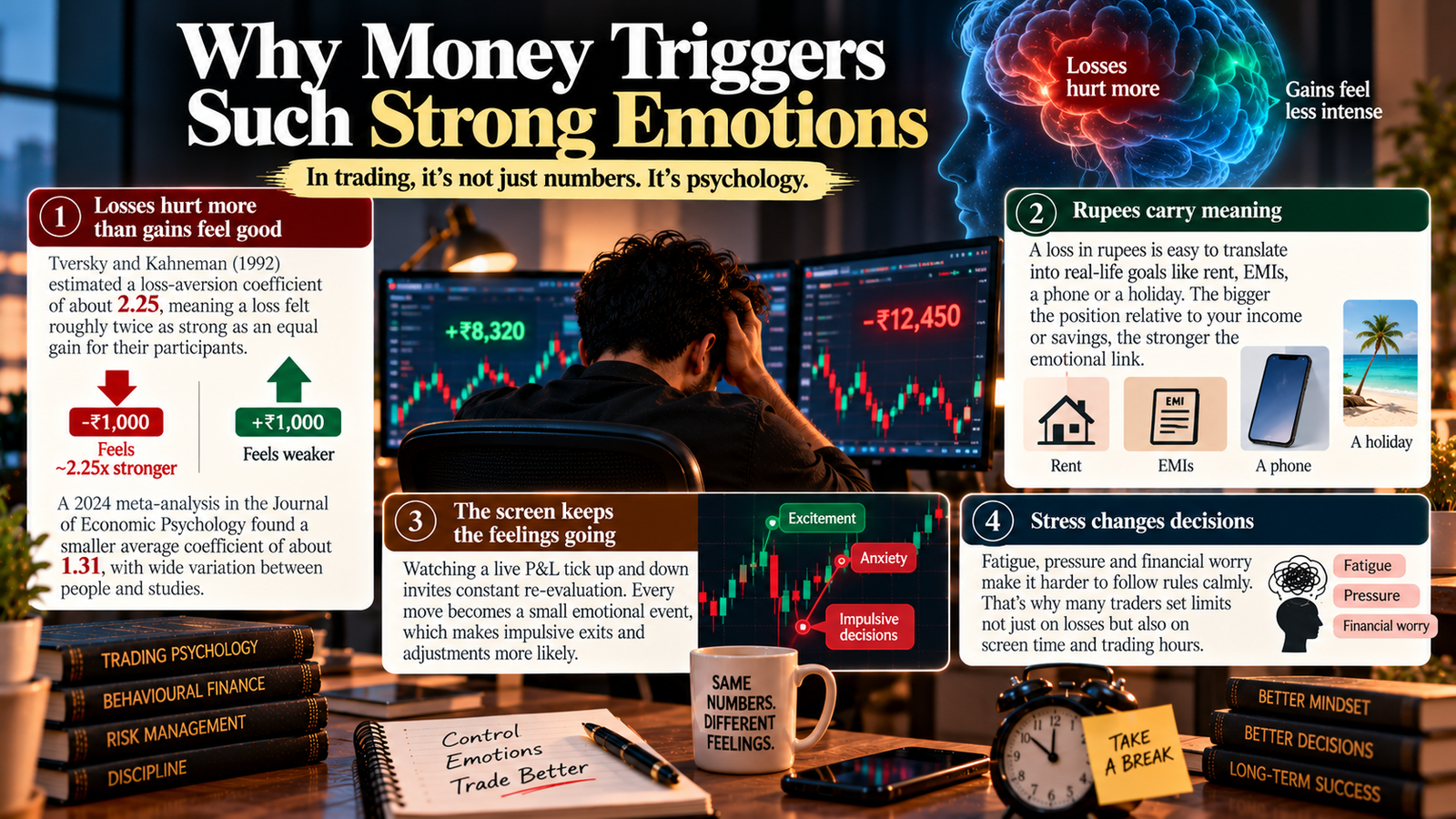
1. Losses hurt more than gains feel good
Fact: In their 1992 work on cumulative prospect theory, Tversky and Kahneman estimated a loss-aversion coefficient of about 2.25, meaning a loss felt roughly twice as strong as an equal gain for their participants.
Fact: A 2024 meta-analysis in the Journal of Economic Psychology pooled 19 datasets from 17 articles on risky choices and found a smaller average coefficient of about 1.31, with wide variation between people and studies.
Analysis: The exact number is debated, but the direction is consistent enough to matter: for many people, losing ₹1,000 hurts more than gaining ₹1,000 pleases. In trading, that pushes you to avoid taking losses (moving stops, holding losers) and to grab gains too soon.
2. Rupees carry meaning
A loss shown in rupees is easy to translate into rent, EMIs, a phone or a holiday. That mental link makes the number feel personal. The bigger the position relative to your income or savings, the stronger the link.
3. The screen keeps the feelings going
Watching a live P&L tick up and down invites constant re-evaluation. Every move becomes a small emotional event, which makes impulsive exits and adjustments more likely.
4. Stress changes decisions
Fatigue, pressure and financial worry make it harder to follow rules calmly. That’s why many traders set limits not just on losses but also on screen time and trading hours.
Detachment vs indifference
| Healthy detachment | Unhealthy indifference | |
|---|---|---|
| Attitude to losses | Expected and accepted within limits | Ignored; no limits |
| Position size | Small enough that losses don’t sting | Oversized because “money doesn’t matter” |
| Emotions | Noticed and named, then set aside | Suppressed or denied |
| Decisions | Made in advance by the plan | Made carelessly |
| Review | Regular, honest journal review | Little reflection |
The goal: care deeply about your process and be relatively calm about any single trade’s outcome.
8 techniques for emotional detachment
1. Size so losses don’t sting
The single most effective technique. If a loss would change your mood for the rest of the day, your size is too big.
Worked example (illustrative): five losses in a row, a normal streak for many strategies, at different risk levels.
| Risk per trade | Drawdown after 5 straight losses | On ₹1,00,000 |
|---|---|---|
| 0.5% | 2.48% | About ₹2,480 |
| 1% | 4.90% | About ₹4,900 |
| 2% | 9.61% | About ₹9,610 |
| 5% | 22.62% | About ₹22,620 |
Compounded on the remaining balance after each loss.
At 0.5–1%, a bad streak is uncomfortable but manageable. At 5%, it’s more than a fifth of the account, and emotions usually take over.
2. Think and record in R, not rupees
R is the amount you risk on a trade. A ₹500 risk that ends at −₹500 is −1R; a ₹1,000 gain is +2R. Recording results in R keeps attention on whether you followed the plan, and makes trades of different sizes comparable.
3. Decide everything before you enter
Set entry, stop, target and size in advance, and place the stop with the order. Decisions made calmly before the trade are harder to override under pressure.
4. Hide or ignore the live P&L
Some platforms let you hide or collapse the P&L column; if yours doesn’t, close the positions window after placing your orders. Use price alerts at your stop and target rather than watching every tick.
5. Use a pre-trade checklist
A short checklist (setup valid? stop placed? size correct? within daily limit? calm?) turns the entry into a routine rather than an emotional decision.
6. Name the emotion
Fact: In a 2007 brain-imaging study, Lieberman and colleagues found that putting feelings into words (“affect labeling”) reduced activity in the amygdala, a region linked to emotional responses, compared with other ways of processing the same images.
Application: when you notice a strong urge, write one word in your journal (“anxious”, “angry”, “greedy”) before acting. It creates a pause between the feeling and the click.
7. Set hard stopping rules
A daily loss limit (e.g. 2% or two full losses) and a rule to stop after a big win to journal first. These rules act when your judgement is most at risk.
8. Build a routine around the screen
Fixed trading hours, breaks, and a post-session review limit the number of emotional moments per day. Trading when tired or distracted makes detachment much harder.
Before and during a trade: a quick routine
| When | What to do |
|---|---|
| Before the session | Read your rules; set daily loss limit; check the calendar |
| Before each entry | Checklist; decide stop, target and size; note your emotion in one word |
| During the trade | Alerts on; P&L hidden or in points; no stop changes except by plan |
| After the exit | Record result in R and whether rules were followed |
| End of day | Short review; stop if limits were hit |
When to step away
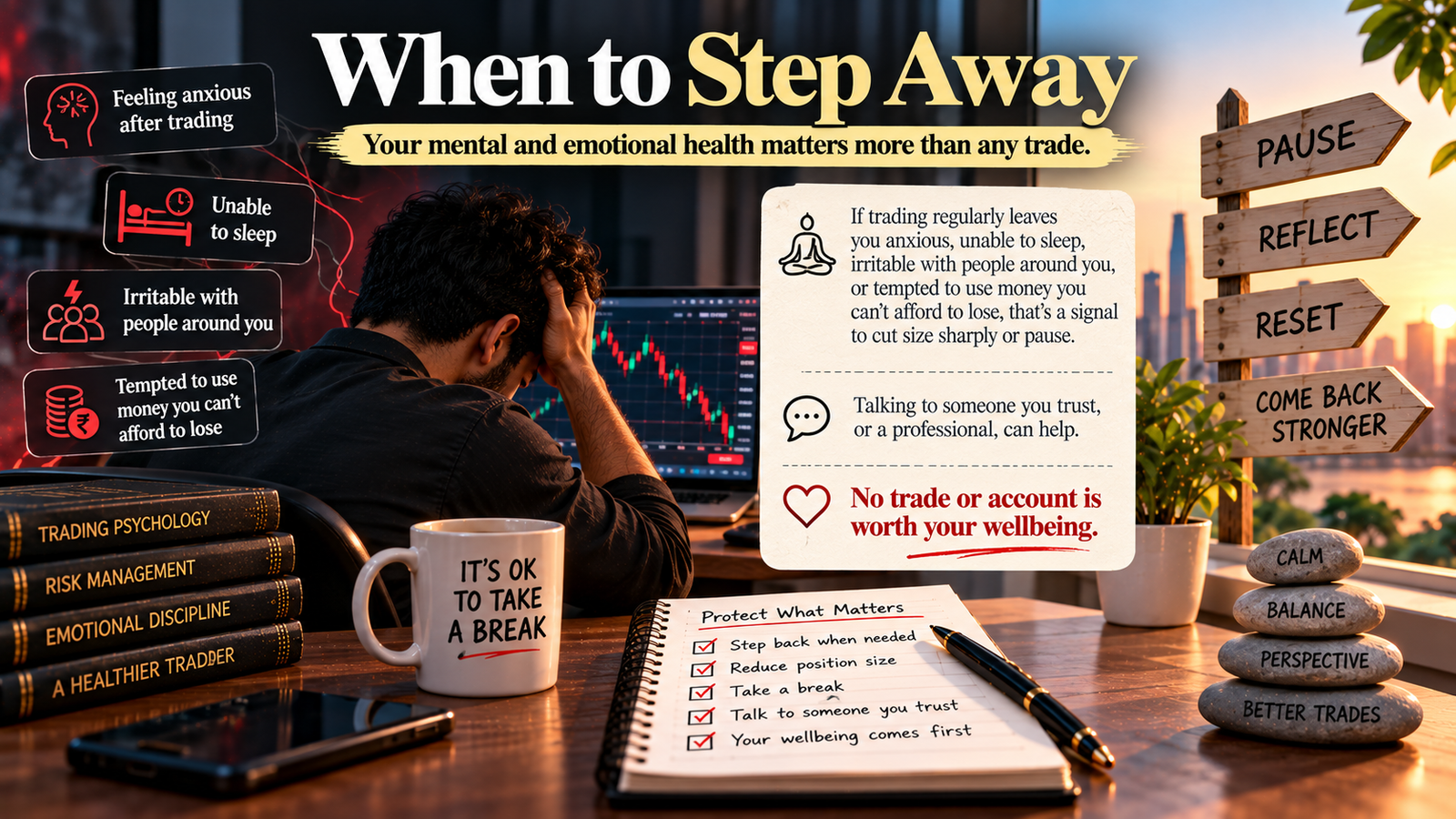
If trading regularly leaves you anxious, unable to sleep, irritable with people around you, or tempted to use money you can’t afford to lose, that’s a signal to cut size sharply or pause. Talking to someone you trust, or a professional, can help. No trade or account is worth your wellbeing.
Expert analysis
Fact: Loss aversion is a well-documented tendency, though estimates vary. Tversky and Kahneman’s classic figure was about 2.25; a 2024 meta-analysis found about 1.31 on average, with wide variation. Brain-imaging research has found that naming emotions can dampen activity in areas linked to emotional responses.
Analysis: Emotional detachment is mostly a design problem, not a willpower problem. The more decisions you leave to the moment, and the larger the money at stake, the more emotions will steer. Small position size, pre-set exits and R-based records remove most of those in-the-moment decisions.
Opinion: Beginners often try to “feel less” by force. It rarely works. A better approach is to make each trade small enough that feelings stay manageable, then gradually increase size only as your process proves robust. If trading still feels like a constant emotional rollercoaster at small size, that’s useful information too.
Learn more about Realistic Trading Returns for Beginners
Common mistakes
- Trying to suppress emotions instead of noticing and naming them.
- Trading size that affects your lifestyle, which guarantees emotional decisions.
- Watching every tick of the P&L.
- Deciding exits during the trade instead of before it.
- Measuring success in rupees only, which ties self-worth to each outcome.
- Trading when tired, upset or distracted.
- Using money needed for bills, EMIs or emergencies.
- Ignoring signs of distress and pushing on.
Myths vs facts
| Myth | Fact |
|---|---|
| “Good traders feel no emotions.” | Most traders feel emotions; the difference is having a process that stops emotions from making decisions. |
| “Detachment means not caring about money.” | It means caring about process and risk limits, while accepting that single trades will sometimes lose. |
| “Losses and gains feel the same once you’re experienced.” | Loss aversion is a common human tendency; experience helps manage it, not erase it. |
| “Bigger size makes you more focused.” | Bigger size usually increases stress and emotional errors. |
| “Checking P&L often keeps you in control.” | Constant checking invites impulsive changes to a planned trade. |
Key takeaways
- You can’t switch off emotions, but you can stop them making trading decisions.
- Losses often feel stronger than equal gains (loss aversion), pushing traders to move stops and exit winners early.
- Size so a loss doesn’t sting, often around 0.5–1% of capital per trade.
- Record results in R, set exits before entry, hide live P&L and use alerts.
- Name your emotions, follow a checklist and set hard stopping rules.
- If trading harms your sleep, relationships or finances, cut size or take a break.
FAQs
- What is emotional detachment in trading? Making trading decisions based on your plan rather than on how a gain or loss makes you feel in the moment.
- Can you trade without emotions? Not entirely. The practical goal is to stop emotions from making decisions, using small size, pre-set exits and routines.
- Why do trading losses hurt so much? Many people experience losses more intensely than equal gains, a tendency called loss aversion. Rupee losses also connect to real-life spending, which makes them feel personal.
- What is loss aversion? The tendency for a loss to feel stronger than a gain of the same size. Estimates vary, from about 2.25 in classic research to about 1.31 in a 2024 meta-analysis.
- How does position size affect emotions? Larger positions make each move feel bigger, increasing stress and impulsive decisions. Smaller size keeps emotions manageable.
- How much should I risk to stay calm? Many traders use 0.5–1% of capital per trade. A good test: if a loss would ruin your day, reduce size.
- What does “think in R” mean? Measuring each trade in multiples of the amount you risked, for example −1R or +2R, instead of rupees. It keeps focus on the process.
- Should I hide my P&L while trading? Many traders find it helps. Use price alerts at your stop and target, and review results after the trade closes.
- What is affect labeling? Naming an emotion in words. Research has linked it to reduced activity in brain areas associated with emotional responses.
- How do I stop moving my stop-loss? Place the stop with the entry order, decide in advance that it only moves in your favour by plan, and avoid watching every tick.
- How do I handle the urge to revenge trade? Set a daily loss limit and a rule to stop after two consecutive losses. Write down the emotion before any new trade.
- Is it OK to feel anxious when trading? Some nerves are normal. Constant anxiety is a sign your size is too big or trading is affecting your wellbeing.
- Does experience remove emotions? Experience helps you manage emotions and recognise patterns, but most traders still feel them.
- Should I trade with money I need? No. Using money for bills, EMIs or emergencies greatly increases pressure and emotional decisions.
- How can a trading journal help with emotions? Recording your emotion before and after each trade reveals patterns, such as losses after boredom or anger.
- When should I take a break from trading? When you hit your loss limits, feel persistently stressed, can’t sleep, or notice trading affecting relationships or finances.
- Does emotional detachment guarantee profits? No. It helps you follow your plan, but profitability also depends on having an edge and managing costs.