
Most intraday mistakes are made before the first trade. A trader sees a red GIFT Nifty, reads a forward predicting a crash, and places a market order at 9:15 AM without checking the F&O ban list, the results calendar or how much capital is at risk. A pre-market routine exists to stop that sequence.
This guide gives Indian equity and F&O traders a practical trading checklist for the hours before the NSE and BSE open. It covers what to check the evening before, what to read in the morning, how the 9:00 AM pre-open auction now works after the NSE changes of September 2026, and how to turn all of it into a written plan with fixed risk.
What Is a Pre-Market Trading Checklist?
A pre-market trading checklist is a fixed list of checks a trader completes before the market opens at 9:15 AM IST. It typically covers overnight global cues, GIFT Nifty, institutional flows, India VIX, scheduled events, stock-specific news and restrictions, key price levels, position size, and available margin. Its purpose is to decide in advance what you will trade, how much you will risk, and when you will not trade at all.
Why Indian Traders Need a Written Routine
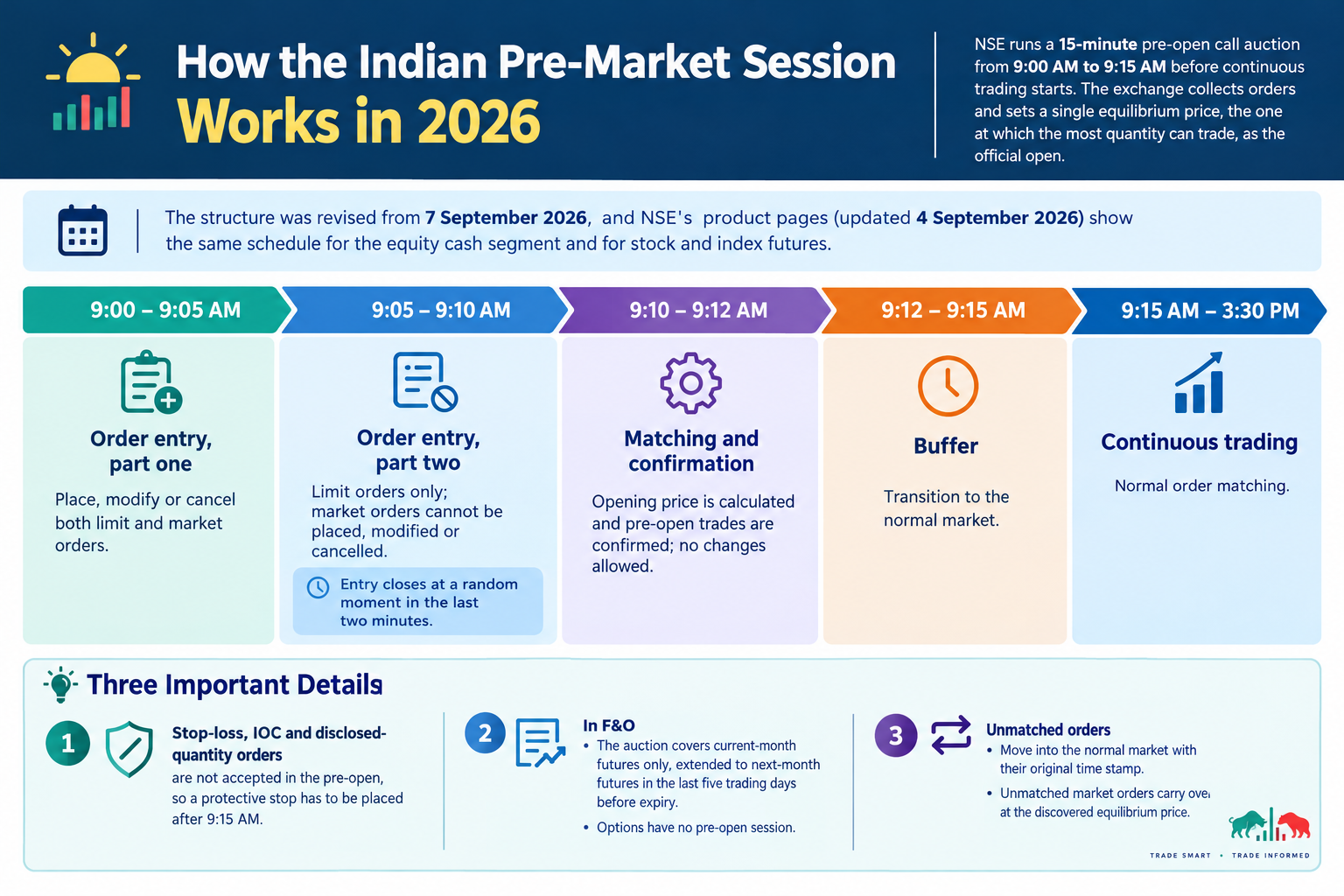
SEBI’s own research shows how difficult short-term derivatives trading is for individuals. Its study on the profitability of individual traders, published on 20 August 2026, found that 87.7% of individual traders in the equity derivatives segment made net losses in FY26, and that aggregate net losses were about ₹91,685 crore. Transaction costs alone were close to ₹25,000 crore during the year, and options accounted for roughly 92% of individual losses.
The companion study on trading behaviour found that about 90% of traders who lost money in each of the two previous years lost again in the following year. More experience did not automatically produce better results.
A checklist cannot change those odds on its own. What it can do is remove avoidable errors: trading a stock you are not allowed to add positions in, ignoring a scheduled RBI announcement, sizing a position by feel, or reacting to an opening gap without a plan.
How the Indian Pre-Market Session Works in 2026
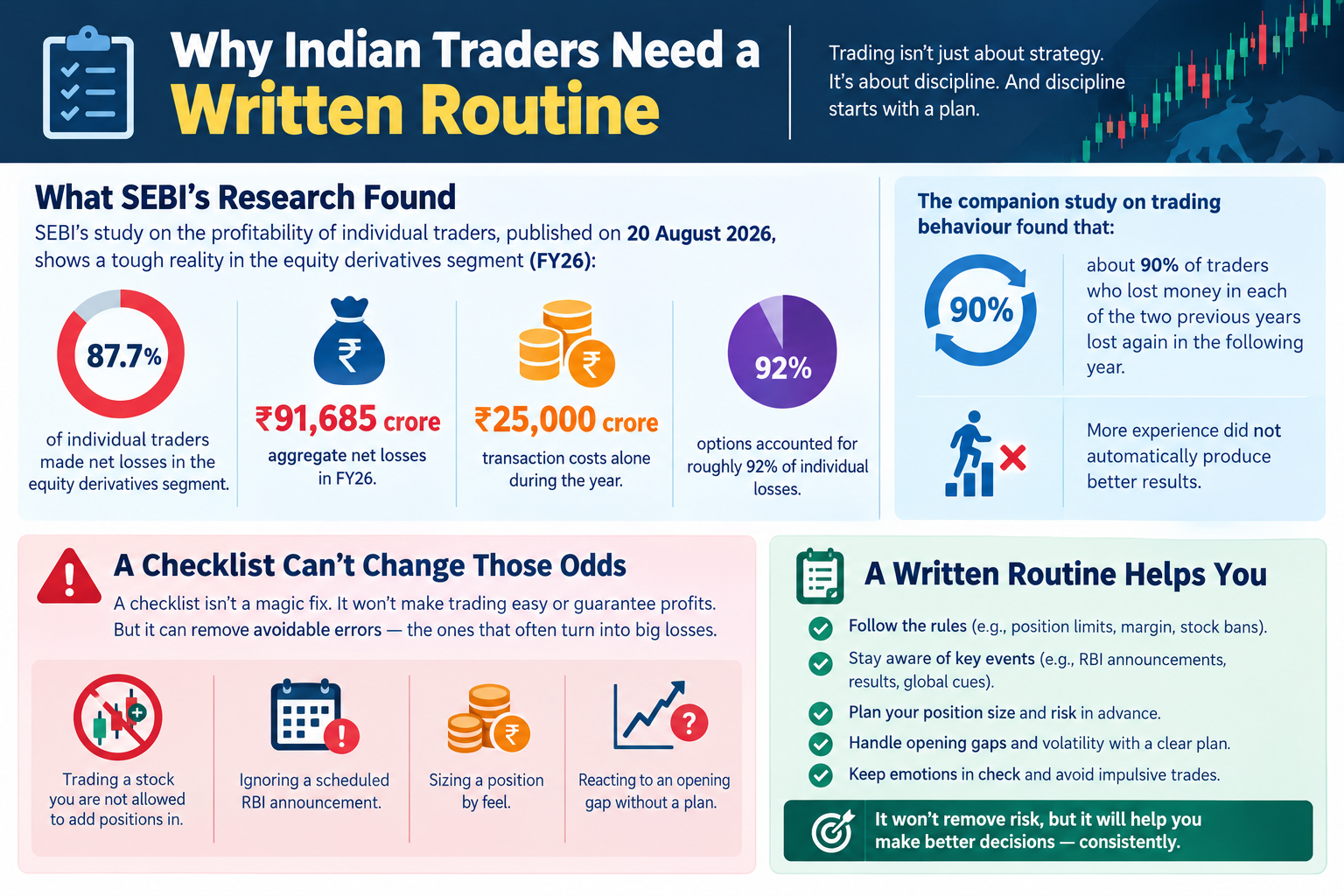
NSE runs a 15-minute pre-open call auction from 9:00 AM to 9:15 AM before continuous trading starts. The exchange collects orders and sets a single equilibrium price, the one at which the most quantity can trade, as the official open.
The structure was revised from 7 September 2026, and NSE’s product pages (updated 4 September 2026) show the same schedule for the equity cash segment and for stock and index futures:
| Time (IST) | Phase | What you can do |
|---|---|---|
| 9:00 to 9:05 AM | Order entry, part one | Place, modify or cancel both limit and market orders |
| 9:05 to 9:10 AM | Order entry, part two | Limit orders only; market orders cannot be placed, modified or cancelled. Entry closes at a random moment in the last two minutes |
| 9:10 to 9:12 AM | Matching and confirmation | Opening price is calculated and pre-open trades are confirmed; no changes allowed |
| 9:12 to 9:15 AM | Buffer | Transition to the normal market |
| 9:15 AM to 3:30 PM | Continuous trading | Normal order matching |
Three details matter for your routine. First, stop-loss, IOC and disclosed-quantity orders are not accepted in the pre-open, so a protective stop has to be placed after 9:15 AM. Second, in F&O the auction covers current-month futures only, extended to next-month futures in the last five trading days before expiry; options have no pre-open session. Third, unmatched orders move into the normal market with their original time stamp, and unmatched market orders carry over at the discovered equilibrium price.
The 12-Point Pre-Market Trading Checklist
The checklist is grouped into four time windows. Keep the order: information first, plan second, execution last.
The Evening Before (After 6 PM)
- Review the previous session. Read your trading journal first. Note which trades followed your plan and whether you hit a daily loss limit. If you broke your own rules yesterday, decide now whether tomorrow is a reduced-size day or a no-trade day.
- Check provisional FII and DII data. NSE publishes provisional cash-market figures for foreign and domestic institutional investors on its website every trading evening. These numbers are backward-looking and get revised, so a single day means little. Track the running weekly or monthly total, and read both lines together: heavy foreign selling absorbed by steady domestic buying describes a different market from selling by both groups.
- Scan corporate events and the F&O ban list. Check NSE’s corporate filings for results, board meetings, dividends, splits and bonus issues in the stocks on your watchlist. Then check the ban list. A single-stock derivative enters the ban period when market-wide open interest crosses 95% of its market-wide position limit (MWPL), and normal trading resumes only after it falls below 80%. Under SEBI’s revised framework, which uses delta-based future-equivalent open interest, any trading in a banned stock must reduce your net position by the end of the day. Index derivatives are not subject to this ban, and the stock itself can still be traded in the cash market.
Early Morning (7:00 to 8:45 AM)
- Read overnight global cues. Note how US indices closed, how Asian markets are trading, and where Brent crude, the US 10-year Treasury yield and the US dollar are moving. Focus on events likely to carry into the Indian open, such as a surprise US inflation print.
- Check GIFT Nifty. GIFT Nifty contracts trade on NSE International Exchange in GIFT City for close to 21 hours a day, so they reflect overnight global news before the Indian market opens. Compare the latest GIFT Nifty level with the previous Nifty 50 close to estimate the likely gap. Treat it as a probability indicator, not a forecast: it trades in US dollars with a different set of participants, and the domestic open can differ from it.
- Confirm the event calendar. List every scheduled event for the day: RBI Monetary Policy Committee announcements, CPI or GDP releases from MoSPI, major US data, weekly or monthly F&O expiry, and large IPO listings. On event days, many disciplined traders cut size or wait until after the announcement.
- Read India VIX and estimate the expected range. India VIX measures the expected volatility of the Nifty 50 over the next 30 calendar days, expressed as an annualised percentage. You can convert it into an approximate one-day range:
Expected one-day move (%) = India VIX ÷ √252
Hypothetical example: if India VIX is 14 and Nifty 50 closed at 25,000, the expected one-day move is 14 ÷ 15.87 ≈ 0.88%, or roughly 220 points either side. This is a one-standard-deviation estimate, so moves beyond it happen regularly. Use it to set realistic stop distances and targets, not to predict direction.
Final Preparation (8:45 to 9:00 AM)
- Mark key levels. On each watchlist chart, mark the previous day’s high, low and close, recent swing highs and lows, and any round-number levels with heavy option open interest. Three to five clear levels are more useful than twenty lines.
- Write the trade plan and calculate position size. For every potential trade, write the setup, entry trigger, stop-loss, target and the condition that cancels the idea. Then size the position from your risk limit, not from available margin:
Position size (shares) = (Capital × Risk per trade %) ÷ (Entry price − Stop-loss price)
Hypothetical example: with trading capital of ₹5,00,000 and a 1% risk limit, the maximum loss per trade is ₹5,000. For a planned entry at ₹1,200 with a stop at ₹1,176, the risk per share is ₹24, so the position is 5,000 ÷ 24 ≈ 208 shares, worth about ₹2,49,600. Brokerage, STT, exchange charges, GST, stamp duty and slippage add to the real loss if the stop is hit, so build a small buffer into the stop or the size.
For futures and options, the same logic applies to lots. If one lot at your planned stop would lose more than your risk limit, the trade is too large for your account and should be skipped.
- Check funds, margin and the platform. Confirm that funds or pledged collateral cover the margin for your planned positions, and that your app, connection and backup device work. Pre-open orders are checked for margin before they are accepted, so an underfunded order will simply be rejected.
The Pre-Open Window (9:00 to 9:15 AM)
- Watch the indicative opening prices. NSE displays the indicative equilibrium price, the tradable quantity and the buy-sell imbalance during order entry. A large imbalance at a price far from the previous close signals a volatile open. Remember that market orders are only accepted until 9:05 AM, and that entry closes at a random moment between 9:08 and 9:10 AM.
- Make the go or no-go decision. Before 9:15 AM, compare the expected open with your plan. If the gap has already moved price through your entry or beyond your target, the original setup is void. Many traders also wait out the first 15 minutes, when spreads are often wider. Write down the decision, including a decision not to trade.
Printable Pre-Market Checklist
| Time | Check | Where to verify |
|---|---|---|
| After 6 PM | Journal review, FII/DII data, corporate actions, F&O ban list | Your journal, NSE reports, NSE corporate filings |
| 7:00 to 8:45 AM | Global markets, GIFT Nifty, event calendar, India VIX | NSE IX, RBI, MoSPI, NSE |
| 8:45 to 9:00 AM | Key levels, written plan, position size, margin and platform | Charts, broker terminal |
| 9:00 to 9:15 AM | Indicative open, imbalance, final go or no-go | NSE pre-open market data |
Common Pre-Market Mistakes to Avoid
- Treating GIFT Nifty as a guaranteed opening level and placing market orders on that assumption.
- Placing a stop-loss order in the pre-open, where it is not accepted, and believing the position is protected.
- Sizing positions from available margin instead of a fixed rupee risk.
- Ignoring transaction costs, which SEBI’s FY26 data shows turned many gross profits into net losses.
- Changing the plan after 9:15 AM because of the first few candles.
Frequently Asked Questions
What time does the pre-market session start in India?
The NSE and BSE pre-open session runs from 9:00 AM to 9:15 AM IST. Order entry runs from 9:00 AM until a random close between 9:08 and 9:10 AM, followed by matching and a buffer before normal trading begins at 9:15 AM.
Can I place a stop-loss order in the pre-open session?
No. NSE does not accept stop-loss, IOC or disclosed-quantity orders during the pre-open. Place your protective stop once continuous trading starts at 9:15 AM.
Is GIFT Nifty an accurate predictor of the Nifty 50 open?
It is a useful indication of overnight sentiment, but not a precise forecast. Differences in trading hours, participants and currency mean the actual Nifty 50 open can differ from GIFT Nifty.
Do options trade in the pre-open session?
No. In equity derivatives, the pre-open auction applies to current-month stock and index futures, and to next-month futures during the last five trading days before expiry. Options start trading at 9:15 AM.
How much should I risk per trade?
There is no single correct figure. Many traders cap risk at 0.5% to 2% of trading capital per trade so that a run of losses does not wipe out the account. Pick one limit and size every trade from it.
Conclusion
A pre-market trading checklist turns the hour before 9:15 AM into a decision process instead of a reaction to headlines. The evening review catches restrictions and events, the morning checks frame the likely open and volatility, and the final steps fix your entry, stop and size before price starts moving. Print the table above, use it every trading day for a month, and record in your journal where it changed your decisions.
Disclaimer
This article is for educational purposes only and does not constitute investment, trading, tax or legal advice. Trading in equities and derivatives involves substantial risk of loss, including the use of leverage. Examples are hypothetical and do not represent actual or expected results. Exchange rules and SEBI regulations change; verify current rules on official NSE, BSE and SEBI websites and consult a SEBI-registered investment adviser before making financial decisions.