Introduction
Trading looks like freedom from the outside: no boss, flexible hours and the chance to earn from anywhere. In reality, it can be one of the most mentally demanding jobs there is. Traders make high-pressure decisions with real money, deal with constant uncertainty and face losses that feel personal.
Over time, that pressure can lead to trade burnout, a state of mental and emotional exhaustion that drains motivation, damages decision-making and can destroy a trading account. Many traders do not notice it until their results, health or relationships are already suffering.
This guide explains:
- What trade burnout is and why traders are vulnerable
- The warning signs to look for
- The most common causes
- A practical plan to recover
- Habits that help prevent burnout in the future
What Is Trade Burnout?
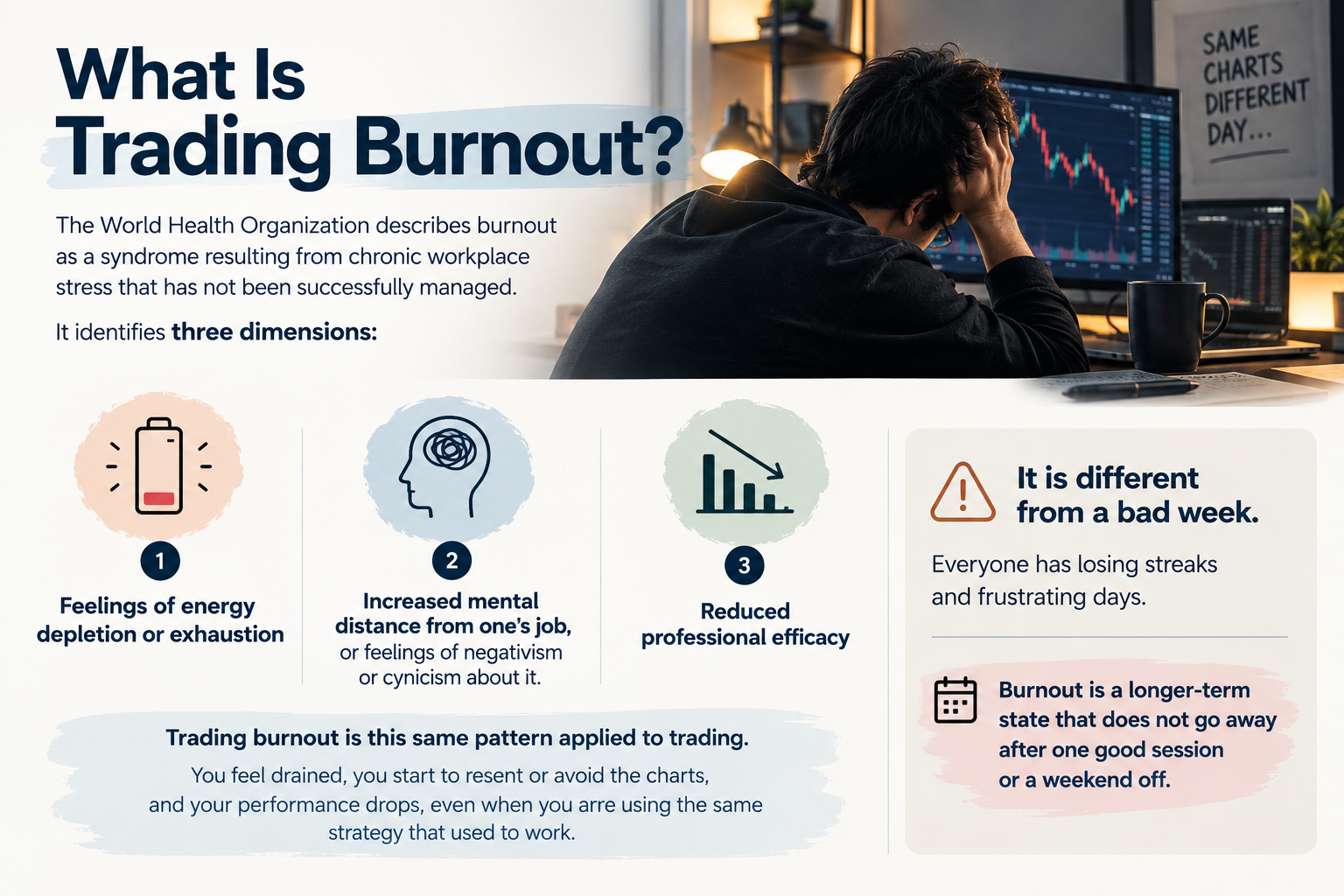
The World Health Organization describes burnout as a syndrome resulting from chronic workplace stress that has not been successfully managed. It identifies three dimensions:
- Feelings of energy depletion or exhaustion
- Increased mental distance from one’s job, or feelings of negativism or cynicism about it
- Reduced professional efficacy
Trade burnout is this same pattern applied to trading. You feel drained, you start to resent or avoid the charts, and your performance drops, even when you are using the same strategy that used to work.
It is different from a bad week. Everyone has losing streaks and frustrating days. Burnout is a longer-term state that does not go away after one good session or a weekend off.
Why Traders Are Prone to Burnout
Several features of trading make burnout more likely than in many other jobs:
- Constant uncertainty: No matter how good your analysis is, the outcome of any single trade is unknown.
- Money on the line: Losses are immediate and visible, which makes stress feel personal.
- Markets that never close: Forex and crypto trade almost around the clock, so there is always another opportunity to chase.
- Isolation: Many retail traders work alone, without colleagues to share the load.
- Screen time: Hours of watching charts lead to mental fatigue.
- Results-based identity: Many traders tie their self-worth to their profit and loss.
For Indian traders, time zones add another layer. Following the London and New York sessions can mean trading late into the evening or night, often after a full day of other work. That combination is a common path to trade burnout.
Warning Signs of Trade Burnout
Burnout builds slowly, so it helps to know the signs early. They fall into three broad groups.
Emotional signs
- Feeling drained before the session even starts
- Dreading opening your trading platform
- Irritability, frustration or anger after small losses
- Cynicism about trading, the markets or your own ability
- Loss of the excitement or curiosity you once had
Behavioural signs
- Overtrading or taking setups outside your plan
- Revenge trading after losses
- Skipping your pre-market routine or trade journal
- Avoiding trading altogether, or procrastinating on reviews
- Checking prices constantly, even when not in a trade
Physical signs
- Poor sleep or trouble switching off at night
- Tiredness that does not improve with rest
- Headaches, eye strain or tension
- Changes in appetite
- Getting less exercise and spending more time at a screen
If you recognise several of these, especially across more than one group, you may be dealing with trade burnout rather than ordinary frustration.

Common Causes of Trade Burnout
1. Trading too much
Watching too many markets or sessions, or simply spending too many hours at the screen, wears down attention. Decision fatigue sets in, and the quality of each decision falls.
2. Unrealistic expectations
Expecting to double an account quickly or replace a salary within months creates constant pressure. When reality falls short, frustration builds.
3. Poor risk management
Risking too much per trade makes every position emotionally heavy. Large swings in your account are exhausting to live with.
4. Long losing streaks
Drawdowns are normal, but a long period of losses without a clear plan to handle them can erode confidence and energy.
5. No boundaries
Trading on your phone in bed, during meals or on holiday means you never truly rest. Without boundaries, trading can take over your life.
6. Lack of support
Trading alone without anyone to talk to about wins, losses or doubts makes stress harder to process.
How Trade Burnout Hurts Your Results
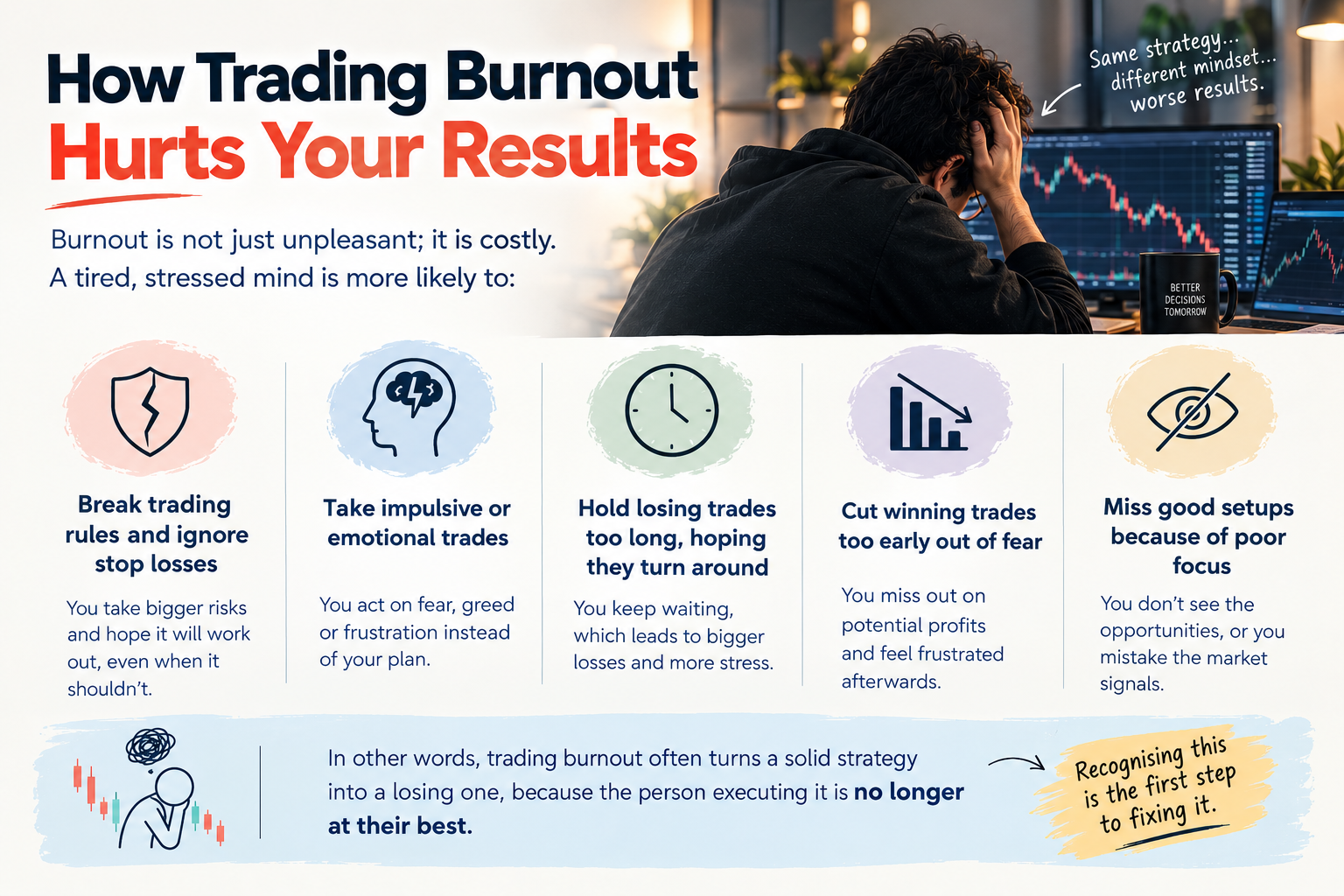
Burnout is not just unpleasant; it is costly. A tired, stressed mind is more likely to:
- Break trading rules and ignore stop losses
- Take impulsive or emotional trades
- Hold losing trades too long, hoping they turn around
- Cut winning trades too early out of fear
- Miss good setups because of poor focus
In other words, trade burnout often turns a solid strategy into a losing one, because the person executing it is no longer at their best. Recognising this is the first step to fixing it.
How to Recover From Trade Burnout
Recovery takes time, but a clear plan helps. These steps work for many traders.
Step 1: Take a real break
The most effective first step is usually stepping away. Close your positions, log out of your platform and remove trading apps from your phone for a set period, such as a few days to two weeks. Tell yourself the break is part of your trading plan, not a failure.
Step 2: Rest and rebuild your basics
Use the break to focus on sleep, regular meals, movement and time outdoors. These basics have a large effect on mood and focus. Reconnect with friends, family and hobbies that have nothing to do with markets.
Step 3: Review without judgement
Once you feel calmer, look back at the period before the burnout. Ask yourself:
- How many hours was I trading each day?
- Was I following my plan, or trading on emotion?
- Was my position size too large?
- Were my goals realistic?
- What was happening in the rest of my life?
The aim is to understand what happened, not to criticise yourself.
Step 4: Reset your trading plan
Before you return, update your plan with clear limits:
- Fixed trading hours, such as one session a day
- A smaller risk per trade, such as 0.5%
- A daily and weekly loss limit
- A maximum number of trades per day
- Realistic monthly goals based on process, not profit
Step 5: Return gradually
Start with a demo account or very small size. Focus on executing your plan well rather than on making money. Increase size only when you feel steady and your results are consistent.
Step 6: Talk to someone
Sharing what you are going through with a trusted friend, family member, mentor or trading community can make a big difference. If you are struggling with persistent low mood, anxiety or stress, consider speaking to a mental health professional. In India, the government’s Tele-MANAS helpline offers free, 24×7 support on 14416.
When to seek professional help
Self-care and a break are enough for many traders, but not for everyone. Consider professional support if exhaustion, anxiety or low mood lasts for several weeks, if you are struggling to sleep most nights, if trading losses are causing serious financial or relationship problems, or if you feel unable to stop trading even when you want to. A doctor, counsellor or psychologist can help you work through these issues safely.
A Simple Trade Burnout Recovery Timeline
| Phase | Focus | Example actions |
|---|---|---|
| Week 1 | Rest | No trading, more sleep, time outdoors |
| Week 2 | Reflect | Review your journal and identify causes |
| Week 3 | Rebuild | Update your plan, set limits, demo trade |
| Week 4 onwards | Return | Trade small, follow your routine, review weekly |
This is a general guide. Some traders need more or less time, depending on how severe their burnout is.
Trade Burnout in Part-Time Traders
Part-time traders face a particular risk. Many hold a full-time job during the day and then trade the London or New York session in the evening. That means two demanding roles back to back, with little time to rest in between.
Warning signs for part-time traders include trading late into the night before work, checking positions during office hours and losing sleep over open trades. Over weeks and months, this pattern can lead to trade burnout and also hurt performance at the day job.
Some practical adjustments help:
- Trade only one session on weekdays, not several
- Use swing trading or higher timeframes, which need less screen time
- Set alerts and stop-loss orders so you do not have to watch every move
- Keep at least one or two evenings a week completely free of trading
Common Myths About Trade Burnout
- “Only beginners burn out.” Experienced and professional traders can experience burnout too, sometimes more, because of higher stakes and longer hours.
- “More screen time means more profit.” Beyond a certain point, extra hours usually lower decision quality.
- “A big win will fix it.” A single win may lift your mood briefly, but it does not address the underlying causes of trade burnout.
- “Taking a break means giving up.” Rest is part of a professional approach to trading, not a sign of weakness.
How to Prevent Trade Burnout
Prevention is easier than recovery. These habits help keep trading sustainable.
- Set trading hours: Choose specific sessions and stick to them. For many Indian traders, one focused session, such as the London open in the afternoon, is enough.
- Limit screen time: Use alerts instead of watching every tick.
- Keep risk small: Small, consistent risk makes losses easier to accept.
- Take regular breaks: Step away from the screen during the session and take days off each month.
- Focus on process: Judge each day by whether you followed your rules, not by profit.
- Exercise and sleep: Physical health supports mental resilience.
- Keep a journal: Track your mood and energy as well as your trades.
- Have a life outside trading: Hobbies, relationships and other interests reduce pressure.
- Build a support network: Connect with other traders or a mentor.
A Weekly Burnout Check-In
Ask yourself these questions every weekend:
- Did I enjoy any part of trading this week?
- Did I follow my trading plan most of the time?
- How many hours did I spend at the screen?
- How has my sleep been?
- Did I take time for rest and other interests?
If several answers worry you, treat them as an early warning and adjust your routine before trade burnout sets in.
FAQs
What is trade burnout?
It is a state of mental and emotional exhaustion caused by long-term trading stress. It usually shows up as tiredness, cynicism about trading and a drop in performance.
How do I know if I have trader burnout or just a bad week?
A bad week passes after rest or a few good trades. Burnout lasts longer, affects your energy and motivation, and often shows up in sleep, mood and behaviour as well as results.
How long does it take to recover?
It varies. Some traders feel better after a short break; others need several weeks or longer to rest, reflect and rebuild their routine.
Should I stop trading completely?
A temporary break is often helpful. Whether you return, and how, depends on your goals, finances and wellbeing.
Can I prevent burnout while still trading full-time?
Yes. Clear trading hours, small risk, regular breaks, good sleep and a life outside the markets all help.
Conclusion
Trade burnout is common, but it is not a sign of weakness or failure. It is a natural result of sustained pressure, long hours and constant uncertainty. The key is to notice the warning signs early, take a real break when you need one, and return with a plan that protects both your account and your wellbeing.
Successful trading is a long game. Traders who manage their energy, set boundaries and focus on process are more likely to stay in the game for years, and to enjoy it along the way.