

Introduction
Losses are part of trading. Every trader, from beginner to professional, has losing trades, and some have losing years. The good news is that Indian tax law does not ignore those losses. If you report them correctly, you can reduce your tax bill by setting them off against other income, and you can carry forward trading losses to future years when you make a profit.
But the rules are strict. Different types of trading losses are treated differently, and if you miss the filing deadline, you can lose the right to carry forward trading loss amounts altogether.
This guide explains:
- How trading income and losses are classified
- What “set-off” and “carry forward” mean
- The rules for F&O, intraday, and capital losses
- How long you can carry forward trading loss amounts
- Filing requirements and common mistakes
- What changed under the Income-tax Act 2025
Set-Off vs Carry Forward: The Basics
Set-off means adjusting a loss against income in the same year. For example, if you lose ₹1 lakh in F&O and earn ₹3 lakh from a side business in the same year, you may be able to set off the loss and pay tax on only ₹2 lakh.
Carry forward means taking a loss you could not fully set off this year and using it against income in future years. This is valuable for traders who have a bad year followed by a good one.
Losses are first set off within the same head of income (intra-head), then against other heads (inter-head), subject to restrictions. Anything left over may be carried forward, if the rules allow.
How Trading Income Is Classified
Before you can carry forward trading loss amounts, you need to know what type of loss you have. The classification decides the rules.
| Activity | Usual tax treatment |
|---|---|
| Futures and options (equity, currency, commodity) on recognised exchanges | Non-speculative business income or loss |
| Intraday equity trading (bought and sold the same day without delivery) | Speculative business income or loss |
| Delivery-based shares held as investment | Capital gains or losses (short-term or long-term) |
| Frequent delivery trading as a business | Can be business income, depending on facts |
| Crypto and other virtual digital assets (VDAs) | Special regime with no set-off or carry forward of losses |
Currency futures and options on NSE and BSE, such as USD/INR contracts, are generally treated as non-speculative because they are traded on a recognised exchange.

How to Set Off and Carry Forward Trading Losses From F&O
Set-off in the same year
An F&O loss can be set off against:
- Any business income, including speculative income
- Other heads, such as capital gains, rental income or interest income
But it cannot be set off against salary income. If you are a salaried employee with F&O losses, the loss can reduce your other income, but not your salary.
Carry forward
If an F&O loss is not fully set off, you can carry forward trading losses of this type for up to eight years. In future years, the carried-forward amount can only be set off against business income, not against salary or capital gains.
This eight-year window is one of the most useful rules for traders. A trader who loses heavily in one year can carry forward trading loss amounts and use them against F&O or other business profits for several years.
Carry Forward Trading Loss Rules for Intraday (Speculative) Trading
Intraday equity trading is treated as a speculative business. The rules are tighter:
- Set-off: A speculative loss can only be set off against speculative income, such as profits from other intraday trades.
- No cross set-off: You cannot use an intraday loss to reduce F&O profits, capital gains or salary.
- Carry forward: You can carry forward speculative losses for up to four years, and use them only against speculative income.
Note that the reverse works: a non-speculative (F&O) loss can be set off against speculative (intraday) income in the same year. But an intraday loss cannot reduce F&O income.
Capital Losses: Set-Off and Carry Forward
Not every trader is in business. Investors can also carry forward trading losses from delivery-based share sales, but under the capital gains rules.
If you buy and sell delivery-based shares or other capital assets as an investor, gains and losses fall under capital gains.
| Type of loss | Can be set off against | Carry forward |
|---|---|---|
| Short-term capital loss (STCL) | Short-term and long-term capital gains | 8 years |
| Long-term capital loss (LTCL) | Long-term capital gains only | 8 years |
Capital losses cannot be set off against business income, salary or any other head. They stay within the capital gains head, which means you should carry forward trading losses of this type separately from your business losses.
Summary Table: Carry Forward Trading Loss Rules
| Loss type | Set off in same year against | Carry forward period | Set off in future years against |
|---|---|---|---|
| F&O (non-speculative) | All heads except salary | 8 years | Business income only |
| Intraday (speculative) | Speculative income only | 4 years | Speculative income only |
| Short-term capital loss | STCG and LTCG | 8 years | STCG and LTCG |
| Long-term capital loss | LTCG only | 8 years | LTCG only |
| Crypto / VDA loss | Not allowed | Not allowed | Not allowed |
The Most Important Carry Forward Trading Loss Rule: File Your ITR on Time
To carry forward trading loss amounts, you must file your income tax return by the due date. Under the 1961 Act, this requirement came from section 80 read with section 139(3). If you file a belated return, you can still report the loss and set it off in the same year, but you generally lose the right to carry it forward.
Typical due dates are:
- 31 July: For most individuals whose accounts do not need a tax audit
- 31 October: For taxpayers whose accounts require a tax audit
Due dates are sometimes extended, so check the official notification each year. Many traders miss the chance to carry forward trading loss amounts simply because they file late, assuming that a loss year means no return is needed.
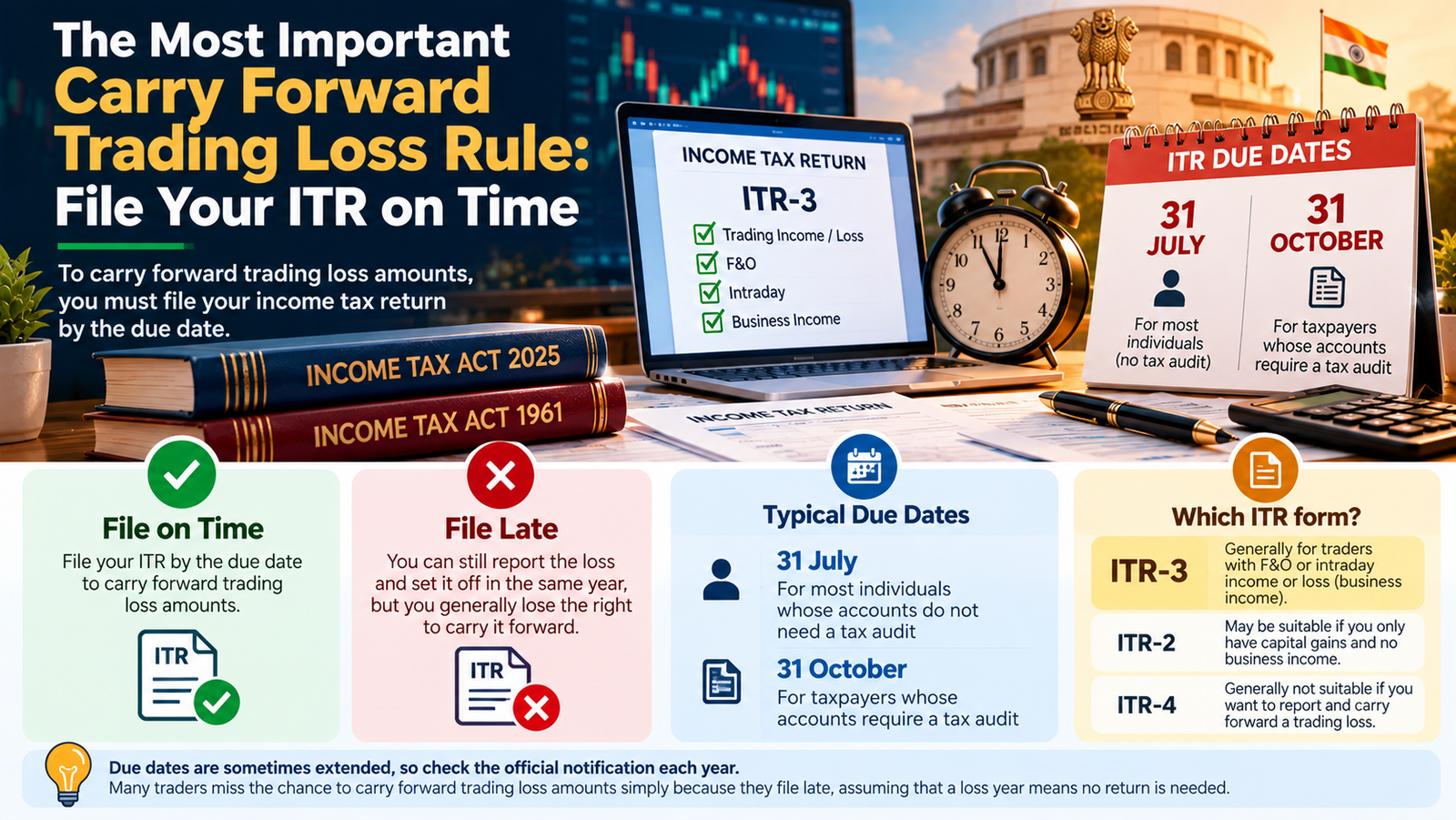
Which ITR form?
Traders with F&O or intraday income or loss generally file ITR-3, which covers income from business. ITR-2 may be suitable if you only have capital gains and no business income. Presumptive forms such as ITR-4 are generally not suitable if you want to report and carry forward a trading loss.
Do You Need a Tax Audit?
A loss alone does not automatically make a tax audit mandatory. Whether you need one depends mainly on your trading turnover and whether you have opted for presumptive taxation. For F&O, turnover is usually calculated from the absolute sum of profits and losses on each trade, not the total contract value.
The general audit threshold is ₹1 crore, which rises to ₹10 crore if cash transactions are no more than 5% of the total. Presumptive taxation rules under section 44AD can also trigger an audit in some loss cases. Speak to a chartered accountant to check your position, because an audit affects your due date, which in turn affects your ability to carry forward trading loss amounts.
What Changed Under the Income-tax Act 2025?
The Income-tax Act 2025 came into force on 1 April 2026, replacing the 1961 Act. It introduced a single “tax year” concept in place of the old “previous year” and “assessment year”. The good news for traders is that the core rules on set-off and carry forward are largely unchanged. Mainly, the section numbers have moved.
| Provision | 1961 Act | 2025 Act (as reported) | Period |
|---|---|---|---|
| Intra-head set-off | Section 70 | Section 108 | — |
| Inter-head set-off | Section 71 | Section 109 | — |
| Business loss carry forward | Section 72 | Section 112 | 8 years |
| Speculation loss | Section 73 | Section 113 | 4 years |
| Capital loss carry forward | Section 74 | Section 111 | 8 years |
 What about losses from earlier years?
For anyone planning to carry forward trading loss balances from earlier years, the transition matters. Losses from years before 1 April 2026 continue to be carried forward under the new Act, according to the transition provisions. They keep their original character, so an old F&O loss stays a business loss and an old intraday loss stays a speculation loss. The original time limits also continue, so a loss from an earlier year cannot be carried forward beyond its original eight- or four-year window.
A loss that could not be carried forward under the old Act because the return was filed late does not become eligible under the new Act.
Worked Example
Ravi is a salaried employee who also trades. In one tax year, he has:
- Salary: ₹12,00,000
- F&O loss: ₹2,00,000
- Intraday profit: ₹50,000
- Short-term capital gain on shares: ₹40,000
Here is how it works:
- The ₹2,00,000 F&O loss is first set off against the ₹50,000 intraday profit (both are business income). Remaining loss: ₹1,50,000.
- The remaining loss is set off against the ₹40,000 short-term capital gain. Remaining loss: ₹1,10,000.
- The loss cannot be set off against salary, so Ravi pays tax on his full ₹12,00,000 salary.
- If Ravi files ITR-3 on time, he can carry forward the trading loss of ₹1,10,000 for up to eight years, to set off against future business income.
This example is simplified for illustration. Actual tax treatment depends on individual facts and current law.
Crypto Losses: A Special Case
Gains from crypto and other virtual digital assets are taxed at a flat 30% (plus surcharge and cess) under a special regime introduced in 2022 (section 115BBH of the 1961 Act). Losses from VDAs cannot be set off against any other income, including other VDA gains, and cannot be carried forward. Traders who move between crypto and F&O should keep these losses completely separate. Check with your adviser how the equivalent provision applies under the 2025 Act.
Common Mistakes to Avoid
- Not filing a return in a loss year: If you do not file on time, you cannot carry forward trading losses.
- Using the wrong ITR form: F&O and intraday trading generally need ITR-3.
- Mixing up loss types: Intraday losses cannot reduce F&O profits.
- Trying to offset salary: Business losses cannot be set off against salary.
- Ignoring turnover: Miscalculating turnover can lead to missed audit requirements and late filing.
- Not tracking carried-forward losses: Each year’s loss has its own expiry date. Keep a record.
- Ignoring broker statements: Use your broker’s tax P&L reports to reconcile figures with your Annual Information Statement (AIS).
How to Carry Forward Trading Loss Amounts: Step-by-Step
- Download your broker’s tax P&L statement for the year.
- Separate F&O, intraday, short-term and long-term results.
- Calculate turnover and check whether a tax audit applies.
- Prepare a profit and loss account and balance sheet if required.
- File ITR-3 (or the correct form) before the due date.
- Fill in the losses in the schedule for carried-forward losses (Schedule CFL).
- Keep records of each year’s losses and their expiry years.
FAQs
How many years can I carry forward an F&O loss?
Up to eight years, to be set off only against business income.
How long can I carry forward intraday losses?
Up to four years, to be set off only against speculative income.
Can I set off F&O losses against salary?
No. Business losses cannot be set off against salary income.
Can I carry forward trading loss amounts if I file my return late?
Generally no. You must file by the due date to carry forward business and capital losses.
Did the Income-tax Act 2025 change the carry-forward periods?
According to published analyses, no. The eight-year and four-year periods continue, though the section numbers have changed.
Can crypto losses be carried forward?
No. Under the VDA regime, crypto losses cannot be set off or carried forward.
Conclusion
Understanding how to set off and carry forward trading loss amounts can save you a significant amount of tax over time. F&O losses offer the most flexibility, with set-off against most income (except salary) and an eight-year carry-forward window. Intraday losses are more restricted, and capital losses stay within the capital gains head.
The single most important step is to file your return on time, using the correct form, even in a loss year. With the move to the Income-tax Act 2025, the section numbers have changed, but the core rules remain. Keep careful records and work with a chartered accountant to make the most of every loss.