

Quick answer
Forex income ITR filing means reporting currency-derivative profits as business income on ITR-3. Gather your broker’s profit-and-loss statement, compute F&O turnover and net profit after expenses, check whether an audit applies, reconcile with your AIS, fill the business-income schedules, pay any tax, and e-verify within the deadline.
Introduction
You’ve traded currencies legally on an Indian exchange – now the return has to be filed correctly, and this is where many traders slip. Forex income ITR filing isn’t hard once you know the sequence, but using the wrong form, mis-computing turnover, or filing late can cost you money or a carry-forward benefit. This guide walks through the whole process, step by step.
We’ll assume you’re trading exchange-traded currency derivatives (the legal route) and reporting them yourself or preparing to hand clean figures to a professional. Details were verified against current 2026 sources, but tax rules and portal steps change, so confirm the latest and use a chartered accountant for anything beyond the basics. This is educational information, not tax advice.

Step 0: Know the Classification (It’s Business Income)
Before touching the portal, fix the classification in your mind: currency-derivative profit is non-speculative business income, not capital gains. That single fact decides your form (ITR-3) and how everything is reported. Trying to file it as capital gains on ITR-2, or as ‘other income’ on ITR-1, is the most common and costly mistake – so start from the right category.
Documents You Need
Gather these before you begin – clean inputs make the whole process quick:
| Document | Why you need it |
|---|---|
| Broker P&L / tax statement | Your realised profit or loss and turnover for the year |
| Contract notes / trade ledger | To verify trades and compute turnover if needed |
| AIS and TIS | The tax department’s record of your reported transactions |
| Form 26AS | TDS and tax credits already reflected against your PAN |
| Bank statements | To trace funds and support expenses |
| Expense receipts | Brokerage, internet, advisory, depreciation and more |
Step 1: Compute Your Turnover
F&O turnover is not your total trade value – it’s computed in a special way, and getting it wrong throws off your audit conclusion. The common method for futures and options is the absolute-profit approach: add up the absolute values of your profits and losses on each trade (treating losses as positive numbers), with option premiums handled per current guidance. Most brokers and tax platforms now compute this for you, but understand it, because turnover decides whether you need an audit.
Step 2: Compute Net Profit (or Loss) After Expenses
Your taxable figure is net profit – trading gains minus deductible business expenses:
Net profit = Trading profit
– brokerage, exchange & statutory charges
– GST on those charges
– internet, electricity, home-office share
– advisory/subscription fees, depreciation
– accounting & professional fees
Every legitimate expense lowers your tax, so record them carefully. If the result is a loss, you’ll still file – reporting the loss is how you preserve the right to carry it forward.
Step 3: Decide on Books and Audit
Two questions follow from your numbers:
- Books of account – maintaining proper books is generally expected once income or turnover crosses the specified thresholds; even below them, clean records are wise.
- Tax audit (Section 44AB) – for derivatives (digital transactions) an audit is generally required if turnover exceeds Rs 10 crore, with additional triggers in certain low-profit cases.
If an audit applies, a chartered accountant must prepare and upload the audit report before you file your return – so identify this early, not at the deadline.
Step 4: Reconcile with AIS, TIS and Form 26AS
Your broker reports your transactions to the tax department, and those appear in your Annual Information Statement (AIS) and Taxpayer Information Summary (TIS). Before filing, reconcile your figures with the AIS so there are no mismatches that could trigger a notice. Check Form 26AS for any TDS credits. If something in the AIS looks wrong, you can submit feedback on the portal. Reconciling first is far easier than explaining a discrepancy later.
Step 5: Fill ITR-3
Now the return itself. In ITR-3, your currency-derivative activity is reported under business income:
- Choose ITR-3 – the form for individuals and HUFs with business or professional income.
- Enter the trading account / P&L – report turnover, gross profit and expenses in the profit-and-loss section (or the no-account-case fields if applicable).
- Complete Schedule BP – the business-and-profession computation that arrives at your taxable business income.
- Add other income – salary, interest and so on, so the total is taxed at the right slab.
- Report losses in the loss schedule – to set off this year and carry forward the balance.
Step 6: Pay Any Tax (and Mind Advance Tax)
Because trading is business income, you may owe advance tax during the year if your total liability crosses the threshold, paid in instalments – missing it can attract interest. At filing, the portal computes your final liability; pay any balance (self-assessment tax) before submitting so the return is complete. If you have refunds due from TDS, they’ll be processed after filing.
Step 7: File and E-Verify
Submit the return on the income-tax e-filing portal, then complete e-verification – typically within 30 days of filing – using Aadhaar OTP, net banking or another available method. A return that isn’t verified is treated as not filed, which can cost you the loss carry-forward and attract late-filing consequences. Verification is quick, so don’t leave the process half-done.
Reporting a Loss (to Carry It Forward)
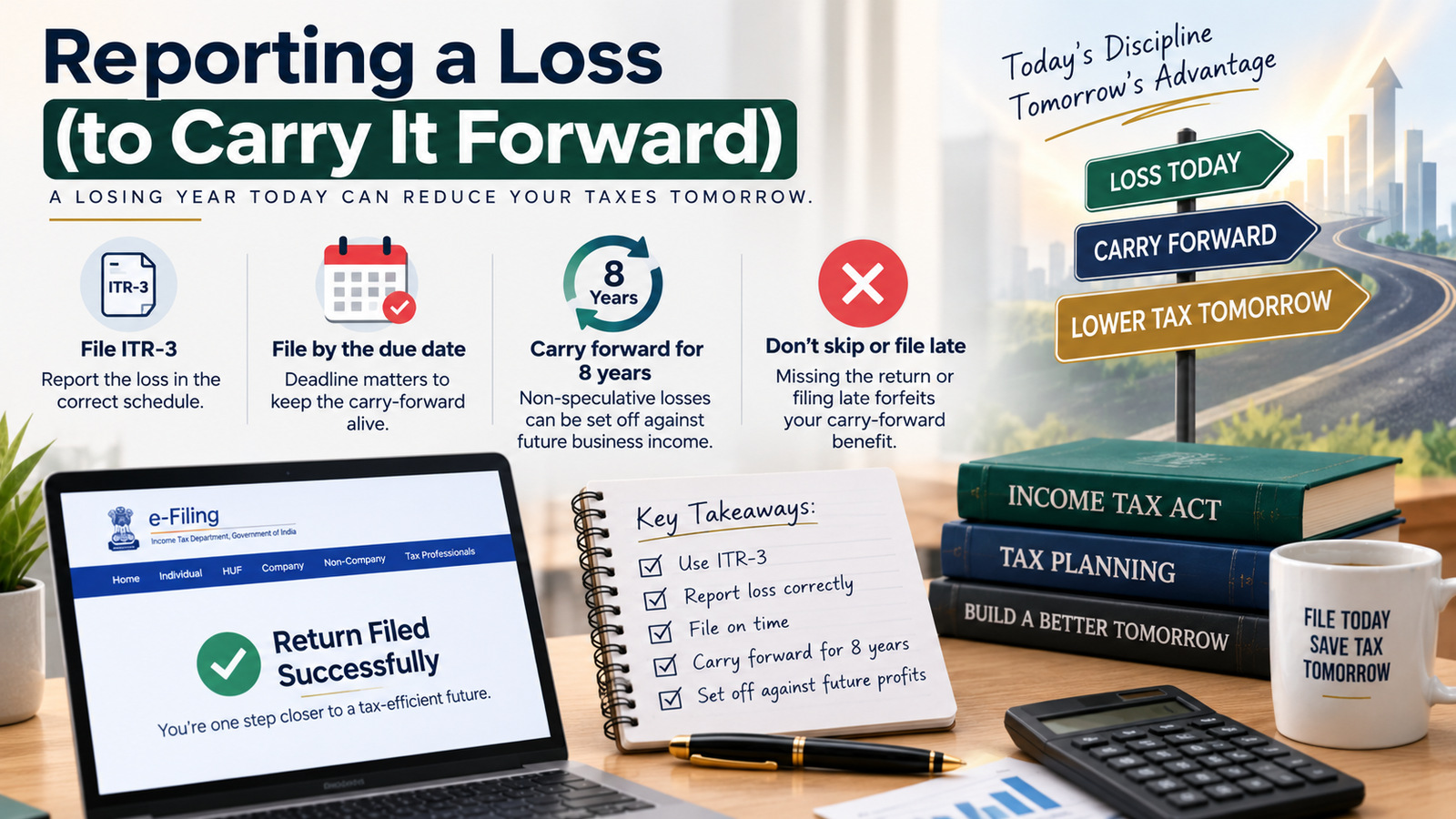
A losing year is exactly when careful filing pays off. Non-speculative losses can be carried forward for eight years and set off against future business income – but only if you file ITR-3 by the due date and report the loss in the correct schedule. Skipping the return in a loss year, or filing late, forfeits that valuable carry-forward. So even with nothing to pay, file – you’re banking a future tax benefit.
Common Mistakes
- Using ITR-1 or ITR-2 instead of ITR-3 for business income.
- Mis-computing F&O turnover and drawing the wrong audit conclusion.
- Not reconciling with the AIS, then receiving a mismatch notice.
- Filing late (or not e-verifying) and losing the loss carry-forward.
- Forgetting advance tax on business income and paying interest.
Learn more about Tax on Forex Trading in India
Myths vs Facts
| Myth | Fact |
|---|---|
| Forex income goes on a simple ITR-1. | It’s business income and must be reported on ITR-3. |
| Turnover is my total trade value. | F&O turnover is computed specially (absolute-profit method). |
| No profit means no need to file. | File a loss return to preserve the 8-year carry-forward. |
| Filing is enough on its own. | You must also e-verify, usually within 30 days, or it’s invalid. |
Tax disclaimer
This article is for educational purposes only and is not tax, legal or investment advice. ITR forms, schedules, turnover rules, audit thresholds, portal steps and deadlines change – and the new Income-tax Act, 2025 applies from FY 2026-27. Details here were checked against 2026 sources but may since have changed. Always verify current requirements with the Income Tax Department and use a qualified chartered accountant for your filing.
Expert Analysis
The friction in forex income ITR filing is almost never the tax computation itself – it’s the sequencing and the classification. Traders get into trouble by starting in the wrong place: reaching for the simplest return, guessing at turnover, or treating a losing year as a non-event. Done in the right order – fix the classification as business income, pull clean broker figures, compute turnover correctly, settle the audit question, reconcile with the AIS, then file ITR-3 and e-verify – the process becomes mechanical. The mistakes that cost real money are structural and upstream, which is why the single most valuable habit is to decide the form and the audit position before touching the portal, not after.
The loss-year discipline is where good filing quietly compounds. Because non-speculative losses carry forward for eight years but only survive if the return is filed on time and verified, the trader who diligently files a loss return is effectively depositing a tax credit against future profits – one that a careless trader forfeits by skipping the filing when there’s ‘nothing to pay’. This is the opposite of the usual instinct, and it’s why a currency-derivative trader benefits from treating every year’s filing, profit or loss, as non-negotiable. Pair that with reconciling against the AIS to avoid notices and using a chartered accountant for audit and turnover edge cases, and forex income ITR filing shifts from an anxious annual scramble into a routine, defensible process – which is exactly what you want when the tax department can see your trades in its own records.
Key Takeaways
- Report currency-derivative income as business income on ITR-3, not capital gains.
- Compute F&O turnover by the absolute-profit method – it decides audit applicability.
- Deduct legitimate expenses; reconcile your figures with the AIS before filing.
- Pay advance tax if liable, file ITR-3, and e-verify within the deadline.
- Always file a loss return on time to preserve the 8-year carry-forward.
Frequently Asked Questions (FAQ)
Q: Which ITR form do I use for forex income?
A: ITR-3, the return for individuals and HUFs with business or professional income, since currency-derivative profit is business income.
Q: How do I report F&O income in my ITR?
A: Report it as business income in ITR-3 – enter turnover, gross profit and expenses in the P&L section and complete Schedule BP.
Q: How is F&O turnover computed?
A: Broadly by the absolute-profit method – the total of absolute profits and losses – not by trade value. Turnover decides audit applicability.
Q: Do I need a tax audit for forex trading?
A: Generally if turnover exceeds Rs 10 crore for derivatives, with extra triggers in certain low-profit cases. A CA must file the audit report.
Q: What documents do I need to file?
A: Your broker P&L/tax statement, contract notes, AIS and TIS, Form 26AS, bank statements and expense receipts.
Q: What is the AIS and why does it matter?
A: The Annual Information Statement is the tax department’s record of your transactions; reconcile your figures with it to avoid mismatch notices.
Q: Can I file forex income on ITR-1 or ITR-2?
A: No. Those don’t allow business income; currency-derivative income requires ITR-3.
Q: How do I report a trading loss?
A: File ITR-3 on time and report the loss in the loss schedule to set it off and carry the balance forward for eight years.
Q: What expenses can I deduct when filing?
A: Brokerage and statutory charges, GST on charges, internet, home-office share, advisory fees, depreciation and professional fees.
Q: Do I need to pay advance tax?
A: If your total tax liability crosses the threshold, yes – business income requires advance tax in instalments to avoid interest.
Q: What is the filing deadline?
A: Typically 31 July for non-audit cases and 31 October if audited, though dates can be extended – confirm the current year.
Q: Do I have to e-verify my return?
A: Yes. E-verify (usually within 30 days) via Aadhaar OTP, net banking or another method, or the return is treated as not filed.
Q: Do I need a chartered accountant?
A: For audit, turnover computation, regime choice and the new Act’s provisions, it’s strongly recommended; simple non-audit cases may be self-filed.
Q: Does the AIS already show my trades?
A: Yes, brokers report transactions to the department, so your trades appear in the AIS – reconcile before filing.
Q: What happens if I file late?
A: You may lose the loss carry-forward, face late-filing fees and interest, and risk notices – so file and verify on time.