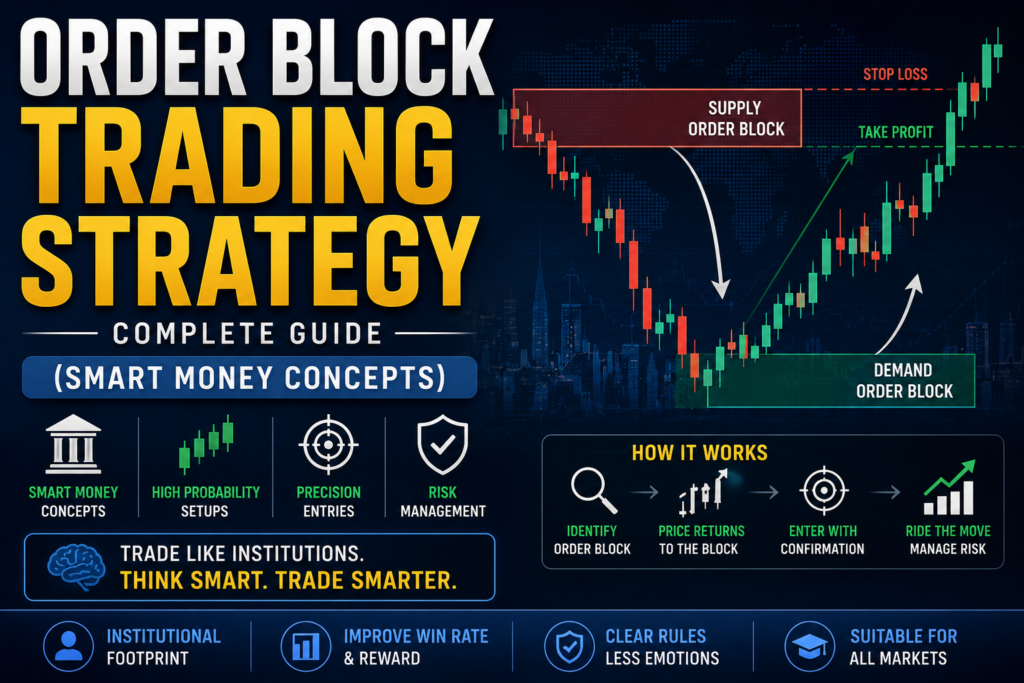
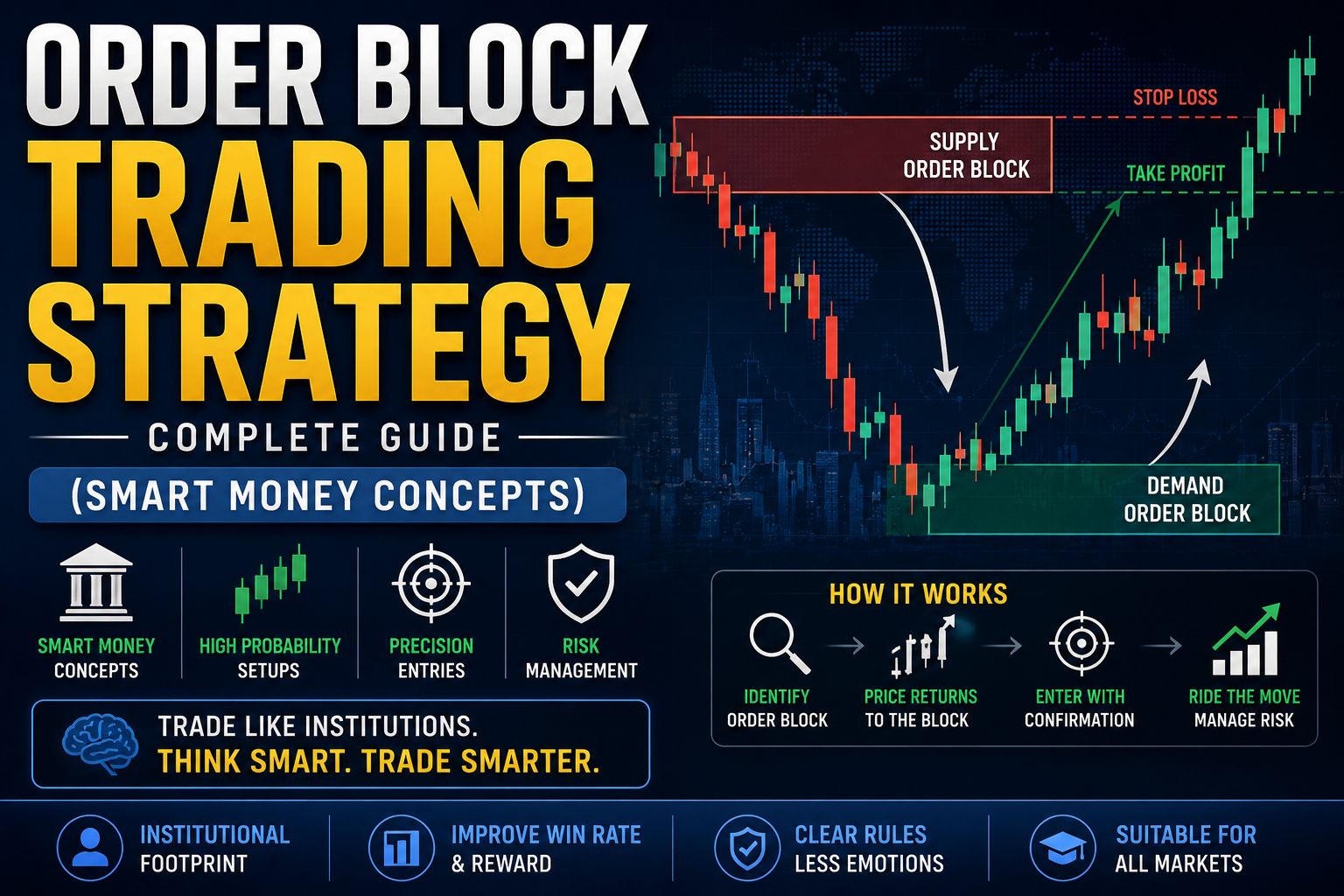
If you have spent any time studying price action, you have probably heard traders talk about “where the big money enters.” The order block trading strategy is one of the most popular ways retail traders try to align themselves with those large institutional footprints. Rooted in Smart Money Concepts (SMC), this approach shifts your focus away from lagging indicators and toward the raw mechanics of how price is engineered on a chart.
This complete guide breaks down what order blocks are, why they matter, and exactly how to build a repeatable order block trading strategy you can apply across forex, indices, and crypto. Whether you are brand new to SMC or refining an existing edge, you will walk away with a clear framework.
What Is an Order Block in Forex?
So, what is order block forex trading really about? An order block is a specific candle (or cluster of candles) that marks the last opposing move before a strong, imbalanced push in the other direction. In simple terms, it is the zone where institutions are believed to have placed a large volume of orders before driving price aggressively away.
Think about it from the perspective of a large fund. When a bank or hedge fund wants to buy a significant position, it cannot simply click “buy” without moving the market against itself. Instead, it accumulates positions quietly, often by pushing price down first to collect liquidity, and then rallies. That final down candle before the rally is the bullish order block. The reverse — the final up candle before a sharp drop — is a bearish order block.
Understanding what is order block forex behaviour is foundational, because these zones tend to act as high-probability areas of support and resistance when price returns to them. Rather than a random horizontal line, an order block gives you a logical reason why price might react at a particular level.
Order Blocks and Smart Money Concepts
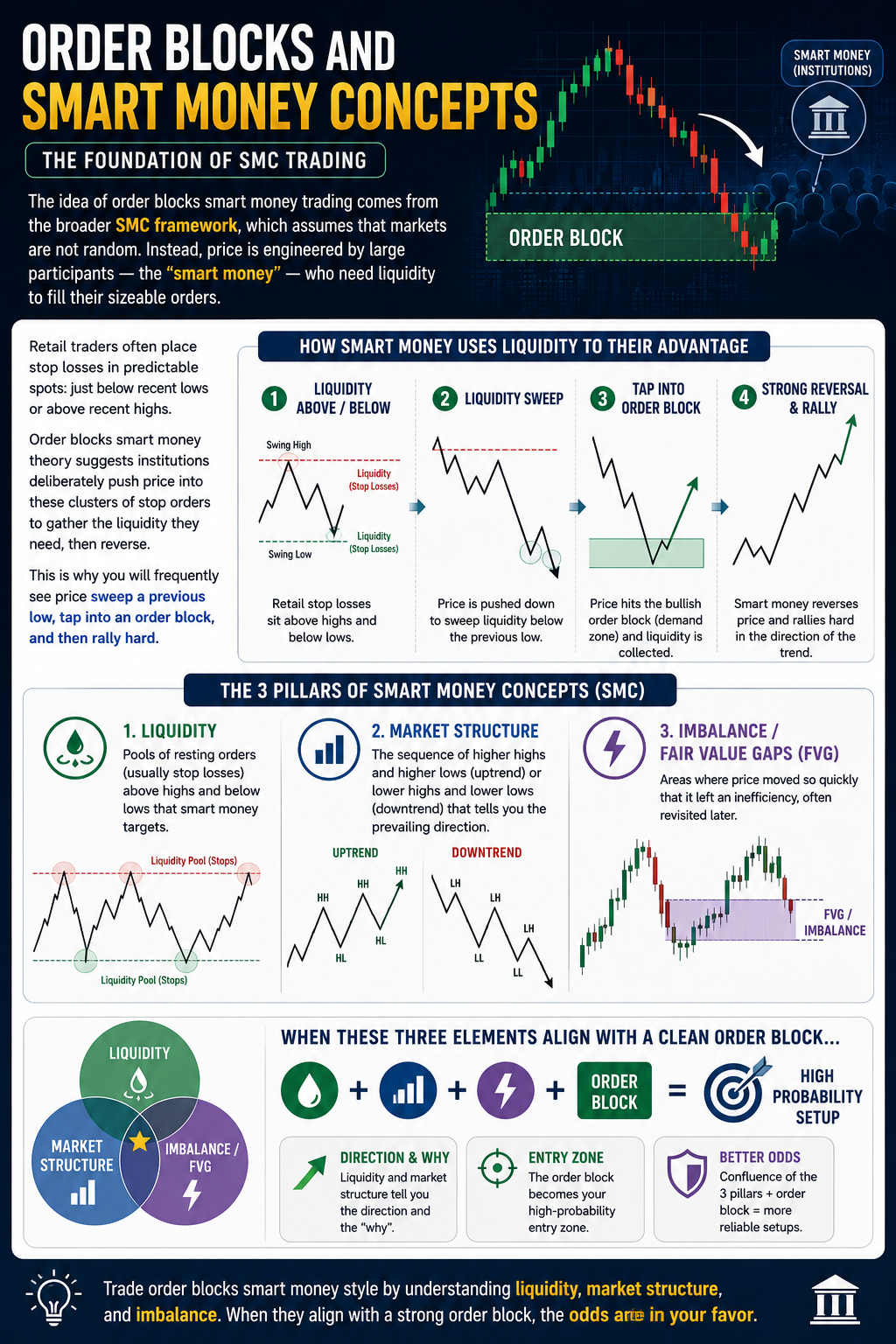
The idea of order blocks smart money trading comes from the broader SMC framework, which assumes that markets are not random. Instead, price is engineered by large participants — the “smart money” — who need liquidity to fill their sizeable orders.
Retail traders often place stop losses in predictable spots: just below recent lows or above recent highs. Order blocks smart money theory suggests institutions deliberately push price into these clusters of stop orders to gather the liquidity they need, then reverse. This is why you will frequently see price sweep a previous low, tap into an order block, and then rally hard.
To trade order blocks smart money style, you need to understand three connected concepts:
- Liquidity: Pools of resting orders (usually stop losses) above highs and below lows that smart money targets.
- Market structure: The sequence of higher highs and higher lows (uptrend) or lower highs and lower lows (downtrend) that tells you the prevailing direction.
- Imbalance / Fair Value Gaps (FVG): Areas where price moved so quickly that it left an inefficiency, often revisited later.
When these three elements line up with a clean order block, the order block trading strategy becomes far more reliable. The order block is your entry zone; liquidity and structure tell you the direction and the “why.”
Types of Order Blocks
Before applying any order block trading strategy, you must be able to classify the block correctly. There are two primary types.
Bullish Order Block
A bullish order block is the last down (bearish) candle before an explosive move to the upside. It represents the zone where buyers absorbed selling pressure. When price later pulls back into this candle’s body, buyers who missed the initial move — plus institutions adding to positions — are expected to defend the level, pushing price higher.
Bearish Order Block
A bearish order block is the last up (bullish) candle before an aggressive move to the downside. It marks where sellers stepped in with force. On a retracement back into this zone, the order block trading strategy anticipates renewed selling pressure and a continuation lower.
Beyond these two, experienced traders also distinguish between “mitigated” and “unmitigated” order blocks. An unmitigated order block has not yet been retested and is generally considered more powerful, while a mitigated block has already been revisited and may have lost some of its potency.
How to Identify a Valid Order Block
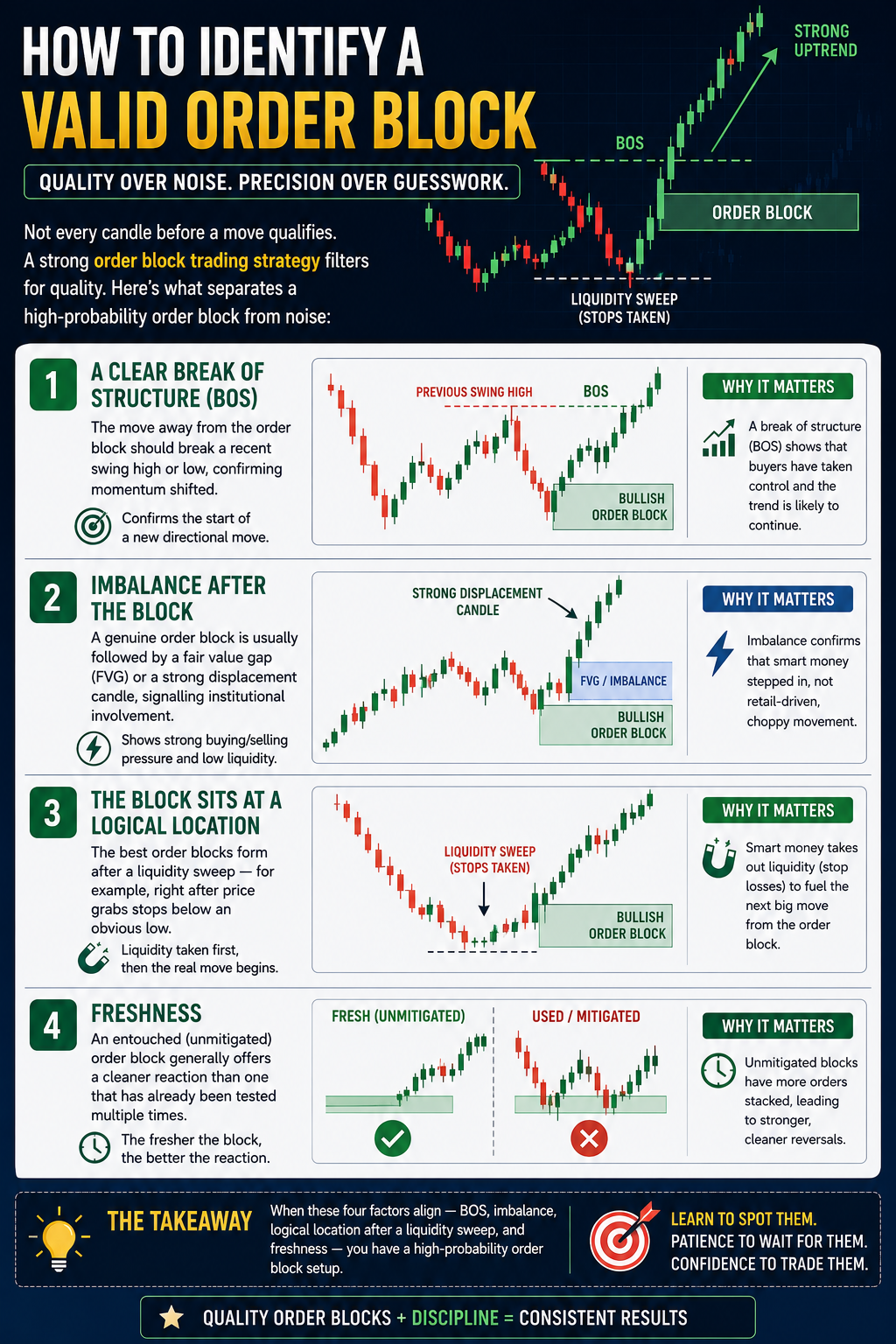
Not every candle before a move qualifies. A strong order block trading strategy filters for quality. Here is what separates a high-probability order block from noise:
- A clear break of structure (BOS):The move away from the order block should break a recent swing high or low, confirming momentum shifted.
- Imbalance after the block: A genuine order block is usually followed by a fair value gap or a strong displacement candle, signalling institutional involvement rather than slow, choppy movement.
- The block sits at a logical location: The best order blocks form after a liquidity sweep — for example, right after price grabs stops below an obvious low.
- Freshness: An untouched (unmitigated) order block generally offers a cleaner reaction than one that has already been tested multiple times.
Learning to spot these characteristics quickly is what turns the theory of order blocks smart money into a practical, tradeable edge.
How to Trade Order Blocks: A Step-by-Step Strategy
Now for the part most traders want: how to trade order blocks with a defined process. Below is a structured, repeatable order block trading strategy you can follow on any timeframe.
Step 1 — Establish the Higher-Timeframe Bias
Start on a higher timeframe such as the daily or 4-hour chart. Identify the overall market structure. Are we making higher highs and higher lows, or lower highs and lower lows? Your bias here determines whether you are hunting for bullish or bearish order blocks. Trading with the higher-timeframe direction dramatically improves the win rate of any order block trading strategy.
Step 2 — Mark Key Liquidity and Order Blocks
Once you know the direction, mark the relevant liquidity pools (obvious equal highs, equal lows, or swing points) and the order blocks that align with your bias. This is where knowing how to trade order blocks intersects with liquidity: you want an order block that price is likely to reach after sweeping liquidity.
Step 3 — Wait for the Liquidity Sweep
Patience is critical. Rather than entering blindly, wait for price to sweep a pool of liquidity — for example, dipping below a prior low to trigger stop losses — before tapping into your bullish order block. This sweep is the “trap” that Smart Money Concepts is built around, and it is a core reason the order block trading strategy has an edge over blind support/resistance trading.
Step 4 — Drop to a Lower Timeframe for Confirmation
When price enters your order block zone, refine your entry on a lower timeframe (such as the 5-minute or 15-minute chart). Look for a change of character (CHoCH) — a small shift in structure that confirms buyers or sellers are stepping in. This confirmation step is what separates disciplined execution from guessing, and it is central to learning how to trade order blocks with precision.
Step 5 — Enter, Set Stops, and Define Targets
With confirmation in hand, you can enter the trade. A common approach within the order block trading strategy is:
- Entry: At the 50% level (mean threshold) of the order block, or on the lower-timeframe confirmation candle.
- Stop loss: Just beyond the far edge of the order block — below a bullish block or above a bearish block. If price fully invalidates the zone, your reasoning no longer holds.
- Take profit: The next liquidity pool, opposing order block, or a fixed risk-to-reward ratio such as 1:3.
Because order blocks are tight zones, they often allow small stop losses and large reward potential, which is a big part of their appeal.
Building Confluence Into Your Order Block Trading Strategy
The single order block on its own is decent, but stacking confluence turns a good setup into a great one. The strongest applications of order blocks smart money theory combine multiple factors:
- Fair Value Gap (FVG): An order block that overlaps with an imbalance is a premium entry zone.
- Fibonacci retracement: Blocks that sit within the 0.62–0.79 “optimal trade entry” region carry extra weight.
- Trendline or moving-average alignment: Confluence with a classic level adds conviction.
- Session timing: Many traders find order blocks react best during the London and New York sessions, when institutional volume is highest.
The more of these boxes an order block trading strategy ticks, the higher the probability of a clean reaction. Confluence is not about needing every factor present — it is about weighting your decisions toward setups where several align.
Common Mistakes to Avoid
Even a solid order block trading strategy fails when executed poorly. Watch for these frequent errors:
- Marking every candle as an order block. Only the last opposing candle before a displacement move — with a break of structure — qualifies. Over-marking creates confusion and low-quality trades.
- Ignoring higher-timeframe context. Trading a bullish order block into a strong downtrend is fighting the current. Always respect the dominant structure.
- Skipping the liquidity sweep. Entering before smart money has grabbed liquidity often means you get stopped out on the very move you were trying to catch.
- Moving your stop loss. The order block defines your invalidation point for a reason. If price closes decisively through it, the setup is void.
- Neglecting risk management. No pattern wins every time, and how to trade order blocks safely depends on protecting your capital first.
Risk Management Comes First
It is worth stating plainly: no order block trading strategy, however precise, guarantees profits. Trading forex, indices, and crypto carries a substantial risk of loss, and Smart Money Concepts are a framework for reading price, not a crystal ball. Losing trades are a normal, expected part of any strategy.
Sensible practice is to risk only a small, fixed percentage of your account per trade (many traders use 0.5%–1%), to define your stop loss before entering, and to test the strategy thoroughly on a demo account or in backtesting before committing real capital. This article is educational and not financial advice; consider consulting a licensed professional and doing your own research before trading. The traders who last are the ones who treat capital preservation as the foundation on which any edge — including the order block trading strategy — is built.
Putting It All Together
Mastering the order block trading strategy is less about memorising a pattern and more about understanding the story behind price movement. Once you grasp what is order block forex logic, recognise how order blocks smart money dynamics create high-probability zones, and follow a disciplined process for how to trade order blocks, you begin to see the market through an institutional lens.
Start with the higher-timeframe bias, wait for liquidity to be swept, refine your entry on a lower timeframe, and manage risk on every position. Combine your order blocks with confluence — fair value gaps, Fibonacci zones, and session timing — and journal your results so you can keep improving.
No single tool wins in isolation, but a well-executed order block trading strategy, grounded in Smart Money Concepts and disciplined risk management, gives price-action traders a clear, logical, and repeatable edge. Study the charts, stay patient, and let the smart money show you where the real opportunities lie.
Frequently Asked Questions
Is the order block trading strategy suitable for beginners?
It can be, but it rewards study and practice. Beginners should first master reading market structure and identifying liquidity before attempting live trades. Demo testing the order block trading strategy for several weeks is strongly recommended before risking capital.
Which timeframe is best for trading order blocks?
There is no single correct answer. Many swing traders use the daily and 4-hour charts for bias and refine entries on the 15-minute chart, while intraday traders may drop lower. The key when learning how to trade order blocks is to keep your bias timeframe and entry timeframe aligned.
Do order blocks work in crypto and indices too?
Yes. Because order blocks smart money principles are based on liquidity and institutional behaviour, they apply to any liquid market — forex, indices, commodities, and crypto alike.