
Introduction
You hit the profit target, never broke the drawdown limit and still did not pass. For many funded-trader hopefuls, the reason is a rule they barely noticed when they signed up: the consistency rule.
A prop firm consistency rule limits how much of your total profit can come from a single day or trade. Firms use it to filter out traders who get lucky once and to reward those who can produce steady results. It does not usually end your account, but it can delay your pass or your payout for weeks if you do not understand it.
This guide explains:
- What a consistency rule is and why prop firms use it
- The formula and how to calculate your own score
- How major firms such as FTMO and Topstep apply it
- Worked examples
- Strategies to stay within the limit
- Points Indian traders should keep in mind
What Is a Prop Firm Consistency Rule?
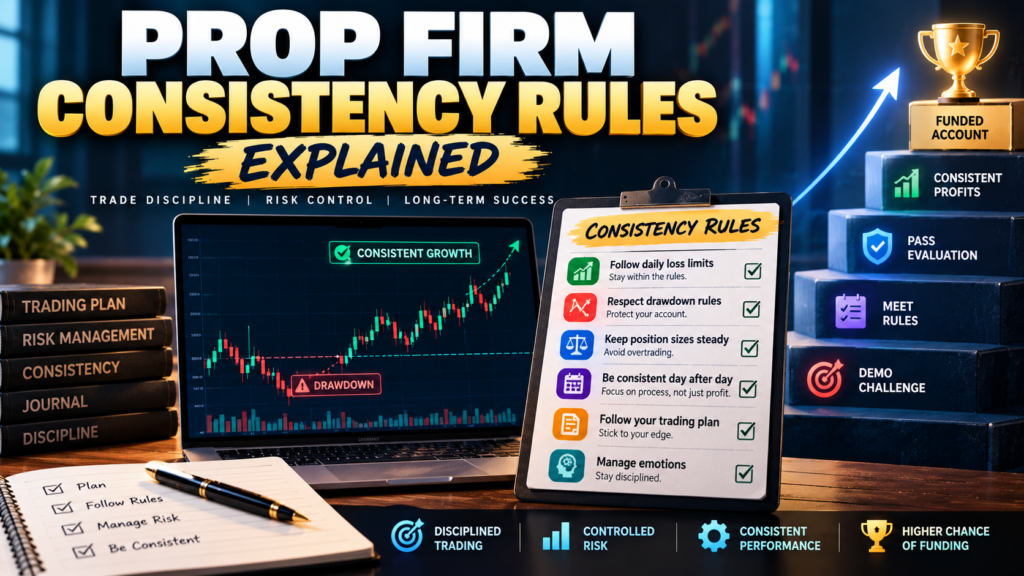
A prop firm consistency rule is a condition that caps the share of your profit that can come from your best day (or, at some firms, your best trade). If one big day makes up too much of your total, you have not met the rule, even if you reached the profit target.
The rule usually appears as a percentage, for example 30%, 40%, 50% or 55%. A 50% rule means your best day must be no more than half of your total profit.
It is sometimes called a best day rule, a consistency target, a consistency objective or a consistency score. The names differ, but the idea is the same: profits should be spread across several days rather than concentrated in one.
Why Firms Use a Prop Firm Consistency Rule
- To filter out gambling: A trader who risks heavily on one trade and gets lucky can hit a 10% target in a day. That says little about long-term skill.
- To protect the firm: Firms pay traders from a shared pool. Traders with repeatable results are safer to fund than those relying on rare big wins.
- To encourage risk management: A consistency limit pushes traders towards steady position sizing and away from over-leveraging.
- To reflect real trading: Professional traders are judged on smooth equity curves, not single spikes.
From the trader’s side, a prop firm consistency rule can feel frustrating, but it also enforces habits that tend to keep accounts alive.
The Prop Firm Consistency Rule Formula
Most firms use a simple calculation:
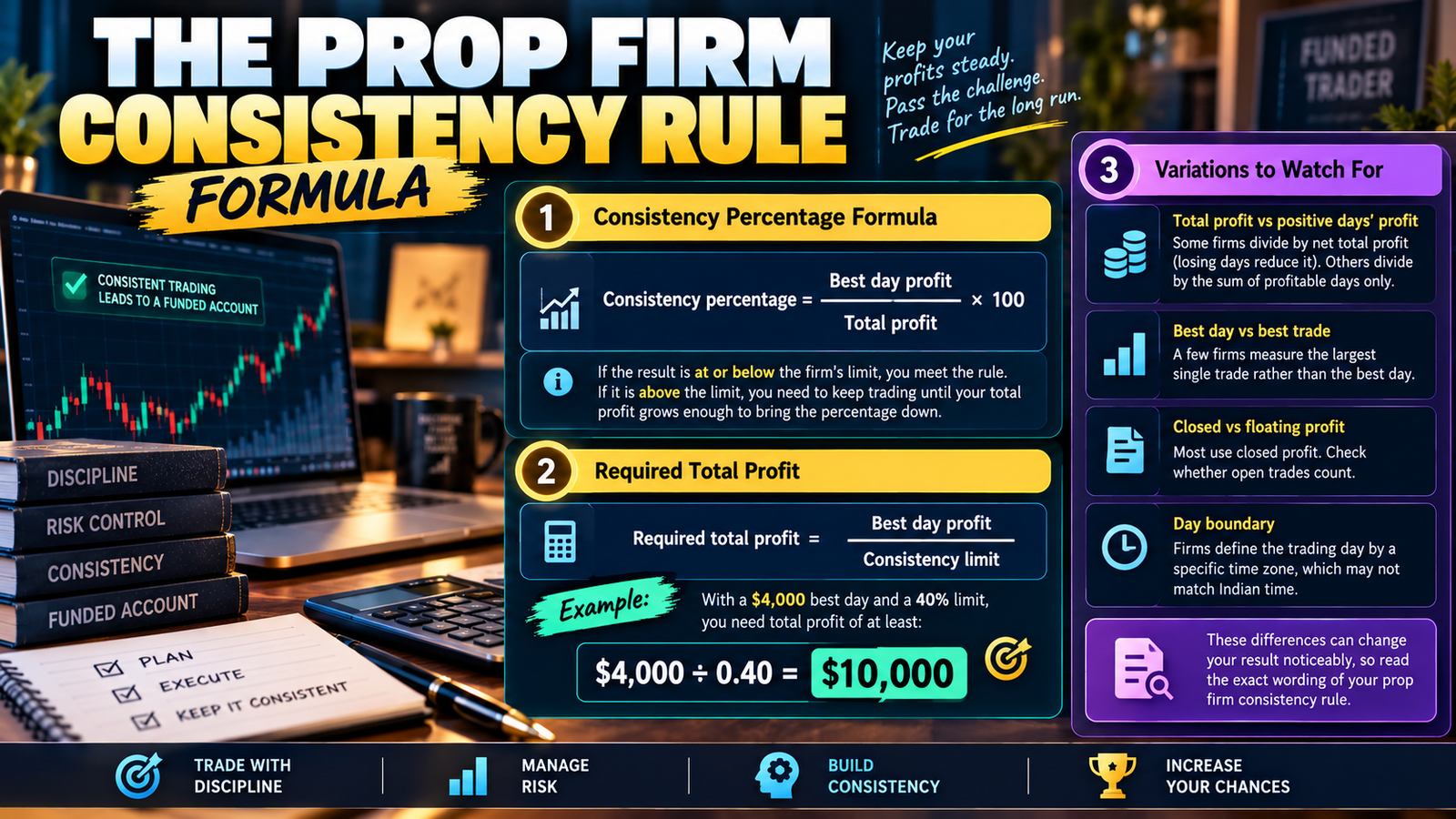
Consistency percentage = Best day profit ÷ Total profit × 100
If the result is at or below the firm’s limit, you meet the rule. If it is above the limit, you need to keep trading until your total profit grows enough to bring the percentage down.
To find the total profit you need, rearrange the formula:
Required total profit = Best day profit ÷ Consistency limit
For example, with a $4,000 best day and a 40% limit, you need total profit of at least 10,000(4,000 ÷ 0.40).
Variations to watch for
- Total profit vs positive days’ profit: Some firms divide by net total profit (losing days reduce it). Others divide by the sum of profitable days only.
- Best day vs best trade: A few firms measure the largest single trade rather than the best day.
- Closed vs floating profit: Most use closed profit. Check whether open trades count.
- Day boundary: Firms define the trading day by a specific time zone, which may not match Indian time.
These differences can change your result noticeably, so read the exact wording of your prop firm consistency rule.
How Major Firms Apply the Prop Firm Consistency Rule
| Firm / product | Limit | Stage | What happens if you exceed it |
|---|---|---|---|
| FTMO Challenge: 1-Step (orders from 12 Oct 2026) | Best day ≤ 50% of total profit | Evaluation and Rewards Account (1-Step) | Not a breach; keep trading until the ratio falls |
| FTMO 1-Step (older orders) | Best day ≤ 50% of positive days’ profit | Evaluation and Rewards Account (1-Step) | Not a breach; keep trading |
| FTMO Instant Account | 30% | Instant funding | Separate rule; check FTMO’s terms |
| Topstep Trading Combine | Best day ≤ 55% of total profit | Evaluation | Profit target increases |
| Topstep Funded Account (Consistency payout path) | Largest day ≤ 40% of net profit | Funded | Affects payout eligibility only |
FTMO’s 2-Step Challenge pages do not list the consistency rule. Other firms use limits of 30% or 40%, and some apply the rule only to certain challenge types. Always confirm the current version on the firm’s own website.
Worked Example of a Prop Firm Consistency Rule
Imagine a $100,000 challenge with an $8,000 profit target and a 40% consistency limit based on total profit.
| Day | Result | Running total |
|---|---|---|
| 1 | +$4,000 | $4,000 |
| 2 | +$1,500 | $5,500 |
| 3 | −$500 | $5,000 |
| 4 | +$2,000 | $7,000 |
| 5 | +$1,500 | $8,500 |
After Day 5, the trader has passed the $8,000 target. But the best day is $4,000, which is 47% of $8,500. That is above 40%, so the rule is not met.
Required total profit = $4,000 ÷ 0.40 = $10,000. The trader needs another $1,500 of profit, and no single day can exceed $4,000, or the best day changes and the target moves again.
If the trader makes $800 on Day 6 and $700 on Day 7, total profit reaches $10,000 and the best day is exactly 40%. The rule is met.
This example is illustrative. Firms differ in how they define total profit and the trading day.
Prop Firm Consistency Rule vs Other Prop Firm Rules
| Rule | What it limits | Typical result if broken |
|---|---|---|
| Daily loss limit | How much you can lose in one day | Account failed |
| Maximum drawdown | Total loss from the starting or peak balance | Account failed |
| Minimum trading days | How quickly you can pass | Cannot pass until met |
| Consistency rule | Share of profit from the best day | Usually more trading needed, not failure |
The key difference is that drawdown rules end accounts, while a consistency limit usually delays them. That makes it less dangerous, but it can still cost time and challenge fees if traders take extra risk trying to fix it.

Strategies to Pass a Prop Firm Consistency Rule
1. Use fixed risk per trade
Risking the same small percentage on every trade, for example 0.5% to 1%, keeps daily results in a similar range and naturally spreads profit across days.
2. Set a daily profit cap
Work out the largest day you can afford. With a 40% limit and an $8,000 target, a cap of around $3,000 per day means you will rarely need extra trading after hitting the target. Some traders stop for the day once they reach their cap.
3. Track your consistency score daily
Keep a simple spreadsheet with daily profit, best day and running total. Calculate the percentage each evening so there are no surprises.
4. Avoid news gambles
Big wins often come from trading high-impact news with large size. These spikes are exactly what a consistency rule is designed to catch.
5. Do not chase after a big day
If you already have a large best day, the solution is more steady trading, not another big day. Doubling size to “catch up” risks breaking the drawdown rule, which is far worse.
6. Read the rule before you start
Know whether the firm uses total profit or positive days’ profit, best day or best trade, and whether the rule applies in the evaluation, the funded stage or both.
Common Prop Firm Consistency Rule Mistakes
- Ignoring the rule until the target is reached: By then, one huge day can force many more sessions of trading.
- Confusing the target with total profit: The calculation usually uses actual total profit, which can be above the target.
- Over-trading to dilute the best day: Forcing low-quality trades to grow total profit can lead to losses.
- Assuming all firms are the same: Limits range from 30% to 55%, and calculations vary.
- Forgetting the time zone: A trade that runs past the firm’s day boundary may count on a different day.
Consistency Rules in the Funded Stage
Passing the evaluation is not always the end of the story. Some firms apply a prop firm consistency rule again once you are funded, usually as a condition for payouts rather than as a trading restriction. Topstep’s Consistency payout path, for example, requires the largest day to be no more than 40% of net profit in the payout window, and the calculation resets after each payout request.
This matters because funded traders often relax after passing and take bigger positions. One large winning day can then make a payout request ineligible until more profit is added. The same habits that helped in the challenge apply here: fixed risk, a daily profit cap and a running record of your best day.
Before you request a withdrawal, check your consistency percentage for the current payout window. A funded-stage prop firm consistency rule is easier to manage if you plan payouts around it rather than discovering the problem when a request is declined.
Prop Firm Consistency Rules and Indian Traders
Many Indian traders take challenges with overseas prop firms. A few practical points:
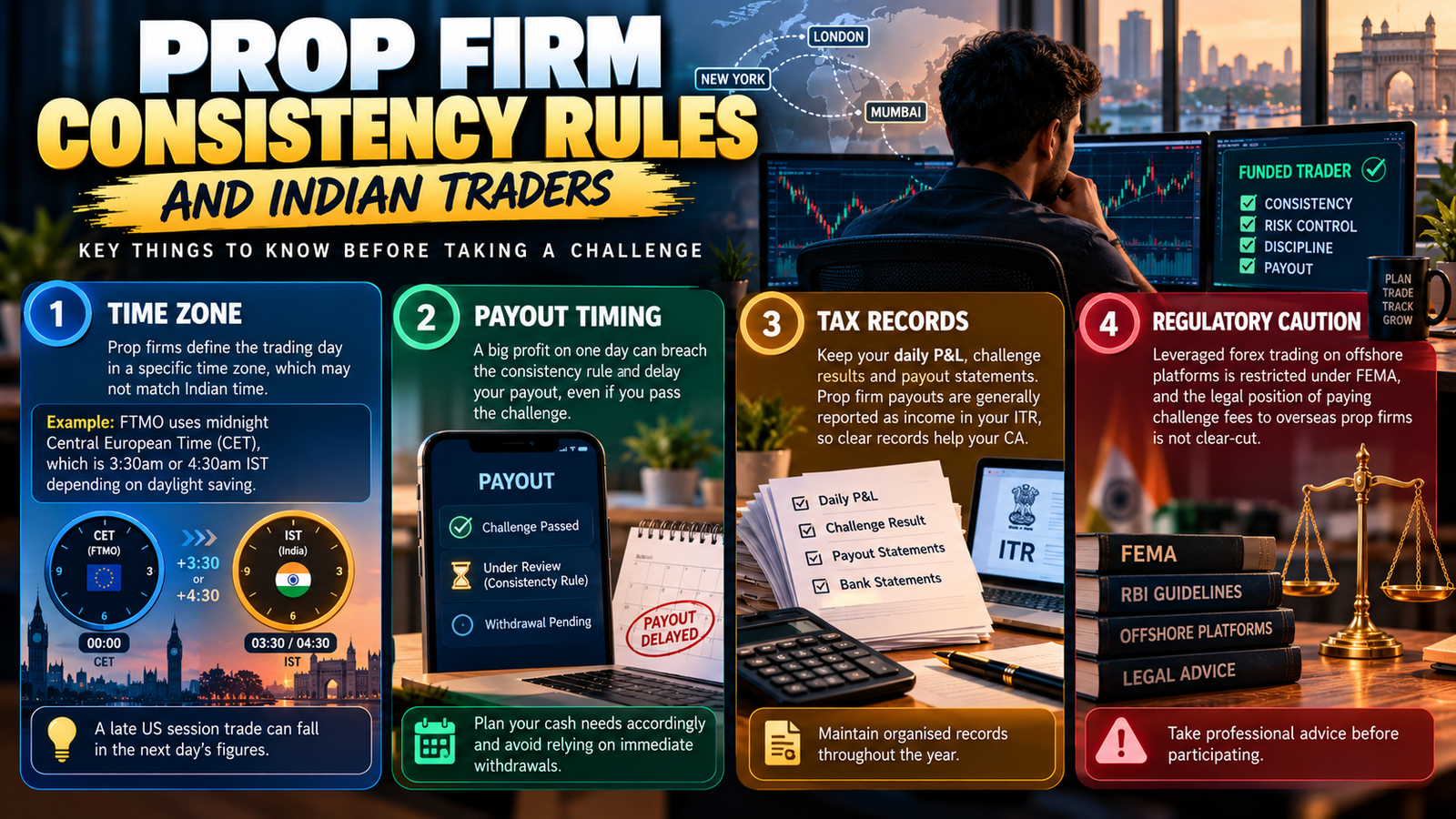
- Time zone: FTMO measures the trading day at midnight Central European time, which falls at 3:30am or 4:30am IST depending on daylight saving. A late US session trade can land in the next day’s figures.
- Payout timing: Where a prop firm consistency rule affects payout eligibility, a big day can delay your withdrawal. Plan cash needs accordingly.
- Tax records: Keep your daily P&L and payout statements. Prop firm payouts are generally reported as income in your ITR, so clear records help your CA.
- Regulatory caution: Leveraged forex trading on offshore platforms is restricted under FEMA, and the legal position of paying challenge fees to overseas prop firms is not clear-cut. Take professional advice before participating.
Prop Firm Consistency Rule Checklist
- What is the limit: 30%, 40%, 50% or 55%?
- Is it measured against total profit or positive days’ profit?
- Is it best day or best trade?
- Does it apply in the evaluation, the funded account or both?
- Is exceeding it a breach or just a delay?
- What is my maximum daily profit to stay within the limit?
- Am I tracking my consistency percentage daily?
FAQs
What is a prop firm consistency rule?
It is a rule that limits how much of your total profit can come from your single best day or trade, usually expressed as a percentage such as 40% or 50%.
Does breaking the consistency rule fail my account?
At many firms, including FTMO and Topstep, exceeding the limit is not a breach. You simply need to keep trading until the ratio falls, or your profit target increases.
How do I calculate the profit I need?
Divide your best day profit by the consistency limit. A $3,000 best day with a 50% limit requires $6,000 in total profit.
Do all prop firms have a consistency rule?
No. Some firms do not use one, and others apply it only to certain challenge types or to payouts.
Is a prop firm consistency rule good for traders?
It can feel restrictive, but it encourages fixed risk and steady sizing, which are habits that help traders keep funded accounts for longer.
Do losing days count?
It depends on the firm. Some use net total profit, which losing days reduce. Others use only profitable days.
Conclusion
A prop firm consistency rule is designed to reward steady, repeatable trading rather than one lucky day. It rarely ends an account, but it can delay your pass or payout if a single big day dominates your results.
The solution is simple in principle: risk a fixed small amount per trade, set a daily profit cap, track your consistency percentage every day and read your firm’s exact rule before you start. Traders who build these habits usually find the consistency rule takes care of itself.