
Introduction
For many Indian traders, passing a prop firm challenge is the hard part. But once you have a funded account and request your first withdrawal, a new set of questions appears. How will the money reach your Indian bank account? Which payout method is safest? What documents should you keep? And how is the income taxed?
Getting these answers right matters. A poorly documented payout can lead to questions from your bank or the tax department, while a crypto payout can create extra tax complications. This guide explains how a prop firm payout in India typically works, step by step, and what you should do to stay compliant.
You will learn:
- How prop firm payouts work
- Common payout methods for Indian traders
- How foreign remittances reach Indian bank accounts
- The FEMA and RBI considerations
- How payouts are generally taxed
- Record-keeping and common mistakes
Prop Firm Payout India Basics: How Payouts Work
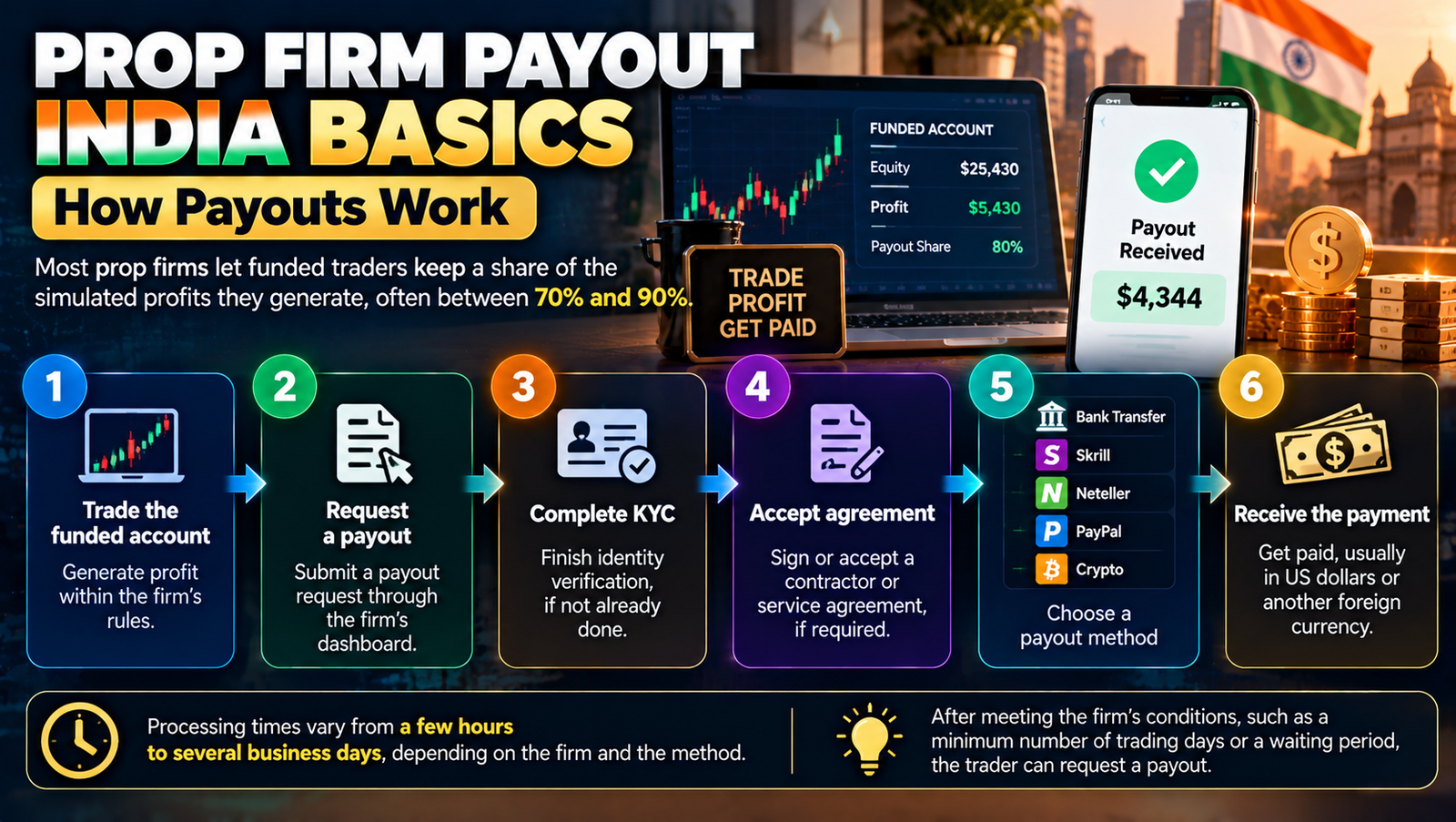
Most prop firms let funded traders keep a share of the simulated profits they generate, often between 70% and 90%. After meeting the firm’s conditions, such as a minimum number of trading days or a waiting period, the trader requests a payout.
Typical steps include:
- Trade the funded account and generate profit within the rules.
- Request a payout through the firm’s dashboard.
- Complete identity verification (KYC), if not already done.
- Sign or accept a contractor or service agreement, if required.
- Choose a payout method.
- Receive the payment, usually in US dollars or another foreign currency.
Processing times vary from a few hours to several business days, depending on the firm and the method.
Common Prop Firm Payout India Methods
Indian traders usually have several options. Availability depends on the firm.
| Method | How it works | Points to consider |
|---|---|---|
| International bank wire (SWIFT) | Money is sent directly to your Indian bank account | Bank charges and conversion spreads; clear audit trail |
| Payout platforms (for example, Rise or Deel) | The firm pays you through a contractor payment platform, which then transfers to your bank | Platform fees; keep platform statements |
| Multi-currency wallets (for example, Wise or Payoneer) | Funds land in a wallet in your name, then you transfer to your Indian bank | Withdraw regularly; keep wallet statements |
| Crypto (for example, USDT or USDC) | Funds are sent to a crypto wallet address | Extra tax complexity and regulatory risk |
For most traders, methods that end with a clean transfer into an Indian bank account, with clear documentation, are the simplest from a compliance point of view. When comparing prop firm payout India options, look at total cost, speed, the quality of statements you receive and whether the account is in your own name.
Prop Firm Payout India: Receiving the Money in Your Bank Account
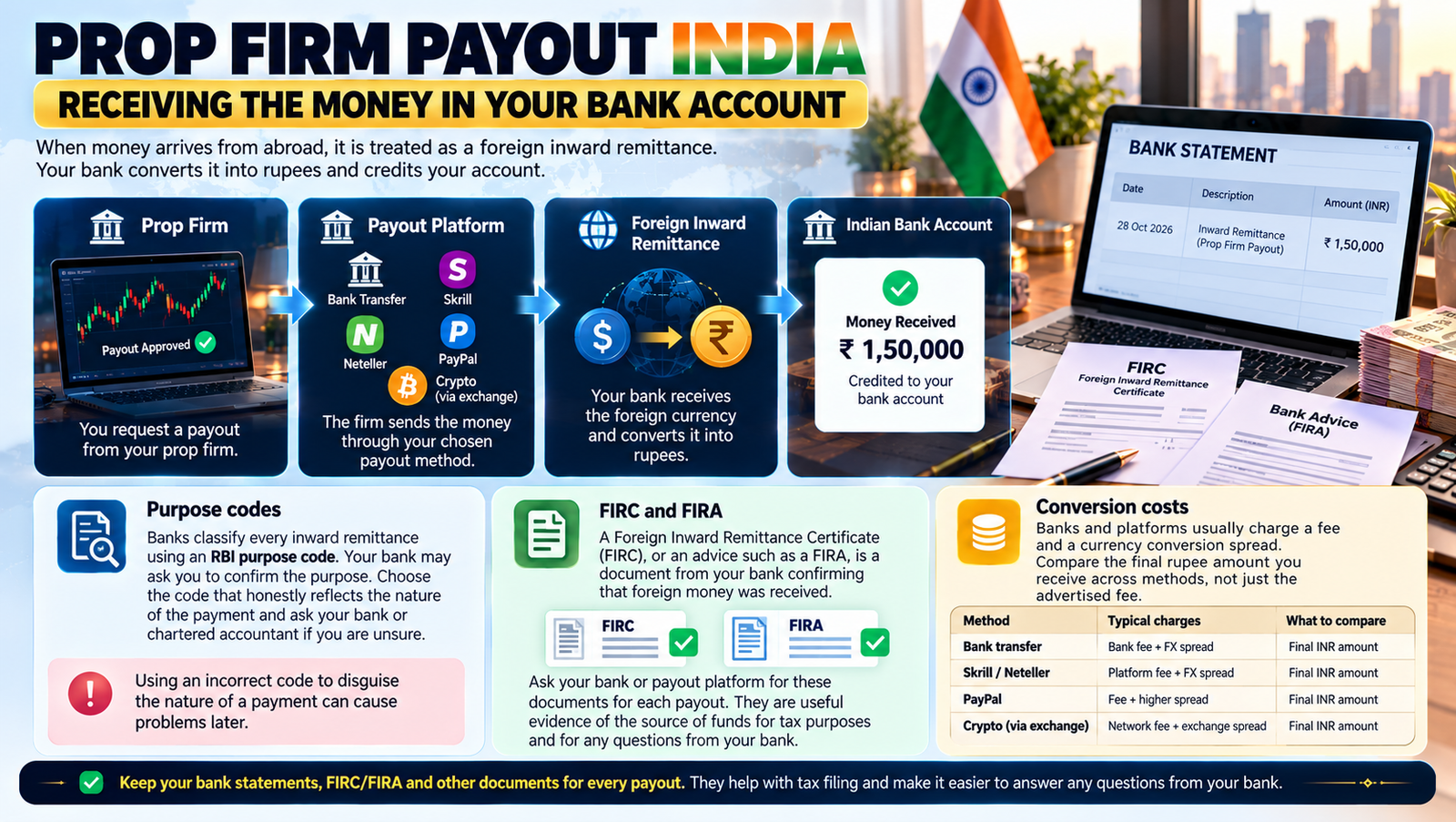
When money arrives from abroad, it is treated as a foreign inward remittance. Your bank converts it into rupees and credits your account.
Purpose codes
Banks classify every inward remittance using an RBI purpose code that describes why the money was sent. Your bank may ask you to confirm the purpose. Choose the code that honestly reflects the nature of the payment and ask your bank or chartered accountant if you are unsure. Using an incorrect code to disguise the nature of a payment can cause problems later.
FIRC and FIRA
A Foreign Inward Remittance Certificate (FIRC), or an advice such as a FIRA, is a document from your bank confirming that foreign money was received. Ask your bank or payout platform for these documents for each payout. They are useful evidence of the source of funds for tax purposes and for any questions from your bank.
Conversion costs
Banks and platforms usually charge a fee and a currency conversion spread. Compare the final rupee amount you receive across methods, not just the advertised fee.
Prop Firm Payout India: FEMA and RBI Considerations
This is the most important and least clear-cut part of the topic.
- Paying challenge fees: Under FEMA, Indian residents may not remit money abroad for leveraged forex or margin trading. Prop firm challenge fees are often described as payments for an evaluation service rather than trading capital, but the position has not been clearly settled by regulators.
- Offshore platforms: The RBI maintains an Alert List of unauthorised forex trading platforms and websites. Check whether a prop firm or its trading platform appears on the list before signing up.
- Receiving payouts: Receiving payment for services into an Indian bank account through normal banking channels is generally simpler than paying money out, but you should still keep full documentation.
- Foreign wallets: Tax experts commonly advise not leaving large balances in foreign wallets for long periods and transferring funds to India regularly.
Because the rules are not fully settled, a prop firm payout in India should always be handled transparently, with full records, and with professional advice where amounts are significant.
Prop Firm Payout India Tax Rules
Indian residents are taxed on their global income, so every prop firm payout in India is taxable whether or not you bring the money into the country.
Head of income
Many chartered accountants treat prop firm payouts as business income, because the trader is providing a trading service using the firm’s capital. Some may consider other heads depending on the facts. Tax experts quoted in the financial press have generally recommended business income treatment.
ITR form
If payouts are treated as business income, you would usually file ITR-3. Depending on how and where funds were held, you may also need to complete schedules for foreign income or foreign assets.
Expenses
Under normal business income rules, you may be able to claim genuine expenses related to the activity, such as challenge fees, platform fees, data subscriptions and internet costs. Keep invoices and payment proofs.
Presumptive taxation
Some traders consider presumptive schemes, but these may not suit irregular income or significant expenses, and they come with conditions. Discuss with a chartered accountant before choosing this route.
Advance tax
Because no tax is usually deducted at source on foreign payouts, you may need to pay advance tax in instalments during the year if your total tax liability is ₹10,000 or more. Missing instalments can lead to interest.
GST
Whether GST registration is relevant depends on your overall situation and turnover. Ask your chartered accountant whether it applies to you.
Prop Firm Payout India via Crypto: Extra Complexity
Some firms offer payouts in stablecoins such as USDT. While this can be fast, it adds layers of tax and regulatory complexity for Indian residents:
- The payout itself is generally income, valued at the rupee value when received.
- Converting the crypto into rupees is a separate transaction under India’s virtual digital asset (VDA) rules. Any gain is generally taxed at a flat 30% plus cess, and losses on VDAs cannot be set off against other income.
- Selling crypto on Indian exchanges generally involves 1% TDS on the transfer.
- You must keep detailed records of every crypto transaction, because they may not appear in your tax statements automatically.
For these reasons, many traders prefer bank or platform payouts that end in Indian rupees. If you do accept crypto, keep a separate record for each prop firm payout in India showing the date, the amount of crypto received, its rupee value at receipt and the details of any later conversion. This makes it far easier for your chartered accountant to calculate tax correctly.
Step-by-Step: Receiving a Prop Firm Payout in India
Here is a simple sequence to follow for every prop firm payout in India, from the first request to filing your return.
- Check the firm: Confirm the firm and its platform are not on the RBI Alert List, and read its payout terms.
- Complete KYC: Use your real details, matching your PAN and bank account.
- Choose a transparent method: Prefer a bank wire or reputable payout platform in your own name.
- Request the payout: Download the payout confirmation and any invoice or contractor statement.
- Confirm the purpose code: If your bank asks, choose the code that honestly reflects the payment.
- Collect the FIRC or FIRA: Request it from your bank or platform for every payout.
- Record the rupee value: Note the amount received in rupees and the exchange rate.
- Set aside tax: Keep a portion of each payout for advance tax.
- Report in your ITR: Include all payouts and related expenses when filing.
Prop Firm Payout India Record-Keeping Checklist
- Prop firm account statements and payout confirmations
- Contractor or service agreements
- Invoices for challenge fees and other expenses
- Payout platform or wallet statements
- Bank statements showing each credit
- FIRC or FIRA for each inward remittance
- Crypto transaction history, if applicable
- A simple spreadsheet linking each payout to its bank credit
Good records make filing easier and help you answer questions from your bank or the tax department quickly. Keeping these records for every prop firm payout in India is one of the simplest ways to stay on the right side of the rules.

Common Prop Firm Payout India Mistakes
- Not reporting payouts: Foreign income is taxable for Indian residents.
- Leaving money abroad: Large balances in foreign wallets can raise questions.
- Using someone else’s account: Always receive payouts in your own name.
- Choosing an inaccurate purpose code: Be honest about the nature of the payment.
- Ignoring crypto rules: Crypto payouts bring VDA tax and TDS implications.
- Skipping advance tax: This can lead to interest charges.
- Losing documents: Missing records make it hard to prove the source of funds.
- Ignoring the RBI Alert List: Dealing with listed platforms carries additional risk.
Choosing a Prop Firm With Good Payout Practices
When comparing firms, look beyond profit splits. Consider:
- Payout frequency and minimum withdrawal amounts
- Available payout methods for Indian residents
- Processing times and fees
- Clarity of contractor agreements and documentation
- Track record and transparency of the firm
- Whether the firm or its platform appears on the RBI Alert List
A firm with slightly lower profit splits but clear, reliable and well-documented payouts may be the better choice for a prop firm payout in India.
FAQs
How do Indian traders receive prop firm payouts?
Usually through international bank wires, contractor payout platforms, multi-currency wallets or, at some firms, crypto. Methods that end in a documented transfer to an Indian bank account are generally simplest.
Is a prop firm payout in India taxable?
Yes. Indian residents are taxed on global income. Many chartered accountants treat payouts as business income reported in ITR-3.
What is a FIRC?
A Foreign Inward Remittance Certificate is a bank document confirming receipt of foreign money. It helps prove the source of funds.
Are crypto payouts a good idea?
They can be fast, but they add VDA tax, TDS and record-keeping complications. Many traders prefer bank-based payouts.
Is prop trading legal in India?
The position is not fully settled. FEMA restricts remittances for leveraged forex trading, and the RBI maintains an Alert List. Seek professional advice before participating.
Do I need to pay advance tax?
If your total tax liability for the year is ₹10,000 or more, you may need to pay advance tax in instalments.
Conclusion
Receiving a prop firm payout in India is straightforward in practical terms, but it needs care. Choose a transparent payout method in your own name, bring funds into your Indian bank account promptly, collect FIRCs and keep complete records. Treat payouts as taxable income, set aside money for advance tax and report everything in your return.
Because the regulatory position is still evolving, check the RBI Alert List, read each firm’s terms carefully and work with a chartered accountant. A well-documented approach to every prop firm payout in India protects both your earnings and your peace of mind.